Matthew Green's Reading List
Matthew Green is the author of Aftershock: The Untold Story of Suriving Peace , which documents the post-conflict experience of British soldiers. He has spent the past 14 years working as a correspondent for the Financial Times and Reuters and has reported from more than 30 countries, including Iraq and Afghanistan. His website can be found at www.matthewgreenjournalism.com
Open in WellRead Daily app →Psychological Trauma (2016)
Scraped from fivebooks.com (2016-05-27).
Source: fivebooks.com

Edward Tick · Buy on Amazon
"He’s a psychotherapist, but he has a very spiritual way of looking at therapy. He has spent decades treating veterans from Vietnam onwards, and he tells some remarkable stories in the book. But what’s so compelling is the way he takes a spiritual approach. His argument is that in classical and native American tradition, serving as a warrior was an archetypal experience characterized by initiation of young men and, then, later, rituals of purification and cleansing that help them to undergo a sort of psycho-spiritual re-birthing process and return to civilian life, not just as civilians, but as individuals who’ve gone through a profound transformation. And that transformation was acknowledged by the wider society. “I’ve never used the word ‘cure’ when talking about PTSD because it makes it sound like some sort of disease. I like to see it as an injury at the level of the soul.” In the book, he argues that this has completely broken down in our modern society, and that lies at the root of many of the problems that veterans face. His argument is that we may not be able to get rid of the trauma, but we can help a veteran to grow more soul around the trauma, and that’s the ultimate remedy. He looks at how we can, in a way, return to those ancient traditions in order to achieve that in a modern context. That’s part of the argument. I’m particularly interested in the native American tradition because I’ve been to a number of sweat lodge ceremonies myself, held in the UK, which are conducted to make a powerful catharsis experience for all the participants. I’ve experienced the power of it at first hand. But he is making a broader argument about the way we look at war trauma. It’s not something that has symptoms that can simply be medicated away or treated through individual therapy, although that can be helpful. He conceives it as a much bigger task for the society as a whole. We need to recognize that many veterans who served in combat have gone through a form of ‘psycho-spiritual death.’ They can become trapped in this no-man’s land when they return. In a sense, they’ve lost a part of their soul. His argument is that we need to come together to acknowledge that soul-loss and help veterans find ways to retrieve it. That might be through rituals, partly, but it is also a much bigger process of recognizing the injuries that war does, not just to the individual, but to society as a whole. That’s right. Certainly in the US, the sheer scale of deployment in Iraq and Afghanistan means that there are many thousands of people who are in need of help. What I love about this book is that he is really setting out an agenda for how we might embrace this problem on a societal level, rather than relegate it into the task of an individual to return functioning. He is acknowledging that this is a collective wound to the whole of society, and that all of us are affected in some way. Rather than shut these people away and categorize them as ‘damaged veterans,’ we should be looking at our own part in the system that wages these wars and seeing how we can provide this collective catharsis, which I think is so important. That’s the debate that we need to be having in Britain as well."
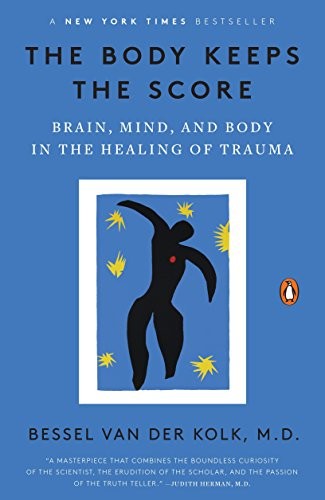
Bessel van der Kolk · Buy on Amazon
"Reading The Body Keeps the Score was a eureka moment for me, in that it provided an explanation for the symptoms—the flashbacks, the hyper-vigilance, the paranoia—that I witnessed among the veterans that I’d been speaking to. For a hundred years, our approach to psychotherapy has been primarily through the mind, talking about our problems and trying to arrive at new understandings. The genius in Bessel van der Kolk’s book is that he manages to set out how our memories and experiences live on in the body and how, in his phrase, ‘the body keeps the score.’ “ The problem in Britain is that many people in the psychotherapy and psychiatry profession simply don’t have a good grasp of the neurobiology at all.” If we’re going to heal trauma—rather than just treat it—we need to find ways to work with the deepest layers of the brain and the oldest, most primitive parts of the nervous system where those traumatic reactions reside. I saw, at first hand, that most of the therapy that is offered, certainly in Britain, isn’t up to the job of doing that. Bessel’s book is a manifesto for how we might start to think about treating trauma afresh. I think they can be significantly addressed. I’ve never used the word ‘cure’ when talking about PTSD because it makes it sound like some sort of disease. I like to see it as an injury at the level of the soul, but also of the body and the mind. Certainly, certain techniques that Bessel and others, who see trauma through this prism, work with show a lot of promise in adjusting the fight or flight mechanism in the brain, which is at the core of a lot of the symptoms. The problem in Britain is that many people in the psychotherapy and psychiatry profession simply don’t have a good grasp of the neurobiology at all. I think that if we’re going to do a better job at healing survivors of PTSD, then we really need to be embracing these ideas and opening our minds. It’s unfortunate that there’s still a great deal of resistance in the medical establishment in Britain to this kind of new thinking. There’s a great deal of complacency. There’s a huge number of people suffering from trauma symptoms in the UK. It’s not just soldiers, but workers in the emergency services, police, ambulance crews, and also civilians who’ve been through childhood abuse or other experiences that have coloured their entire lives. As Bessel says, in The Body Keeps the Score, such people can feel they are damaged to their very core and beyond redemption. Too often, in the current system, if people don’t respond to the standard talking therapy offered, they are written off as ‘treatment resistant,’ which is a bit like blaming the patient for the therapist’s failing. The people who have the loudest voices in this world aren’t shouting loudly enough that we need to be rethinking the whole system and taking a 21st century approach to trauma, rather than one that is still rooted in the work of Freud, from the end of the 19th century. It makes me very angry, actually, the sluggishness with which the system in Britain is changing. I think we could be doing a far better job if there was greater political will. Without a great deal more money, we could be doing a far better job of giving people a shot at resolving many of their symptoms, rather than just trying to teach them to cope with them."

Bryan Doerries · Buy on Amazon
"This is a remarkable book by Bryan Doerries about how he managed to convince the US military, which was very sceptical at first, to allow him to stage plays of Sophocles and other Greek tragedies before audiences of recently returned veterans from Iraq and Afghanistan. These plays are remarkable. Sophocles, the author, was himself an Athenian general and wrote them to speak to the varying issues which veterans grappled with on a daily basis: the anger, the rage, the sorrow, the remorse, and the shame that each soldier so often encountered at home. Doerries saw these plays as a way of providing a collective catharsis to these returning veterans and they proved remarkable. Get the weekly Five Books newsletter He describes, in his book, scenes where, temporarily, the military hierarchy is allowed to dissolve in the discussions that take place in the wake of the plays. Men are allowed to say things that otherwise would have been unsayable. The results can be incredibly challenging, but it is clear that some of the men find that it’s the first time they are really able to face their own feelings, and for some of them, it starts the healing journey of the kind that Ed Tick describes in War and the Soul. In a sense, what Doerries is doing is providing a way to operationalize and apply the insights that Ed Tick advocates in his book. Those two books go very well together. He went into prisons as well. I think, again, the core insight is that so much of the way we think about therapy is that it is an individual who is struggling, or is depressed or anxious – that it’s their personal problem and they need a therapist that fixes them at an individual level and on an individual basis, a little like a machine that needs to be fixed by a mechanic. But actually it is much more helpful to recognize that many of the problems we face as individuals are a reflection of the collective dysfunction, particularly in the institutions which are founded to apply organized violence. It’s no wonder that the people who participate in them show signs of breakdown. The work of somebody like Bryan Doerries is incredible. It has reached people and individuals in these institutions in ways that nobody else has. I noticed others doing similar work. There are companies in the US and in the UK who are adopting a similar approach. I really hope that his book will help to promote that, not just for his company, but for many others, in the years to come. Certainly in Britain, we get very uncomfortable with words like ‘spirituality’ or the ‘soul.’ I very consciously avoided using those words in my book. But actually the kinds of journeys that many veterans described, as they tried to come to terms with their trauma, were incredibly spiritual. In Aftershock, I wrote about a veteran of the Falklands war called Gus Hales, who suffers from terrible PTSD and embraces meditation as his vehicle for coming to terms with what happened to him, his losses and learning to function again. He underwent a profound spiritual awakening as a result of his trauma. I also wrote about a sniper who served in the Royal Marines in Afghanistan. He talked about his worst moments, where he was on verge of committing suicide, what he called a ‘meeting God’ experience, when he was suddenly filled with this sense of peace, reassurance, and tranquillity. This numinosity suggested that all will be well. That was only a brief sense that he had, but it was enough to stop him from taking his own life, and start the process of gradually rebuilding his life. In the final chapter of the book, I look at the work of therapists and psychiatrists in Scotland who were using very spiritual tools, drawn from Native American traditions, for treating veterans. This included encouraging them to admit the help of the power animal, a kind of a spirit guide, to help them confront their past. There was a veteran of the British army who has a jaguar now, an invisible jaguar that follows him everywhere he goes. Certainly, in our secular society, it is very easy for people to raise their eyebrows when we start talking in these terms. I found that many of these soldiers have suffered so much that they’re far more open to exploring these realms than they might have before they went to war."

Steve Taylor · Buy on Amazon
"I wanted to include this book because we’ve talked about the fact that, in many ways, trauma is an injury to the soul, and, therefore, finding a way to heal the soul or grow more soul is the most promising pathway to helping people to recover. As I said, in our very secular society, this is something that makes people uncomfortable. You won’t hear many therapists or psychiatrists working for the NHS talking about the soul. But actually, what Steve Taylor has done—he is a lecturer in psychology at Leeds University—is that he’s taken an academic approach to examining what we mean by a spiritual awakening. He sets out his findings with academic rigor in his book, Waking from Sleep. A lot of the time, this is a conversation that has a religious or a new-age context. Steve Taylor has done an amazing job of bridging the divide with the world of contemporary academic psychology in Britain, and providing a very clear account of what it means when somebody ‘wakes up,’ when they start to see beyond the voice in their heads, the usual patterns of their thinking, into much deeper parts of themselves. Anybody could do that in their daily lives, of course, but as Steve points out, it is often an experience that happens to somebody when they reach their lowest point, when it seems that there is no other way. It can often be that that darkest point is where the breakthrough takes place. It’s about understanding this breakdown not so much as a dysfunction, as a symptom of a spiritual crisis, and the way forward is to explore that and embrace it, and then rise phoenix-like out of the ashes. For a lot of the men I met in the book, the trauma forced them to undertake a journey of self-discovery that they would have missed, otherwise. Steve Taylor’s book sets out that journey in very clear, academic, empirical terms, almost, in so far as we can talk about this as an empirical field. It’s a very valuable book for anyone who might be struggling or trying to think about this awakening process with a more academic perspective. There are all kinds of spiritual paths that people choose to pursue. In my book, I write about equine therapy, or working with horses. At first, I thought it was a case of a man feeding some ponies apples. Actually, it is a very profound methodology for bridging the gap between neuroscience, psychology, and spirituality. I met veterans who went through a very clear awakening in spirit, who began to live life in a completely different way, as a result of work with the horses. This “awakening” can come in many forms, but it is a real thing. As a society, with the multiple crises we’re facing—environmental, mental health, and just as a species—it is something we need to be focusing our attention on at a cultural level, rather than relegating it to the fringes. This idea—that there is a spectrum of consciousness and that we are able to move along it and work on ourselves to become more in tune with a higher self—is an important idea that shouldn’t just be the problem of religion. It should be something that is embraced by the mainstream."
Terence McKenna · Buy on Amazon
"This is one of my favourite books. Terence McKenna is the pioneer of psychedelics. There’s a revival in interest in the power of psychedelic compounds to treat a whole range of psychiatric disorders, in particular PTSD. In Wales, researchers are conducting trials into the use of MDMA or ecstasy to assist in therapy of PTSD. Other substances are being tested as well. There’s been a great surge of interest in the way psychedelics can be used to treat all kinds of problems because, back in the 1950s, before they were banned, they showed very promising results. There’s been a huge amount of fear, paranoia and repression on the part of the government which is not justified at all by science, but driven by political and ideological considerations. Terence McKenna was one of the leading pioneers who tried to think about psychedelics in a visionary and intelligent but also scientifically rigorous way. His book is an enormously enjoyable read. It is an absolutely mind-bending, mytho-poetic reality on the banks of a river in the Amazon jungle. It challenges every single preconception you might have about the nature of reality and the human mind. It’s an absolutely rip-roaring read. But he was a pioneer who advocated the study of these substances because he saw their potential for transforming people in positive ways, when used responsibly. I think that now, again, researchers in mainstream academic institutions are starting to acknowledge that. Sadly, he is no longer with us, but I think that many of the arguments and insights he provides are relevant for anybody seeing how these substances can be harnessed to help people who we simply can’t reach using all our conventional tools. Just because of fear and ignorance, we missed 50 years of research that could have transformed our ability to help people who are facing immense suffering. I’ve never suffered from PTSD in the classic sense from reporting in war zones, but I have had experiences of depression where I had to take stretches of time off work to recover. That’s something that has happened to me a number of times throughout my life. It is certainly true that my own interest in this field is driven partly by my own experiences, my own journey in finding what would help me to reconnect with the sense of joy and rebuild my own life. Although I don’t write about that journey in the book, I think it opened me up to exploring alternative avenues, alternative ways of thinking about what it means to have a personal crisis, and whether or not it can be the doorway to a new appreciation of life and a new way of being in the world. Having had those experiences and having had my own dark times enabled me to connect with many of the men and women I interviewed in a way that I don’t think I could have done had I not. Although I don’t write about them in the book, certainly they are there in the background. I certainly wouldn’t compare what I’ve been through to anything of the magnitude of the people I interviewed, but I think, ultimately, that some form of breakdown can, in some ways, be the cracking of a shell. Sometimes your old persona has to undergo a form of psychic death before you can emerge. I think that is a universal motif that can resonate with many people, regardless of the experiences they’ve had. The last thing many people struggling with these symptoms are going to do is read a book. We have to be realistic about that. What’s been very rewarding is that I’ve often been approached, after events or talks, by relatives or friends of soldiers and veterans, who bought the book because they were trying to understand what their loved ones are going through. That’s wonderfully gratifying to me, to write a book that’s been a practical help. I also do regularly receive emails from soldiers or former soldiers who have read the book and felt that the stories they’ve read have resonated with and validated their own experiences. One of them, who served in Afghanistan, wrote, ‘I thought I was the only one, but you’ve given me my sanity back.’ Having the opportunity to write a book is an immense privilege for the author. It is very rewarding to see that it has struck a chord and perhaps given some people, who are still trying to find their way out of that tunnel, hope. It’s not always possible to resolve these symptoms. Some people are trapped, but there are other people who are able to get a lot further than they thought possible when they were at their lowest point. The fact that these emails arrive is a sign that it is working. Hopefully, it will encourage more people to come forward and get the kind of help that can really change their lives — I hope sooner rather than later."