Massimo Pigliucci's Reading List
Massimo Pigliucci is K.D. Irani Professor of Philosophy and Chair of the Department of Philosophy at the City College of New York. In addition to the books he has written on Stoicism, he is one of the organisers of Stoicon , an annual meeting of people interested in exploring Stoicism as a philosophy of life.
Open in WellRead Daily app →How to Be Good (2022)
Scraped from fivebooks.com (2022-10-02).
Source: fivebooks.com

Christian B Miller · Buy on Amazon
"One of the interesting things about this book is that it looks at the evidence. My background is both in science and in philosophy and while I love philosophical arguments and discussions, I also have been trained to say, ‘This is nice. It sounds good. But what do we know in terms of empirical evidence?’ This is an area where it’s difficult to do research. Character is difficult to describe in an operational way, in a way that you can measure. People disagree on what it means to have a certain character trait. What is a virtue? How do you measure that? Psychologists and social scientists in general are having a pretty hard time making progress. Miller’s book is a nice overview of where the empirical evidence is. He’s nuanced enough that he tells his readers, ‘You need to take this with a pinch of salt because there is discussion about this, that or the other.’ Nevertheless, the evidence that he shows cumulatively, throughout the book, is very interesting. The title, The Character Gap, refers to the notion that, typically, we’re not as good as we think we should be. There is a gap between where we would like to be and where we are in terms of our behavior. Most of us would like to be generous, fair and just and all that sort of stuff but it turns out that, in practice, we’re not quite there. “Typically, we’re not as good as we think we should be” A good part of the book is, firstly, about why. What kind of factors determine this character gap? Secondly, how do we overcome the gap? What kind of strategies work or do not work? So one of the reasons there is a gap is because we tend to be far more influenced by local situations than we realize. For instance, there is a classic experiment where people walk into a shopping mall and are exposed to the smell of freshly baked bread. If they are, it turns out that they’re far more likely to help a stranger in need a few minutes later than if they walk into the mall without smelling the bread. Now, of course, smelling or not smelling the bread has no moral valence at all, it shouldn’t influence how prone you are to help other people. But it turns out it does. So there are a lot of these subtle, and sometimes not very subtle, factors that affect our behavior. The good news is that once people are made aware of this, they can consciously improve. One nice example that is discussed by Miller is the so-called bystander effect. If you see somebody in distress on the street and you happen to be surrounded by people who are not intervening, the chances you are going to intervene are very small. That’s presumably for a number of reasons. You start asking yourself, ‘Why is it that these people are not doing anything? Maybe there is something fishy going on, maybe this is a setup.’ You don’t want to be embarrassed by being the person who puts themselves out. But once people are made aware of the existence of the bystander effect, they overcome it in very large percentages. There is a major shift in the way people behave. So the bad news is we’re influenced by a bunch of things that often are difficult to predict, and we’re not aware of; the good news is once we’re made aware, we can do something about it. Miller does discuss that. He has also published a technical article in the Stanford Encyclopedia of Philosophy that covers this issue. His analysis of the literature is that there is evidence for the existence of reliable patterns of behavior, which is what a character trait is. If you say that your friend is known to be generous, what you mean is that other things being equal he is more likely than average to give money to a charity or to be helpful to somebody with his time or something like that. It turns out that is true. But, again, there is a lot of variance because the specific circumstances do affect our behavior. Interestingly, however, as I said before, those circumstances play less and less of a role, the more we are aware of their effects. If somebody pays attention to what they’re doing, if they’re consciously saying, ‘I want to be a generous person’ then they more reliably act that way. The only part of the book where I have an objection—and I talked to the author about this and he wasn’t surprised—is the second to last chapter where he talks about how one way to become a better person is to embrace your belief in God and your religion. I’m sure that that works, but there’s nothing special about religion. You might as well embrace a philosophy of life, like Confucianism or Stoicism or Buddhism and you’ll probably get the same results. There’s nothing magical, so to speak, about God, as opposed to having a general framework and the self-conscious notion that you want to improve yourself."

Stephen Angle · Buy on Amazon
"The reason I picked this book is because too many of our discussions here in the West about morality, character, etc. tend to be rooted in the Western tradition. This semester at City College in New York, I’m going to be teaching a course that we call ancient philosophy , but that’s a misnomer. It’s Greco-Roman ancient philosophy. I’m not going to teach any Buddhism or Confucianism, partly because I don’t know enough about them to teach them and partly because we do have special courses for those. But there is this tendency to think of ancient philosophy in terms of the Greeks and the Romans. But, as much as I love the Greeks and the Romans, there’s plenty of other traditions that do need to be taken into account in this context. Angle’s book is a good one from that perspective, for a couple of reasons. It’s essentially the equivalent of my book, How To Be a Stoic . That is, it talks about Confucianism as it was, as it originated, and how it has evolved over time, but he’s mostly concerned about articulating a vision of what Confucianism might look like today, and how modern Confucians might address some contemporary issues and also how that might change or alter, to some extent, the original philosophy or at least the take on certain issues that the early Confucians had. Get the weekly Five Books newsletter Confucianism is often, rightly I think, accused of being somewhat conservative in terms of values. It’s about a patriarchal structure, a particular family structure, about respecting rules, etc. etc. But Angle makes an interesting argument—whether you buy it or not, you’ll have to read the book—that the basic Confucian ideas can be evolved and adapted to a 21st-century, more multicultural setting. It’s a good way of looking at the issue because this happens with all ancient traditions. Modern Buddhists don’t subscribe to the same beliefs as the early Buddhists had. Modern Christians don’t necessarily believe all the things or act in the ways in which early Christians were acting. So if religions which are notoriously somewhat rigid can evolve over time and in fact have evolved over time in order to adapt to modern circumstances, certainly philosophies of life can do the same. Angle’s book is a good example of how to do that with a non-western tradition. You should talk to Stephen about that. I agree. When I started reading the book, that was my initial reaction: ‘I’m curious to see how this guy is going to work his way through this because it seems very difficult to me.’ But the strategy that Angle uses is the same or very similar to the one that I’ve seen used by other authors. For instance, Robert Wright, in Why Buddhism is True , tries to do a similar thing with Buddhism. Or, again, in my own book, How to Be a Stoic . You don’t focus on every single word that the ancient Confucians were writing, you try to put that into the historical and cultural context of the time. You raise your bar to the more abstract level of the generalities, the general ideas, the general framework that a particular philosophy puts forth and then, from there, you work your way to modern times and ask, ‘Okay, so how would that work today?’ So yes, there is certainly a very strong component of patriarchy and rigidity in ancient Confucianism. But if you turn that into ‘we ought to have respect for people who are more experienced, we ought not to discard the opinions of people just because they’re old’ that becomes pretty valuable in a modern setting. Insofar as women are concerned, certainly the original Confucianism had nothing to do with feminism. But once we move into a society which is inherently multicultural and multi gender, then if the focus is, ‘I need to be respectful and listen to whoever has enough experience that might have something to contribute’ then that makes it easier to update to modern times. Yes, it resonates with us, doesn’t it?"

Marcus Aurelius & Robin Waterfield (translator) · Buy on Amazon
"There are plenty of translations, many of which are good, but I think the Waterfield translation is by far the best. Not only is the translation itself is very good—the language is accessible, it really makes Marcus come alive in English—but the notes are priceless. The full title is Meditations: The Annotated Edition and you could spend more time looking through the notes than in the actual text. They’re very helpful, especially if one doesn’t have too much of a background either in the history of the Roman world or in Stoic philosophy. There are lots of things in the Meditations that make a lot more sense once you read the notes. Otherwise, there are some passages, some references Marcus makes to pre-Socratic philosophers , or he’ll throw in a quote by Plato without telling you that it was by Plato, where you don’t know where it comes from but once you read the note by Robin, it enlightens the whole thing. So it’s a really good translation. Yes, there’s been a discussion about that by scholars since forever. I tend to lean more toward the notion that this was in fact his personal diary. It surely would have been edited, especially later on, because of course we don’t have the original of the text. The first title, by which it was known in the early Middle Ages, was To Himself which goes with the idea that yes, this was a personal philosophical diary. The Romans did have this tradition of writing to themselves, these notes about things that were interesting, or things that could help them in terms of their path to self-improvement. It wasn’t that unusual at the time. The reason I picked this book is because, as you say, it is an explicit effort to improve yourself, to become a better person. Marcus does it from the Stoic perspective, although not exclusively, he does bring in material from Plato, the pre-Socratics and some of the Greek tragedians. So he expands all over the place, although the core of it is certainly Stoic in nature. You’re right that the book has no structure, except for the first chapter. The first chapter is essentially a long exercise in gratitude. It’s a list of people that Marcus is grateful to, and why. ‘I’m grateful to my father, because… I’m grateful to my teacher, because… etc. etc.’ So exercises in being grateful, in gratitude, are part and parcel of the kind of exercises that you do if you want to engage in self-improvement. You want to recognize what is good in your life, you want to recognize the people that have been influential. It’s an example of a good exercise. But from this we also get an idea of what Marcus’s criteria for ‘good’ were. What is he thanking these people for? And, it turns out, he’s thanking them for being just and honest and straightforward and not deceitful to other people. So you get a long list of points of reference in a moral compass that Marcus builds for himself. “Moral philosophy made a couple of wrong turns with Kant and Mill” The rest of the book, the other 11 chapters, are without any structure. People have tried to find a hidden structure, but there isn’t one. It is what it is. It’s a diary. If you were writing your diary, even a philosophical diary, there wouldn’t be any structure. In fact, the book is redundant, repetitive and a bit preachy, but that is to be expected for a personal diary. Why is it redundant and repetitive? Because Marcus runs into the same problems over and over. For instance, he was known to be prone to anger. Therefore, sure enough, you see that he chides himself, ‘You got angry again. You shouldn’t do this because…’ He’s preachy because he’s talking to himself. Interestingly, he’s talking in the second person, not in the first person. He says, ‘You should be doing this or that.’ In that he actually anticipates a standard technique in modern cognitive behavioral therapy. Cognitive behavioral therapists will tell you that keeping a personal journal of self-improvement is a good idea, but that you should try to do it in the second or even the third person. The reason for that is because it helps you distance yourself emotionally from what’s going on. You should try to use analytical language, which Marcus very much does, not emotional language. And you should try to write as if you were writing to a friend. Both of those things—the language and the writing in the second person—put a bit of distance between the otherwise emotional issues and your analysis and therefore you can be a bit more objective and learn more from your own experiences. It is, you’re right. Marcus goes into these day-to-day situations that presumably recurred in his life and tries to address them. At one point he says something along the lines of ‘Don’t wait for Plato’s Republic . Do whatever little you can do because it makes a difference, because it’s important.’ Of course, waiting for Plato’s Republic is his way of saying ‘don’t wait for utopia,’ for a perfect situation. He has all these little ways of reframing a particular problem. One of my favorites is when he says, ‘You don’t like bitter cucumbers? Fine. Don’t eat them. But why do you have to go on and complain about the fact that there are bitter cucumbers in the world?’ Since I have my own number of bitter cucumbers in my life, I find that particularly useful. Every time that I find myself going cosmic and saying, ‘Why are these people in the world?’ I say to myself, ‘They’re bitter cucumbers, just avoid them.’"

Jane Wilson Joyce (translator) & Marcus Annaeus Lucanus · Buy on Amazon
"It’s an epic poem. In fact, quite apart from the topic that we’re talking about today, how to be a better person, Pharsalia is one of the best epic poems in the Western tradition. If somebody is interested in Roman/Latin literature , it’s definitely something to read, also because of the history. It’s a historically fairly accurate poem, not like Virgil’s Aeneid , or Homer’s Odyssey . Marcus Annaeus Lucanus was a Roman poet of the first century, better known in English as Lucan. He was the nephew of Seneca, one of the famous Stoics of that period. Seneca was an adviser to the emperor Nero for several years and then was “invited” to commit suicide by Nero. Seneca was suspected by Nero of being a member of a failed conspiracy against him. We don’t know whether Seneca was or not, he probably wasn’t. But he was also probably aware of the conspiracy and didn’t tell the emperor which, to all intents and purposes, is the same as being part of the conspiracy. Lucan, on the other hand, definitely was a part of that conspiracy. Sure enough, he was put to death by Nero. He was pretty young at the time and the Pharsalia was unfinished because of that. There are at least two books that are missing. It’s a really interesting, well-done poem. It refers to the civil war between Pompey and Julius Caesar, which happened about a century and a half before Lucan. The title, Pharsalia , refers to a place called Pharsalus which is where, in 48 BCE, the final battle between the two sides took place and Julius Caesar vanquished Pompey, thereby ending the Roman Republic and setting the stage for the onset of the Roman Empire a few years later. Support Five Books Five Books interviews are expensive to produce. If you're enjoying this interview, please support us by donating a small amount . Other than reconstructing the historical happenings there, Lucan pits two major characters in the book against each other from a moral perspective. One is Cato the Younger, a Stoic senator on the Republican side. Cato opposed Caesar for many years in the Senate and eventually took up arms, joining the Republican forces against Caesar’s army. The other is Julius Caesar himself. The contrast couldn’t be starker and, therefore, in my mind, this is a good study into what you want to be and what you don’t want to be, how to be a good person and how not to be a good person. Cato is the example of the good person, the quintessential Stoic role model, the paragon of moral virtue. He was very consciously always trying to do what he understood to be the right thing. He was very famous in Rome. If you were caught by a fellow Roman doing something not quite right, your likely response would have been something along the lines of, ‘Well, not everybody can be a Cato.’ That’s the extent to which he was a role model, even for regular citizens. He also continued to have an influence through the centuries, even influencing founding fathers of the American republic, like George Washington. Lucan presents Cato as the person who does the right thing no matter what and at great personal cost. In the end, he loses his life. At the opposite end of the spectrum, you have Caesar, who comes across as self-serving, self-aggrandizing and devious in his political aims. Throughout the poem, little by little, you have this emerging contrast between these two larger-than-life figures. There are also other interesting characters in between. Pompey the Great, for instance, comes across as a little bit of both. He’s self-aggrandizing but he’s not as bad as Caesar. He tries to do the right thing, at least some of the time, and so on. So I thought that Pharsalia was a good and unusual choice. It’s a poem and we tend to think of philosophy in the form of essays or prose. In fact, as you know, a lot of philosophy has been done as literature, either poems or dialogues in the case of Plato and Xenophon . It’s an interesting and different way of looking at a philosophical issue. It’s beautifully written in the original Latin and the Jane Wilson Joyce translation is one of the best available. It’s certainly possible to be like Cato. He wasn’t a god or anything like that. But it’s definitely very difficult, which is why he became such a well-known role model. The idea of role models, especially in Stoicism and for the Greco-Romans in general, isn’t necessarily that you want to be exactly like the role model. Cato did have vices. He really liked his wine and was drunk a number of times. The notion of a role model isn’t somebody you want to equal in every sense. It’s simply a reminder that people can be good, most of the time, they can strive seriously to do the right thing and to behave in a way that is virtuous. You can then reflect on your own behavior and say, ‘I can do better.’ It’s about being inspired. Let’s say you’re into football and you’re inspired by a great footballer. That doesn’t mean that you want to become a Messi because very few people can become a Messi. In fact, only one can become a Messi, as far as we can tell. But that doesn’t mean that Messi doesn’t inspire others to improve, to work hard to become better in so much as they can. So that’s the notion that Lucan tries to put forward. Role models are good, not because you are ever necessarily going to be like them, but because they are an inspiration."
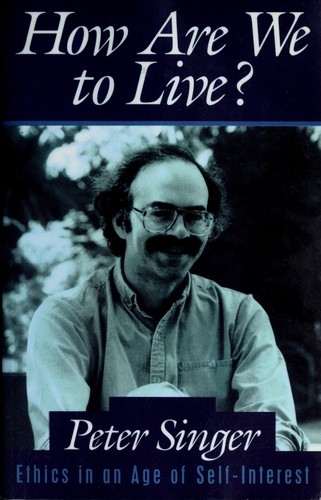
Peter Singer · Buy on Amazon
"Even though I’m not a utilitarian, and so I tend to disagree with Singer in terms of the general framework, this book literally changed my life. I read it many years ago, in the 1990s, when I was in Knoxville, Tennessee. I was part of a book club that I helped organize and I don’t remember who suggested it but we read this book. One of the things that struck me as really reasonable and useful in it is that Singer says, ‘Don’t try to be perfect, don’t try to change everything you do all at once because most likely you will fail and give up. Try to do the little that you can, and as much as you can in the right direction.’ So, for instance, Singer is famously an advocate of animal rights and vegetarianism. He says that if you agree that the vegetarian or even the vegan position is, in fact, morally preferable, that doesn’t mean you have to give up everything on the spot, or indeed ever. It means that you want to move in that direction. What are you doing now, eating steak three times a week? Go down to one a week, or once every couple of weeks. Start moving in that direction. Any movement you make in the right direction is progress. It’s progress for you as an individual and it’s progress for whatever cause—in this case, animal rights and the environment—you’re concerned with. I remember my wife and I discussing this book after the book club, and we immediately made the decision to sell one of our two cars, because we really didn’t need two, and to move downtown from the really nice suburban area where we were living to a smaller house. Those were relatively small steps, but they were significant for us. There were costs: it costs to sell your house and buy another one. You’re putting yourself into smaller quarters, you’re inconveniencing yourself by going down to one car instead of two. You have to start coordinating going to work and all that stuff. But it immediately felt like the right thing to do as a result of reading Singer’s book. It’s an example of a book in practical philosophy where even if you disagree with the general framework that informs the book—as I said, I’m not a utilitarian—you can still take a lot of what Singer says about individual strategies of how to go after certain issues and make changes in your life instantly. We implemented those changes in a matter of days. It’s an example of how even a book with which you disagree can have a direct impact on your life and, hopefully, move you toward a better situation. You’re right. That is where I disagree with Singer. He seems to think that he has the right priorities at a global, universal level. From the point of view of virtue ethics, I think each one of us has to make their own decisions based on their own circumstances and in their own judgement of those circumstances. It just so happened that on those two issues, my personal judgment agreed with that of Singer and so I wanted to act. And the reason the book was important to me is because I was spurred, by reading the book, to act on those particular issues. But what is important and what is not important is a personal decision, I don’t think there is a universal answer. That’s a major disagreement that I have both with the Kantian and the utilitarian approach. They’re a little too ‘one size fits all.’ “I wish more contemporary philosophers were clear about what they’re saying” That said, I am not a moral relativist either, nor were the Greco-Romans. They thought that there are certain parameters, a certain framework that you can use, that is more or less universal in the sense that it takes into account what’s common among human beings. We are a particular type of social being with certain needs and wants. So, anything that directly or indirectly helps us move toward those needs and wants is a good thing and anything that impairs our moving in that direction is a bad thing. But those are general enough that then you can have a lot of reasonable discussions and even reasonable disagreements about the details. For instance, going back to the ancient sources, although I just said that Cato the Younger, as presented in Lucan, was a role model for the Stoics, Cato arguably made a number of bad political decisions. He was presumably making those decisions in good faith. But his friend Cicero, who was not a Stoic, but a skeptic philosopher and also a senator, apparently at some point, lost his patience and said, ‘You know, Cato, you keep trying to do these things because they seem right to you. In fact, you’re undermining your own long-term goals by doing what you’re doing.’ At some point, Cicero writes a letter to his friend Atticus where he says, ‘Our friend Cato, I love him to death. But he doesn’t seem to realize that we don’t live in Plato’s Republic , we live in the mud of Romulus.’ It’s a great way of putting things. There is definitely more than one way to be virtuous and more than one way to look at the same problem in terms of what the right thing to do is. Exactly. I often use one or another of Peter’s books in my courses at City College. The students often disagree with his take, but things get interesting when I say, ‘Okay, but what exactly do you disagree with? Where does he go wrong in the reasoning?’ That’s far more challenging than just saying, ‘Oh, I disagree. I’m going to reject the whole thing.’ It’s a great exercise and I think you’re right that it’s possible because Peter is very clear when he writes. I wish more contemporary philosophers were clear about what they’re saying and why they’re saying it because that would make possible a lot more interesting and fruitful discussions. How to Be a Stoic is my personal take on Stoicism as an ancient philosophy that I think has much value for the 21st century. It’s supposed to be a practical approach. This is not just a general philosophical or historical discussion of Stoicism, as interesting as that may be. I want to know how you can put into practice Stoic principles in your own life. The book is written from a very personal perspective. Several of the anecdotes are real life things that happened to me or that I had to deal with, from health issues to being robbed. It concludes with a set of practical exercises that people can do on a regular basis, if they want to give the general approach of Stoic philosophy a try. This was co-edited with my friends and colleagues Skye Cleary and Daniel Kaufman. It came out of a podcast hosted by Dan. We were having a conversation and, at some point, we said, ‘Maybe it would be interesting to ask people who are not only knowledgeable about a particular philosophy or religion, but actually live that philosophy and religion, to write a personal essay about how do they put together the theory and the practice?’ And so you’ll find essays in the book on Aristotelianism and Epicureanism, the ancient Greco-Roman philosophies, you will find the Eastern traditions, Buddhism, Confucianism, and also some religions, Christianity, Judaism, Islam, as well as modern philosophies, existentialism, effective altruism, which I’m not sure qualifies as a philosophy but it’s close enough, and secular humanism and ethical culture. It was really interesting to put together, to ask people who are actually living these approaches, ‘How do you do it? How do you put into practice the principles of, let’s say, Christianity in the 21st century? How do you navigate modern life in a way that is sensible and good and doesn’t betray the fundamentals of whatever philosophy or religion you’ve actually chosen to follow? It was a really interesting exercise, putting together that book. This one is about the quest for character, what the story of Socrates and Alcibiades teaches us about our search for good leaders. Most of the book is about leadership and how you get leaders with a good character. Of course the implication is that there is such a thing as a good character, and that we can achieve it. So, near the end of the book, there is a discussion of ‘Okay, forget the leaders for a moment. Let’s ask the same question about ourselves. How do we become better people?’ As the subtitle says, the starting point of the book is the famous dialogue between Socrates and his friend, student and possibly lover, Alcibiades. The reason I start there is, first of all, because it’s a great example of how you do practical philosophy that has to do with statesmanship and leadership. But it’s also because the Alcibiades figure is fascinating. I’m stunned that nobody—as far as I know—has done a movie on the life of Alcibiades, because this guy was incredible. He was a handsome, rich, brave, unbelievable character. And yet he was also affected by what the ancient Greeks called hubris. Socrates tells him so, very clearly, in the Alcibiades Major from Plato, where the two interact. A very young Alcibiades goes to Socrates and says, ‘Look, I want to be in charge of things in Athens, but I want to do it right, I need to know how to be virtuous.’ Socrates talks to him a bit and at the end says, ‘You know, Alcibiades, you really should give up, you’re just not the kind of person to do that sort of thing, if you insist you will bring all sorts of bad consequences.’ And, sure enough, that’s what happens. Alcibiades was singlehandedly responsible for a large chunk of the disasters that befell the Athenians during the Peloponnesian War. Socrates was right. So that’s the start of the book. After that, I examine a number of other interesting figures, statesmen and/or philosophers who interacted with statesmen in ancient Greece and Rome. So Marcus Aurelius, Cato the Younger, Cicero, Alexander the Great and Aristotle and the relatively less known story of Dionysus the Second of Syracuse and Plato. Many people don’t realize that Plato at the age of 60 and then 70 did a couple of trips to Syracuse, to put into practice his philosophical ideas. In his fairly old age, he crossed the Mediterranean because he wanted to see if he could actually make a difference. He almost lost his life twice as a result. The book also updates this whole discussion beyond the Greco-Romans to the Renaissance, and then modern times. Of course, you cannot talk about Renaissance ethics and statesmanship without mentioning Machiavelli and his Prince and the kind of advice that he was giving. That’s right. That is the origin of what we today call realpolitik, or political realism, which has been adopted by a number of characters in the 20th and 21st centuries, Kissinger, for instance, who I wouldn’t necessarily recommend as the ideal statesman. Get the weekly Five Books newsletter By the end of the book, we have a discussion about not only what we have learned from this whole issue of character and leadership and what individuals like us, who are not emperors, prime ministers or presidents, can do in terms of improving ourselves, but also how we should think about the relationship between ethics and politics. To simplify greatly, I come down in between Socrates and Machiavelli. Socrates basically thought that unless you’re virtuous, forget it. Just don’t get into politics. He’s right in theory, but in practice, it’s just not going to happen. The opposite extreme, as you mentioned, is Machiavelli, who says, ‘If you want to be a statesman, here’s how you take advantage of people, here’s how you betray people, etc. etc. in order to actually get what you want.’ It seems to me that somewhere in between is the right position and I do think that of all the people that I present as case studies in the book, Cicero is the one that comes closest. He was a philosopher, he certainly did believe that there is such a thing as virtuous character, and that we have an imperative to become better people. But, at the same time—as I mentioned before with the quote about Cato not realizing that he lives in the mud of Romulus—he was also a pragmatic politician. He had been a consul in Rome, which was the highest political office during the Republic; he had actually had to deal with a conspiracy against the state, orchestrated by Catiline . He knew that in order to be an effective statesman and politician you have to compromise. Cicero is often nowadays accused of being a flip-flopper, changing his allegiances right and left depending on the situation. It’s true and that’s exactly what you would expect from a good politician. What he did not change was his aim. His goal was to try to do his best to save the Roman Republic. If that meant sometimes allying yourself with a not exactly great character like Pompey, then you have to do that as long as you keep in mind where you want to go."
Stoicism (2020)
Scraped from fivebooks.com (2020-09-01).
Source: fivebooks.com

Epictetus · Buy on Amazon
"Yes. He was a very interesting figure. He was a slave, born in Hierapolis, which is modern Pamukkale in Turkey, which at that time was a Greek city and became a Roman colony in the late 1st century/early 2nd century. He was born a slave and badly treated when he was young: his master, through either carelessness or viciousness, broke his leg, and as a result he was crippled throughout his life. Then, at around age 15, he was bought by a much better master, who turned out to be Nero’s personal secretary. Epictetus was brought to Rome, and for a while lived at Nero’s court. Then Nero became more unhinged both in life and in the way in which he was running the business of the empire, and eventually that led to revolt. Nero committed suicide—well, in fact Nero botched his attempted suicide and it was his secretary, Epictetus’ master, who helped him in the end, so he’s the one who killed Nero. As a result of those events, Epictetus then started having his own quasi-independent life in Rome. Eventually he became a freedman, which was not unusual for bright slaves in ancient Rome. In the meantime he had, under the tutelage of his second master, started reading and learning about philosophy, and became the pupil of Musonius Rufus. Musonius was a major Stoic philosopher in ancient Rome. Epictetus studied with him for a number of years, and eventually started teaching on his own. In the meantime, several political events happened in Rome: there was one emperor after another. One was Domitian, who was a little unhinged himself and wasn’t particularly fond of philosophers: all this talk about virtue and how you should do things as opposed to how you actually do things I guess didn’t agree with him. Domitian kicked out all philosophers from Rome and sent them into exile. Yes, this is something that few people hear about. When we think about Rome, we think about persecution of the Christians, but actually philosophers, and in particular the Stoics, were persecuted by several Roman emperors because they really didn’t like this constant reminder that you should be doing better than you are doing. A number of philosophers were put to death and a number exiled. Musonius Rufus, Epictetus’ teacher, was twice exiled. Epictetus was also exiled by Domitian. He went to North West Greece to a place called Nicopolis and he established his new school there. He was about 40 by that time. Later on he was recalled to Rome, but refused to leave. He lived in Nicopolis to a ripe age of 80, which for the time was remarkable. Yes. It was really amazing. He kept teaching and he built a reputation so that fairly wealthy people sent their kids to Nicopolis to study with Epictetus and one of the later emperors, Hadrian, became a good friend of his. Hadrian was impressed by Epictetus and went to visit him, and they met a few times and became friends. Epictetus, by the end of his life took a wife of about his own age, apparently so she could help him raise a child fathered by a friend of Epictetus’. The child was destined to be exposed—which was the euphemism in Rome for being left to fend for himself in the elements, and probably die. Epictetus’ was an interesting life: a slave who turns prominent philosopher and teacher, who becomes friends with emperors and is kicked out by other emperors: it’s fascinating. Epictetus didn’t write any books; he was a teacher, in the same vein as Socrates, who made a point of not writing his ideas down. The two books we have by Epictetus are called the Discourses , and the Enchiridion— ‘enchiridion’ means ‘handbook.’ Both the Discourses and the Handbook were put together by one of Epictetus’ most brilliant students, Arrian. Arrian was probably about 23 or so when he did this. After a few years as Epictetus’ student, he became a historian and a writer in his own right. He wrote the definitive account of Alexander the Great’s expedition. Arrian was very well known in the ancient world. Some of his works survive. He put together eight volumes of the Discourses— basically these are his handwritten notes from Epictetus’ lectures. Of those eight books, unfortunately only four remain. The other four got lost somewhere during the Middle Ages. The Enchiridion , the Handbook, is the short version that Arrian put together by picking the best bits from the Discourses. So that’s all we have from Epictetus today: the surviving four volumes of the Discourses and then the Enchiridion, which is very short. It’s interesting because it guides you on how to live your life from a Stoic perspective. The chapter titles are topics that Epictetus debated with his students, and these topics were often very practical. There’s very little theoretical philosophy in Epictetus. He wasn’t interested in metaphysics. In fact, he explicitly told his students that whatever the nature of the world turns out to be doesn’t make any difference to human life. If the universe is made up of atoms, or it’s made up of something else, those are interesting questions but they’re not going to affect your life. In that sense he’s an unusual Stoic because most Stoics were into system-building, especially the early ones: the Greek Stoics before the philosophy moved to Rome, made major contributions to logic, they wrote a lot about metaphysics. Epictetus was focused on ethics, which is the third Stoic concern. That’s right. He says whatever turns out to be turns out to be. There are people interested in that stuff and they’ll figure it out, but really when you have to deal with your daily life and the challenges that it brings, that’s not going to be particularly helpful. Yes. That’s an interesting question. The early Stoics thought that there were three areas of philosophical inquiry. What they called ‘physics’ is what today we would describe as a combination of metaphysics and natural science. Their ‘logic’ we would still call logic today, but for them it included epistemology, cognitive science, and psychology . And then there was the ‘ethics’, which was the study of how to live your life. Their idea was that in order to figure out how to live your life, you needed to understand how the universe works and what your place in it was—that would be the ‘physics’—and you also needed to understand how human beings reason and fail to reason well; that’s where the ‘logic’ came in. Now, Epictetus didn’t necessarily reject this, he just said there were many different alternatives, many different ways of doing or understanding physics and understanding logic that would support the same way of living your life. So, in modern terms, we would say that Epictetus thought that the physics and the logic were relevant at some level to the ethics, but they underdetermine it. It’s not as if you need to know all the details about how the world works in order to figure out how to live your life. Correct. Exactly. In fact, Epictetus says just this in several places in the Discourses . There are a couple of places, for instance, where he says that we can have interesting discussions about metaphysics or logic, but those discussions have to bear on specific ethical issues. If you’re just going off splitting hairs in logic, then you’re doing something different that’s not particularly interesting or particularly relevant to living your life. “Some things are under your control and other things are not under your control” Broadly speaking the Discourses are about how to live your life: they present the basic principles of Stoicism over and over, from different angles and exploring the consequences in different contexts. Arguably the most basic one, which Epictetus insists on several times, and is also how the Enchiridion starts, is his famous dichotomy of control: he says, some things are under your control and other things are not under your control. Then he lists the kinds of things that are under your control and those that are not: things under your control are your behaviour, your decisions, your rational thinking processes; the things that are not under your control are all the externalities: your health, your wealth, your education, your stature in life, your reputation. It’s not that you can’t influence the things not under your control, of course you can. He says so explicitly. But they’re not entirely under your control. You can only try to be healthy, and wealthy, and educated, and have a good life in the sense of externalities, but, you know, shit happens, so to speak—that’s not a direct quote—and Stoicism in the great part, especially Epictetus’ Stoicism, is about how to deal with situation where shit does actually happen. What do you do then? How do you react in life when things don’t go your way? The dichotomy of control is crucial in Stoicism, particularly to Epictetus’ philosophy. When I began reading Stoic works I started making furious notes and highlighting things and then going back to quotations one after another. I just want to read you one which is right at the beginning of the Discourses , volume 1, chapter 1.32, it’s an example of the dichotomy of control, but it’s also an example of something that immediately endeared Epictetus to me: his sense of humour. He has a very wicked sense of humour, a very interesting sense of humour. Here’s the quotation: I have to die. If it is now, well then I die now; if later, then now I will take my lunch, since the hour for lunch has arrived – and dying I will tend to later. When I read that I started laughing. Ok, sure—death is inevitable. Is it coming now? If it’s now then I’m ready, let’s go, let’s do it, because everybody has to die; but if not now, then I’m going to do other things, and of course when death comes, it’s not under your control, so you just accept it, whenever it is. Yes. Suicide is a big deal for the Stoics, and for Epictetus in particular. Epictetus referred to it as “the open door.” He says to his students several times not to take it lightly: suicide for the Stoics was a serious business and he was not saying jump out of the window at the first problem; but, he says, if you do get yourself into a situation where there really is no way out and life really does become insufferable, or so painful, or you realise that you cannot contribute any longer to society in any meaningful way, then the door is open, you can leave of your own accord. He also adds, which is crucial I think to understanding the whole thing, that it is the fact that the door is open that gives meaning to what you do. The very reason why you can keep on going, struggling on, and living your life, and trying to do your best, is precisely because you know that if it becomes unbearable, you do have another option."

William B Irvine · Buy on Amazon
"That is, as you say, a caricature of Stoicism; but it’s a very common one, and it’s not going to go away anytime soon. The second book that I recommend, William Irvine’s A Guide to the Good Life , deals with this in some detail. There are several chapters in which Irvine goes into these ideas about the Stoics and emotions. The basic idea is this: yes, Stoics do have that reputation, but if you look at what they wrote and the way they actually behaved in life, they were far from emotionless. We have excellent accounts of the lives of ancient Stoics: we know a lot about the Greek Stoics, beginning from Zeno, the founder of the philosophy, through Diogenes Laertius’ Lives of the Philosophers, which includes several mini-biographies of Stoics; and of course we also know a lot about Epictetus, Marcus Aurelius, Seneca , Musonius Rufus, and others too. We know what these people did, and how they practised their philosophies. There is nothing in any of these biographies or in any of their writings that suggests that they behaved in a Spock-like way and suppressed their emotions in order to think about things rationally. What they did, and they were very explicit about this, was recognise that there are different types of human emotions. The first emotional reaction you have to something, they called an impression. So for instance let’s say that you are walking in the street by yourself at night and you hear a sound that doesn’t feel right. Your first impression, your first reaction might be one of fear, and the Stoics said there’s nothing you can do about that. There are natural reactions, and you cannot and you should not, in fact, suppress them. But what you should do, if it is at all possible, is examine them, step back for a second and say: ‘Why am I afraid? Is there really something to be afraid of, or not?’ If there is something to be afraid of, a real danger, by all means deal with the danger; but a lot of the time the first impression is actually misleading. If you get angry, for instance, at something, think: ‘Why am I getting angry here? Am I being insulted? What is an insult? What is this person who is insulting me trying to tell me? Is there some truth perhaps in what he’s saying? Should I even pay attention to an insult to begin with? Why am I reacting this way?’ The aim was to examine your emotion and to manage or gradually eliminate the negative, destructive ones. The obvious example of a destructive emotion, particularly in Seneca’s writing, was anger. Seneca calls it a ‘temporary madness’. If you do things in anger, you’re very likely going to do things that you regret. I’m so glad you brought that up because indignation at injustice, a sense of injustice, those are positive emotions. The Stoics believed that good character is made of the practice of four fundamental virtues, we call them the cardinal virtues. One of those virtues is justice, and yes, a sense of justice needs to be cultivated because it is a positive emotion. The contrast between anger and justice is exactly this: that anger will cloud your judgement, even if it is justifiable anger, even if there is a good reason to be angry at something. If you react just on the basis of anger, you’re very likely going to make wrong decisions or act rashly; but on the other hand there are situations where you do want to cultivate a sense of indignation, a sense of justice being violated, and you do want to do something about it, and that’s a positive emotion—that’s something that the Stoics would definitely say you should do. I think what you’re getting at there is this separation between academic philosophy and practical philosophy. There was a series of studies a few years ago showing that academic moral philosophers are actually no more moral than the average academic. So there’s solid empirical evidence that that’s the case. The response by many academic philosophers has been: ‘What did you expect?’ But that’s like a mathematician, let’s say, or an economist, who’s caught badly managing his bank account and his personal finances, and who responds when challenged about this incompetence: ‘I’m interested in the theory here, not the practice’. My response would be: well, maybe you should be interested in the practice, to some extent. I find that sort of study very disturbing. As I said before, I came to philosophy late in life, other than my early bout in high school, and I love the field. I’m very happy that I switched and I’m very interested in what I’m doing, but it is disturbing when you hear things like that, especially the rationalisation. You would hope that somebody would think it’s time to do something about this. “It’s a sort of philosophical judo, what Bill practises” One of the things I find interesting about the modern Stoic authors is that those people really do try to live their life that way. They’re not just writing about it; they’re not just theorising about it; they really practise it. Bill Irvine has become an expert, a virtuoso I would say, in dealing with insults, which is one thing that Stoics receive a lot. Let me give you an example: one day he was in his department and he met a colleague who said ‘Oh Bill, hi, I was thinking of citing one of your papers in my book’, and Bill was thinking, ‘Oh, that’s interesting—I’m glad that one of my colleagues thinks my work is worth citing’. But the colleague immediately added ‘Yes, I’m trying to decide on whether your work is just mistaken or downright evil’. Obviously that’s not a compliment. The way that Bill responded was straight out of Epictetus: he almost quoted Epictetus verbatim. He said: ‘Oh, well that’s because you only read one of my papers: if you’d read the other ones you’d see that I’m really evil.’ So he turned things around; that’s exactly what Epictetus did. There is an anecdote in the Discourses where somebody, one of his students, tells him: ‘I heard so-and-so speaking ill of you.’ And Epictetus’ response is: ‘Well, that’s because he doesn’t know me well, because otherwise he would be saying much, much worse things.’ Exactly, it’s a sort of philosophical judo, what Bill practises. As a result, he tells me, he’s been a much happier person, because a lot of things that were stressful for him, like his colleagues not thinking well of his work now just washes over him, and he’s even amused by it. Now, that comes with a caveat, because whenever I tell this kind of story, the objection is: ‘Ah, but that way you run the risk of not actually learning from criticism’. That’s not the point. The point is to ignore the insult, not the criticism. So the intelligent Stoic would react with humour or simply just ignore the insult, but then he or she would go back and think: ‘Why did my colleague object to that paper? What can I learn from that reaction?’ Epictetus is very specific about this, that you should do this, that you should analyse the problem with a calm eye; but what you shouldn’t do is react to the insult, because reacting to an insult is something that is under your control. The insult itself is not, but how you react to it is up to you. You can step back and say, ‘Well this guy is trying to hurt me, I’m not going to let him, I’m just walking away.’ Excellent question. So, here’s the thing, the reason there was a shift between Greek Stoicism and Roman Stoicism. Just briefly, from a historical perspective: Stoicism started in Athens in the year 300, or 301 BCE in a school established by Zeno. It thrived in Athens until the Athenians made what turned out to be a fundamental political mistake siding with Mithridates against the Romans. As a result of that the Roman general Sulla marched on Athens and laid siege to the city, destroying both Mithridates and many of the Greeks. Now, after that event, we are talking about 1st century BCE here, there was no relevant school of philosophy left in Athens. The philosophers left. This is referred to as the ancient philosophy diaspora: the philosophers from different schools went out into different places. Some of them went to Alexandria, some of them went to Rhodes, many of them went to Rome, including most of the Stoics we know from afterwards. This is referred to as the Early Stoa, which is the Greek version, and then the Late Stoa, which is the Roman version—there is also the Middle Stoa, which is the transitional period. No they went of their own accord. They figured out that the heyday of Athens was over and the new power was Rome. So the reason I am telling you this is because it does go back to your question about the purpose of Stoicism, whether it is to live a happy life. For the early Stoics, the emphasis was on what the Greeks called the eudaimonic life. The eudaimonic life, which is often translated as ‘the happy life’, doesn’t really translate very well—it’s more like ‘the flourishing life’. For the Stoics in particular the eudaimonic life was a moral life. It was the kind of life where you are on your deathbed, you look back and you say: ‘Yes, that was worth it: there is not much that I’m ashamed of, that was a life well-lived, not just in the sense that I thrived in terms of material possessions, but mostly I was a good person.’ So that puts the emphasis on the virtues. Externalities, practical goods and things like that, are OK. There is nothing in Stoicism that says you cannot pursue wealth, health, education and all those sorts of things. There was nothing wrong with material possessions, as long as you never, ever traded those for virtue. So if, in order to acquire or attain health, or wealth, or education, you did something that was morally questionable, morally wrong, then you would be doing the wrong thing from a Stoic perspective. That was the view of early Stoics. “There is nothing in Stoicism that says you cannot pursue wealth, health and education” The later Stoics, such as Epictetus, based in Rome, added a second component to this. They retained this fundamental idea that it’s about practising virtue, it’s about having the good moral life, but they also added what they call apatheia, which of course is the Greek root for the English word ‘apathy’, and yet has nothing to do with it. They didn’t counsel apathy. What they did counsel was apatheia . The best way to translate this word is as ‘magnanimity’ or ‘great soul-ness’. So the idea was that you achieved tranquillity in life, you achieved what the Epicureans, who were rivals of the Stoics, called ataraxia or tranquility of mind, if you developed a magnanimous attitude towards the world. That’s why I gave you the example of the way Bill Irvine responds to insults. Bill’s response to insults is magnanimous. If someone insults him he uses humour to deflect the insult, and through this achieves inner calmness. Yes. Funny you should say so. Epictetus says exactly this in the Discourses , he says: ‘I used to go round responding humorously to people and then I got my nose broken.’ And he adds: ‘— so I don’t do it anymore, I just walk away.’"
Marcus Aurelius & Robin Waterfield (translator) · Buy on Amazon
"This is probably the most famous book written by a Stoic. It has been in print ever since there have been printing presses. The same can be said about Epictetus’ Enchiridion incidentally, though Epictetus is far less well known than Marcus. This is a recent thing, a 20th-century phenomenon. Up until the 19th century, Epictetus was one of the most prominent philosophers studied. You’d find references to him everywhere: Descartes, Spinoza, many of the major philosophers you can think of were influenced by the Stoics and particularly by Epictetus and by Seneca, and the Enchiridion was used as a training manual in Christian monasteries throughout the Middle Ages. Going back to Marcus’ Meditations , that book was never meant for publication. The Meditations initially did not have a title at all and it was known during the Middle Ages by the title To Myself because this was the Roman emperor’s personal diary. Yes, it is a better title, I agree. It later became known as the Meditations , but it really was his personal philosophical diary. Marcus Aurelius had studied philosophy when he was young and in particular Stoicism. He had a major Stoic for a teacher who gave him a copy of Epictetus’ Discourses . You can see Epictetus’s influence in the Meditations . The Meditations consists of twelve short books. If you read them through you will see that there’s a lot of redundancy there. He comes back over and over to the same themes, and he repeats the same sorts of concept again and again. It is not so great to read through from beginning to end for this reason. Marcus wrote this over the course of a few years when he was on the German frontier fighting the Marcomanni revolt against Rome. “Marcus Aurelius was the most powerful man in the world at the time, yet his wife was cheating on him, and his advisers were treacherous” The reason the Meditations have endured is because you really get a very clear sense of an interesting man who is struggling with his own limitations, as well as with the environment that surrounds him. Marcus Aurelius was the most powerful man in the world at the time, and yet he was dealing not only with major events like revolts throughout the Roman Empire, but also with his wife who was cheating on him, and with some of his advisers who were treacherous. Yet the first book of the Meditations opens with a long list of people whom he thanks. It’s an exercise in gratitude, which is a basic Stoic practice: you have to remind yourself of the people you are grateful to because they are important in your life. The very first person he thanks is his grandfather: “From my grandfather Verus I learnt good morals and the government of my emperor,” and then he goes on to thank his mother, his teachers, his brother, and so on. If you read this for the first time, you don’t really expect it. If you bear in mind that it is the most powerful person in the world writing this, and in his own personal diary—not done for show to other people—he starts out by thanking people who had made a good impact on his own life: it’s a very humbling exercise. Often people say that the Meditations come across as preachy, and that’s true to some extent. But they forget that he is preaching to himself. He is not telling other people here’s what you should do and should not do; he’s telling himself, he’s reproaching himself. For instance, he says—this is one of my favourite quotations from the Meditations , from book two, chapter one: Begin the morning by saying to thyself, I shall meet with the busy-body, the ungrateful, arrogant, deceitful, envious, unsocial. All these things happen to them by reason of their ignorance of what is good and evil… I can neither be injured by any of them, for no one can fix on me what is ugly, nor can I be angry with my kinsman, nor hate him This struck me as really profound. A lot of people who surrounded the emperor would have wanted favours, and many were treacherous; but he says: ‘Remember, they do this because they don’t know better. They don’t have the advantage of your education, they don’t have the advantage of your self-reflection so they’re just doing this out of ignorance, ignorance of what is good for them or what is good to do: ignorance of virtue.’ And then he goes on, ‘but I cannot be injured by them, and nor can I actually hate them because they’re my fellow human beings, I am just as imperfect as they are: I also lose my temper, I also do things that I may regret or I’m not proud of, and we are all in the same boat together.’ I find these very down to earth observations of human nature and Marcus’ way of dealing with it both very refreshing, and at the same time actually very insightful. That’s an interesting point about Stoicism: is it an impossible ideal? There, I think, a good comparison can be made between Stoicism and Christianity. Despite the fact that Christianity, early Christianity, adopted quite a bit of Stoicism, the early Christians rejected Epicurus because of his emphasis on pleasure—that’s why still today the word ‘epicurean’ is almost an insult: simply because the Christians completely rejected this worldview, and we have inherited the Christian disdain for Epicurus. But Christians did learn from Stoicism—not only from Epictetus’ Enchiridion but also Saint Paul knew Seneca’s brother, Lucius Junius Gallio Annaeanus, and so was aware of Stoic writing. There was even a medieval forgery of an alleged correspondence between Seneca and Paul. You can find reactions to Stoicism in all the major Christian Church fathers beginning with Augustine, too, and then all the way to Thomas Aquinas. Now, the reason I’m bringing this up, in answer to your question, is because there is a good, interesting distinction between Christianity and the Stoic approach. For Christians, if you think about it, they have their role model—Jesus—who is, by definition, an impossible role model to emulate: he’s a god. I can aspire to behave as much as possible like him, but I’m never going to achieve that fully because he’s an immortal and I am not the son of God. I simply cannot be perfect, and that of course is part of the Christian doctrine of repentance for your sins. For the Stoics, in contrast, they have a similar figure, a role model to whom they aspire and they call him the ‘sage’. The sage represents an ideal to aspire to, but is an achievable role model. The sage is a human being. It’s difficult, but not impossible to emulate the sage. Stoics are clear that there haven’t been many sages throughout history, but there have been some, and they point to some examples, the obvious one being Socrates, who was not a Stoic because he pre-dated the school. Many of the Stoics referred to Socrates as a sage. There were other examples too: Cato the Younger, for example, who was a famous political opponent of Julius Caesar during the Roman Republic; Seneca refers to him as a sage and as a role model. The Stoics also had fictional role models, ancient heroes and demigods like Hercules. That’s debatable, though a good point. It’s hard to imagine that Seneca actually took stories about the Olympian gods seriously. True, but the basic point is that even when the Stoics refer to demigods, if you look at the story of Hercules, for instance, the actual ancient myth, it doesn’t end well: for one thing, Hercules ends up dying of a horrible death. He makes mistakes, he’s a human figure, he’s somebody you can relate to but who constantly strives to do better: he constantly strives to do the right thing. This is the Stoic idea of a sage, which has some affinities with Buddhism. Buddha allegedly achieved enlightenment in his lifetime. In the Buddhist tradition that’s not easy. It’s not something that everybody can do—the fact that he as a man achieved enlightenment, however, shows that it is achievable. In Stoicism you have an ideal model, and, yes, most of us will fall short of that, but it is an achievable model. Seneca explicitly addresses this in his letter to a friend ‘On the Firmness of the Sage’ where he writes: ‘Don’t think that we mean by this just an unachievable ideal, just a theoretical thing. We think there are people who actually are sages, and those are our role models, and we try to do as they did’."

Seneca · Buy on Amazon
"They literally were letters. The reason I picked this book is because a great deal of writing by Seneca has survived, more than that of other Stoics. Seneca was a playwright: he wrote tragedies, and even influenced Shakespeare. He also wrote long essays and epistles—a lot of epistles. There is a particular collection of epistles, normally referred to as either The Moral Epistles or the Letters to Lucilius . This book consists of more than a hundred letters. Many of them are short, just a few pages long. We know that Seneca wrote them late in life, during the last two or three years before he was ‘invited’ to commit suicide by Nero after he had fallen out of favour with the emperor. They’re written to his friend Lucilius, who was probably a real person living in Sicily at the time. Yes, they were. Yes. Unlike the Meditations , these were not meant just as personal correspondence. They were personal correspondence, but when scholars look at the way the text is structured, they are convinced they were meant for publication. A lot of people, not just Seneca, wrote letters that were meant both as personal letters to friends or acquaintances, but also for broader circulation. The Moral Epistles is in some ways Seneca’s philosophical testament because it conveys his mature thought. Of course he didn’t know he was about to die prematurely, but he was an old man already, he was in his sixties, and he knew he wouldn’t live that much longer and was frank about it. Seneca is often criticised, even by modern Stoics, as a somewhat ambiguous figure because despite being a self-professed Stoic he was preaching virtue at the same time that he oversaw Nero’s first five years in power. It was during those years that Nero became unhinged: he killed his mother, several of his wives, and his stepbrother. Exactly. Not just because he was there, but because he was Nero’s principal advisor, and in a couple of cases he wrote public letters defending some of Nero’s actions. On top of that he was immensely wealthy. He was a senator, and owned land all over the Roman Empire. As I mentioned earlier, there’s nothing intrinsically wrong with that for a Stoic. Stoics are not Cynics (in the ancient sense), so they’re not against wealth. But, one can make an argument, as Seneca himself does, that too much wealth becomes obscene because you become focused on the externalities at the expense of virtue. If you can use your wealth for good, you’re fine from a Stoic perspective, there’s nothing wrong with that; but if you keep accumulating wealth for the sake of it, then you’re definitely not a good Stoic. These are some of the reasons why Seneca is criticised even by modern Stoics. There are two recent biographies of Seneca that take that kind of attitude towards the man. But there’s more to be said. First of all, this is all very debatable, since we don’t really have a lot of independent historical evidence on his life; and secondly, it’s a very recent development in the way we look at Seneca. Throughout the Renaissance, for example, Seneca was thought of as close to being a secular saint because he tried to do the best that he could do in the impossible situation of having to deal with Nero, and because in the end he did the right thing, by committing suicide, partly to save some of his properties for his family. If he’d refused to commit suicide then he’d have been killed anyway, and on top of that his family would have lost his property. It was a practical decision, but on behalf of others. I’m talking to you from Rome where I’m on my sabbatical, and I’m writing a book on how to be a Stoic, which will be published next year by Basic Books. One of the things that I do, the reason I’m here in Rome, other than that my family is here and it’s a nice place to visit, is because I wanted to be in a place that would inspire me—I’m literally next door to the Colosseum and the Roman Forum. Whenever I need a break, like after our conversation today, I’ll just go down and walk by the Forum. One of the things that I have done while here was to visit the Domus Aurea. This was Nero’s huge villa that he had built, as it turns out not for himself but mostly for public gatherings and diplomatic purposes. I’d never seen the Domus Aurea because when I was living in Rome, it was underground. Over the last few years archaeologists here in Rome have opened it up. It is right in front of the Colosseum, but it’s several metres below ground. You can visit now, but you have to make an appointment, and there is a nice guide from the Ministry of Cultural Goods, who walks you through for an hour or so. So I did this, and the woman that was leading the excursion of course talked a lot about Nero, and she also talked a lot about Seneca. I was surprised that her take on Seneca, which she says reflects the angle taken by many Italian historians and archaeologists, was much more positive than anything I had read in the English-speaking literature. The reason for this is interesting. She said that if you examine the historical records, Seneca did a good job in the first five years of Nero’s reign. The first five years of Nero’s reign were a very good time for Rome and for the Empire, precisely because, she argued, Seneca and a colleague of his who was the chief of the Praetorian Guard managed to counsel Nero and restrain him to some degree. He would have been much worse without Seneca’s advice. When Seneca saw that Nero was going too far and was definitely going off the rails, Seneca tried several times to retire. He said: ‘This is it. I can’t do this any more. I can’t handle Nero, I can’t do any more good. So I’d rather retire outside of Rome in my own villa.’ He used some of his great wealth to try to bribe Nero to let him retire, offering two thirds of his lands to the emperor. Now I don’t know exactly how much money we are talking about, but it would have been a substantial offer. Nero refused it. Exactly. Nero refused and tried to keep Seneca in his entourage. Seneca eventually managed to achieve a sort of semi-retirement anyway. He started spending more time outside of Rome, and that’s when he wrote the Epistles to Lucilius. That’s right. If you look at just the titles of the letters, that’s revealing, titles such as: ‘On true and false friendship’. This was a crucial Stoic principle, the idea that you really should surround yourself with good people, ideally people who are better than you, because that’s the way you learn, that’s the way you challenge yourself. I know, right. Then there’s: ‘On the terrors of death.’ Death was a constant Stoic theme. Seneca famously said that ‘we die every day of our life,’ by which he meant that our entire life is a preparation for the ultimate test: how you handle death. No. Seneca meant that every day that passes brings us one step closer to the end of our lives. For the Stoics, what makes our life worth living is precisely the fact that it’s finite, and it is something that we need to be aware of. Exactly, and in fact that is the title of one of the two recent biographies I mentioned of Seneca: Dying Every Day. Then there is an essay on old age, for instance, on how to age gracefully and deal with it if you’re lucky enough to live to experience that. That’s right, it depends on how you look at it, on your attitude. There are so many topics that Seneca covers. Another one I like is called, ‘On festivals and fasting’. Seneca wasn’t fond of the Roman games and festivals: he thought they produced a lot of noise and a lot of confusion. He uses that starting point as a way to counsel his friend Lucilius, and therefore his audience at large, about moderation. He writes, for instance, that it’s good to fast every now and then, because these moderate exercises of self-deprivation, a day or two without eating, remind you that you can deal with not being fed. If in fact one of these days, as a result of externalities or adversity, you really do find yourself starving, you will be psychologically prepared. You know that you can handle it, within physiological limits. That’s one benefit, but the other one, and this is something that Bill Irvine in one of the other books that I mentioned also emphasises, is that the psychological effect of these exercises in self-deprivation is that when you come out of them you enjoy what you have much more: the self-deprivation reminds you of just how good it is even to eat some simple food. You don’t need to go for a gourmet meal, you don’t need to go for really fancy cuisine, you can appreciate some good bread, or good wine and recognise that this is an incredibly enjoyable experience. That would be pushing it. I think the Romans would definitely not go that far. Seneca and the other Stoics are very careful to remind you that you don’t do these things in order to punish yourself, something that, again, some of the late medieval Christians actually did. Yes. There’s nothing like self-flagellation in Stoicism. In fact one of the four Stoic virtues is temperance—self-control, so that you do everything in moderation, including, of course, these Stoic exercises of self-deprivation. One of my favourite exercises which does come straight out of Seneca’s writing and the ancient Roman tradition is this idea of taking a hot shower and then during the last few seconds turning it completely cold. This shocks your system. “The psychological effect of these exercises in self-deprivation is that when you come out of them you enjoy what you have much more” The Romans did this on a regular basis. They went to the thermal baths, starting with a hot sauna; then they went into hot water, what they called a calidarium; and then they jumped into what they called the frigidarium, which was this pool of really, really cold water. This cold shock has a number of effects. First of all, interestingly, there is modern research that shows that this really does have physical benefits: it helps to boost your immune system, and things like that. Obviously the Romans didn’t know that. Beyond that, it reminds you that you can deal with these kind of things. A hot shower is a luxury. Most people throughout most of history didn’t have hot showers, didn’t have hot baths. That’s a good point. Think about it this way. What you’re describing seems to me to be a perversion of the Stoic idea. One of the things that I learned very early on, both from reading the ancient Stoics and also from modern Stoics, is that Stoicism is not supposed to be something that you impose on other people. It comes from within. It’s your own discipline. You shouldn’t go around with either a metaphorical or an actual stick beating people and saying, ‘you’re not virtuous enough.’ There’s no tradition of proselytising for Stoicism. The ancients simply opened schools, and competed with other schools. This was a time in ancient Rome where philosophy was all over the place: Stoicism had to compete with Epicureanism, with Cynicism, with the Platonic Academy, with the Peripatetics, followers of Aristotle , and so on. There was an open market of philosophical ideas, and to some extent, people just gravitated to one school or another depending on either the fame of the teacher or the appeal of the teaching. Back in Athens, Cleanthes (the second head of the Stoa) was apparently a good philosopher, but not a particularly engaging teacher and by the end of his career the number of students dropped off significantly. Then Chrysippus, a charismatic figure, took over, and students returned. The idea is that you should just live your life as a Stoic and lead by example, not going round telling people, ‘Hey, I’m a Stoic, look at me, come and join us!’ I think the ancient Stoics believed it was the only way. You can see that from the fact that they spent a certain amount of time—not a lot, but a certain amount of time—arguing against other schools. Cicero was not a Stoic; rather he was a Platonic and academic sceptic. But he was very sympathetic to Stoicism. He presents Stoicism in good light. If you read Cicero, and if you read Epictetus himself, it becomes clear that many Stoics did believe that they had the best way, if not the only way, certainly the best way of achieving eudaimonia. In contrast, in the Letters to Lucilius, Seneca recognised that good ideas for living can come from diverse sources. In the early letters, over and over he ends with what he calls a gift for Lucilius, and it’s always a quotation from somebody else, a quotation from Epicurus, or whoever. At a certain point he felt like he had to justify doing this. So he says: ‘My dear Lucilius, you might wonder why am I quoting our competitor’; his answer in Latin is ‘ quod verum est meum est’ which means ‘that which is true is mine’. As he put it: ‘I do occasionally wander into the enemies’ camp and I pay attention to what they’re saying, and if there is something good, I will use it’."

Laurence Becker · Buy on Amazon
"Lawrence Becker is a retired philosophy professor. The first time I encountered A New Stoicism was in the context of a book group discussion in New York. It’s quite a difficult book to read in some ways; if you don’t have a certain amount of background in philosophy, you’re probably not going to get as much out of it as you should, although Becker himself is aware of this. The book is structured so that at the end of each chapter there is a commentary, and the commentary is very technical and is where he goes back to the original sources and says things like, ‘I made this point in the chapter because it’s relevant to these other thinkers, these other quotations’. It’s very academic in that sense. But the main sections of each chapter can be read, can be understood, by somebody with little or no background in philosophy. “Becker wants to explore how much Stoicism can be updated to be compatible with modern science, with modern philosophy” One slightly odd feature of the book is that when he writes about Stoics, he writes in the first person plural. So he says ‘we’ do certain things, or this is something that happened to ‘us’. He reminds the reader throughout that he is a Stoic, not just a scholar of Stoic philosophy. The reason it’s called A New Stoicism is because unlike, for example, the Buddhist tradition, or even the Christian tradition, Stoicism was interrupted by the fall of the Roman Empire. The golden years for Stoic philosophy was five centuries, give or take, from 300 BCE to the second century. The last major Stoic was Marcus Aurelius. Stoicism as a philosophy kept on in the Roman Empire for a little longer, but then eventually, the Byzantine emperor Justinian closed down the last philosophical school and basically imposed Christianity on everybody. That was the end of all Hellenistic philosophy, not just Stoicism. For many centuries there was no school of Stoicism, no practice, there was no theory going on. Becker’s point is that there is a resurgence of Stoicism in modern times, that there are people interested in Stoicism as both theory and especially as practice. Becker is interested in updating Stoic philosophy for today. We now have sophisticated cognitive sciences, logic, and so on, and he wants to explore how much Stoicism can be updated to be compatible with modern science, with modern philosophy, and still be called Stoicism. His answer, of course, is ‘yes’, and I tend to agree. He updates a number of aspects of Stoic philosophy. So, let me give you just one example to give you a flavour: remember we started out this conversation by talking about Epictetus’ dichotomy of control—some things are up to me; some things are not up to me. Now, Epictetus and the ancient Stoics had a somewhat optimistic view of what is up to us, as it turns out, because of course a lot of modern cognitive science tells us that much human thinking is not conscious, and that a lot of the time we engage in rationalising about things more than in proper rational thinking. Exactly. Becker takes that into account and says, ‘Look, we need to understand that even the dichotomy of control has to be revised and updated as it turns out there are fewer things that are completely under our control.’ If you were to go with the most extreme view that I’ve seen coming from cognitive science, which is the idea that conscious thinking is entirely an illusion, it’s all about rationalisations, then Stoicism would collapse. Yes, and not only that, but science itself would be threatened, because then I could just turn the table and say, ‘Oh, you cognitive scientists, you think that you’re the only ones not rationalising’ and the whole damn thing collapses. Becker doesn’t go that far, fortunately. And I don’t either. His idea is that you need to take seriously the findings of cognitive science, and update some things, and have a more modest view of human rationality; but as long as there’s a core of your rationality, as long as it’s possible for human beings to think rationally and engage in the kind of reflective exercises that Epictetus was teaching to his students, then an updated version of Stoicism is possible and desirable. That’s the sort of project Becker is engaged in. I also want to say something about Becker himself as a man. I met him through a common friend, and this common friend told me stories about Larry that put everything in a different perspective for me. Before I met him, I thought of him as just the author of an academic book on Stoicism. Well, it turns out Larry was hit by polio when he was young, and this crippled him, and for three years he was in rehabilitation. He completely lost the use of both legs and arms. Then, eventually, he recovered the use of his legs to some extent, though never his arms or hands; and then for several years he has been living in a wheelchair. Despite this, he had a successful career as a university professor, and would grade his students’ papers by writing with his foot. In fact his foot writing was much neater than my friends’ handwriting, apparently. Becker had a dedication to his students and to his career and didn’t allow his physical problems to stand in his way. For me this made it clear that he had lived the philosophy of Stoicism—talk about having no control over external circumstances! When I met him, I did a long interview with him and we discussed his experience in life and how it related to his Stoicism. Yes, I think we do. People like Larry Baker and James Stockdale are obviously fascinating because they show you just how much a human being can actually deal with. But most of our lives do present us with challenges, even minor challenges, for which I think Stoicism is perfectly appropriate. Let me give you an example, I have a very good friend, who is both a practising Stoic and a practising Buddhist. He says Stoicism has helped him cope with moderate inconveniences, like getting on the subway in the morning to go to work in New York City and having to deal with the obnoxious behaviour of some people. He told me: ‘It used to be that I got irritated, it used to be that I started my day miserably because of somebody doing something obnoxious on the subway, but once I started practising these things and sort of readjusting my mental expectations, I just saw these things as the kind of behaviour that really cannot touch me.’ Well, it is in this sense. One of the reasons Stoicism came back in modern times is because these ‘tricks’ are useful. Some of them have been elaborated into fully-fledged psychotherapeutic approaches, such as Viktor Frankl’s logotherapy; cognitive behavioural therapy; Albert Ellis’ rational emotive behaviour therapy, and others. All of these therapies bear traces of Stoicism. Ellis and Frankl both read the Stoics and used their ideas as a starting point. So in some sense, yes, it’s a bag of psychological tricks—but the reason it’s a philosophy is because this bag of tricks is put into a more general context and framework, and this is the idea that the good life is the moral life, and that the moral life is the life where you practise the four fundamental virtues: temperance, justice, courage, and wisdom. End of 2016 interview ————————— Update, 2020 It’s hard to tell for sure, of course. Someone should do a sociology thesis on this! My guess is that it has to do with a combination of factors. First off, Stoicism is a solid philosophy of life, analogous to, say, Buddhism , Daoism, and Confucianism. So it is no surprise that at a time when mainstream religion is losing its appeal, people turn to secular or at least theologically neutral approaches to living a good life. Second, Stoicism originated and became popular — back during the Hellenistic period — at a time of turmoil, where society was changing in dramatic ways, and people felt they had no control over what was happening. This is the situation we are living in now, in the second decade of the 21st century. Although our focus currently is on a pandemic, we shouldn’t forget that we still face the possibility of climate collapse, are under the constant threat of nuclear Armageddon, and we keep experiencing dramatic political upheavals and civil unrest. People need some sort of ethical compass to live and perhaps even thrive through these sorts of things. Third, for all the negative comments we can rattle out about social media, they are making it much easier to discover new ideas and especially to share them with others. The major Stoic interest group on Facebook now has over 82,000 members, and a number of other such groups have sprung up either for people interested in practising Stoicism locally (Italy, France, Portugal, Brazil, India, etc.), or for those wishing to pursue particular aspects or applications of the philosophy (Stoicism and the military, politically progressive Stoicism, and of course Stoic dating!). Finally, there has been the deliberate, concerted effort of a relatively small number of people, largely coalescing around two organizations: Modern Stoicism and the Stoic Fellowship . The first group organizes the annual Stoic Week and Stoicon events, and has been fostering a number of local, smaller “Stoicon-X” gatherings; the second one has the goal of helping people create local “Stoas,” connecting in person, as much as it is currently possible because of Covid, of course."


William Irvine · Buy on Amazon
John Sellars · Buy on Amazon
"A third book I’d like to mention is John Sellars’s Lessons in Stoicism , written by one of the foremost scholars in ancient and modern Stoic philosophy. It’s short and organized around seven basic and highly useful concepts: the philosopher as doctor, what we control, the problem of emotions, dealing with adversity, our place in nature, life and death, and how to live together. Yes, I’ve been rather active myself. After my first book, How to Be a Stoic , I co-wrote with Gregory Lopez A Handbook for New Stoics (UK title: Live Like a Stoic ), which is a rather unique entry in the modern canon. It presents 52 exercises for practising Stoicism, from which people can sample in order to tailor their practice to their specific needs. It’s a hands-on book, meant to be written on, and the exercises are grouped according to the three “disciplines” of the second century Stoic Epictetus: desire (i.e., how to reorient our priorities), action (i.e., how to deal with other people), and assent (i.e., how to improve our judgment). And speaking of Epictetus, my newest book is coming out in the UK on 9/17, with the title The Stoic Guide to a Happy Life (American title: A Field Guide to a Happy Life ), and it is a complete rewrite of one of ancient Stoicism’s most important texts, Epictetus’s Enchiridion (or Manual). The idea is that Stoicism is now 23 centuries old, and that just like modern Christians or Buddhists are not sticking necessarily to the original version of their philosophies, so Stoics need to update things for the 21st century, taking into account the progress incurred in the meantime by both science and philosophy. So yes, Stoicism is getting more popular, and it seems to be here to stay. And I think that’s a good thing. This particular philosophy may not be for everyone, and it certainly isn’t the only way to live a good life. But one of the most rewarding things that has happened to me since I started writing about it is the constant flow of testimonies to the fact that it really helps people. Just like it did back in Athens around 300 BCE, when Zeno of Citium got things started."