Martin Wolf's Reading List
Martin Wolf is chief economics commentator at the Financial Times , London. He was awarded a CBE or Commander of the British Empire in 2000 "for services to financial journalism."
Open in WellRead Daily app →Challenges Facing the World Economy (2023)
Scraped from fivebooks.com (2023-05-16).
Source: fivebooks.com

Adair Turner · Buy on Amazon
"I decided to focus on books that are on things I think and write about a lot. Obviously, I constantly read books that don’t fall into that category, but that didn’t seem to me so interesting. They are all books which, in different ways, influenced my previous big book, which was on the financial crisis, The Shifts and the Shocks , and my current book, The Crisis of Democratic Capitalism , which is on what’s happening to politics. I have to admit I know all these authors. I tend to know people who write in my area, and one should always be upfront about this. I admire them all. What Adair is arguing in this book is that we have a Faustian bargain with the financial system, and particularly with debt, which is the major instrument of finance. Debt has real advantages, in that it allows people to shift their spending patterns over their lifetime, to borrow when they need to borrow (to buy a house, for instance), and then to pay it off over a long time. The net creditors, the people they borrow from, are mostly older and better off and can afford to give up this power to consume. This is all perfectly valuable. The banking system plays a core role in the debt system and we do need banks—at least as we are running our economy now. The trouble with debt is that it creates profound fragility in the economy because it creates a very large and important set of contracts—debt contracts—which are really inflexible. The only way you can end them is if you pay them off. So if you get a crisis when lots of people can’t pay their debt, then lots of people go bankrupt. And if lots of people, including companies, go bankrupt all at the same time, you have a whacking great recession, or even a depression. It takes a lot of time to work out who owns what, who owes what, and people don’t know how well off they are—either as creditors or debtors. It freezes the economy. So his view—which I share—is that we would do much better with less debt in our society than we have. If we didn’t have so much debt, we wouldn’t have had these huge financial crises in history and again now and our societies and economies wouldn’t be so fragile. The book is a simple statement of that fundamental point. It’s a very good statement of that case and had a lot of influence on my book, The Shifts and the Shocks . The most important, I think, are two. The first is that we have to turn more debt contracts into equity-like contracts, which are contracts in which people share in the risk. The suppliers of money need to share in the risk. A very simple way of doing that is to get rid of the current situation in which debt is tax-favored. It’s not true for households, but if companies borrow with debt, they can write it off against tax. You can’t write off the cost of equity against tax, so there’s a natural incentive to go for debt. That’s why we have so much private equity nowadays. Private equity is built on this disparity. So tax changes are important, I think. “We would do much better with less debt in our society” The second thing you can think about is reducing the role of the most highly leveraged or indebted sector in our economy, which is the banking sector. There you have to start talking about changing the assets that back ordinary bank deposits, shifting them from being private long-term debt to shorter-term debt, and particularly government debt. So you make banks safer, because the assets that banks hold are safer. So we could imagine a radical reform of the banking system, which would deleverage our economies quite substantially. Both of these are very radical. There are other possibilities which get to the question of how the state helps people. But it is possible to imagine a society in which debt is less important than it is and therefore financial crises will be less frequent than they are."

Adam Tooze · Buy on Amazon
"Adam Tooze’s book was written after I wrote mine. It’s the work of a real historian who has a very, very wide view and an exceptional knack for bringing everything together. He writes beautifully. Obviously, I would like to say my book is the book on the financial crisis. But he has stuff which I didn’t know when I wrote mine. What his book brings out is how many different facets of our economy interacted to produce this monstrous financial crisis of 15 years ago, from 2007 onwards and, as you say, its longer-term ramifications—because we’re still very clearly living with the consequences of that financial crisis. The book tells you about the policies and the institutions, particularly the financial institutions and how global the crisis was. He brings up the interaction of Central and Eastern Europe, which is something I wasn’t so aware of when I was writing my book. If you’re just curious about how we got into this state, as far as the financial crisis is concerned, why it happened and what policymakers did, he’s a great storyteller. If what you want is a really good story of what was going on by someone who is economically literate but also a really good historian, Crashed is my recommended book. Adam is very much the outsider and a critic, which is good. Lots of mistakes were made and somebody has to make those arguments. But I was in policymaking institutions a long time ago, am closer to policymakers, and think more as an economist, and what you have to recognize is that you’re making decisions to deal with events in real time. You will never have all the information you need or even most of it, and a lot of what you do will be wrong. That’s just how it is. It will be guided by political pressures, myopia and vested interests, which matter. So, for example, a lot of the policy decisions made in Europe during and after the crash of the financial crisis of 2007-9 were made in the eurozone under German pressure. Germany was the dominant creditor and had certain interests and views about what had to be done and how it should be done. They were partly moral, partly political, partly in response to interest groups. Now, it’s perfectly reasonable to say—and I did write at the time—that these were mistakes. But you have to accept countries will respond to domestic political pressures, which were very profound. They will respond to how they see the world order and what a moral world order should look like, which was very significant in this case. They will make mistakes. They learn—and they did learn a lot—on the job. One of the things that happens in life—Adam is a bit of an exception—is as a young person you are consumed by the stupidity of your elders. That was me, half a century ago. How could they make so many mistakes? Well, by now I must say I feel much more forgiving of my then elders because, by God, we made mistakes and they’re never easy to avoid. They happen for all sorts of reasons: misunderstandings of the situation, misleading ideology, oversimplifications of various kinds, perfectly understandable interests and interest groups. So I’m much more forgiving, but I think Adam’s criticism is important. If we’re going to learn, we have to learn from mistakes."

Daron Acemoglu & James Robinson · Buy on Amazon
"Daron Acemoglu is an economist of Turkish origin who is a professor at MIT. James Robinson is a political scientist and also a very distinguished academic. They’ve written a slew of books, several together. They write real political economy and have been splendidly influential. I think they’re wonderful economists. The reason I chose The Narrow Corridor is that it is the closest to the argument in my most recent book, and it influenced it a great deal, while having, as you indicated, an even broader canvas. So the argument they have is that to manage a complex civilization, you want a society in which civil society is influential and powerful, so it’s not just an autocracy. But if the civil society is too strong and the state too weak, it collapses into different forms of anarchy, so you don’t want that either. They start off with the views of Hobbes , the great English political theorist of the early 17th century, who propounded the view that in order to have a functioning state, you need what he called a Leviathan , which is an overpowering state that can prevent catastrophic disorder like the one he experienced. In his view, the English Civil War showed that you need a strong state to prevent terrible catastrophes in which vast numbers of people die. It deeply influenced his view of the world. “We should have paid much more attention to what was happening to the losers” But Acemoglu and Robinson point out that it’s not very nice living under an absolute state. It’s rather repressive and most of us wouldn’t want to live in contemporary Russia or China. We want something else. We want a society in which civil society—normal associations of people acting together, talking freely and so on, have a real role. We can think of that as democracy. But if nobody obeys the state, we then start having to look out for ourselves, the state disappears, and we’re back into anarchy. They argue there is a narrow corridor between the two, where there’s just enough state to give order, but there’s enough civil society to give democracy and freedom. Civilization is basically about having that balance. They discuss at length the difficulties of this and how rare it is. They discuss the Leviathans on one side, but they also discuss societies—and a lot of their examples come from developing countries, Latin American ones particularly—where the Leviathan is too weak. It’s what they call ‘a paper Leviathan.’ It interferes with everything in a chaotic way but doesn’t provide order. The Leviathan is weak, the society is an anarchy, and nothing productive gets done. The really crucial point they make is that the sort of society we think we live in in a country like ours—which is stable, ordered and reasonably prosperous and, at the same time, gives genuine freedoms to people and associations—is incredibly fragile. It can never be taken for granted. Its imperfections must be dealt with to preserve its legitimacy, which is a theme of my book. But we also have to remember how dangerous change is because we can tip ourselves over into either the Leviathan or anarchy. So I like this book. I like the image of a narrow corridor as a way of thinking about how difficult the task of maintaining what many people in the contemporary world would think of as a civilized order is. I reviewed books by them before and what’s interesting about their previous works is that they started off with a basic optimism about the Western system. They were in the Francis Fukuyama camp, if you like. They thought that the world was tending towards liberal democracy . They focused very much on institutions (as opposed to the environment) and argued that if you got the right institutions, it would just follow. In this book, they realize it’s more complicated than that. It’s about the people and their values, how they relate to one another, their sense of history, of who they are, and the institutions are as much a reflection of that as a cause—or at least that’s my interpretation. That’s very much how I see it. But they were very optimistic about the world as a whole. After the fall of the Soviet Union, and the spread of democracy across much of the developing world, many of us were. 30 years ago, we thought we were moving into a liberal democratic world. It turns out that wasn’t the case, not at all. This book reflects, I think, their reckoning with a very painful reality. It’s important because it’s a reckoning with reality we all need to go through, which is, of course, why I wrote my book. Yes, very much so. I’ve been an adult person for 55 years now, so it’s almost inevitable that you realize that you got quite a few things wrong—particularly that you were too naive about. If I think about Britain and America, for example, I took for granted the basic stability of political and social institutions and relations to a naive degree. There were assumptions about what economists would call ‘degrees of freedom’ in the system, in changing policy and institutions, which turned out to be much more dangerous for the underpinnings of democracy than most of us realized. And this is my reckoning with that. I very much regret that I didn’t realize this 30 years ago, but I didn’t. That’s a very important question. I think I would say that particularly over the last 40 years or so, in economic policy and institutional development, we should have paid much more attention to what was happening to the losers. Yes, we had winners, but what about all the losers? And I would also focus much more on how the winners are behaving and the sort of society they’re creating. It would have been very difficult, because the forces acting on the other side were objectively very powerful—as I discussed at the beginning—but with that general mantra, we might have done a better job of managing the transformations that have befallen us. Many of them were going to be very difficult to manage in any case but, at the very least, we could have been more aware that what might be at stake is not just policy mistakes, but fundamental damage to the trust of people in their political lives and their society’s political system. I should have been more aware of the things that could follow once people lose that trust. That’s really quite important."

Brad DeLong · Buy on Amazon
"The two last books are not dissimilar, in a way, but also very different because the people writing them are so different. So Brad is American, he teaches at Berkeley, I’ve known him for decades. He’s incredibly knowledgeable. It’s well known that he’s been working on this book for 15-20 years. It’s a history of the last 150 years. There is lots in it that I absolutely love. It’s very American. It’s not American-focused, but it’s a book an American would write. That’s really important because America has made the world we live in. People in Europe and Britain don’t want to accept that, but that’s the reality. I mean that in every respect: culturally, economically, technologically, and so forth. The Industrial Revolution in Britain was incredibly important but since the late 19th century, everything has been dominated by America. What Brad argues is that between 1870 and 2010 we had an extraordinary period in human history in which, particularly in the Western world—but now spread globally—there were sustained high rates of growth of productivity and real incomes. There’s no doubt that these were quite broadly shared, very profound and they were cumulative. They can be seen in pretty well every aspect of our lives: life expectancies which almost tripled over this period of time, in urbanization, in universal education (which was completely unthinkable before that), in entertainment, in transport—in every way we live our daily lives. He makes the provocative remark—which I think is actually true—that if we told our great great grandparents, in 1850, that by 2010 this is how many of us would live, they would have thought, ‘This is utopia!’ Think of all the gadgets we have in our homes that we take for granted—like washing machines. Just think what that would have meant for my great-grandmother! So much leisure and such superb medical care. For example, in 1800, around 300 infants per 1000 might die before they were five. That would now be considered unthinkable, but parents lived with it. The rate now is two or three. It’s still horrific, but just think of what that change means in terms of human welfare. “If we’re in a post-growth world…a lot of things we’ve taken for granted…may no longer be relevant” So we’re Slouching Towards Utopia . Brad discusses why this happened and how it worked, as well as the huge political failures of the 20th century and the horrors of totalitarianism. We slouched towards utopia, because we made so many mistakes in so many ways. Nonetheless, life really did, in profound ways, get better. But he argues that in the last 13 years, the great productivity growth machine has stopped. It’s a very controversial view, but it seems we’re going back to the stagnant economies our great-great-grandparents—and everyone else going back for thousands of years—took for granted. That leads to two things at the end of the book. Do we recognize that we’re in utopia? No, of course we don’t. We take everything that happened for granted and we’re just miserable about what we don’t have. Secondly, do we know how to deal with our society if we don’t continue towards it, if things don’t continue to go better? How much of our society is built around the idea that we’re all going to get better off? This history raises those questions. It’s very long, but it’s beautiful stories, beautifully told, on a really important theme."
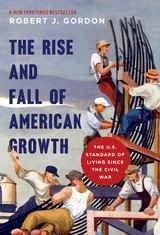
Robert J. Gordon · 2016 · Buy on Amazon
"My last book follows on directly from Brad’s (though it was published earlier) and is another way of telling the same story, but it’s more technical. It’s built around specific revolutionary developments. What were the great technological transformations that led to this extraordinary explosion? Bob Gordon, who is also an American economist—he’s at Northwestern University—has done this wonderful history, which talks about the range of technological transformations of the late 19th and early 20th centuries. Electricity was one of the most important. There was the internal combustion engine, which gave us motorcars and civil aviation (which we now think are pretty horrifying). There was universal sanitation and I think people should understand how transformative that was. Clean running water is, I think, perhaps the most important innovation in the history of urbanized humanity. There was the chemical industry, which among other things meant we could properly package food. Along with refrigerators and electricity, that meant we wouldn’t need to eat contaminated food again. We tend to forget that our great-grandparents routinely got fantastically ill and died from unpasteurized milk—pasteurization being another great invention of this period, by the way. Then Robert explains how this led to urbanization, and so forth. A big part of his story is that these are one-off transformations. For example, we’ve got much closer to the longest it seems easy for us to live. Life expectancy rises have slowed, in fact, in many countries like the UK and America, they’ve stopped. There are many reasons for that, and it’s partly that we haven’t done as well as we could. But one of the reasons is that we’re getting much closer to the limit. Now people are thinking about whether we can re-engineer the human genome to live for 200 or 300 years. That’s a much bigger project. But rising life expectancy may be getting to as far as we can get. Similarly, maybe most of the machinery that can really help us we’ve got already. Some of it turns out to have difficulties—like the car—so we’ve got to change that. So maybe we’re moving to a world which is post-growth. That fits in with Brad’s argument and it’s also a bit in my book, though people disagree. I’m a bit more optimistic, but I may be wrong. But if we’re in a post-growth world—or at least a completely different world where all the growth is in IT and AI —a lot of things we’ve taken for granted about how the economy interacts with politics and society may no longer be relevant. Support Five Books Five Books interviews are expensive to produce. If you're enjoying this interview, please support us by donating a small amount . My view, and the crucial point in my book, is that modern democracy and modern society came out of the Industrial Revolution and this transformation of our economies that Brad and Bob are writing about, what’s sometimes called the ‘Second Industrial Revolution’. That’s what created these new social forces and ways of living that led to the demand for an open and democratic society as against the hierarchical, aristocratic, rentier societies of the 16th, 17th, and 18th centuries and before. These books are profound explorations of the great transformation of the last 150 to 200 years, and put forward pretty credible pessimism about whether it will continue. I think that for many people who are thinking about the future, it’s really important to confront those questions. Some people welcome it or say, ‘This is the way to lead a more natural, healthy, ecologically appropriate life.’ But you have to ask yourself—I do in my book—if we try to make that shift away from industrial society, what might we lose in the process? How many of the gains we achieved in political and social life will be reversed? I would argue, for example, that the most important change of my lifetime, the transformation of the role of women in society, is related to those changes. In America, we’re beginning to see a backlash. It’s very disturbing and may be related to what’s happening in the economy. So these are big subjects, which people should read about. None of these books I’m recommending require technical economics. There’s no math. They’re stories. But they’re important stories, and they’re stories that I am interested in. They’re open-ended. We don’t know what the answers are, but I think people will find these books interesting."