Mark O'Connell's Reading List
Mark O'Connell is a writer based in Dublin. His book, To Be a Machine: Encounters With a Post-Human Future won the Wellcome Book Prize in 2018
Open in WellRead Daily app →Transhumanism (2016)
Scraped from fivebooks.com (2016-08-20).
Source: fivebooks.com

Mary Shelley · Buy on Amazon
"I read Frankenstein years ago in college. You know when you have the vague sense that you need to go back to a book because you know there’s something in it that can give you something? I don’t think it comes into my book all that much — in fact, I don’t think I even mention it — but I did read it a couple of times whilst writing the book. I was surprised to see when I went back to it that Frankenstein’s explicit aim in making the creature is to tackle mortality. The book is subtitled ‘The Modern Prometheus’ and it’s about the Promethean urge and the way that it can lead to really quite insane avenues. Does it speak directly to transhumanism? I think so. I thought about it a lot when I was writing the book, particularly the chapter about the DARPA Robotics Challenge. I was trying to find ways to get to grips with the uncanniness of those creations. I tried to reach out to Boston Dynamics a number of times when I was writing the book, and fairly recently since, but they don’t seem to do a lot of press as far as I can see. I’m convinced that their whole thing is like a viral marketing campaign for some future horror movie based on humanoid robots. There’s no other reason why they would be constantly releasing these terrifying videos . So I was trying to think of ways that I could think through the terror of these robots. What is this feeling that you get when you look at these uncanny human-like but very inhuman creations? Frankenstein was something that helped me think that through. There’s an amazing passage [at the beginning of chapter four] where Shelley talks about Frankenstein’s horror at the creature. He’s looking at his lips and his hair, and there’s a deadness to him, but there’s this weird, uncanny paradoxical combination of living death. Frankenstein talks about how it’s the nearness to life that’s so terrifying about it. It’s just slightly off. So, she defined what the uncanny valley is in this really interesting way, well before it was even a concept. I think there’s something about the monstrosity of the monster that speaks to transhumanism, in a way."

George M. Young · Buy on Amazon
"I didn’t write directly about the cosmists in the book, but I spent a lot of time reading about them and getting really fascinated with the whole pre-history of transhumanism that is Russian cosmism. But I’m not sure that there is any direct intellectual through-line between those guys and transhumanism. Obviously, there are certain transhumanists who are well-aware of what those guys were doing and are interested in it. I’m sure Anders Sandberg, for instance, is probably well-up on all of that stuff. So, I don’t know that there is any direct lineage at all. That was what interested me about it: so many of these ideas were existing at the time when the technology and the culture were completely different. But their ideas were every bit as crazy as — actually, probably much much crazier than — today’s transhumanists. There was no sense that the technology was even theoretically in the ballpark of being able to do what they wanted to do back then. Yes. One of the ideas that was really intriguing to me was this notion that Konstantin Tsiolkovsky put forward. He had this notion that it was the duty of Mother Russia and the Russian people to resurrect every person who had ever died. He didn’t really talk globally, actually. He was only interested in making Russians immortal, which I find entertaining. The idea was that this generation of Russians digs up the previous generation. He doesn’t go into the specifics scientifically, but it’s your responsibility to bring your father and mother back to life. And then, once they’re reconstituted, they dig up the previous generation. So, eventually, you have the situation where everyone who has ever lived, going back to Adam and Eve as he puts it, is resurrected and brought back to life. It’s completely crazy and it totally reminds me of Flann O’Brien’s novels. But it was taken quite seriously at the time. There were serious Russian intellectuals and artists who were persuaded by this, if not the details then at least by the spirit of the enterprise. These included, most notably, Tolstoy. He wasn’t a signed-up cosmist but he was really drawn to it. So, I think, was Dostoevsky, though to a slightly lesser extent. “There was no sense that the technology was even theoretically in the ballpark of being able to do what the Russian cosmists wanted to do back then” With contemporary transhumanism, there does seem to be a fair amount of Russians who are on board with it as well. I never really got under the skin of it too much but it seemed to me something to do with Russia’s sense of itself and America’s sense of itself. Both of these countries as cultures are really tied in with the notion of technological progress. Obviously, you immediately think of the Cold War, but cosmism predates this by a couple of generations. I just thought it was really interesting that there was a previous transhumanism. With the process of writing and abandoning things from books and cutting out entire sections, at this point I’m not entirely sure why I cut out the whole thing about cosmism. I spent a really long time looking into it, writing about it, and got really fascinated by it. I think it just broke up the flow of the book to a degree. John Gray had already done it really well. That was probably part of it."

Flann O’Brien · Buy on Amazon
"I thought about this book all the time while I was writing To Be a Machine . This may be just the result that I think about Flann O’Brien an awful lot anyway. My master’s thesis was comparative study of Flann O’Brien and Jorge Luis Borges. These are two writers who I think have an incredible amount in common. Borges was a huge fan of O’Brien. So, I have been obsessed for a long time with O’Brien generally and The Third Policeman in particular. What links it with transhumanism in my mind is that a big part of the experience of writing that book for me was meeting people who were incredibly smart and extremely logical. I would be sitting and listening to these really smart people explaining their ideas to me in what seemed to be really rigorous logical lockstep movements. At a certain point, I would step back and my mind would be blown. I would think this seems to be pure logic all the way, but where it’s leading is to a place of absolute absurdity. There’s a scene in The Third Policemen where one of the policemen takes the narrator into a back room and shows him all the projects he’s been working on, like the infinite series of boxes that keep getting smaller and smaller. And there’s the spear with the tip that’s so small that you can’t see it, where the point is like a foot beyond the point of visibility. The writer is having his mind blown by this. I talked to my editor about this, about how there’s something culturally Irish, but not uniquely Irish, of using logic against itself — of exposing the absurdity that’s inherent in logic, if you know what I mean —that he does incredibly well. Swift did it amazingly as well, as did Beckett, but I think Flann O’Brien really takes it to the limit with that book. O’Brien was intrigued by Relativity and related ideas in physics that were current at the time when he was writing. I think he was interested in them not primarily for science reasons but because he saw in them the potential for comic absurdity. At the risk of sounding pretentious, that’s kind of where my interest in transhumanism comes from. I’m interested in the science, obviously, but that’s not my primary concern. It’s the potential for absurdity and the potential for exposing the weird absurdity that’s inherent in an extreme rationalist view of the world. I think that’s true. When I was writing the book, part of my suspicion about transhumanism was that maybe all of this is just the result of men who are spending way too much time with technology. With these people who spend too much time around computers, being in the matrix of computers, and thinking in the language of programming and so on, the boundary between the machine and the person — the self — begins to blur. In exactly the same way, in The Third Policeman you have men riding bicycles, and the molecules start to get confused and you get these half-men half-bicycles. And also, The Third Policeman is this overwhelmingly, stultifyingly male environment. It’s marked by the complete absence of women. Yes, it’s overwhelmingly a male environment. That’s a really interesting question. I’ve thought about it a lot and I’m not entirely sure whether the maleness of transhumanism is just in keeping with the general maleness of the tech-world or of Silicon Valley, or something else. I suspect that there is something about the delusion of transcending the body — of becoming a pure rational being — that is an specifically, or at least overwhelmingly, male delusion. Yes. I’m wary of essentialising but, for whatever reason, women seem to be much less susceptible to this idea. I met a few. At a certain point I realised, ‘hey, I’m just writing about men. This is a sausage-fest of a book and I needed to address that somewhat.’ So, I met with Natasha Vita-More and I write about it in the book. She’s a fairly prominent figure in transhumanism. She’s the president of the Transhumanist Association and she’s got really interesting ideas about the future of the body and so on. I also met Laura Deming, who probably wouldn’t describe herself as a transhumanist or would not want to be described as such. She’s the shockingly young woman who runs the life extension venture capital fund, which is funded by Peter Thiel. There were also women I met for the book who I didn’t end up writing about, just because they weren’t quite as strong characters as some of the others. In general, it’s an extremely male movement in a way that is probably, to be fair, more extreme than the tech world in general. If you go to any of the meeting and you look around you think, Jesus, where are the women at?"
Ray Kurzweil · 2005 · Buy on Amazon
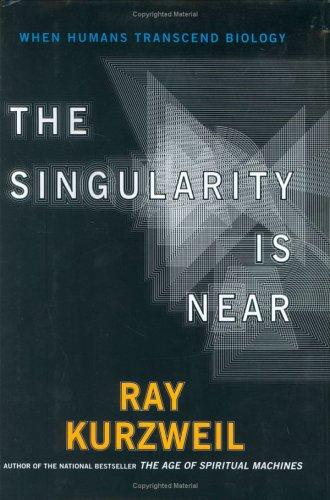
"I never got to speak to Kurzweil for the book — I reached out to him and it didn’t happen — but he’s maybe the most prominent proponent of these ideas. I guess he’s the high priest of this notion of the singularity which is kind of the logical endpoint that most transhumanists point towards when they talk about their aspirations for the future. Part of the reason why Kurzweil is so prominent is because he actually puts a date on it. He says that this is going to happen in the year 2045. And he has a relatively impressive record of predicting technological change in the past. He’s really staked everything on this notion that 2045 comes along and it’s going to be this point— often dismissively referred to as ‘the Rapture of the nerds’ — when we’re all subsumed into this giant all-consuming general superintelligence, where human existence as we know it ceases to be and, in turn, we reach this heavenly situation. I wouldn’t be the first to look at him this way but I read Kurzweil’s work as essentially a work of religious mysticism. I think there’s no other way to read it, really."

Don DeLillo · Buy on Amazon
"I’ve long been a huge DeLillo fan and his work, generally, was something I was thinking about a lot when I was writing the book . I used some lines from White Noise as an epigraph to my book: This is the whole point of technology. It creates an appetite for immortality on the one hand. It threatens extinction on the other. Technology is lust removed from nature. So much of his work is about the confluence of anxieties about death and technology. He combines those things in a really interesting way. It’s definitely in White Noise; Underworld is full of it as well, but Zero K — which I actually only read this book after I finished To Be a Machine — just becomes very explicit and tackles it head-on. It’s a book about cryonics and it’s set in this DeLillo-ised version of Alcor , the cryonics facility that I visited for the book. I talked to him, actually, when the book came out. I asked him about how aware he was of transhumanism and the Singularity and all these ideas. He told me that he didn’t do all that much research. He read a little bit about this stuff and then took it in his own direction. So, it wasn’t like he was doing a fictionalised version of somewhere like Alcor. He was just taking the notion of cryonics and running with it in his own way. I thought it was really interesting that a writer at such a late stage of his career — DeLillo is in his eighties now — has such a prescient and deep understanding of technology right now and of how it’s moving through society and through people. He shows that really brilliantly in Zero K . After I finished To Be a Machine I spent a whole year desperately casting about for a topic for a new book and nothing really took for me. I eventually figured out that the thing I was most interested in was the idea of the apocalypse, and the apocalypse as a way of thinking about the particular moment of anxiety and uncertainty and confusion and breakdown that we’re going through. Now, it seems like a really obvious move to have made. It seems like, in a way, I was already writing about the apocalypse with the transhumanism book and that this is just a continuation of that project. With this book, it’s less about the tech stuff, although I am writing about Peter Thiel again. I seem to be unable to move away from Thiel as a character! It’s a little bit more diffuse than the transhumanism stuff. I’m not writing about any particular movement or whatever. It’s a lot more personal, in terms of writing about my own life and my own anxieties that have, in the past, tended towards an apocalyptic despair. I visited the Chernobyl exclusion zone for the book and spent a bit of time there. I hate using the term ‘psychogeography’, but there was a little element of that to it. I write about places a lot in this book. I went to Transylvania with an amazing group of artists and environmentalists and spent a week on a mountain, just thinking about these apocalyptic ideas around climate change and so on. I also visited a former dairy farm in South Dakota that’s been bought by a sort of apocalyptic entrepreneur who converts old missile silos and military bunkers into luxury apocalypse solutions. There’s a few different strands to it that I’m currently trying to wrestle together. That’s the idea anyway."