Mark Harris's Reading List
Mark Harris is the author of Pictures at a Revolution: Five Movies and the Birth of the New Hollywood , which was a New York Times notable book of the year , and Five Came Back: A Story of Hollywood and the Second World War. He is currently a writer for New York , where he often covers the intersection of culture and politics.
Open in WellRead Daily app →American Film (2021)
Scraped from fivebooks.com (2021-04-25).
Source: fivebooks.com

Neal Gabler · Buy on Amazon
"An Empire of Their Own is a great starting place for anyone who wants to understand Hollywood because it grounds you in an understanding of the fact that film was an upstart art form and an immigrant art form, largely created by Jews who were trying to find a place in American society when the doors of a lot of other businesses were closed to them. You really get a great sense of the fact that movie studios like Universal, Paramount and Warner Brothers, which we might now think of as multinational faceless corporations, began as scrappy businesses. Gabler really captures the excitement and cultural particularities of American cinema’s birth. Yes, but another thing Gabler gets at is that the studios weren’t the same, so they didn’t reflect the same aspect of America. Warner Brothers movies were largely urban and scrappy and the studio chose heroes who were upstarts and rebels. A different kind of American experience is reflected in the movies of MGM, a world of luxury and good manners presented a view of what American success looked like. Because movies are so influential, those visions shaped views of America. When people talk about ‘Hollyweird’ or ‘coastal elites’ those are, to some degree, code words for Jews, who have always been accused of having a disproportionate influence in the media and of using that influence in a concerted way to advance an agenda that is presumably self-serving. That nativist idea formed in the 1910s and 20s, when these companies were just starting, and it persists to this day. The specifics are different, but the conviction that movies are made with nefarious intent has not changed over the century. There’s a growing understanding that progress can’t just be measured by how many African Americans are in a position to get good parts in movies, for instance. It has to be measured, for example, by how many African Americans are at the industry’s executive level, empowered to greenlight projects and give people good parts in movies. I’m sympathetic to the argument that nothing will change meaningfully and permanently in movies until the power structure that shapes and makes those movies changes. That’s happening slowly. But I think the understanding that it needs to happen is more broadly accepted now than it was even 10 years ago."

Thomas Schatz · Buy on Amazon
"The Genius of the System is a great follow-up to Empire of their Own and contradicts conventional wisdom about Hollywood. The conventional wisdom was that the studio system churned out cookie-cutter cinema and that filmmakers needed to overcome the pressures of the studio system so that works of individual vision and artistry could be made. This is largely what I wrote about in Pictures at a Revolution . The Genius of the System is not a reactionary book. Thomas Schatz isn’t making the case that revolution didn’t need to happen. But, he is exploring how the system made artistry and even individuality possible during the ‘Golden Age of Hollywood.’ “Making a movie is a matter of extreme pressure almost every day” The Genius of the System explodes the notion that studio films were bland or monolithic. He explores the individual styles of each studio. A Warner Brothers movie and a Universal movie and an MGM movie were all distinct. Schatz shows how the house style at each studio evolved over from the 1920s into the 1950s, and adjusted to a changing world. It’s a great book for anybody interested in studio filmmaking at its strongest from 1928, which was the beginning of sound, to 1960. For all the oppressive elements of the studio system, Schatz shows that structure unquestionably allowed for real artistry and the production of fantastic foundationally important work. But, by the early 1960s, that system was outliving its usefulness. His story ends when the rise of interest in non-American cinema begins. Starting in the late 1950s or early 1960s, movies from other countries started to get more distribution. The French New Wave, with directors like Jean-Luc Goddard, the rise of realism and all the films that came out of Italy , like those from Federico Fellini, and the work of Sweden’s Ingmar Bergman, all these exciting currents started to make American cinema exhausted. It’s about how the studio system was on its last legs and gave way to something new in the late 1960s."

Lillian Ross · Buy on Amazon
"Picture is great. I’m a huge fan. This a book about the making of one movie, which can tell you a tremendous amount about how movies are made and what goes wrong when a movie goes wrong. The movie is one not many people talk about anymore, Red Badge of Courage , directed by John Houston. Ross shows that movies are the result of a combination of idiosyncratic personalities and chance decisions. It was the first book ever about the making of a single movie. Many books since have tried to shed light on the industry by looking at the making of a particular movie but fail to give readers a good sense of the larger picture. Picture succeeds in showing you everything you would ever want to know about Red Badge of Courage and you also learn so much about the world in which the movie was made. The idea of films as brands is recent. The incredible expense involved in marketing movies has given marketers greater say in the movies that studios make and has led to people who know how to sell things, rather than people who know how to make things, becoming the people who run studios. That is a relatively recent phenomenon that you can trace back to the mid 1980s. Studios live and die based on their franchises. Movie delivery dates and release dates are planned years in advance. Before movies are cast or written, or even conceived, there will be a slot on a release schedule saying, ‘August 7th, 2024 untitled event film from Universal.’ Support Five Books Five Books interviews are expensive to produce. If you're enjoying this interview, please support us by donating a small amount . Now it’s almost impossible to get a mid-budget movie that isn’t based on a piece of existing intellectual property made at a studio. With rare exceptions, legacy studios are out of that business now. They don’t have, in their executive ranks, people who are trained to find intellectual property, shape them into movies and develop scripts. Happily, people still want to watch those movies, so they are made by places like Netflix, Apple and Hulu. Having an eye for material that would make a great commercial movie, which wasn’t based on a franchise, used to be key to advancing at studios. Now, if you want to run a studio, you develop expertise in selling a franchise."

Vito Russo · Buy on Amazon
"I tried to think of these five recommendations as a unit. Having recommended books about the invention of the studio, the rise of the studios, the value of the studios and the way filmmakers work, I wanted to recommend one book at least about the dark side of the system. The Celluloid Closet is a history written by Vito Russo several decades ago about how gay people were depicted, demonized, villainized and caricaturized in films from the 1910s to the 1970s. It’s important for anyone who’s interested in movies to know that the effect of a cultural system as powerful as Hollywood moviemaking can also be pernicious, that it can dehumanize people and reinforce the ugliest cultural perceptions of particular groups of people. It took a really, really long time for gay people to be treated as human beings in American movies. The Celluloid Closet is a fascinating and valuable exploration of that. Of course, this is a subject that is very much on the front burner. African-Americans, Asians and Pacific Islanders, Indigenous peoples, Latino people, trans people and gay people are focused on how they are portrayed in film. The Celluloid Close is great reading for anyone who wants to understand that movies can be a powerful ally or a powerful obstacle. There are a lot of arguments, including within the gay community, over the idea that all gay parts should be played by gay actors. There are places where all minorities are in the same boat and there are places where they’re not. Sexuality isn’t like race, in some respects. And it’s important to remember that these distinctions really do matter. There are, for one thing, serious legal and ethical issues involved in demanding to know someone’s sexuality before you cast them. My personal preference would be to see a world in which gay actors are castable in any role, rather than a world in which we have to decide that gay people are the only people who are qualified to play gay parts. Art isn’t autobiography. But I don’t think that that issue should overshadow the importance of representation . As I said, there are logistical and even ethical complications in casting mandates for gay parts. There’s no ethical issue in saying African American roles should be played by African American actors and, at the same time, that African American actors should be castable in any role. You asked how things have changed. The only way I can answer it is to say that it’s not so much that they have changed as that they are changing. For one thing, if we take gay people specifically, there are way more out gay actors than there used to be. A larger question is how many gay parts there are and how great is the variety of gay parts and lesbian parts and parts for trans people. And how many gay stories there are and how many specifically trans movies are made. This is a fight for progress on several different fronts at once. The fewer opportunities there are overall the more unfairly packed every decision about one of those parts is. It’s unfair for a gay actor or a Black actor to have to go into a part feeling that they are carrying the representational burden for a group of people that goes far beyond that part. That is a challenge that straight people and white people don’t have to carry around their neck. The first thing that has to get solved is there must be more opportunities, more roles, so that the playing field can at least be level, in terms of an actor feeling that their job is to do the job that they were hired to do, not the job that they were hired to do, plus the fulfillment of an obligation to a community that is only an obligation because there are so few jobs."
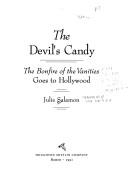
Julie Salamon · Buy on Amazon
"I love it. It’s so much fun. Picture is from the 1950s. Devil’s Candy is from a very different period, the early nineties. It’s from an era of Hollywood where the decision-making process might be a little more recognizable to contemporary readers. I always felt that the story of the making of a disaster can illuminate as least as much about the world of movie making as the story of a success. There are several making-of-a-disaster books; Devil’s Candy is probably the best. It’s incredibly entertaining. It also gets into the complexities of taking a hot literary property of a novel, which Tom Wolfe ‘s book Bonfire of the Vanities certainly was, and adapting it for film. Get the weekly Five Books newsletter Bonfire of the Vanites had challenging things about race and urban politics that have not aged well and that were easily mishandled in a movie. Julie Salamon looks at what happens when people are not thoughtful about those issues. Better than any book I’ve ever read, Devil’s Candy conveys that making a movie is a matter of extreme pressure almost every day. At every stage of the making of the movie, there’s always a combination of high spirits, chaos, and impending emergency. These are strange circumstance under which to create art. Since reading Devil’s Candy, I’ve watched movies a little differently, knowing that any 30 seconds of film that I see probably represents the result of a hundred different decisions and accidents and coincidences and compromises and arguments that I’ll never know about. The key word in your question is Hollywood. What do we mean when we say Hollywood? It’s a noun we all use, but what do we mean by it? Do we mean the studios? Do we mean the heads of studios like Disney or do we mean directors like Ava DuVernay or producers like Shonda Rhimes? The answer to your question changes based on how we’re defining Hollywood and how Hollywood defines itself at any given moment in its history. The more the definition of Hollywood changes, the more that sense of responsibility will grow."