Mark Chutter's Reading List
Mark Damon Chutter is the Chairman and Academic Director of the Thomas Hardy Society . Mark is also a teacher of performing arts, who has twice been shortlisted for the title of the The Times Educational Supplement' s 'Teacher of the Year' and 'Most Innovative Teacher.' Mark is a member of the Dorchester Civic Society, the Dorchester Town Council Heritage Committee, and Visible Women UK.
Open in WellRead Daily app →The Best Thomas Hardy Books (2025)
Scraped from fivebooks.com (2025-08-19).
Source: fivebooks.com

Thomas Hardy · Buy on Amazon
"The Mayor of Casterbridge is an underrated work. I think it’s where you should start, when you start reading Hardy. It’s a good read, and it introduces his idea that character is fate. It’s about Michael Henchard, a man who sadly sells his wife and daughter at the beginning of the novel, while intoxicated by alcohol. And he pays for what he has done for the rest of the novel. His ex-wife, Susan, returns, with a child she calls ‘Elizabeth Jane,’ his daughter. I don’t want to spoil it for everybody, so I won’t share all the details, but we see the rise and fall of a man, of a character. After the sale, he is full of regret, makes a vow not to drink for 21 years, and becomes the Mayor of Casterbridge. But ultimately he will end up a very lonely man at the end of the novel. It’s a tragedy that plays on coincidence, on fate, on tragedy, on character, and it will really introduce the reader to Hardy. There are elements of melodrama, elements of the Gothic . But I would call them elements. He’s a very different writer to Charles Dickens , for example, who really uses caricature, even satire at times. Hardy isn’t like that. He has a rustic chorus of characters who are endearing, but also representative of the period in which he was writing. Hardy was concerned with institutions like the workhouse, but not to the extent of Dickens. So the writing is very different in that sense. So, yes, Hardy does use melodrama: melodrama through coincidence and fate."
Thomas Hardy · Buy on Amazon
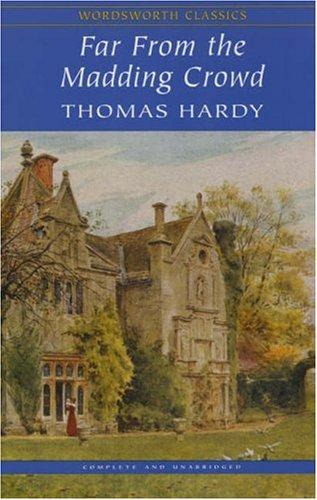
"That’s right, yes. Far From the Madding Crowd has all the key ingredients of a Hardy novel. We have Bathsheba Everdene, this strong-willed woman at the heart. She’s almost feminist in many respects. She says: “I hate to be thought of as men’s property,” which I think is very daring for the time. There is a paradox in Hardy. People always say to me: with Bathsheba Everdene, he created such a strong-willed woman, so why was he so awful to his wives? He had two wives, Emma Lavinia Gifford and Florence Dugdale. It could be suggested that Hardy behaved with misogynistic tendencies towards Emma. Writers’ private lives can be very different to their fiction, you know. I think it’s a dangerous game to read life in terms of the writing and vice versa. Sometimes you can extrapolate some interesting nuances, but it can be reductive. Yes, the book is very cinematic, isn’t it? It’s lent itself beautifully to different versions. There’s the 1960s version with Julie Christie and Terence Stamp, which is a great one. And then we have the 2015 Carey Mulligan version. They are two very different films. Far from the Madding Crowd shows us all the different forms of love. With Gabriel Oak, we have that sense of solidity, of constant love. Then we have Boldwood, who has an obsessive love for Bathsheba. Then, of course, we have the dashing Sergeant Troy, a military man who wants Bathsheba for her money, but who is redeemed through his love for Fanny Robin. So there’s a whole love triangle going on, isn’t there? And through all these different men, Hardy is showing us the challenges and caveats of relationships—how people can be drawn into relationships without knowing what the other person is like behind closed doors. I think you’re right. They are thinking: What do I get out of these relationships? Sadly, for some of the characters, it’s very little. But I suppose, from any relationship, you learn something, don’t you? Even if it is only how not to love, or how not to form a relationship. And in Far from the Madding Crowd , the characters navigate the different forms of love."

Thomas Hardy · 1878 · Buy on Amazon
"This is a great one. It’s set on Egdon Heath, which almost has a character of its own in the novel. And it concerns Eustacia Vye, a young woman who has come to live on the heath with her family. The heath becomes very suffocating for Eustacia. She meets Clym Yeobright, an educated man who has returned from Paris. This is the ‘return of the native.’ But, things are not good. Mrs Yeobright, Clym Yeobright’s mother, doesn’t agree with their relationship. And of course: tragedy ensues. Eustacia is very much an example of the ‘New Woman,’ that Hardy’s society could not accept, both socially and psychologically. Thus, Eustacia has to drown. That drowned woman motif represents both punishment and cleansing; she represents this new type of female sexuality and independent identity. And it also shows how somewhere like Egdon Heath can suffocate someone like Eustacia. She dreams of going to Paris, to the Louvre, of being out in the world. And of course, sadly, she has to perish. The Return of the Native is a great read, if you want to learn more about the landscape. It’s very artistic in its descriptions. I would totally agree. Hardy was right of his time. And he was looking, very much, at class, at the rich versus the poor. If you take Under the Greenwood Tree , for instance, one of his first novels, which is set in ‘Mellstock’—Stinsford in Dorset—it’s all about the gallery musicians, the choir in the local church, things like that. He looks at music, customs, rituals, routines they had in relation to the church. I think what I’m trying to say is that, with Hardy, the context is so important. He was really, really worried about the coming of mechanisation in agriculture. Because Dorset was completely agricultural. His work is all to do with the land, working the land, and not with factories or anything like that. I think he was a great advocate for the poor. I don’t think his rustic characters were intended to in any way mock the poor. I think he was giving a voice to the way that rural Dorset was, what life was like there, and the position of women within a very male-dominated, patriarchal culture. His women—fictional women—are strong, there’s no doubt about it. Tess is educated to sixth form level. Bathsheba hates to be thought of as men’s property. Eustacia remains defiant against a society that cannot accept her sexuality."

Thomas Hardy · Buy on Amazon
"I think that Tess is a book that everybody should read. For me, the novel is very much looking not just at Tess’s plight, the way she is treated by men—which is abominable—but also the hypocrisy of religion. Tess has a child called Sorrow, the result of a rape, and the vicar will not bury Sorrow on consecrated ground. And it’s all very complicated in terms of human relationships. Tess tries to confide in Angel on their wedding night, to tell him about Sorrow. But she can’t, can she? I mean, she does, but she shouldn’t have done because he cannot cope with it and calls off the marriage. Really, you know, Angel is so wet, isn’t he? He doesn’t stand up for her, she has nobody. Because Tess’s mother says: You’ve told him, you’re a fool! What a thing to say to your daughter. There’s a lot of tragedy in this narrative. But one thing I want to say about this novel, and indeed all the novels, is that they are staged. There’s a performativity to them. In Tess , we have the famous Stonehenge scene at the end. I think Hardy places these characters in this ancient circle, this henge of the past, to get across the idea that all people have a past. See what I mean? The staging is mirroring not only the setting, but the story of these characters. The same in The Mayor of Casterbridge . We have the Maumbury Rings, another ancient henge, also a Roman amphitheatre. It’s a place of spectacle, and a place of secrecy. There’s a wonderful irony there. But as for Tess, it’s a great read about a woman’s journey, from her teenage years upwards. I think that’s why it’s so readable—it’s a coming-of-age story, really, about the relationships she has and, sadly, a tragic demise. I do think that. And of course, there’s the quotation at the end: Justice was done, and the President of the immortals had ended his sport with Tess."

Thomas Hardy · Buy on Amazon
"The Woodlanders is an important one, and the characters are so key. We have Grace Melbury, whose father adores her and wants to secure her a good marriage. Grace gets together with a doctor. I won’t ruin it for all your wonderful readers, but she is left lonely and isolated. And there is Giles, who she grew up with and who she really loves. But Giles is a very rustic character; he’s not as educated as her. Of course, she should have chosen Giles because they are so well suited. There’s an education and class barrier there, which appears in Hardy’s writing always. That comes across very much in Jude the Obscure , which is about Hardy wanting to get to ‘Christminster’—Oxford—which of course he never did. Hardy, more or less, taught himself everything. We saw this with Bathsheba and Gabriel Oak. She wouldn’t look twice at him, because he was a rustic character. She thought he wasn’t good enough for her, to begin with. And the same with Grace and Giles in The Woodlanders . Here, the context is the coming of the divorce laws, and Grace must navigate that process with the support of her father. But what’s loveliest about The Woodlanders is, again, the description of the landscape, the woods, the heath. So it’s a great read, and I think still very relevant today. Because his writing is all about human relationships, the human condition. And that’s what draws people to Hardy. Also the characterisation, all those interrelationships and connections that we see in Hardy’s narratives."