Lucy Newlyn's Reading List
Lucy Newlyn is Professor of English Language and Literature at St Edmund Hall, University of Oxford. She has written several books on the Romantic era. Her new book, William and Dorothy Wordsworth: ‘All in each other’ , was chosen as one of the Times Literary Supplement ’s books of the year.
Open in WellRead Daily app →William and Dorothy Wordsworth (2013)
Scraped from fivebooks.com (2013-12-17).
Source: fivebooks.com

Stephen Gill (editor) · Buy on Amazon
"Stephen Gill’s edition gives us William Wordsworth’s career from the beginning right the way through, and it’s a long career – he started writing very young. Gill gives it to us collection by collection, so we see Wordsworth emerging at publication moments. The poems are selected with considerable care, and the book gives a very even account of Wordsworth’s whole life as a writer – prose as well as poetry – both in his publications and his unpublished, more private moments. This edition highlights the sense in which William Wordsworth attempted to tilt poetic tastes in a new direction. He famously talked about having to ‘create the taste by which he was to be enjoyed’. Each publication moment shows him engaged with current tastes and trying to reform them. In the Lyrical Ballads of 1798 and 1800, he tried to get rid of artifical poetic diction by using plain language. And in his Poems in Two Volumes (1807) he brought poetry into the household, using a domestic register to explore intimate moments, family relationships, and the wonder of everyday sights and sounds in a cottage garden. Some reviewers hated this book. They regarded it as ‘namby pamby’ and feminine – the domestication of great poetic themes was condemned as infra dig. That’s right. The reviewers of 1807 were repulsed by the idea that poetry written by a man could be this domestic. Wordsworth succeeded in straddling both public and private worlds; and in his poetry – particularly his long autobiographical poem The Prelude — he succeeded in bringing grand epic themes down to earth. His reclusive life in the Lake District was not by any means an abnegation of his public responsibilities, but it does show that he put his family life first. He was never happier that when he was at home in Cumberland. In his late years, when he was Poet Laureate, he hated the world of London literati, and being lionised. He wanted to go back to his family."
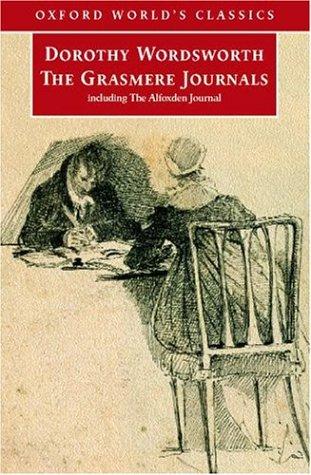
Pamela Woof (editor) · Buy on Amazon
"The Grasmere Journal, written by Dorothy between 1800 and 1803, covers the most formative and important years in the Lake District, after William and Dorothy settled in a small house (now known as Dove Cottage) by the side of Grasmere lake. They were cohabiting, companionably and very happily, in the period leading up to William’s marriage to Mary Hutchinson. The journal records many details of their domestic life together – the walks they took, the natural sights and sounds they noticed – as well as Dorothy’s involvement in William’s poetry. Her writing feeds into his, and his writing feeds into hers. The journal celebrates the creative process that they’re sharing. If you want to look at the Grasmere Journal as a narrative, it offers the story of Dorothy’s adjustment to the fact that William is about to get married. But the journal is about the social life around them too. It charts their meetings with beggars, with discharged soldiers, with a leech gatherer – the many homeless people who during the Napoleonic war were trekking the roads in England, passing Dove Cottage and occasionally stopping to pick up a bit of bread or money. So we see Dorothy the social critic as well, observing the appalling effects of war and the economic devastation it entails. They are very interesting sentences, and of course they have provoked a great deal of speculation. The journal entry in which they appear records a highly significant moment, just hours before William’s marriage to Mary. Looking back on the events of that morning, and writing several weeks after they occurred, Dorothy recalls: “William had parted from me upstairs. I gave him the wedding ring – with how deep a blessing! I took it from my forefinger where I had worn it the whole of the night before – he slipped it again onto my finger and blessed me fervently.” The sentences have been crossed out – probably by William or Dorothy. We don’t know the reason, but we can speculate. The journal was readily accessible to Mary, especially after she moved in to Dove Cottage in 1802. Maybe one or other of the siblings felt that Dorothy’s highly emotional recollection might give Mary pain, by implying that Dorothy had prior and higher claims on William’s affections? (It’s not a subsequent editor who thinks “incest!” and scrubs it out. The ink wouldn’t go with that, it’s contemporary.) Personally, I think the astonishing ritual with the ring was William’s way of reassuring Dorothy that she would go on being the centre of the household – that she would never be ‘replaced’. (It was much more normal in those days for a sister to have a central role in the marital household.) But of course there’s all sorts of things you could read into this extraordinary moment. If you wanted, it could be grist for the mill in the incest interpretation. The Alfoxden Journal was written in 1798, while Dorothy and William were living at Alfoxden in Somerset, a few miles away from Coleridge. Unfortunately, the manuscript hasn’t survived. All we have is a heavily edited transcript, which is not at all like the Grasmere Journal because the person who made it – a scholar called William Knight – took out all of what you or I would think is interesting, all the domestic details which would give us an insight into how the Wordsworths were living their daily lives. Instead, Knight’s transcript gives us the descriptive passages relating to William. The loss of the original is mysterious and tragic — but by putting what survives of the Alfoxden Journal alongside the Grasmere Journal, we can see some of the ways in which Dorothy’s writing developed between 1798 and 1800."

John Worthen · Buy on Amazon
"The friendship between William Wordsworth and Samuel Taylor Coleridge was at its most intense during their year in Somerset, from 1797 to 1798. But John Worthen chooses to concentrate on 1802. During that year the friendship was under considerable strain, because Coleridge was having terrible problems with his marriage and was in love with Sara Hutchinson, Mary’s sister. Worthen’s book concentrates on the interactions of a scattered but closely-knit community — Coleridge, Sara and Mary Hutchinson, and William and Dorothy Wordsworth — following the story of the group up until Mary’s marriage with William, and ending in mid-flow. He tracks the relationships between these people, geographically, psychologically and creatively, by following the letters and poems they wrote to and for each other. If you choose a single year in a group’s life, and look at it really up close, you get something compelling, especially when members of the group are collaborating and in dialogue, as they were in this case. Because it’s such a microscopically detailed analysis, one gets a very full picture. For instance, Worthen takes the great ‘Dejection Ode’ of Coleridge, and Wordsworth’s ‘Immortality Ode’, looking at the poems as they were forming, investigating the manuscripts stage by stage. But that’s just one example among many. His book is a magisterial study of one year in the closely knit lives of this group. I have learned a great deal from his approach to group dynamics and creative process."

Lewis Hyde · Buy on Amazon
"The Gift is not a book about Wordsworth. The subtitle of the UK edition is “How the Creative Spirit Transforms the World”. Lewis Hyde looks at creativity not as the route to celebrity, but rather in terms of a “gift economy”. He plays off the great Marcel Mauss’s 1923 anthropological essay The Gift , building on Mauss’s idea that there’s no such thing as a free gift – when you give something, you expect something in return. If you apply this notion to creativity, thinking of creative artefacts as gifts that elicit further gifts, then you begin to understand creativity in terms of community – as an economy that is spiritual, communal, energising and potentially transformative, rather than simply egotistical, for fame and money. What this book gave me as I approached the symbiotic relationship of William and Dorothy Wordsworth was a methodology for understanding how creative artifacts circulated within their household, and also within the larger group that we talked about. Those artefacts were created for each other, to work out feelings within the group. William Wordsworth, for example, wrote about grief that was communally experienced – the grief of losing parents, a brother, and two children. His poems were consolations for other members of the family – they provided a channel for communal mourning. It’s this authentic intimacy that has made them so powerful and reparative for many generations of readers. Get the weekly Five Books newsletter"

Pamela Woof · Buy on Amazon
"Dorothy Wordsworth: Wonders of the Everyday is an exhibition catalogue. It was written to accompany an exhibition which ran at the Wordsworth Museum in Grasmere. The exhibition focused on Dorothy’s life, using contemporary watercolours, artefacts, manuscripts, and selections from her writings. Pamela Woof, who edited the Alfoxden and Grasmere Journals, was very well equipped as a scholar to curate the exhibition, and she’s also put together this wonderful book to accompany it. She includes a careful analysis of how Dorothy went about writing her journals, as well as accounts of her relationships with friends, with William and with her family. No-one has written quite as well as Pamela Woof about Dorothy Wordsworth’s prose. This book, alongside Dorothy Wordsworth, Writer, is the best way into understanding Dorothy as a creative person in her own right. I wouldn’t want to put the question like that. Both of them should get credit for their own writings, and for each other’s as well. William was just as important to Dorothy’s writing as she was to his – it was an equal partnership. William himself credited Dorothy both publicly and privately, again and again, for the enormous influence that she had on him intellectually as well as emotionally. There are long passages in the Prelude devoted to thanking her for what she’s given him. Hers was a mind that he regarded as equal to his own. It’s nonsense to see the relationship as hierarchical, with her subordinated to his creative genius. Support Five Books Five Books interviews are expensive to produce. If you're enjoying this interview, please support us by donating a small amount . But it’s not a case of someone filching a poem from a journal. That poem was written several years after the journal entry, and we need to consider how the Wordsworth household used the Grasmere Journal – what its place was in their daily lives. In reconstructing what happened, I like to imagine them sitting by the fireside and recalling a walk they had enjoyed together – perhaps trying to reconstruct its details. I believe it was a shared scene of remembering that prompted one of them to check out Dorothy’s journal account of seeing the daffodils. Being reminded of it then inspired William to write his marvelous poem. It’s not a question of intellectual property being stolen. When the poem was published, it spoke on behalf of them both. They were two intertwined lives, and two intertwined minds."