Lev Grossman's Reading List
Lev Grossman is the author of eight novels, including the bestseller The Bright Sword , an epic retelling of the story of King Arthur, and the #1 New York Times bestselling Magicians trilogy.
Open in WellRead Daily app →Dark Academia Books (2025)
Scraped from fivebooks.com (2025-05-03).
Source: fivebooks.com
Donna Tartt · Buy on Amazon
"This was the first novel by Donna Tartt. It famously took her many, many years to write. It’s set at a small exclusive college in New England – probably at Bennington, although that’s not what she calls it – where a student shows up who’s an outsider. He comes from suburban California, and he somehow finds his way into this clique of students who have gathered around a very influential professor of classics. Together, they plumb the mysteries of the ancient world, which leads to them reenacting cultic rituals and strange phenomena and violent behaviour. They go down the rabbit hole of dark academia, and that turns out to be a very scary and dangerous place. It’s something of a thriller, and something of a mystery, but also written with a great amount of literary flair. It’s held up as one of the early novels that is difficult to classify as literary or genre, and it was wildly popular with people like me who find the trappings of reading and learning – the libraries and all the rest of it – unbelievably appealing. There’s a question at the heart of the book about whether they have summoned supernatural forces, which have taken possession of them and wrought evil around them, or whether the darkness came from inside them. It’s a question that Tartt wisely leaves unresolved."
Leigh Bardugo · Buy on Amazon
"This is the most contemporary novel on the list. It’s set at Yale. Yale famously has about a dozen secret societies, which have these interesting stone headquarters dotted around New Haven. If you’ve ever gone there, you’ll be aware of them as a mysterious presence… Probably all that actually goes on in them is a lot of drinking and hooking up. But in the fantasy world of Ninth House , they are hotbeds of actual sorcery, and each house has a particular magical specialty that it practices, and the magic is always crossing dangerous lines and getting them into trouble. So there is a ninth house which is tasked with keeping all the others in line, and making sure things don’t go off the rails. That is where our heroine comes in. (She’s also from California; there’s probably a lot of The Secret History in Ninth House .) She knows nothing about magic when she arrives at Yale, and she has to learn everything, so we learn about it with her. Although she starts from a place of ignorance, she discovers that she has great power within herself, which is very satisfying. We’re unravelling old mysteries around the campus. But the real pleasure of it is the amazingly rich, magical setting and magical system that Bardugo constructs, and the way in which it crosses with the young intellectual American aristocracy. So you have people performing divinations to try and figure out what the stock market is going to do, and making lots of money from it, and buying nice clothes as a result. It’s a really appealing novel, and just an amazing piece of writing. It’s true. I went to Harvard as an undergraduate, and I’ve been asked if the school in The Magicians is based on Harvard. And of course, it isn’t – it’s what I hoped that Harvard would be. I had hoped that they would be guardians of secret knowledge, which everybody would obsessively pursue – while, you know, looking very good and drinking lots of cocktails. That didn’t turn out to be the reality. But it remains a compelling thing to think about. A young man named Quentin goes from Brooklyn to a secret school for magic. It’s an attempt to look realistically at what it would actually be like, as a teenager, to be introduced to the study of magic – how fun and exciting it would be to be in possession of secret knowledge and powers that no one else has, and to go places and do things that ordinary people can’t do. But it also tries to take seriously how unbelievably stupid teenagers are, and the horrible mistakes that they would definitely make if they could actually do magic. And that is a common thread through all dark academia: being led from the outside into an inner circle, defined by the possession of knowledge which only certain people can truly understand and use. The people who have and use it are, at the same time, doomed by this privilege. But they look so good while they’re going to their dooms."
Susanna Clarke · Buy on Amazon
"This really is one of my all-time favourite novels – it’s possibly my favourite novel by a living person. It doesn’t fit the typical mould in that it’s not set at a university or a school. It’s set in England during the Napoleonic Wars, and it’s about two magicians. Magic has long since faded from the world and become a dry theoretical topic, until Mr. Norrell figures out how to do it for real. He is actually a very realistically depicted academic, in that he’s unbelievably dry and humourless, and just spends his days and nights beavering away at the minutiae of the topic that he studies. At the same time, another magician arises, Jonathan Strange. He’s much more the dark academia avatar: he’s tall, aristocratic, funny, good-looking… Strange and Norrell have opposing ideas about what magic should be and where it comes from. Norrell is a moderniser: magic is a tool, it’s useful, but we shouldn’t get any dark academic ideas about it. Jonathan Strange is all dark academia: he wants to follow magic’s roots back into the past and into the fairy world, back to this mysterious figure named John Uskglass, the father of English magic. Norrell and Strange desperately need each other because they’re the two geniuses of magic, but they also can’t reconcile their opposing philosophies. Meanwhile, the Napoleonic wars are happening, and lots of fairies are running around… It’s a truly amazing book. I don’t know if I’ve ever read magic described so convincingly. Yes!. It is adorned with its own internal academic apparatus, these brilliant footnotes, which initially gave me bad flashbacks to Infinite Jest , but then I realised that they were their own thing. They’re a wonderful, whimsical way to provide context and history, and they seem to gesture at this vast academic literature of magic which is out there – without, of course, giving you the whole of it. That’s also part of that dark academic feeling: this sense that there is a vast body of hidden knowledge, and you are just brushing up against it and getting the tiniest sliver of it. You feel this sense of the sublime, of everything that must be out there, just out of your reach."

Kazuo Ishiguro · 2005 · Buy on Amazon
"Never Let Me Go sits at the opposite pole from Jonathan Strange and Mr. Norrell , in that it really belongs in the science fiction world, and is in many ways gritty and crushingly grim. It’s a difficult book to talk about because one almost doesn’t want to give away the premise, which drops on you like a ton of bricks around page eighty or so… It’s set at a very unusual boarding school where the students are being raised and educated for the absolute darkest of purposes, which they initially have no knowledge of or control over, and prove ultimately unable to escape from. You can only sit and watch them go to meet their inevitable fates. I feel like it’s a book about the inescapability of death, and the particular way it comes to you in late capitalism. If you could choose to project yourself into any of these books, it would be your last pick, because it is very unromantic in its depiction of the academic world, but it is still a world in which knowledge leads to great pain and suffering and darkness. I think in most of these books, there is a fateful choice that the hero makes to partake of forbidden knowledge. What’s distinctive about Never Let Me Go is that the children have no choice. It’s thrust upon them, and they just have to sit and wait to be devoured by it. Yes – it goes beyond anxiety, to resignation. It’s a painful book to read, one that I don’t know if I’ll ever reread, but I’ll never forget that experience."
Joan Lindsay · Buy on Amazon
"This is the masterpiece of my adopted country, Australia. It’s set at a boarding school for girls – a very proper, very English boarding school of the kind that you only see in Australia, where people try almost too hard to become English. It’s about a school excursion. The girls go and have a picnic at a local geological formation called Hanging Rock, which actually exists. A few of the girls go climbing up the rock, and they never return. The book is about the aftermath of their disappearance and its effect on the people around them. Little hints at what might have happened to them leak out and drive people literally insane. It’s as if it were the story of Narnia, but turned inside out. It’s about what would happen to the people from whose lives the children disappeared, and the ways in which they would fall apart, trying to understand where they had gone and what had happened to them. It’s an amazing book, which I think is also about colonialism, and the attempt to impose order and a particular naive Western idea of civilization on a place which is wild and foreign to it. There’s a very famous movie made of it as well. As for its place in dark academia… It has these wonderful trappings of an English boarding school, with everybody speaking in a certain way and wearing the uniforms and going about the rituals of being a sporting English school student, but you’re overwhelmingly aware of this darkness very near to them, and they’re aware of it too. They can’t make any sense out of the disappearance of the girls. And, spoiler alert, we’re never told what happens to them, and they never return – or rather, one of them returns, but can’t remember what happened to her. And that’s the end. It’s all about what happens when people stare into this unsolvable mystery, and the havoc it wreaks on them. It’s a truly unique book and a genuine masterpiece. I think Joan Lindsay was something like seventy when she wrote it, so there’s hope for us all! Except for the girls who went up Hanging Rock. There’s no hope for them. Oh, of course – once I learned it was out there, I couldn’t stop myself. But whoever advised her to leave it out gave her very good advice. It’s certainly interesting, and I think it has to do with her trying to introduce into the story some of the indigenous Australian mythology. The girls go into a dream-time-like world where time doesn’t exist, and vistas of knowledge open up to them. It’s actually a little bit of a happy ending, in that the girls are not at all saddened by their fate, and they have no desire to return home. It’s a funny turn from the darkness of the rest of the book, and I think it would detract from the power of the whole – it would be a different book if she’d left it in. It’s funny, I find myself turning over this idea of dark academia… Once you think of it as a category, it turns out to be everywhere. It exists purely as an aesthetic, apart from any actual books, and there are plenty of people who just think of it as a way of dressing and photographing themselves. But when you look back, so many works retroactively fall into the ‘dark academia’ category. I almost put Frankenstein on the list, for example, in that it is a story about the pursuit of knowledge that leads one into forbidden territories. I feel like it’s not as sexy as dark academia is supposed to be. But there’s this very primal mythological story about knowledge leading to the fall, which dark academia has its roots in – the Bible is dark academia. Dark academia has been taken to this very specific, wonderfully aestheticised place. The idea has become extra-refined now because it is specifically about knowledge that does not exist on computers or in digital form – it’s the kind of knowledge that you’d only find in books, and nowhere else. And the pervasiveness of empty digital information makes us yearn even more for this kind of knowledge."
World Wide Web (2009)
Scraped from fivebooks.com (2009-04-21).
Source: fivebooks.com
Marshall McLuhan & Quentin Fiore · Buy on Amazon
"Well, in a bizarre way that I can’t explain through anything other than through McLuhan’s sort of freakish brilliance, he understood immediately before it had ever happened what the future history of the Net was going to be. How networks of the size we now have would behave, how they would affect us socially, and basically everybody who’s been trying to theorise the Net ever since has been playing catch-up to him. The language he employs is, of course, somewhat quaint, and his tone is basically Messianic but if you really want to look at what everybody else is building on, it’s really McLuhan’s ideas. Yeah, it’s amusingly of its time, and it has that sort of 60s-era Utopianism, but it’s also amazingly up-to-date."
Tim Berners-Lee · Buy on Amazon
"Tim Berners-Lee is the guy who designed and named the World Wide Web. He was a physicist, he was working in CERN, and this book is extremely engaging and readable. It’s very similar in some ways to Francis Crick’s The Double Helix, and he really just talks about where his invention came from, how it happened, and what everything you read about the history of the Internet tells you that a lot of it happened by accident. What he did was to slap a graphical front end on it. Before, what you have is, you have a lot of really crunchy back slashes and numbers and ampersands, and suddenly this guy comes along and, in a brilliant stroke which I don’t think he could understand the consequences of, he buried all that stuff under a graphical interface, just in a very similar way to the way in which Macintosh buries the command line under a graphical desktop. Berners-Lee put all that stuff a little bit underground. You can see it peeking out in the URL line in your browser, which still has that horrid ‘http’ in it, which stands for ‘hypertext transfer protocol’ which is what BL invented. But he turned it into pictures, which made it international, which made it user friendly, and, you know, it spread like a weed."
Katie Hafner and Matthew Lyon · Buy on Amazon
"If you want to go all the way back, Janet Abbate’s Inventing The Internet really takes it all the way back to the Eisenhower administration and the very beginnings of electronic computers. It all gets pretty dark. But I would characterise the difference more as Abbate being more technically fluent and Hafner more interested in the human story of the personalities that gave rise to the Internet. Abbate really pursues it all the way back, and Hafner picks it up more in the 60s. Both of them emphasise what a mixed bag the Internet was; this bizarre collaboration between the military, academia and telecommunication industries produced something that we perceive as a natural resource almost, but which, in fact, was cobbled together in a very happenstance way, and there are a lot of accidents that contributed to the way it’s set up right now."
Sherry Turkle · Buy on Amazon
"Life On The Screen: Identity in the Age of the Internet. Turkle is a brilliant observer of the online world, and what makes the Net incredibly interesting is that it was never intended to be a social medium. They created this kind of pipeline for trading hard data between scientists and sharing computer resources in the military and for some reason we insane people decide to start pouring other things down that pipeline, like, for example, our social lives, and Turkle is the best living observer of the way in which pushing your social life through that medium, that pipeline, distorts it. And in some way it distorts it in a way that’s very intoxicating, it’s very liberating – identity becomes much more of an elastic phenomenon over the Net. And yet it also attenuates it. There are ways in which interpersonal relationships over the Net are different from ‘RL’ [real life] relationships. There are ways in which they are richer and ways in which they are more impoverished. Support Five Books Five Books interviews are expensive to produce. If you're enjoying this interview, please support us by donating a small amount ."
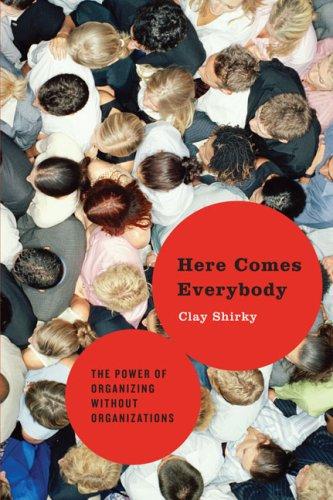
Clay Shirky · Buy on Amazon
"Yes, a benign anarchy. But a benign anarchy which oddly also resolves itself on other levels as very orderly and purposeful. A lot of ink has been spilled, much of it by me, about the Web 2.0 revolution, and how it changes the way business and art and socialising and political organisation get done. Shirky is simply the best person at articulating what’s very weird and new about what’s going on. The Net’s power to facilitate popular political organisation? Well, I think that’s very real. Certainly there are authoritarian governments working very hard to restrict that aspect of the Internet, with limited success. We haven’t seen an authentic Internet revolution. The effect, I think, isn’t that dramatic. But, even in this country, the way Obama used the Internet to raise funds was quite extraordinary. There’s a level on which the Internet is also a mass tool for pacification. I think it allows people to play out their lives in a fantasy context, which is very politically unthreatening. So the effect goes both ways, certainly. You recognise that title as a James Joyce quote by the way? Finnegans Wake."
Randall Stross · Buy on Amazon
"Well, Stross is no privacy nut. He embraces with the minimum of criticism the Utopian vision of Google, and you know, what he does in a really great, clear way, with lots of access and good writing, is to reveal the sheer scope of the Googlean vision of the world, whereby information would be catalogued and searchable. And that would include all kinds of information, including information that we don’t think of as the kind of thing that you could organise, including what streets look like and genetic information and stuff like that. Get the weekly Five Books newsletter Well, he’s not that concerned. You know, people have called him naive. I don’t think he’s really all that naive. I’ve met the Google founders, I know what it’s like to talk to them. And, you know, you can look over the past years at how the US has woken up to ideas about data mining and intelligence gathering that are pretty scary, and then there’s been an appropriate counter-veiling movement away from them. I should probably be more frightened than I am. What I find fantastic about Google is that they’re the ones who are retro-fitting the Internet, basically. The Internet was never designed to get this big, it was never designed to carry the kinds of information that it does, on the scale that it does. It was a huge mass that had just sort of metastasised to grotesque proportions. And then Google came along and figured out a way of bringing order to what was an extremely disorderly creation. We’re not just talking about archiving the wilderness here, but organising it. The Web had essentially collapsed under its own weight. And at this point Google came along, because you just couldn’t find shit."
Fantasy (2012)
Scraped from fivebooks.com (2012-08-30).
Source: fivebooks.com
J R R Tolkien · Buy on Amazon
"First up, The Hobbit, or There and Back Again, by JRR Tolkien. But you knew I was going to say that. This one book, which was published in 1937, defined so many variables for the fantasy tradition that are still in place today. Tolkien’s extraordinary achievement was to recover the epic landscapes of Anglo-Saxon myth, bring them back to life, and then to take us through them on foot, so we could see the details up close, at human scale. The Hobbit is both mythic and relatable at the same time – The New Yorker writer Adam Gopnik recently called it “an arranged marriage between the Elder Edda and The Wind in the Willows ”, and I think that’s entirely fair. Though I would give more credit to the bass register of Tolkien’s imagination, its abyssal depths. Mole never delved as deep as the Mines of Moria."
C S Lewis · Buy on Amazon
"You win some Turkish delight. Everyone knows Lewis’s Narnia books are a foundational work of the modern fantastic. But I don’t think Lewis gets enough credit for his craft as a writer. Those books are deceptively simple. Look at the way he constructed the opening of The Lion, the Witch and the Wardrobe . He puts the shadows of the war in the background, the excitement of a new house in the country in the foreground. Look at how he carefully sketches all the relationships between all four of the Pevensie children. And when he sends Lucy through the wardrobe (it’s on page five – he doesn’t waste time), it’s like nothing else in fiction up to that point. There are no sparkles, no wondrous rhetoric, just one precisely observed sensory detail after another: A dead bluebottle on a windowsill; some soft coats; some cold crunchy snow; some prickly pine branches – and then you’re in Narnia. People dismiss Lewis as a Christian propagandist, but that’s a mistake. He was a novelist before he was a Christian."
T H White · Buy on Amazon
"T. H. White’s The Once and Future King. White is less famous than Lewis and Tolkien, but he was a better writer, at least as far as style goes, and his book is a true masterpiece in its own right – a thoroughly modern re-imagining of the great English epic, the story of King Arthur. Like Tolkien, White takes an ancient, mythic landscape and scales it down to human size (or perhaps he scales us up). But White’s world is more brightly lit than Tolkien’s – he dispenses with all those Wagnerian storm clouds. White’s England is all streaming banners and sun-splashed meadows and shining walls, and he lingers longer over his characters, making them more complex and flawed and divided against themselves. The first part alone, “The Sword in the Stone”, about Arthur’s early years and his education by Merlin, may be the best story of a childhood ever committed to paper."
Ursula Le Guin · Buy on Amazon
"Not all. Let’s do Ursula Le Guin’s A Wizard of Earthsea next. It was published in 1968 and it was a revelation for fantasy readers, and possibly a revolution. In Le Guin’s work you can see a predominantly Christian, patriarchal, English tradition reinvented by a writer who was not only an American woman but a Taoist-atheist. (I like to think of the map of the archipelagic Earthsea as an image of a Middle Earth without a middle, as if it had been dropped and shattered.) Both Tolkien and Lewis were devout Christians, but Le Guin brought fantasy back to its pagan roots. She used as the foundations of her magic system and her story the building blocks of nature and sex and language."
Susanna Clarke · Buy on Amazon
"It’s hard to pick one book to represent all the richness and coolness that’s going on in fantasy right now, in the present moment. But I have to, so I’m picking Susanna Clarke ’s Jonathan Strange & Mr Norrell, which was published in 2004. The humour and sadness and beauty and complexity of this book, which took Clarke 10 years to write, are like nothing that came before it. Unlike the fantasies of the 1920s and 1930s, Clarke’s book isn’t about people losing a world – instead they’re rediscovering magic that has been lost for centuries, and reacquainting themselves with both its great boons and also its enormous costs and the sorrows they bring. It’s a magic that feels absolutely real, as if the book were an eyewitness account. Not since Lewis has the supernatural been such a thrilling, immediate, concrete presence on the page. It’s no accident that I began The Magicians in 2004 – Strange is the book that woke me up to the power of the new fantasy. Read it, and you may be woken up too. Writers like Clarke aren’t just the future of fantasy, they’re the future of literature. We’re living at a time when more and more readers are turning to what used to be dismissed as genre fiction – fantasy, young adult novels , mysteries, science fiction, romance – to get what they used to get from literary fiction. The reign of realism, which began in the 18th century, is finally being eroded. Writers like Michael Chabon and Jonathan Lethem and Kazuo Ishiguro and Colson Whitehead are crossing from literary fiction into genre fiction, just as Clarke and Link and Gaiman and the others are crossing the same divide from the other direction. They’re interbreeding the two forms, to create new and vital kinds of novels for the new millennium. They’re our literary avant-garde. They’re the writers who are mapping out the future of the novel. From where I sit, it looks fantastic."