Kit de Waal's Reading List
Kit de Waal, born to an Irish mother and Caribbean father, was brought up among the Irish community of Birmingham in the 1960s and 1970s. Her debut novel My Name Is Leon was an international bestseller, shortlisted for the Costa First Novel Award and won the Kerry Group Irish Novel of the Year Award for 2017. In 2022 it was adapted for television by the BBC. It is now on the GCSE curriculum for schools. Her new novel, The Best of Everything, was released in April 2025.
Open in WellRead Daily app →The Best Novels: The 2025 Women's Prize for Fiction (2025)
Scraped from fivebooks.com (2025-04-15).
Source: fivebooks.com

Aria Aber · Buy on Amazon
"It perfectly captured this time in a woman’s life, or this woman’s life. She’s the daughter of an Afghan refugee in Berlin, and she’s ashamed of it. Anyone that has had shame in their lives, especially shame related to your identity, will really identify with this book. There’s a section in it where she really fancies this guy, a very unsuitable guy, and—as we all do—she is trying to be cool, trying to say the right thing, to sit right, eat right, smoke right. It has really unusual sentence structures—the way they start. It’s quite extraordinary, really. So well done. Nila is trying things out, trying to stabilise herself, trying to accommodate all the aspects of herself that fight against one another. It’s not easy to write about that time of life without becoming maudlin and it isn’t that, it has a lot of life in it."

Miranda July · Buy on Amazon
"There’s no way to get around this, it’s weird. I love its weirdness. It’s about a woman who is a semi-famous artist who embarks on a road trip from one side of America to the other. She’s been given some money and she’s always wanted to do this. She says goodbye to her husband and child, gets to the next town and stops. The whole book is about what happens in that next town. She never makes it across the country. It is so unusual, I’ve never read a book like it. The concept of the book and the way it’s a woman speaking about a distinct time in a woman’s life—it’s like: ‘Who am I? What do I want? Am I a mum, doing small town things? Am I more than that? Do I want an adventure? Should I completely derail my life? It’s chock, chock full of life. Literally bursting with life. I’m slightly sick of the perimenopause or menopause being presented as a catalyst for change. Is that when you’re allowed to be a bit weird, to take control of your life? Do we now have to have a reason to reclaim our lives? So I’m not keen on ‘the menopause made me do it.’ Or ‘the menopause made me realise…’ You’re talking to a woman who had the menopause at 39, and it did upend my life. So I understand. But it’s a bit of a convenience that women have to have a medical reason for their reclamation. Men just ‘realise.’ Absolutely. I think when fiction engages with a woman at a certain stage of life, it resonates. So that’s why people say ‘menopause novel’ or ‘mother’s novel.’ It’s a shorthand for: if you have this life event going on, there will be resonances. Of course that speaks to women, and it’s an important thing, but I don’t think we have to have that. I mean, thinking of Miranda July’s book, I certainly didn’t do that. I understand that there’s a time of life when it might hit you. But these life events don’t necessarily hit you when they ‘should.’ For example: people are having children later. So you can’t say, ‘Oh, you’re 27, you’ve just had your first baby…’ You might be 45 and just had your first baby! Women are changing careers at 55. Or women are discovering they want to be in a same-sex relationship at 32. It’s all a mishmash. I think we should give permission to have these life events when we have these life events, not by nailing them to motherhood, or the menopause, old age, coming of age. Although, no doubt, there are definite patterns in what you feel at a certain age."

Sanam Mahloudji · Buy on Amazon
"The joy. It’s very funny, and it’s so unexpected. When I picked up the book, I didn’t know anything about it. I didn’t want to read any blurb or reviews, I just came to the work very clean. So I thought, when I picked this up, that it would be a historical novel about the Persians. I expected a different country, a different time, a different culture. But then this opens and it’s like the Kardashians of Aspen. They were once a very, very wealthy family, with servants and everything. It’s told from lots of different points of view, of women within this family. And it’s a book about who they are now, now they’ve lost their money, their clout. How can they negotiate America as immigrants—and not powerful immigrants either. It’s very good, very funny. Of course, it has very serious undertones. But it’s a joy to read."
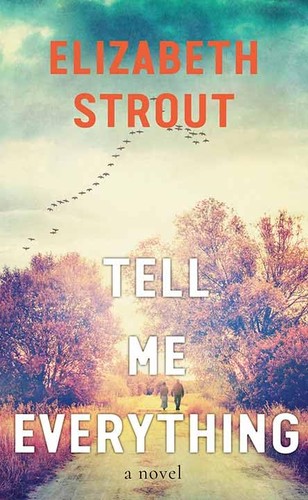
Elizabeth Strout · 2024 · Buy on Amazon
"This is a book about small people in a small town. It’s a celebration of ordinariness. It’s certainly about inner turmoil, coming to terms with ageing, and coming to terms with history—you know: your history, my history, everyone’s history and how it affects us. It’s also a sort of love story and a sort of murder mystery. I mean, it’s everything! And yet it’s so gentle. You know the way some of the most gentle things can be the most powerful, because they come at you slowly but forcefully? It’s lovely. It also feels very much like a classic. There’s no earthquakes, no murder. Well, there is a murder, but you don’t see the murder. It’s gentle, affecting, and very well written. Yes, these kinds of books can be underestimated. This has no big shocks in it. I don’t think it has a ‘fuck’ in it. As I say, gentle but powerful. It definitely speaks to who we are now, and of those small towns where nothing, apparently, is happening, and yet so much is happening."

Yael van der Wouden · Buy on Amazon
"It’s set in Holland in the 1960s, and it’s about this pretty unhappy woman who lives in a house. Her brother’s girlfriend comes to stay with her. It’s really about the relationship between the two women, and also about how history rises up unbidden and knocks your life aside. It’s very well written. I think it will be a classic. It’s short as well! The subject matter is unusual, and yet we think we know it. 80% of the book takes place in the rooms of a house. It’s not a big adventure, it’s a mini, interior adventure that this woman goes on, and the horrible realisation that she makes about who she is and the things that have been done in her name."

Nussaibah Younis · Buy on Amazon
"That’s accurate. Well, it’s not quite Bridget Jones , but it is the most surprising book on the list. I saw the title and—as I say, I came to the work knowing nothing—and I thought, okay, it will be a very serious book about fundamentalism and how it affects young girls like Shamima Begum, groomed young girls who were radicalised and went out to join ISIS. And it is about those girls. But, oh my God, this book is so funny. How she’s managed to make that subject funny and light, I don’t know. It peels back the veneer of sophistication and seriousness around the UN. You’d assume it was all very serious and proper, but no. It also doesn’t pull its punches about who these women are and what they want, as well as the protagonist herself being a surprising person of what you might think Muslim women are. It’s very good and, above all, funny. It’s definitely a book that you turn the pages to see what happens. Oh, completely. Women are leading the way in tackling some of these big subjects. They aren’t shying away from surprising narrators, ugly subjects , writing about sex in new and brave ways. From old subjects that we think we know, or—like Elizabeth Strout—saying, well, this is just who I am and what I write about."