Kate Elliott's Reading List
Kate Elliott has been publishing science fiction and fantasy for over thirty years, with a particular focus on immersive world-building and stories of adventure and transformative cultural change. She’s written epic fantasy, space opera, and YA fantasy, plus an Afro-Celtic alternate-history fantasy featuring lawyer dinosaurs ( Cold Magic ) , and two novellas set in the Magic: The Gathering multiverse. Her work has been nominated for the Nebula, World Fantasy, Norton, and Locus awards. Her novel Black Wolves won the RT Reviewers’ Choice Award for best epic fantasy in 2015. She lives in Oahu, pa
Open in WellRead Daily app →The Best Space Opera Books (2023)
Scraped from fivebooks.com (2023-06-11).
Source: fivebooks.com
C. J. Cherryh · Buy on Amazon
"Cherryh is one of my formative writers, someone who was a huge influence on me when I was starting to read deeply into science fiction and fantasy, and taking my first stabs at writing. The Pride of Chanur and its sequels were not the first Cherryh I read; I could have chosen many of her books, or her entire Alliance-Union universe. I highlight the Chanur books because their complex setting, exciting plot, and wonderful characters capture many of the things I love most about what space opera can accomplish in the right hands. Get the weekly Five Books newsletter The books are set in a region of space where humans are not known, and where alien spacefaring species struggle with their own political upheavals while juggling inter-species diplomacy, trading, and interaction. The sheer inventiveness Cherryh displays with her aliens is fabulous. They are our frame of reference, which means they are not alien to the story or to themselves but only to us. The politics are labyrinthine and the action is exciting, and then she adds to the mix the arrival of a single, lone human—a species no one in the setting has ever seen before. From the point of view of the other characters, he is the alien. We as readers see him both as an alien and as one of us. Great stuff. A big, well-constructed universe will offer a multitude of story openings just as our own Earth’s history is a foundation for so many different tales. A universe, ‘a narrative world,’ is also a form of creation, and many writers want to explore beyond the confines of a single story. I think it’s natural for writers who love world-building to want to expand their worlds through different characters, different plots, and different time frames. If there wasn’t room for a person or landscape in book one, then maybe they can enter the story in book two or three. Or an event or person dealt with in an early book may suggest repercussions to be written about in a later book. Some stories simply take multiple volumes to tell. Cherryh’s Downbelow Station is a standalone novel in her Alliance-Union universe that has a beginning and a resolution all in one; you could read it and never read another novel by her, although I wouldn’t recommend that. Meanwhile, Tad Williams’ Otherland is a single story told in four volumes. To get the full story and a resolution the reader has to read all four—and you should! I love that series. My own series don’t all interlink. Most are separate ‘worlds’ except in as much as they are written by me, with my sensibility. When I do write a series over multiple books I have a large plot frame in mind that needs multiple volumes to unfold. I also just genuinely enjoy world-building and am always happy to explore as much of the landscape as is reasonable within the story."
Simon Jimenez · Buy on Amazon
"The Vanished Birds is a novel that is thoughtful, character-driven, and literary. As it also features interstellar travel, time jumps , teleportation, and corporate skullduggery, I believe it can be said to creep over the line into space opera. It’s a beautifully written debut novel with so much to say about corporate malfeasance and colonization, all of it managed with the kinds of intrigue, gripping action scenes, and a strong plot line featuring “found family” that give it the larger-than-life feeling that space opera is so good at when done right. I would argue that fantasy can depend on advanced technology—if by advanced technology we mean ‘advanced for its day.’ Some fantasy books do explain the technology that is vital to their plots—for example, Ken Liu ’s Dandelion Dynasty series—although it’s true many do not and may rely on an assumption that fantasy worlds are set in the ‘primitive’ past even though there are, say, Roman aqueducts still standing two thousand years after they were built. Technology is a continuum and technological advancement has been going on among humans for millennia. At the same time, it’s true there is a style or sub-genre of science fiction that specifically goes into detail about technology, physics, and so on. In my experience space opera does tend to gloss over the technologies and the science in favor of a focus on action, characterization, and big set pieces."
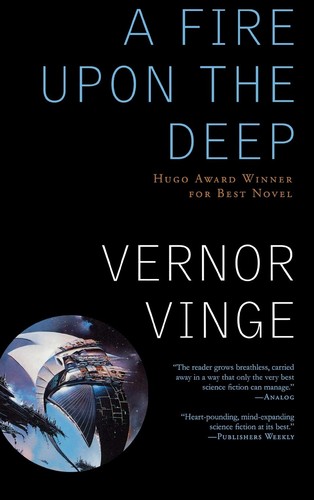
Vernor Vinge · 1992 · Buy on Amazon
"A Fire Upon the Deep is a classic example of a novel that uses a big idea to power and amplify its plot. This kind of book usually doesn’t work for me, but in this case, the big idea is so appealing and so very, very big that I bought into it, and really loved how Vinge works it through the plot. That it has to do with how quickly people and communication can travel in the galaxy is, for me, part of its great appeal, as I love transportation and communication networks as a subject of story. In addition, one of the alien species in the novel is loosely inspired by dogs, and as a dog-lover, I love their depiction so much. The story is, at its root, about preventing a great cataclysm. I don’t want to say more about the plot. It is an older book with a somewhat older sensibility, and I haven’t re-read it recently so I can’t say for sure how it holds up, but I still am dazzled by its big idea even after all these years, so that counts for a lot."
Neon Yang · Buy on Amazon
"Transmute the saintly Joan of Arc into a foul-mouthed and combative protagonist, decant them into a weird and wild far future, and strap in for a wrecking ball of a ride. It’s a little Pacific Rim, a little medieval Europe—although it may or may not be related to our own Earth at all—and it is ridiculously wonderful in its language and over-the-top conflicts and characters. So enjoyable. I wanted to retell the Alexander the Great story as space opera because it seemed perfectly suited for space opera’s particular blend of characteristics. In writing, it was both helpful and challenging to have to adapt an actual history and actual people whose actions are known. It was helpful because I had a template to work with, so I didn’t have to make everything up. It was challenging to make it all work in a new and quite different setting while also keeping aspects of the story and people true to the history without slavishly following it. Setting a story taken from the ancient world in the far future also allows the writer to upend narrative expectations about who belongs in a story of this kind and what they may or may not accomplish and how they might behave."
James S. A. Corey · Buy on Amazon
"These books blend fantastic action and character with really smart examinations of what our medium-term future might look like as humans expand into the solar system. The people—good and bad and indifferent—are relatable. The political dynamic, especially with respect to the exploitation of the ‘Belters,’ feels realistic. Corey is actually two writers working under a single pen name; they cleverly structured the entire sequence as three linked trilogies rather than a single nine-volume story. This allows them to wrap up satisfying narrative arcs within three books, and also continue following old characters while introducing new ones in subsequent linked trilogies. It’s a big universe with a lot of depth. Beyond that, the television series adaptation is excellent, with great acting, great writing, and wonderful effects. That means the Expanse can be read, or viewed it, or both! I am currently working on Lady Chaos , the third book in the Sun trilogy. In the future, I hope to return to my Jaran universe stories, which are also space opera although with a different tonal vibe than the Sun books. Beyond those I don’t know, and only the future will tell."