Jonathan Boff's Reading List
Jonathan Boff is a Senior Lecturer in Modern History at the University of Birmingham.
Open in WellRead Daily app →World War I (2018)
Scraped from fivebooks.com (2018-10-22).
Source: fivebooks.com

Michael Howard · Buy on Amazon
"First of all, as a standalone book, this is the best, single, short introduction to the whole First World War. It’s a remarkable piece of concision, where Sir Michael has apparently absorbed all the research about the First World War and then boiled it down to 150 pages, which is remarkable. But it’s also partly because of who wrote it. Sir Michael Howard is a very fine historian by any measure, but certainly the greatest living military historian or historian of warfare. He’s someone who has fought—he won a medal in the Second World War; he’s thought about war all his life. He’s brought all of that thinking and experience and writing and advising policymakers and all sorts of other things and put it all into this one tiny little book about the First World War. So it’s incredibly rich and wise and balanced in the views that it takes. And because it also reflects all the research that was excellent when he wrote it, it’s the very best way for a beginner to get into the First World War. It’s a balanced, modern interpretation. Well quite. The First World War is a trees-and-forests war. There is so much of it, it’s very easy to get lost in the detail and lose sight of the bigger picture. Where he is so good is that he’s got a sense of what life was like for the ordinary soldier and yet can see the overall picture, the geopolitics that was at work and the strategy."

Hew Strachan · Buy on Amazon
"Yes, 1,139 pages. You need pretty strong wrists if you want to read it in bed. The bibliography alone is 50 pages. And it’s almost all about just the first year of the war, 1914. In many ways, I think Sir Hew Strachan is the natural successor to Michael Howard. He was also Professor of Military History here in Oxford, at All Souls College. What’s different about this book is that although, again, it’s a synthesis, what he’s done is he’s gone off and read everything in every language and he’s identified—I think correctly—that you can’t understand any war, certainly not the First World War, unless you look at it from all different sides involved. War is a bit like other people’s marriages; it’s hard enough to understand even when you know all the facts. When you only know one side of the story, you have no chance. So his attitude throughout is comparative. He looks at it from the British point of view, the German point of view, the Austrian point of view and so on and so forth. You get a real sense of the similarities and differences between the countries and their experience of the war and what they’re all about. That’s the first point. “War is a bit like other people’s marriages; it’s hard enough to understand even when you know all the facts. When you only know one side of the story, you have no chance.” The second point is that he understands something that, particularly in Britain, we tend to forget. The centenary commemorations were a good example: you could have been excused for thinking that the British were the only people in the First World War. There was very little discussion of their allies and almost none of their enemies. Whereas Hew Strachan is saying, ‘No, you can’t do that. You’ve got to think of it as a world war. It’s called the First World War for a reason. You’ve got to put the world back in the world war.’ He sees it very much as a global event. Although, in theory, the book is only about 1914, in practice he spends a lot of time talking about themes that run through the whole war, like the financing of it. He also tells the whole story of the war in Africa, all the way up to 1918, in this first volume. So it’s much bigger than it pretends to be. You get a very real sense of how the war moved from being just a bunch of Europeans fighting each other into a World War, both in terms of the European war sucking in the resources of the world to add fuel to the fire but also in terms of the war being exported to Africa, to Asia, to the Americas. It’s not a work of advocacy. He’s not a barrister arguing a particular case. He’s more like a judge. On the whole, he’s summing up other people’s arguments and saying, ‘On balance, I think this.’ So it’s magisterial in that sense. It’s more useful for helping you understand the overall picture than for fighting a particular corner or a particular interpretation. Although, as I say, the two points that come out of the book are the need to treat the war internationally and the need to see it globally. Those were the new departures that he made when the book came out in 2001. Although some people had talked about looking at it in those terms, not enough people had. He was, essentially, laying down the agenda to say, ‘In future, here’s how we should be thinking about it.’ On the causes of the war, he does two interesting things. The first chapter of the book is a fairly traditional diplomatic history, ‘Such and such an ambassador said this’ and ‘Such and such a minister said that’ in the course of which he basically explains that he thinks—I’m scared of caricaturing his argument because it’s always more complicated—but, broadly, that Austria Hungary was the risk-taker. It was Austro-Hungarian mistakes, backed by Germany, that caused the outbreak of the First World War. This slithering-by-accident-into-war is not the case. Secondly, he says, ‘Look. There’s another aspect to this which is not actually to do with just the diplomacy. If you want to find the causes of the war, we have to look deeper. We have to look into mentalities: how people were thinking and the way that people thought about war and international relations. And even cultural trends.’ It’s about the ideas that make people fight as well as the relatively dry diplomatic documents. One of the points that he makes is that the traditional distinction that most historians make—whereby, broadly, you have international historians talking about the causes of war and then military historians talking about what happens during the war—is a false one. You can’t actually explain the causes of the war without also looking at its conduct and how it is fought out. Nor can you understand the conduct without understanding the causes. And so he tries, if you like, to bridge the divide between peace and war. There’s an element of social Darwinism to all this—the idea being that if you don’t grow, you will die. You have to keep expanding, or else you will die as a country or as a nation. That idea goes deep into the German psyche. That’s one example. But it’s also just, ‘Is war a viable way of carrying on international relations?’ Back then it was broadly accepted that it was. Now, most of us would probably say it isn’t. I don’t know if it’s a widely held view, but I hold it. It’s very hard to see how Germany could have won the war after the Battle of the Marne in 1914. She still had to lose it, but she wasn’t going to win it after that. The war had been decided by that battle, but it hadn’t been concluded. So, I think so and probably some military historians would also say that’s the case."

Adrian Gregory · Buy on Amazon
"The first two books we discussed were both trying to tell the global history of the war. This book is doing something different. Adrian Gregory is one of the best historians of the British Home Front that we have. What he’s been able to do is to pull together the social history of the First World War—with a very good understanding of the dynamics of the war itself as well—and put it all into a package. This book is, I think, the best single volume book on the British Home Front in the First World War. The way that the book pulls together social history and cultural history, in particular, is the most distinctive thing about it. So when he’s talking, for instance, about what motivated people to go to war, he’s actually asking a question that French historians have asked themselves a lot, but no one in Britain had really bothered to ask until he did. His explanation is partly the political factors we were talking about earlier, but it’s also about cultural determinants, such as the role of religion, for example. He’s able to look a bit sideways at some of these questions and think of them in non-traditional ways, which I think adds a lot of richness to the story. There were people who literally thought that God was on Britain’s side, and that by fighting for Britain, they were doing God’s work. It was an extreme view, but there were people who thought that. There were others, for instance, who when the churchmen stood up on a Sunday and gave their sermons and said we should fight the Hun because he represents everything that is ungodly believed that too. A lot of the tropes that were used were suggesting—maybe sometimes very subtly—that this was a sacrifice not only for Britain but also to God. It’s striking that all the memorials of the First World War have religious overtones. There’s a cross in every Commonwealth War Graves Commission cemetery, for instance. There’s the stone of sacrifice, which looks just like an altar. A lot of modern historians, because of who we are and the relatively secular society that most of us have been brought up in, tend to underestimate how much religion was part of the warp and weft of everyday life 100 years ago. It must, therefore, have played a much greater role in explaining how people acted. The whole argument is essentially, ‘Were people tricked into going to war?’ And his argument is, ‘No, they were not.’ On the other hand, there wasn’t mass enthusiasm. People did cheer in the streets, that definitely happened. But most people went off to war because they felt they had to, rather than because they actively wanted to. They think they’re fighting for home and country or to protect their wives and so on. There are some people who are. There’s Rupert Brooke, ‘To turn, as swimmers into cleanness leaping, / Glad from a world grown old and cold and weary’: we’ve been living in this murky, unsure world we don’t really understand—in the Edwardian period there was a lot of social conflict—and suddenly the war makes everything simple and clear. We know who’s on our side. We know who we’re against and we know what to do. We’ve got a job to do that doesn’t involve us having to find a job. So there’s some of that. “We’ve been living in this murky, unsure world we don’t really understand, and suddenly the war makes everything simple and clear. We know who’s on our side. We know who we’re against and we know what to do.” But I don’t think you should confuse lack of keenness with lack of willingness. They’re willing to go. They’re willing to go just as soon as they’ve sorted out their home affairs and made sure that their business is going to be looked after and that the wife and kids are going to be all right. They make sure all that is done and then they join up. The rush to the colours doesn’t happen on the first day of war, which is when you’d expect it to if everyone was mad keen to go off and fight. It happens after about a month. World War II looks like a straightforward crusade against the Nazis. World War I can look futile and hard to explain in comparison. Now, of course, that’s not quite true in either case. The Second World War wasn’t fought to save the Jews; people didn’t know what would happen to the Jews in 1939. The nature of the Second World War changed a lot as it went on. But, with hindsight, it looks very black and white. With the First World War it’s just not that straightforward. There’s another side to this as well, which he touches on, which is that the Second World War is seen as being a progressive war, in Britain anyway. What are the results of the Second World War? In 1945 you get peace, you get the Attlee government, you get the National Health Service. There’s the nationalisation of the industries and the birth of the welfare state. From very early on, people like George Orwell , and others, like William Beveridge, were saying, ‘Look. We can’t repeat the mistakes of the First World War. We have to make a better world at the end of this one.’ And so there is this social mission, if you like, that runs through World War II, at least in the popular perception. Whereas with the First World War the dominant feeling seemed to be, ‘When we finish this war, let’s get back to how things were. Life was good before. How do we get back there?’ And of course they fail to get back there. That’s one of the problems that helps cause the Second World War. So, if you like, the Second World War is in tune with history. It’s going with the march of progress whereas the First World War looks reactionary. It’s not true; a lot of this is hindsight."

Aimee Fox · Buy on Amazon
"I have to declare an interest here because she is a student of mine. Thinking purely about the military history of the war, a lot of it has been caught up with debates about the ability or otherwise of the armies, particularly the British Army, to learn how to fight this new kind of war. The traditional trope, if you watch Oh! What a Lovely War or read C. S. Forester , is that it’s lions led by donkeys: brave Tommies let down by these butchers and bunglers who are their generals. In the last 30-odd years, there’s been a bit of a fight back against that popular view amongst professional historians. They’ve pointed out, ‘Well, considering the problems they faced, the British Army did a remarkable job of learning and improving such that by 1918 they were capable of going toe to toe with the German army—the best in the world—and beating them consistently.’ And therefore there must have been some learning process that was going on and the idea of butchers and bunglers is not as true as popular opinion would have it. This argument has been going back and forth for a generation or so. It probably more or less represents the academic consensus that there was a ‘learning curve’ (the shorthand that’s used). But the argument had got a bit stale, in my opinion. What Aimee came along and did was say, ‘Well, actually, we’re thinking about this in too narrow a frame. We’re thinking about it almost exclusively in terms of the Western Front. We can’t do that. What we need to do is think about the British Army as an institution and a very representative institution of British society at the time.’ Because this whole argument also has a wider resonance, because one of the stories of Britain in the 20th century is of its decline, that the establishment was incapable of change. The army is a microcosm of that. Support Five Books Five Books interviews are expensive to produce. If you're enjoying this interview, please support us by donating a small amount . So you’ve got to look at the whole army and see how lessons that were learnt in one place — the Western Front, say —were then applied in Palestine or Mesopotamia or vice versa. What she also did was to say that academics have done a lot of work explaining what was learnt, but no one’s really explained how the learning process operated. How did these lessons get transmitted and how did people learn new stuff? She gets into that. Ultimately, the picture that comes back is much more complex than people had thought. It could be accident, it could be design, but the army came up with a whole range of different methods for disseminating information and lessons learned. Some of them are very formal and stratified, part of the hierarchical structure; some are very informal, people sticking up a sign on the notice board in the officer’s club saying, ‘I’ve got some thoughts on this, if anyone wants to come and have a chat with me come along.’ She’s managed to reconstruct some of these networks, especially the informal ones, which is an incredibly difficult thing to do. So, she’s given us some new ways to think about this. The two armies had very different ways of going about it. The Germans were much more programmatic and centralized in the way that they tried to do it. Their self-image was that they were very good at learning. I don’t think they were. I think they were too programmatic. They were very good at uniformity and systemization, but that made them a bit predictable, which can be a problem. “Change is easier to effect if you go with the cultural grain of the organisation rather than cutting across it” The British were a lot more ad hoc. Sometimes that can be a bad thing. Sometimes you need uniformity and systematization, and the British couldn’t always manage that. But the real point—and the same is true for any organisation—is that change is easier to effect if you go with the cultural grain of the organisation rather than cutting across it. The British Army with all this ad hocery looks terribly haphazard, but actually it suits the way the British Army works. A bit. It comes back to the point I was making earlier about people thinking about it as a British experience. It wasn’t all about the British. Even on the Western Front, a lot of the time it was about the French—never mind all the other fronts. In the English language historiography at least, we’ve tended to write the French ally out, to a large extent. A few people have tried to put them back in, but a lot of the time it’s written about as a British experience. Well it isn’t, actually. Britain is the junior partner, militarily. They’re the senior partner politically, but they’re the junior partner militarily on the ground in France and Belgium."
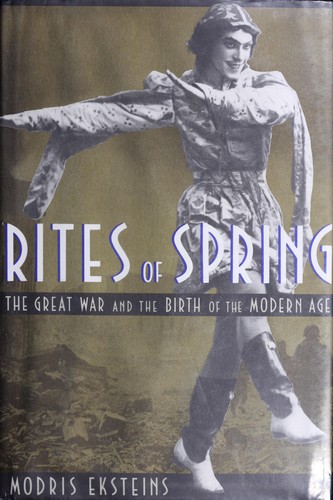
Modris Eksteins · Buy on Amazon
"This is a really interesting book. It’s deeply flawed, in many ways, but what it does is it views the war as a cultural phenomenon, rather than a military phenomenon. He’s a cultural historian who thinks in terms of literature, music, plastic arts, and so on. He sees the war as being important and interesting primarily because it heralds or helps to bring in modernism. In his view, the First World War plays a major part in changing the mindset of artists, enabling the Virginia Woolfs and T. S. Eliots to flourish. The anomie and uncertainty and apparent irrationality of events all feed into surrealism. Essentially, he says the world changes—or begins to change—with the performance of The Rite of Spring by Stravinsky in Paris in 1913. It’s an interesting thesis, but it’s wrong. You don’t have to be much of a cultural historian to know that modernism is often seen to pre-date that by quite a long way. People like Debussy and Baudelaire and Oscar Wilde are often seen as modernists in some sense. He also conflates modernism and modernity in a way that is not terribly helpful. He talks about this tiny coterie of avant-garde artists as if that’s what everyone in the country thought. That’s inevitably not true. But the questions that the book is asking, about the connection between these literally earth-shaking events and the impact they have on individuals, and how that feeds through into the way that people perceive the world around them and interact with it—whether that’s artistically or just in terms of their everyday life—I think are really, really interesting. I’m not sure it does terribly. Inevitably, he’s cherry picking from a huge number of sources and then trying to drag them together into this broader thesis about the modern world. It doesn’t work, but I think that’s the nature of the project. If you go and look at 100 different artists, you’ll get 100 different responses to the war. They can’t be generalized about in that way. But it’s a brave attempt."