John Kay's Reading List
John Kay is a British economist. He has been a Fellow of St John’s College, Oxford since 1970 and has held chairs at London Business School, the University of Oxford, and the London School of Economics.
Open in WellRead Daily app →Economics in the Real World (2013)
Scraped from fivebooks.com (2013-10-26).
Source: fivebooks.com

Eric D. Beinhocker · Buy on Amazon
"It’s important because it adopts the organic, evolutionary perspective we have just been describing; it doesn’t see economics being a purely mechanical system divined by optimisation models. I rather regard it as being similar to my own book The Truth About Markets , which I was far too modest to put on my list. This book emphasises the way that an understanding of the operation of markets has to be embedded in a social context and that complexity, agent-based modelling and evolutionary thinking are every bit as important to understanding the way economies and businesses develop as the models of the standard neo-classical paradigm of economics. What’s good about this book in particular is that he understands that these traditional paradigms of economics are not wrong, just that they are only a part of the story. And that I think is critical because there is quite a lot written that is critical of mainstream economics but it tends to be ‘all that stuff is rubbish, I have this other story about how economies work that is different and better.’ For me, that misses the point that there isn’t a single story. The way we understand economics and economies is by learning from lots of sources and thinking about them in lots of different ways. It’s understanding that the economic world, like parts of the physical world, is described by non-linear dynamic systems in which outcomes are heavily influenced by quite small changes in initial conditions. So there is no equilibrium, but just constant evolution and change. The whole mathematics of complexity, which has mushroomed over the last 30 years, has been about understanding the development of these types of systems. Yes it is. What’s good about it is that it is eclectic. I initially picked it up to write a review and was planning to do a hatchet job given that it had a ludicrously ambitious title and was by a McKinsey consultant. I then discovered it was actually very good. Support Five Books Five Books interviews are expensive to produce. If you're enjoying this interview, please support us by donating a small amount . The development of firms and economies is fundamentally an evolutionary process that has the characteristics that evolutionary natural selection has of adaptation, replication and selection. All of these are characteristics of the way economies and businesses evolve. That doesn’t mean you do what some people have done and try quite literally to translate mathematical models developed to describe biological evolutionary processes into economic terms, but it does mean that kind of thinking and kind of mathematics is as relevant to economics as it is to biology."
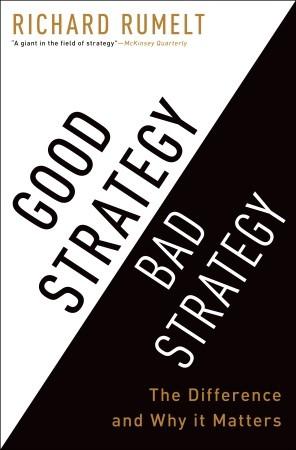
Richard Rumelt · Buy on Amazon
"Most books about business strategy are indeed terrible. The great take away of this book is that good strategy is really just about structured thinking about problems. Rumelt is a brilliant expositor of how you can do that in relation to a range of business issues. In the course of doing so he pokes brilliant fun at strategy gurus and people who sit down and have visions, essentially thinking themselves effective businesses. Rumelt is someone who is a very thoughtful observer of businesses, and has been involved in many, but has never really written very much in the course of his lifetime. This book is really the accumulation of a lifetime’s thinking. At the heart of a good strategy is organised thought about your business, what its competitive advantages are, and how they relate to the markets in which you operate or might operate in. This book is full of lovely vignettes. One of my favourites – which I can relate to from my own experiences – is when he was in discussion with an investment banker about a proposed merger and describes brilliantly the fundamental pretentious vacuity of the banker who just wants to do the deal. The discussion ended when the two of them agreed that they simply couldn’t communicate with each other."

Michael Lewis · Buy on Amazon
"Lewis is a great writer and this is one of the best accounts of what happened in the run up to the crash. In fact, I just recommended it to someone I was with last night who was talking about the efficient market hypothesis – which is the basic paradigm of financial economics – and I told him that if he wanted to understand why it didn’t apply in the run up to the financial crisis, he needed to go away and read this book. In it, Lewis talks about the bankers who knew early on that what was happening was nonsense and was all going to end in tears and how they translated that insight into money making strategies. It tells us the difficulty markets have in correcting group think. You really have to be quite Aspergerish to take a stand against the crowd. In fact one of Lewis’s heroes, as it were, is hedge fund manager Michael Burry, who clearly had serious socialisation problems. Yes it does. The hedge fund manager John Paulson, who made serious money out of the financial crisis, has lost quite a lot of money in subsequent bets since then which raises questions as to what extent he was just lucky to get that particular call right or whether hubris has made him over confident as a result of having got that one right. It’s really readable. What Lewis does so well is give the reader a lot of fun while actually making a number of serious points. You can pretty well read this book on the beach for amusement, but there is a point there. That makes sense as Brad Pitt starred in the film version of Lewis’s book Moneyball . He must have connected with Lewis in some way."
Jared Diamond · Buy on Amazon
"He’s an anthropologist writing about economic history in a big picture way. Yes, and he explains the interaction of geography and science with economic development. He starts with what he called the Yali’s question, when a Papua New Guinean man asks him: ‘Why do you have so much stuff to bring to us, and we don’t have the equivalent amount of stuff to bring to you?’ Behind this question lay a bigger one: Why has there been greater economic development in Western Europe than in other parts of the world? Diamond traces his answer over 13,000 years, through the development of agriculture and the particular places that were conducive for the development of crops and domestic animals that became critical to economic development. You also had the crops in Europe that allowed for the development of agriculture. Equally there’s the oddity he describes of the geography of Eurasia running east-west, so you don’t get huge differences in climate which allowed for innovations to be easily transmitted. If you are brought up with the rationalist tradition of standard economics, you just never make the sorts of connections that Diamond makes. It’s about understanding how the disparities of income and wealth which we have today have built up over millennia."

David S Landes · Buy on Amazon
"If Diamond’s book is a very long term economic history, Landes does it for the last 500 years. He provides an explanation for why Western Europe was the cradle for modern economic growth and looks at the development of the institutions that made modern economic development possible. Landes provides the best account I know of these kinds of developments. To me, there is a pluralism theme that is common to most of the elements that he describes. Here I mean pluralism in the sense of freedom of experiment in economic terms and freedom of thought in political and intellectual terms. Or indeed has the lack of pluralism inhibited growth there in the past? One of the big questions of economic history is why economic growth did happen in Western Europe and not in China 200 years ago. It’s the question Kenneth Pomeranz takes on in his book The Great Divergence . I did think about putting it on my list, but it is not as well written as the others and I don’t think its thesis is entirely convincing. I think that pluralism is the story. Most of Western Europe was an area that encouraged freedom of thought and experiment whereas China, until very recently, has not. It does continue to restrict freedom of thought, but much less now than it did. Economic pluralism and political pluralism seem, in principle, separable. But there don’t seem to be any examples of being able to sustain one without the other."
Best Investing Books for Beginners (2018)
Scraped from fivebooks.com (2018-04-27).
Source: fivebooks.com

Burton Malkiel · Buy on Amazon
"Yes, that’s the book I recommend when asked by people who are highly intelligent, have a little bit of money, but feel at sea. I’m not very impressed by financial advisers—for pretty good reasons. But there is very little you can read on investment that’s not insulting to the intelligence. As you know, there are lots of ‘how to become rich by day trading’ books around, but intelligent people know what to do with those kinds of books: namely not to open them. The first edition of Malkiel’s book was published in the early 1970s, soon after people started talking about the Efficient Market Hypothesis. That’s the idea that all relevant information about securities is in the price. That led people to think about index investing which really began then. You didn’t need to pay active managers who, on average, were not worth their cost: you could simply replicate the index as a whole. “There is very little you can read on investment that’s not insulting to the intelligence” That was about the time a rather evangelical Jack Bogle in the US set up Vanguard to market index funds to individuals. Vanguard has now become one of the largest fund managers in the world, still specialising in that kind of product. Essentially, the theme of Malkiel’s book was that you could, in effect, do investing yourself. Yes, but of course there were very few index funds around then, which is really why Bogle set up Vanguard. Now, of course, there are lots. The Efficient Market Hypothesis is if you think…Gosh. What would everyone agree is a good company these days? We used to say Tesco or Sainsbury’s. Let’s take Apple. Apple produces excellent products, it has a very enthusiastic band of consumers, it’s a very profitable company and has a very large pile of cash—but everyone knows these things and so the market value of Apple reflects the fact that everyone knows these things. That’s true generally. If it’s general knowledge, you would expect it to be reflected in the price. What I say in my book—and I can’t say it often enough—is that the Efficient Market Hypothesis is illuminating but not true. If you haven’t grasped that idea, that publicly available information is going to be in the price, you really have no idea how to go about investing. But, equally, it’s a mistake to think that the Efficient Market Hypothesis is invariably true. If it were invariably true, Warren Buffet and George Soros and others would not be very rich men. That’s right. If you haven’t got that idea, you haven’t got to base one. Yes, and without doing too much talking down to people either. There are some corny American jokes that perhaps don’t go down quite so well with a European audience, but you can forgive that. Yes. If you go and see a doctor, you’ll have a reasonable expectation that what he or she proposes to you is in your best interest. That used to be true of an accountant or a lawyer as well. It’s perhaps less true of them now, but it still has some validity. It’s much less true of a financial adviser, unfortunately. It’s partly a matter of incentives. A lot of things have been done in the UK to try and remove the distorting incentives, knocking a lot of the more overtly corrupt practices out of the industry. But it’s still pretty bad in the US. I suppose people just go where the money is. Historically, it was true that for professions like medicine or accountancy there was a rigorous professional training. That’s never been the case with finance. There has been no rigorous professional training either of financial knowledge or about ethics. Get the weekly Five Books newsletter People would claim there is now, as a result of modern finance theory. Indeed the CFA Institute is attempting, with some success, to replicate the knowledge and ethics of other professionals across the finance sector. Whether the corresponding body of knowledge is actually all that valuable is another matter altogether… No, of course not. Well, over a long period of time it’s gone up. Over the last 10 years, it’s gone up. 1999. You would have recovered by now, but 18 years is a long time. 1969 would have been another bad time to have bought an index fund. No comment. If you buy an index fund for the FTSE All-Share Index, say, all you’re doing is buying all the companies that are listed on the London Stock Exchange. That will include British companies, although the largest British companies that dominate the index are, in fact, companies that largely operate overseas. You’d be buying BP and Vodafone and Glaxo and so on. You would also be buying any company which has a London listing so you might be buying eastern European-run resource companies with somewhat doubtful commitment to high standards of corporate governance. Indeed, there is competition to attract these companies among stock exchanges. Yes. The Saudis have been talking about floating some of Aramco over this past year. People are salivating at the prospective fees that this could produce and therefore suggesting that perhaps some of the requirements and obligations that are normally imposed on listed companies might be relaxed if the Saudis were to direct their business this way. The reckoning is that Aramco might well be the most valuable company in the world if it were listed. Yes and no. What I’m really against is people paying quite high fees for what is little better than an index fund. That is what is often offered to savers. You can certainly do better than that in an index fund and starting your investing activity by buying an index fund is not a bad thing to do. “I’m not very impressed by financial advisers—for pretty good reasons” On the other hand, as we’ve just said, you are buying a certain kind of company when you buy an index. It’s heavily weighted towards these large international companies. An index fund is not really very well diversified because economic sectors are weighted proportionately to the role of listed companies rather than by reference to the economic significance of the activity. All the big companies that dominate the indices basically sell to well-off consumers in western markets. Glaxo, BP and Vodafone are marketing to pretty much the same people around the world. In a sense, the drivers of their profits and earnings are much the same. You can diversify more if you’re willing to choose your own stocks. Also, you don’t have to buy shares in the eastern European controlled resource companies that you might not choose if you were to invest for youself . There’s not much to choose between them, for the retail investor. You also need to be slightly careful about the nature of the fund because there are funds that simply buy the stocks that are in the index. There are other funds that attempt to replicate it by buying derivatives, so-called synthetic funds. I think the unsophisticated investor should stick with ones that actually buy the stocks, like the ones from iShares, the biggest ETF provider, or Vanguard."

John Lanchester · Buy on Amazon
"John Lanchester was a novelist who set out to write a book about London life in the first decade of the 21st century and realised that finance was a big part of London life in the first decade of the 21st century. He decided he’d better learn about what was going on in finance and wrote a novel, Capital, which is very well worth reading, but not appropriate as one of your five books. He also produced a book about the crash called Whoops! Get the weekly Five Books newsletter He then had the idea that, having accumulated this knowledge of finance, he should write what is, in effect, a glossary of financial terms for people like him. I suppose the kind of book that he would have liked to have had when he started his project. This is it. It’s not just a dictionary. It’s a book you can read through and enjoy. There are certainly definitions I would quibble with but the standard is high, yes. And, as he discovered, and as my wife and other people have discovered, it isn’t that difficult to tune in with a modicum of effort – and help. Yes, that’s right. That’s probably the most striking example. It means he can write well, which is not true of most people writing books about finance. I find it very strange because bonds used to be regarded as incredibly boring. Not in The Long and the Short of it , but in Other People’s Money, I wrote about the contrast between F Scott Fitzgerald’s The Great Gatsby where the completely colourless narrator is a bond salesman—because that’s about the most boring activity Fitzgerald can think of—and the Bonfire of the Vanities , the great American novel of the 1980s, where the vainglorious, flamboyant anti-hero is a bond salesman. Probably not right now, no. Right, and that’s terrible advice. People tend to confuse certainty with safety and security. The way I framed it in a talk the other day is that a person who knows they’re going to be hanged tomorrow has got certainty but not security. If you buy bonds now, that’s pretty much the outcome you get. If you buy bonds to provide for your retirement—which is what a lot of people are encouraged to do—you’re getting certainty that you will have a pretty low standard of living in your retirement. The market for bonds has been completely distorted by the fact the government has been buying them. Historically, governments have always been the main issuer of bonds, but now around a third of total government bonds in issue are owned by the Bank of England through its Asset Purchase Facility. This is the so-called quantitative easing that has gone on for the last 10 years. “What I say in my book—and I can’t say it often enough—is that the Efficient Market Hypothesis is illuminating but not true” People regard the 30-year German government bund (as it’s called) as one of the ‘safest’ investments in the world. I think I say in my book that if instead of buying that, you bought an apartment in Berlin and the rent remained constant over 30 years and the flat were worthless at the end of those 30 years, you’d still do better than you would with that bond. Given that comparison, quite why anyone should want to buy the bond is hard to understand. In present circumstances, no. The market for bonds has been dominated by these government policies and as a result bonds are just very unattractive to private investors. If and when interest rates go up, you’ll hear about it. It really will be the first item in the news. It’s not going to happen soon, at least on any scale… When long-term bond yields get up to more traditional historic levels, you might start thinking about holding some. Yes. Imagine a bond that’s never going to be redeemed, to keep it simple. If it’s yielding 2% and interest rates go up to 4%, a new bond will be yielding 4% forever. Your bond is only worth half the value of the new bond. That’s why the price goes down if interest rates go up. There are also index-linked bonds which are linked to the retail price index for both the interest and the redemption payment. In Britain, index linked bonds currently yield negative amounts, so these aren’t very interesting either."

Benjamin Graham · 1949 · Buy on Amazon
"It was the best book then. There is more competition now. The idea is that you look at the underlying value of the company’s activities instead of relying on market gossip. In my book, I talk about two kinds of underlying investment strategies. One is to second-guess the market gossip and the other is to look at the underlying value of the assets you’re buying. My suggestion is that if you’re an ordinary punter, trying to do the first—the market gossip stories—is a mug’s game. Yes, though a lot of what Graham did was only possible in an era when you had boring, badly-run companies where the value of the underlying assets of the business were much greater than its trading value. Famously, Charles Clore bought half the shoe shops in Britain, not because he was interested in shoes but because these shops were trading out of premises that were far more valuable than the shoe businesses they were running. And no one had noticed. “If you go and see a doctor, you’ll have a reasonable expectation that what he or she proposes to you is in your best interest” That kind of strategy reached its culmination in the 1970s with Jim Slater. He was the most notorious of asset strippers but eventually, in the crash of ’74, Slater effectively went bust. By then most of these kinds of opportunities had been taken. I think the principal kind that remained were some badly-run businesses that had almost monopoly positions, so two or three companies—Hanson was the most famous of them—went around taking over businesses like London Brick and EverReady batteries. You bought them, cut some of the costs, put the prices up and made a profit that way. But even that kind of opportunity is now pretty rare. Not really. I think of private equity now as when it’s good, it’s very, very good and when it’s bad, it’s horrid. The worst kind of private equity—which is probably the dominant kind—is where you acquire a business, massage its earnings up for a couple of years, and then flip it on to somebody else. A classic illustration for me was staying in a hotel somewhere and thinking the carpet was not being replaced, the mini bar was ludicrously overpriced and breakfast cost far too much. This was obviously a hotel run by people who didn’t care if you came back and I thought, ‘This is a private equity deal.’ I checked afterwards and of course it was. Yes, the advice that you should look through to the underlying value, earnings and assets of the company remains valid. But the assets of Apple and Amazon are clearly very different from the assets of a shoe shop. Typically the assets of that older era were in real estate of one kind or another. Now they are in people. Not sensibly. People devote a lot of effort to so-called brand valuation and valuing other intangibles but, in a sense, you’re inventing a number to make the numbers add up: since the value of Apple is $800 billion—far above the value of physical assets and cash—we invent an asset to account for the difference. Warren Buffet has famously said that investors would have been better off if the Wright Brothers’ plane had crashed."

Alice Schroeder · Buy on Amazon
"It’s on the list, firstly, because Buffet is the most successful investor in history. Secondly, he’s a successful investor based in Omaha, Nebraska, miles away from the City and Wall Street – like the beginning investor. Thirdly, his investment philosophy has been based on some very simple ideas, which are essentially a modernised version of Graham. He is asking the question, ‘How well protected are the earnings of these companies I’m buying from competition?’ Which leads him to talk about ‘moats’ and the like. “Buffet is the most successful investor in history” There’s a nice story in the book about Buffet as a kid noticing a kind of pinch point where all the trams went through and thinking, ‘There must be a way of making money out of this.’ That’s, in a sense, the investment philosophy: if you have a pinch point, you have a profitable business. In the 1980s, people started talking about ‘hollow corporations’. Apple is not quite the best example, because Apple does have retail stores. But Nike, for example, doesn’t make the shoes. They don’t sell the shoes. What Nike does is, essentially, brand the shoes, which others make and others sell. That’s where the value in the chain actually is, which is how you end up with these companies, like Apple, which don’t employ very many people, although they’re very large and very profitable businesses. If you looked at the largest companies in Benjamin Graham’s day, they would have been General Motors and US Steel and so on, companies that employed very large numbers of people, as well as having very large sales and plants. Many of today’s largest companies don’t. They’re characterised by these controlling, coordinating, competitive advantages like Apple and Nike. That’s the next generation of the kind of companies Warren Buffet likes. Many of his first investments were local newspapers. See’s Candies was a famous early investment. As you probably know, all of this is funded by the insurance business which underpins it. There are supposed to be some reasons for being in Nebraska to do with lax Nebraskan insurance regulations. That’s right. He’s not just a hick from Nebraska who turns out to be a wildly successful investor. There’s another side to that, which is the relative modesty of his lifestyle given his extraordinary wealth. The one time I’ve been in Omaha, the taxi drivers insisted on driving me past Warren Buffet’s bungalow. It’s the main tourist sight of Omaha. No. I think Buffet strikingly doesn’t get involved with the management of his companies. The head office of Berkshire Hathaway in Omaha is tiny. His philosophy has been very much about finding good managers and letting them get on with it—by which I mean good managers who are there at the time he buys the business. Yes, Nebraska Furniture Mart and Mrs B, Rose Blumkin, who reportedly went to the store daily till she died aged 104. You want to look at the underlying fundamentals of the business. You want to ask how sustainable these are against competitive threats and you want to ask what is the quality of the management of this business. Help you organise your thinking, really. It’s like the Efficient Market Hypothesis. It’s useful to know about these things, so long as you don’t take them too seriously. You should think about probabilities but it’s not going to help you to do the elaborate calculations that investment consultants would do or that there are now spreadsheets that will do for you. Salomon Brothers. In the late ’80s, when it was struggling, he bought into it. Later there was a scandal, many of the senior managers of the business had to be fired and he ended up having to become the chairman. That was a big mistake, as he acknowledged. Carol Loomis, a journalist, helps him write the very amusing Berkshire Hathaway annual shareholder letter. There are endless aphorisms that are the sayings of Warren Buffet."
Richard Rumelt · Buy on Amazon
"I thought to give more variety I’d recommend Richard Rumelt. It’s not a book about investment at all. It’s a book about business strategy. The title is Good Strategy, Bad Strategy: The Difference and Why it Matters (2011). It’s very well written and I see I am quoted on the back cover saying, “This is the only book about business strategy which I didn’t want to put down.” “What I’m really against is people paying quite high fees for what is little better than an index fund” It goes back to what we were just saying about understanding the fundamentals of a business, as the key to successful long-term investment. Rumelt’s book is about businesses that are effectively developing their capabilities in line with the development of their markets; he contrasts those with the vast majority of businesses where what is said about strategy is basically fluff and statements of aspiration. If you want a guide to pick your way through sense and nonsense in what companies say about themselves this is the best book I know for helping you do it. Understand the business better. To decipher either what companies are saying about themselves or what other people are saying about these companies. There are several nice vignettes in the book where he discusses put-downs of finance people talking nonsense about business because they don’t really understand the business or anything about business in general. The bad strategy would be the classic strategy as aspiration that goes into these kinds of mission statements. ‘Our strategy is to grow profits at 20% a year, revenues at 20% a year and so on.’ Whereas Rumelt has a very interesting contrasting vignette about talking to Steve Jobs just after he went back to Apple in the ‘Second Coming of Jobs.’ He asked Jobs, ‘What are your plans for the business?’ Jobs said, ‘I’m going to wait for the next big thing.’ The next big thing in consumer electronics turned out to be music downloads. That came in ’98, ’99 with Napster and prompted Jobs to devise the iPod to facilitate downloading and maintaining of digital music: “A thousand songs in your pocket.” The iPod was Steve Jobs’s first new product when he returned to Apple. The other next big thing was the growth of text messaging and later other social media. The genius, in the end, was to put these things together and that’s our smartphones. This company, Apple, now has a dominant position in consumer electronics. I don’t know what is going to happen in this market, but I know what the capabilities of this company are. They’re going to look for new opportunities in the way technology for the market is developing. If you think about probably the three most successful investors in the world in the last 20 years, you’d point to Buffet, Soros, and the third would be Jim Simons. Simons has built a hedge fund worth tens of billions of dollars around, essentially, high frequency trading and very sophisticated algorithms. He’s a maths professor who turned to finance. What’s interesting and ironic is that none of these people use conventional finance theory at all. Indeed all of them positively disparage it. “I think reflexivity is actually very important—the notion that in this world future events depend on our beliefs about these future events” Soros’s strategy has basically been to understand macroeconomic events and their relationship to markets. He’s done that better than anyone than else, really, over that period. Of course, the greatest of all his coups was the so-called breaking of the Bank of England in 1991. Get the weekly Five Books newsletter The reason for not putting his book on the list is that if you look at these three strategic approaches, the only one you could recommend to the ordinary investor would be the Buffet one. The Simons one obviously isn’t available to retail investors. And you’d be very brave to believe that you could achieve the combination of macro analysis and market understanding which is the basis of Soros’s investment success even if you devoted yourself to it full time. Yes. He has both an understanding of the market gossip and an appreciation of the underlying macro fundamentals. Yes, he’d really rather be an academic than a very rich man. I think reflexivity is actually very important—the notion that in this world future events depend on our beliefs about these future events. That’s why economics and finance are so fundamentally different from physics and the attempt to draw analogies and techniques from physics, have limited relevance."