John Gapper's Reading List
John Gapper is chief business commentator of the Financial Times , where he writes a weekly column. He co-authored All That Glitters , an account of the collapse of Barings bank in 1995. His new e-book is How To Be A Rogue Trader , pegged to the story of a young trader who allegedly ran up $2.3bn of losses
Open in WellRead Daily app →Financial Speculation (2020)
Scraped from fivebooks.com (2020-12-20).
Source: fivebooks.com

Charles Mackay · Buy on Amazon
"It’s a very patchy book, but it leads off with three classic financial booms and busts – tulip mania in Holland, the Mississippi scheme in 18th century France, and the South Sea Bubble. MacKay was a journalist with a fine tabloid style, and he writes it all up very entertainingly. He gets the eyewitness quotes and he finds the human foibles. And, because he was the first person to collect these episodes, his book has become the source material for a lot of later works that are more scholarly and more rigorous. And yes, when you read Mackay, you do think, “Oh my goodness, this is what’s happening now.” There are extraordinary parallels. In periods of speculation, people start trading derivatives of whatever the primary commodity might be. During the South Sea Bubble they were speculating not only on sailcloth for the expeditions, but on options to buy the sailcloth. Surowiecki talks about the way in which crowds of people making independent judgements can come up with good decisions. But if you have a coordinated mass hysteria, that’s something completely different."
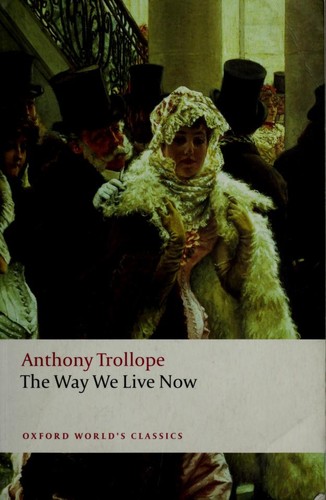
Anthony Trollope · Buy on Amazon
"Absolutely. And, slightly atypically for Trollope, it is a book written in a spirit of moral disgust. Trollope generally takes a detached, somewhat comic or ironic view of society. But here we have contempt for the state of Victorian Britain in 1875. Augustus Melmotte, the tycoon at the centre of the story, is a great character: A mysterious outsider with a bullying, charming, intimidating presence. He promises money and riches to London’s decadent and foppish aristocrats. He is really a speculator in railway bonds, with an American shyster, Hamilton K Fisker, as his partner. Aristocrats crowd on to his boards, as baubles, for the money. Support Five Books Five Books interviews are expensive to produce. If you're enjoying this interview, please support us by donating a small amount . You sense an entire class of society wanting to be corrupted, wanting to believe in this man. Melmotte is the precursor of modern figures such as Bob Maxwell and Bernie Madoff, who bully or charm you into believing they have the key to boundless riches. Other writers have tried to capture the world of high finance, and failed, because finance is abstract and complicated. Trollope succeeded because his real interest was in bringing to life the way that money could change human character. There’s nothing abstract or complicated about greed, vanity and weakness. Tom Wolfe managed something similar a century later with The Bonfire of the Vanities ."

John Kenneth Galbraith · Buy on Amazon
"The book shows his talent as a popular economist. It’s not chiefly a work of economics , though it does analyse the causes of the Great Depression . It’s more a work of history, almost of journalism. For an academic, Galbraith writes unusually well. When you open this book, it starts with real estate speculation in Florida. Everybody is rushing down there because they believe Florida real estate is going to have an enormous boom. They are speculating in derivatives on it. The parallels could hardly be more precise. “There’s nothing abstract or complicated about greed, vanity and weakness” Galbraith also draws out well the way in which one of the top bankers of the day, Charles Mitchell of National City Bank, together with Richard Whitney, head of the New York Stock Exchange, contrived to prolong the period of financial speculation. After the crash, these two became the symbols of the financial class’s malfeasance. They were prosecuted and reputationally ruined. Whitney was sent to Sing Sing [prison]. There, the parallel breaks down. No senior banker has faced such harsh justice this time. Galbraith didn’t go so far as to say that it could never happen again. But he did conclude that Wall Street would never be trusted in the same way. Instead, America would trust new institutions and regulations – first and foremost the Securities and Exchange Commission. But if you fast-forward to the past decade, you find that the SEC had become ineffectual. And the Federal Reserve, at least under Alan Greenspan, was treating derivatives as though they were reducing and distributing risk, rather than creating it. So with benefit of hindsight, you have to say that Wall Street came through the Great Crash without being fundamentally changed."

Roger Lowenstein · Buy on Amazon
"The Fed itself did not bail out LTCM, but it was worried enough to get a bunch of big banks into the room and say, “Would you care to chip in and save this thing?” Which they obligingly did – and then liquidated it. The Fed foresaw that the failure of a single big hedge fund could send shock waves through the entire financial system. The issue of systemic risk was highlighted. LTCM was a leading indicator in another way. Its principals didn’t believe they were speculating. They believed they had risk models that worked. As they saw it, they were arbitraging divergences between markets and instruments that were bound to come back in line, based on the historical data. And because they thought the risk was so controlled, the traders leveraged up enormously, placed huge bets, thanks to the magic of derivatives. What LTCM left out of its calculations was what we now called “fat tail” or “black swan” events. Those came with the crises in East Asia and in Russia in 1997-98. A lot of LTCM’s trades not only went wrong, but went wrong simultaneously across lots of different markets. The firm collapsed. Yet even as it was going down, John Meriwether – who appears in Michael Lewis’s Liar ’ s Poker as the man who took the liar’s poker bets – still believed that his bets were the right ones, if he only he had had more time and more money. He had a liquidity problem. But it was the markets that were wrong. Lowenstein explains in very elegant terms some pretty complicated concepts involving derivatives, Black-Scholes [financial model] and trading. He captures the characters. But it’s less a character book than a book about this thing that many people hadn’t heard of, bubbling up within the financial system. Before LTCM, nobody outside the elite of Wall Street had any idea of the importance of derivatives. But inside this elite, a whole class of traders was starting to think of financial markets in completely different terms. Meriwether is a stone-cold gambler. I think what he believed was that he’d found a way to twist the odds in the casino, using models that only a few brainiacs could understand. He got people on his side who knew more sophisticated ways to place bets on financial markets than even central banks did. So, as he thought, he had the intelligent money on his side, and the uninformed betting against him, and that made for pretty good odds. And indeed, he was right for a long time. It worked brilliantly for four years. And then it went bang. It’s a hazard of having high-powered economists as strategists. They always want to short volatility. They believe that the markets are going to come to their senses. It’s reverse speculation, if you like. The underlying idea is that other people panic, and that’s why markets go crazy. If you can think through all the noise, you can bet against them and win. The problem is, of course, that the markets can stay crazy a lot longer than you can stay solvent."

Bethany McLean and Joe Nocera · Buy on Amazon
"It comes from The Tempest : “Hell is empty / And all the devils are here”. There are lots of really good books about the recent financial crisis, by Andrew Ross Sorkin, Roger Lowenstein, William D Cohan and others. I’ve picked McLean and Nocera because they give a broad view, rather as Galbraith did for 1929. They tie everything together, from the central banks at the top of the chain down to the subprime borrowers at the bottom who were given credit because everybody else wanted them to have it. Get the weekly Five Books newsletter Their account will upset anybody who thinks you can reduce what happened to a single institutional failure or a single actor. It’s very hard on Fannie Mae and Freddie Mac. But it’s equally hard on Wall Street, and it’s pretty hard on [Alan] Greenspan, and on the Fed’s refusal to recognise or do anything about the developing credit bubble. There’s a clue in the structure of MacKay’s book. It includes three big financial episodes. But it also takes in some non-financial phenomena, including alchemy and the Crusades, which MacKay views as analogous examples of human irrationality. If MacKay is right, then financial speculation is just one type of a broader human tendency to get caught up in things. People love a party, they love a crowd, they love to get enthusiastic and hopeful about the future. When you’re caught up in a crowd of people speculating, it’s a very exciting business. “The problem is, of course, that the markets can stay crazy a lot longer than you can stay solvent” What’s more, when you do get into loss, you will do anything to get out of that loss. As Daniel Kahneman and Amos Tversky have shown, losers stop being risk averse and start being loss averse. You double up on your bets. Clearly, there are deep-rooted psychological instincts, not only to enjoy speculation, but to carry on speculating even – or especially – when things are going wrong. We all have a bit of the rogue trader in us. This interview was first published December 20th, 2011"