Joe Posnanski's Reading List
Joe Posnanski is a senior writer at Sports Illustrated. Prior to joining SI in 2009, he was a sports columnist at The Kansas City Star. He has twice been named the best sports columnist in America by the Associated Press Sports Editors, and is the author of three books Joe Blogs
Open in WellRead Daily app →Baseball (2011)
Scraped from fivebooks.com (2011-05-14).
Source: fivebooks.com

Roger Kahn · Buy on Amazon
"I don’t think there’s any question that The Boys of Summer has always been larger than a baseball book. On the surface, at least, it’s about the 1952, 1953 Brooklyn Dodgers – their triumphs and their inevitable failings. They were good enough to get to the World Series, but not good enough to win. But they were a great team, and Jackie Robinson is a prominent part both of the story of the book, and of the team as a player. But it’s so much larger than that, because it’s really a story about Roger Kahn and his father. The first half of the book is written somewhat chronologically, about those two seasons, and Roger Kahn’s own place in them. He was a young reporter, just learning how to become a writer, and all of this was happening around him. Then, in the second half of the book, he goes back and revisits the players 20 or so years later. There’s real depth in every element of the book, to my mind, as a reader. It touches on things that are much larger than sports. Yes. I’ve heard Roger Kahn say that the quintessential story of sport is the fact that great athletes die two deaths. They die the first death when they no longer play their sport, and then they also die, of course, like all of us do. Their second death is, in many cases, much much later. Roger Kahn goes back to see Jackie Robinson, who was this extraordinary lion of a player – but at the end, by the time he sees him, is having troubles with his son. He’s come crosswinds a bit with the civil rights movement. And Jackie Robinson is one of the players on that team who died young as well. So there is this tremendous bittersweet nature to the book, which is a big part of it. There’s a humanity to the book. There’s this exciting baseball part in the first half and then this bittersweet part of it in the second half that is, in many ways, even more touching. They do in many ways. One is working in a bar; one is working in construction. (This wouldn’t necessarily be the case today, since baseball players make so much more money.) But in other ways they were almost heroic. They had this glorious past and now they’ve come back into society, into civilisation. It’s really very interesting to see how these great players are now living their lives. Some are living it with more success than others. But that effort to try to be ‘normal’ – for lack of a better word – I found to be really touching. I didn’t find it to be heartbreaking at all."

Bill James · Buy on Amazon
"Bill is a very good friend of mine. He was always a baseball fan, but in the 1970s he started looking at baseball and asking all these questions about the game. Was it really the way people described it, in terms of the strategy of the game and the focus of the game? He found that in many, many ways it was not. And he just started writing about it. He’s a brilliant writer. The New Bill James Historical Baseball Abstract is his big thing; it’s an entire history of baseball. There’s a section where he goes through decade by decade, telling all the biggest stories about the game. There’s another section where he picks the 100 greatest players in every position – so the 100 greatest catchers, the 100 greatest first basemen and so on. This could be extremely dry, but Bill takes it as an opportunity to tell 1,900 different stories. I’ve read the book cover-to-cover, but even more than that, I’ve read some parts of the book a thousand times. I’ve picked it up, turned to a page and started reading about, say, the 23rd-best second baseman. The stories are just so wonderful, and Bill’s mind is just so remarkable. It’s a great book. There are certainly sections that are number-oriented, sections where he explains how he does the rankings, and things like that. But this one is actually not so much a numbers book – not in the way I look at it. It’s mostly these amazing stories about people. For every player there is a story about a drunken episode that he got into, or a fight that he got into, or some good deed that he was constantly doing, how he was constantly taking care of his mother while he was playing, et cetera. It’s really this amazing collection of baseball stories, which is why I love it. I do have a bent for some of the baseball numbers, and enjoy looking at those, but if I’m just sitting down to read, that wouldn’t necessarily be what I would go for. This is different. In some ways Bill has probably gotten a bad rap, because people tend to think that’s all he does, when actually his best work has no numbers in it at all."
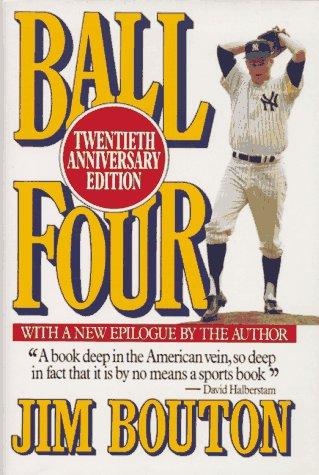
Jim Bouton · Buy on Amazon
"That’s exactly what it is. It’s a diary of a season. Jim Bouton was a wildly successful young player for the Yankees and then basically lost his arm, he got hurt. The book is about his attempt to come back. What makes it wonderful reading, and the reason I love it, is that it’s beautifully written and, again, there’s a great deal of humanity in it. There is certainly also a lot of shock-value in it. There are stories about athletes taking drugs and some of the off-field relationships. That is what made the book somewhat scandalous when it first came out. Yes, there is quite a lot of that in there. But Jim is a wonderful writer and the book really turns out to be the story of somebody trying desperately to hold onto his youth, trying desperately to hold onto his talent. There’s the famous last line of the book: “You spend a good piece of your life gripping a baseball and, in the end, it turns out that it was the other way around all the time.” There’s a depth to the writing, and to the story. Again, the great American baseball story is the story of the player at the end. There’s the wonderful youth when they’re a dominant player, but how will it be when you can no longer throw at 95 miles an hour, when you can no longer hit 40 home runs? How are you going to handle that? From a player’s perspective, I think this is almost unquestionably the best-written book on that. There are other books like it, and some are very, very good, but this is the one that captures it best. In a vague way he does, and he actually tries another comeback, which he added to the book later. He doesn’t, of course, come all the way back – he never does recapture his youth. I don’t want to ruin it for anyone. It’s about the struggle. It’s a very funny book."

Lawrence S. Ritter · Buy on Amazon
"What Lawrence Ritter did is he went back and talked to a bunch of players about their era. Again, it’s wonderful because there is this humanity to it. He’s talking to these athletes long after their successes are over. The stories get to be somewhat exaggerated, and somewhat more fully realised in a lot of ways. I don’t know if I would rely on every single thing in the book if I was writing a doctoral thesis or a paper, but it’s just wonderful, fun reading about a time when baseball was really just becoming the American pastime. There are so many characters that they talk about, and so many stories. It makes for great baseball reading. It does have some of that in there. But it’s a big book and it has a lot of great reading in it. It’ll touch on that, then it’ll have some of the best Babe Ruth stories. There are some great stories about the players. This was back in the day when they were essentially coming right out of the coal mines, or right out of the factories, to try to bang out a bit of a living playing baseball. It was a very, very different time than it has been, even in the last 50 years or so. It touches on a lot of the scandals of the game back then, the challenges of the game, the fun of the game. It gives a great feel for that time. You come away from it feeling like you really understand that era a lot better – not just that era in baseball, but that era of American history. There is definitely a nostalgic feel to the book. One of the great things about baseball -– probably more than any other sport, and perhaps because of its history – is that people in the 1920s longed for the days of the teens, people in the 30s longed for the days of the 20s, and people in the 40s longed for the days of the 30s. Baseball is really a sport where people tend to look back more than they look forward. In some ways I am. I’ve been writing about baseball for 25 years or so and there have been some wonderful books that have come out in the last 25 years about baseball now. But to me, as a reader, I almost need the passage of time to fully enjoy those books, to feel about them the way I do about players from a little bit more in the past."

Jane Leavy · Buy on Amazon
"This is just a wonderful biography of one of the great pitchers of baseball history. Mostly the 60s. His real prime was the mid-1960s. Again, we’re talking about a very different era, with civil rights, with Vietnam in the air. There was this different kind of feel in America. Koufax was this heroic figure. What I love about the book is that, again, it’s definitely not just about sports. Jane Leavy starts the book by saying what a pride Sandy Koufax was to Jewish people, and what a pride he was to her when she was young. He was not only a great Jewish athlete – of which there haven’t been that many in baseball history – but he was proudly Jewish. He sat out for Yom Kippur during the World Series. He stood out, in a way, for that time. She talks about religion, she talks about the stance he took on it and of course she talks about what an amazing pitcher he was. He grew up in Brooklyn and ended up playing for the Dodgers. Then the Dodgers moved out to LA as the country was expanding. Support Five Books Five Books interviews are expensive to produce. If you're enjoying this interview, please support us by donating a small amount . Again, what connects all these books is their connection to American history. I really like that. I wouldn’t call myself a history buff, because I don’t know enough about history to say that. But I love reading about history. The books that connect baseball to a time and place in America are the ones that move me most. I’ve tried! I made a specific effort to do that. I could name 50 baseball books that I’ve loved to read, but what I really wanted to do was try to capture something. I’ve done a lot of reading – and even writing myself – about the Negro Leagues, where African-Americans used to play before Jackie Robinson. There have been some wonderful books about the Negro Leagues. But I felt that with The Boys of Summer I got quite a lot about Jackie Robinson already, so I wanted to move to different eras, to try to capture a little bit of the century. I really think so. I think baseball now is every bit as great, if not greater in many ways, than it ever was. I wrote a book about Buck O’Neil, who was this great Negro Leagues player and manager, and a wonderful, wonderful man. People would always say to him, “You must really miss the days when baseball was… whatever, in the 50s or 60s.” He’d always say, “No. Baseball is still baseball”. I think that’s exactly right. Baseball has this staying power. The scandals are part of the game – whether it’s the steroid scandal of the 90s, or the slow-moving efforts to bring African-Americans and dark-skinned Latin players into the game in the 50s, or the gambling scandals of the teens. Those have always been a part of the game, but the game has always endured. Get the weekly Five Books newsletter It began in the mid-70s. That’s when the union, led by Marvin Miller, really started to assert itself and they won a big court battle. It’s funny, because players started making as much as $100,000, and people were outraged. Then suddenly players were making $1m and people were outraged. Then they were making $5m-10m. Now there are players making $25m-30m a year. At every step along the way, there has been this extraordinary outrage. It’s moved very quickly, but even though it has moved very quickly, at every stage it has felt like a new story to people. People now complain about how much money players make. They don’t realise that they’re basically saying exactly the same thing that people have been saying for the past 40 years."