Jim Al-Khalili's Reading List
Jim Al-Khalili OBE FRS is a scientist, author and broadcaster. He holds a Distinguished Chair at the University of Surrey where he is a Professor of Theoretical Physics and Public Engagement in Science. He is currently President of the British Science Association .
Open in WellRead Daily app →Physics Books that Inspired Me (2020)
Scraped from fivebooks.com (2020-02-27).
Source: fivebooks.com

Abraham Pais · Buy on Amazon
"Subtle is the Lord is a biography of Einstein . It’s a thick book, it’s not just a breezy, gentle read. It contains mathematics in it as well. The author is a physicist and he tries to get across Einstein’s thinking when he was developing his relativity theories. I read it in my final year as an undergraduate and, at the time, I didn’t follow all of the maths, but I surprised myself by wading through it. So it’s not the easiest of reads, but it’s one of the books that made me fall in love with physics. It’s one of the books that persuaded me that I wanted to spend the rest of my life dedicated to thinking about some of these ideas. “I’m not expecting a person to read my book and say, ‘OK. I now understand the subtleties of quantum gravity or the nature of space and time.’ That takes a lifetime of effort and dedication.” Biographies are wonderful for making science come to life. This book was the first time I had a really good look behind the iconic Einstein, the Einstein as an old man sticking his tongue out, holding his trousers up with a piece of cord. That’s the Einstein everyone knows. But the really great Einstein was the man in his twenties who did all this great work, a man with all this time on his hands to think deep thoughts. He was almost an amateur at the time, in comparison with the big names based at the top universities. He was an amateur who figured out what no one else had done before. That’s not what he won the prize for. There were a few months in 1905 when he published four earth-shattering papers. One of them was on Brownian motion. When you put specks of particles of pollen seed in water you can see them jiggling about. What, he wondered, is the life force inside water that makes them do that? He proved that it was the thermal vibrations of water molecules. This was the first mathematical proof that atoms exist. If that was all he’d ever done in his career he could have retired famous. No. He won the prize for the photoelectric effect. If you shine ultra-violet light at a metal surface the light can knock out electrons from the surface of the metal. So the light has an oomph to it. At the time people thought light was a wave and if they sent brighter light then electrons would be knocked out with greater energy. But it didn’t happen. Einstein understood that light isn’t exactly a wave. It’s made of particles, what we call photons. The only way you can knock off electrons more energetically is to change the wavelength. He won it for this because to win the Nobel Prize your theory has to be backed up by experimental evidence. Relativity was, at the time, just a theory. Well, there are two. When he came up with the special theory of relativity in 1905 people had almost got there before him. Again, this was to do with the nature of light. Sound waves need air, water waves need water. What is the medium you need to carry light waves? What is the oscillating thing that light travels through? It must be invisible to us and must pervade all space or the light from the sun and stars would not reach us. At the time scientists called it the ‘ether’. But when they did experiments it seemed not to exist. No one could understand how, but Einstein proved it doesn’t exist – light travels through empty space and doesn’t need a medium. I should say that I teach this to undergraduates and this one concept takes me all term to explain so it’s hard to do it in a few sentences. Light will travel at the same speed according to all observers no matter how fast they are moving in relation to each other. So, if you stay still but I head off chasing a beam of light in a space rocket that travels at three quarters of the speed of light then you would expect that when I looked out of the window it would appear to be going more slowly than it would to you on the ground. But, actually, we both see it moving away from us at the same speed. Because in my space rocket my time is running more slowly than yours. This is where all the stuff about time as the fourth dimension comes from, the space-time continuum. And the fourth paper, the E=mc² one, was an afterthought. When I ask people what they know about the theories of relativity this equation is what they come up with, but it was a consequence of the more important first paper about the way time slows down and space stretches. Yes, the easiest way to explain why this happens is to think speed is distance over time. So, if speed (of light) is constant and time changes then distance has to change too. If you are travelling very fast, close to light speed, then your clocks will appear to outside observers to be running slower and you will look squashed up and flatter. This is not an optical illusion. Well, it seems like an optical illusion because you don’t feel any different. You don’t feel yourself becoming squashed up but the point is that everyone’s point of view is equally valid. The popular way of describing this would be to say: ‘Everything’s relative.’ No. Einstein says there is no absolute constant for length or time. If something that is 1m long is moving very fast it looks shorter. There is no frame of reference because nobody can say that they are truly stationary. It is democratic – you can’t say my clock is fast and yours is slow. Yes, because we don’t move anywhere near the speed of light so these effects are tiny enough for us to ignore in ordinary life. But in things like GPS systems, satellites, these effects have to be taken into account – a satellite is moving round the earth so they only work if we do take into account the fact that the clocks on the satellites slow down. This all follows from the weird nature of light. And that’s just the special theory of relativity. There’s also the general theory of relativity. We all know about Newton’s law of gravity. The apple falls on his head because of this invisible force of attraction. It turns out that this is actually a very crude explanation for what happens. What Einstein said was that actually anything with mass, which therefore has a gravitational pull, actually curves space around it. When the earth orbits around the sun it is just following the curved path in space-time. Einstein’s general theory even explained black holes and how the universe began with the Big Bang. When a massive star runs out of nuclear fuel, has no more hydrogen to change into helium (this is thermonuclear fusion), it stops shining and there is nothing to stop it collapsing under its own weight. It has been inflated by heat and energy but then it collapses. If a star is massive enough it collapses under its own weight so violently, getting denser and denser and curving space around it until it literally punches a hole in the universe. Yes, and it could be curved but finite. We don’t know. It could be infinite but it is impossible to imagine because we can’t visualise higher dimensions. So we can simplify it a little: a sheet of paper could be infinite but you could still punch a hole in it. You could even imagine this hole leading to another sheet underneath it, which would be a parallel universe. Einstein suggested that there could be a parallel universe at the other end of a black hole. Black holes could be like tunnels leading back out of another black hole via what is called a wormhole. Like Alice in Through The Looking Glass , they become gateways to somewhere else. It’s mathematically possible but can’t be proved yet. Einstein’s theory of relativity works because it’s been tested many times, so if it predicts this other more exotic stuff that we can’t test we still have to take it seriously."

Albert Messiah · Buy on Amazon
"That’s right, it’s a quantum mechanics textbook. It’s not even as an undergraduate textbook, it’s a graduate, PhD-level textbook. But when I started my PhD, I was expected to buy some textbooks with part of my stipend, a few hundred pounds. I was given a list of books by my PhD supervisor and Messiah’s two-volume book on quantum mechanics was top of the list. It’s the book I needed to get me up to up to speed to work on the area of research I was doing for my PhD, which was nuclear physics. For me, it’s still the Bible of quantum mechanics that I go to when I want to look something up that I’ve forgotten. Get the weekly Five Books newsletter The book was originally written in French and it goes further than all that undergraduate stuff about atoms being in two places at once and it throws a lot of the laws of physics out of the window and says… Yes. You cannot say for sure where an atom is until you look at it. Looking at it makes it decide. Only when you look at it is it in one place. Well, yes. I mean, you don’t look. You send an atom through something with narrow slits in the top and bottom and you hear a blip when it hits the other side. You send loads of atoms and so would expect to see loads of hits at the top and the bottom adjacent to the two slits. But you don’t. What you get is an interference pattern like you would with waves washing through both slits at the same time. But you get this effect even when you send only one atom at a time. But if you spy on it then it only goes through either the top or the bottom and not both at once. It’s as though it knows you’re looking. If I knew that then the King of Sweden would be calling me up with the Nobel. It’s counterintuitive and weird but we’ve learned to accept it. Quantum mechanics is hugely accurate – most of modern scientific development is based on it and on what it tells us about the subatomic world, but at its heart it says that an atom can be in two places at once. We’ve learned to live with that. You mean why doesn’t your hand go through a table? Because electromagnetic forces hold the atoms together and give rigidity. Atoms themselves are mostly empty space – there’s a nucleus and then these electrons buzzing around. The nucleus has a positive charge and the electrons have a negative charge, so the negative charges repel each other and it is this electromagnetic force between the atoms in my hand and the atoms of the table that give rigidity and solidity."

Richard Feynman · Buy on Amazon
"Everyone should read this book, because it gets across why a subject like physics is so enjoyable. Physics is not just about sticky tape and rolling balls down hills and springs and batteries and ripple tanks—the sort of physics that a lot of people remember from school and may have turned them off the subject because they think it’s dry and boring. A book like Surely You’re Joking, Mr. Feynman! gives you the joy of discovery. Feynman is the most colourful character in physics and he just showed what an incredible adventure science was and is. He just makes you think: ‘Wow! How can the world be like that?! Wait until I tell everyone! I mean, you think the paranormal is amazing – let me tell you about quantum mechanics!’ Get the weekly Five Books newsletter Feynman epitomises this attitude, the absolute joy of seeking answers. He was a genius but he was also an extrovert and loved playing pranks. He was a very young scientist in Los Alamos, working on the Manhattan Project, and he recounts how he found a hole in the fence. There was all this security but he didn’t tell anyone he’d found a hole; he just came in through security in the morning and then crept out the hole and came in again, trying to see how many times he could do it before security noticed he hadn’t actually left. He just had this wonderful sense of fun and this book relates episodes from his life. Well, there’s a bit where he’s making spaghetti with a young researcher and he notices that whenever you break a stick of spaghetti it never breaks in two. It breaks into three pieces. The middle bit pings off. We would just say: ‘That’s weird.’ But Feynman studied it mathematically, looking at the properties of spaghetti and its bendiness. He was one of the committee looking at the space shuttle Challenger disaster and he realised that it was one of the rubber O rings in the fuel tanks that had got cold and brittle and had snapped. At the press conference he took a tiny rubber O and dropped it into his glass of iced water to demonstrate. He brought science alive to people."

Albert Einstein and Max Born · Buy on Amazon
"Absolutely. The Born-Einstein Letters is a collection of the correspondence of these two men over decades and decades. You know – ‘Dear Albert…’ ‘Dear Max…’ There’s no commentary at all, just the letters. Max Born is one of the unsung heroes of the quantum revolution. He was at least as influential as Bohr, Schrödinger and Heisenberg. It’s a mixture of two old friends and colleagues keeping in touch, but also highlights the ongoing debate, in particular about some of the ideas of quantum theory, in the first half of the 20th century. Quantum mechanics’ revolutionary way of looking at the structure of the subatomic world changed our view and overthrew a lot of old notions. But Einstein—probably the greatest physicist who ever lived (bar maybe Newton)—had issues with it. He was unhappy with some of its implications and famously had debates with many of the founders of quantum mechanics. He was almost like an outsider on this. The Born-Einstein Letters is a correspondence over many years highlighting the toing and froing in these arguments about the nature of reality between two of the giants of the field. The book gives us a window into what their problems were and how they tried to persuade each other their view was right. But it’s done in a way that is reasonably accessible to people. You don’t have to be an insider or an expert to follow their arguments. The letters map out the whole of the theory of 20th century physics but include all the conflict and personal life, the head-scratching. I think we’re all having to re-examine and revise how we feel about some of the great scientists and thinkers. There’s no doubt that without their contribution the world wouldn’t be the way it is now. The advances in science have led to advances in technology, which have made our lives better and richer. They have changed the world and we can’t take the contribution they’ve made to science away from them. But people like Erwin Schrödinger, Albert Einstein and Richard Feynman were, in many ways, misogynists. They were sexist. They had some views that today would be utterly unacceptable. And we do have to temper our enthusiasm and admiration for their work with how we feel about them as people. We shouldn’t just unquestioningly say, ‘these were great people, they made great contributions to science and knowledge.’ We also have to acknowledge that as human beings, in their private lives, they weren’t as pleasant as they could have been. It’s not enough just to say, ‘It was a different time then.’ With some of these things you have to draw a moral line. Today we live in a different world and when we look back we have to judge them differently as well."

Roger Penrose · Buy on Amazon
"I read The Emperor’s New Mind when I was either finishing or had just finished my PhD. There was huge excitement when it came out in 1989. It was a book that was so rich in lots of different areas. I just remember the excitement of reading it and feeling, ‘Yes! And this is the subject that I’ve chosen to work on for my career!’ He really got across the passion across lots of different areas. Again, it’s a book that I think could be enjoyed by anyone who wants to know a little bit more about the subject. And it really hasn’t dated much. I believe so. He wasn’t simply Stephen Hawking’s sidekick, as many people might see him. He’s now 88—I know that because he’s the same age as my father—and he’s still coming up with ideas, with ways of explaining the evolution of the universe. Between them Hawking and Penrose developed the theory of black holes. Einstein had provided the mathematical framework with his general theory of relativity, but they studied them theoretically to understand their properties. Well, spotting and identifying a black hole is astronomy . This has nothing to do with that – it is theoretical work. Anyway, in this book Penrose brings together different areas of modern science like quantum mechanics and thermodynamics, which says that if things are left to their own devices they decay and unwind and disorder increases. If you take an ordered pack of cards and shuffle it they will get mixed up. That doesn’t work the other way round. If you take a disordered pack of cards and shuffle it they won’t come back up in the right order. Well, they might but the odds are so tiny that we can ignore them. Things do not spontaneously order themselves. So, the question is, unless you have a divine creator, how are we such organised and developed structures, here? Support Five Books Five Books interviews are expensive to produce. If you're enjoying this interview, please support us by donating a small amount . His ultimate idea is that he wants to explain consciousness using logic, philosophy and quantum mechanics. This is very controversial and has spawned all kinds of interdisciplinary conferences with theologians, philosophers, physicists, all exploring the ideas that come from this book. He does come up with a way to get complexity out of randomness without God. There are proteins in the brain, tubulin, which can have two shapes at the same time, a quantum superposition, but when consciousness clicks in they choose one particular shape. But this idea of how we get complex structures from random chance and simple rules is fascinating. I don’t."
The Best Science Books to Take on Holiday (2019)
Scraped from fivebooks.com (2019-06-13).
Source: fivebooks.com

Philip Ball · Buy on Amazon
"I thought I’d kick off with something simple! How about a book on the meaning of quantum physics? You may have heard the saying, ‘If you think you’re not baffled by quantum mechanics then you haven’t understood it’. Well, there is certainly no shortage of books out there all vying for the title of best demystifier of this counterintuitive, yet powerful, theory of the subatomic world. Philip Ball’s book, which has received much praise since it was published last year, is one of the most lucid and enlightening books on the nature of reality of the quantum world that I have ever read."

Hannah Fry · Buy on Amazon
"Computer algorithms are playing an increasingly important role in our lives, so should we be afraid? This immensely enjoyable book from the mathematician and broadcaster, Hannah Fry, looks towards the not-too-distant future when machines might rule supreme, making important decisions on our behalf, not just about what movies we might want to watch online or what items to buy, but in healthcare, transport, finance and security. She explores whether this is the kind of future we want. The fact is, the age of AI is coming fast, and we need to be ready for it. This book will help you decide how worried you should be."

Sarah-Jayne Blakemore · Buy on Amazon
"Any parent of teenagers will enjoy this book. What is it that happens to your child’s brain as they enter adolescence—their mood swings, their need for intense friendships, the excessive risk taking . . . Blakemore is a superb neuroscientist, and also, it turns out, a remarkably engaging and talented writer. Drawing on her own research, she digs into the teenage brain and explains how it undergoes such a remarkable transformation. Teenagers have been much maligned, but there is a biological reason for their behaviour and we really should cut them some slack. Get the weekly Five Books newsletter"

Carlo Rovelli · Buy on Amazon
"Because they are translated from the original Italian, Rovelli’s books retain a beautiful poetry which, combined with his deep knowledge of fundamental physics, make for a wonderfully charming mix. This, his latest book, will definitely get you thinking. It deals with the age-old mystery of the nature of time itself and what modern physics has to say about it. To give you an example of his style, when he tries to persuade us that the most fundamental feature of our universe is not the solid, permanence of physical matter, but ephemeral events in space and time. He says ‘the world is made up of kisses, not stones’. See what I mean? Utterly mesmerising."
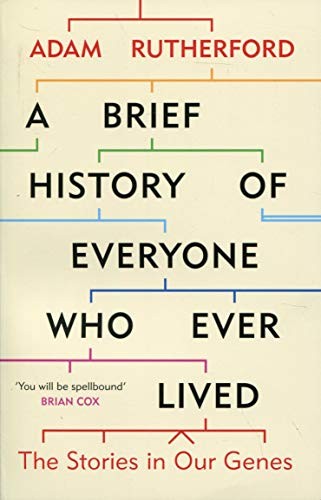
Adam Rutherford · Buy on Amazon
"I took this book on holiday with me a couple of years ago and simply couldn’t put it down. I kept annoying my wife by sharing with her a lot of the ‘did you know . . . ?’ nuggets I was reading. Rutherford tells the story of our genetic makeup, how it has shaped human history and what history can now tell us about our genes. It’s a hugely illuminating and fresh take on who we are and how we came to be."