James Warren's Reading List
James Warren is Professor of Ancient Philosophy at the University of Cambridge and a Fellow of Corpus Christi College. He is currently completing a book on the moral psychology of regret in ancient philosophy, to be published by Oxford University Press.
Open in WellRead Daily app →The Epicureans (2019)
Scraped from fivebooks.com (2019-12-21).
Source: fivebooks.com
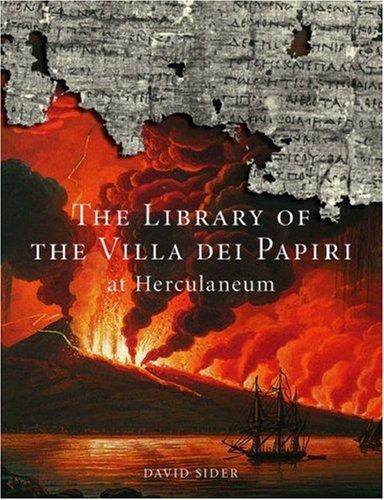
David Sider · Buy on Amazon
"It’s another remarkable and curious accident in some ways. And it’s one of the things I think that, for me at least, makes Epicureanism a really challenging and interesting area to work on because we have this variety of kinds of evidence. We’ve got Diogenes, we’ve got Lucretius, and we have a range of other secondary texts. The town of Herculaneum, in southern Italy, was one of those that was completely destroyed by the eruption of Vesuvius in 79 AD, and when it was excavated it was discovered that there was a rather opulent villa just a little outside the town that had a library, and in that library were preserved—albeit in a scorched, carbonized form—papyrus rolls of ancient books. Quite a lot of them in fact. It’s likely that we haven’t excavated fully the extent of the library. There may well be texts still remaining to be discovered. So this book by David Sider about that villa is a lovely introduction. It’s detailed, but accessible and it talks about how papyrus is made, how ancient books were made and used, and then describes the history of the excavation of this villa and the recovery of these texts, first of all in the 18th century. It’s a fascinating story that continues now with people who are interested in novel ways of reading and unrolling these papyri. They’re a bit like a tightly packed loo roll, with a kind of core and then the rolls of papyrus wound around it. But the papyrus has completely carbonized as a result of the eruption. So it’s very difficult, first of all to unpeel one layer from another. Previous attempts to do so have often resulted in damage to the roll. Then, even when you unroll it, what you’re faced with is black text on a black background, which is extremely difficult to read. For a long time people had to just hold it to the light so that the light reflected slightly differently off the ink than off the base papyrus and gradually and carefully and meticulously transcribe what was there. “There may well be texts still remaining to be discovered” People are now developing really interesting technological ways of CT scanning these papyri and digitally unrolling it, if they can, which does less violence to the thing that’s there and may well be a way of proceeding in the future that will give us better and better readings of these texts. Anyway, David Sider sets out all of these challenges and the interest of the texts. What might matter for the study of Epicureanism is that many of these texts, in fact the majority of them, are indeed quite technical and detailed philosophical texts by members of the Epicurean school, including Epicurus himself. We have bits of works by Epicurus that we didn’t have through the indirect transmission from people like Diogenes or people quoting him in later antiquity. These are direct texts from antiquity, which is a very unusual. It’s the largest find of papyri outside Egypt and through an enormous painstaking effort by scholars, especially since the 1970s, we are now beginning to produce more and more and better understood editions of these works, and they really are transforming our understanding of the richness of what Epicureans were doing as well. One example is lots of works by an Epicurean author called Philodemus who was a rough contemporary of Lucretius, but who wrote in Greek rather than Latin. From him we’ve got all sorts of works on aesthetic theory, which is a gap that we otherwise wouldn’t know anything about from the other kinds of texts that have survived one way or another. You can, but they’re really quite hard to read, in the sense that what you’ll find is even in areas where the text is legible, it’s often damaged. What papyrologists have to do is work out precisely what can be read and then depending on how optimistic they are, they often suggest what went in the gaps, based on their understanding of the overall text. There are various bits where we’ve got a more or less continuous text, where you can you can actually translate it. So there are editions available, but they tend to be not just quite technical to read but also the ancient texts themselves are often rather more specialised and technical in their subject matter. Yes, that’s quite likely. Lucretius seems to have based his work on Epicurus’s On Nature , which was an enormous multi-volume work, bits of which we have surviving on these papyri, but we don’t have the full work by any means. In fact, we’ve got good reason to believe there were multiple copies of Epicurus’s On Nature in that villa; often there are multiple papyri that have the same parts of Epicurus’s On Nature on them. It may be that some of them are copies they themselves had commissioned. It does seem it might have been a matter of conspicuous learning to have multiple copies. It looks like some people were deliberately trying to source better copies than the ones that they had, because it was known there were textual variants and so on, and maybe they were trying to source older copies as antiquarians might search out first editions of things. Oh, yes, and this is similar. That same villa is also famous for the enormous range of sculpture that it contained. Yes, and the other interesting thing is if you want to get a sense of what the villa was like, the Getty Villa in Malibu, California is modelled directly on that floor plan. So you can go and pretend to wander around the Villa of the Papyri. That’s right. The last two books I’ve chosen are discursive critical engagements with Epicureanism, so ways of presenting the material but also getting to grips with it in the sense of trying to evaluate the arguments, trying to evaluate the cogency of the arguments and so on. These are the kind of books that I would set my students to read once they’ve read the primary texts. So these are ways of getting them to work out where they might direct their fire if they’re interested in getting to grips with this stuff."

Tim O'Keefe · Buy on Amazon
"Tim O’Keefe is a really excellent scholar of Epicureanism. There are a number of works that are explicitly supposed to be introductory to people who are wanting to engage with Epicureanism in this way. I chose this one because it’s a relatively brief, but really well written and very philosophical. Tim deliberately avoids the philological nitpicking that you might get elsewhere and takes you directly to the meat of things. It’s very readable and it covers the whole range of Epicureanism. He doesn’t merely concentrate on the ethical stuff that people find fascinating; he’s just as interested in Epicurus’s theory of perception, of knowledge, and so on. So, I think it’s a really good way in. If that doesn’t suit, then I should mention there’s a really excellent Cambridge Companion to Epicureanism , which has multiple authors, but I think is certainly worth checking out. I edited that particular volume so it didn’t make it onto my list. That’s right, though I think there is a virtue to having a single guide to take you through it, actually, because that person can look at the system as a unity and present it in ways that make interesting connections."

Julia Annas · Buy on Amazon
"The book is called The Morality of Happiness . It’s not devoted entirely to Epicureanism: it’s a really deep and sophisticated presentation of the way these ancient philosophers went about thinking about ethics. So Julia starts with Aristotle, quite reasonably, because in some ways that’s the first systematic approach to ethics in this vein that we have, but also takes on those schools after Aristotle. So the Epicureans are one, the Stoics are in here as well. And then she also looks at some Sceptics and various other kinds of people like that. “What you want to do is live a life that avoids the harm and maximises the good” Why I think this is potentially interesting is that it’s a way of fitting Epicurus into a broader philosophical context and showing the ways in which Epicurean ethical theory is part of a way of thinking about approaching these questions that’s shared with Aristotle and the Stoics, but also what Julia does really well is draw out the various important differences between these schools and how they go about things. So for example, there’s a really interesting section about how these schools appealed to the notion of nature, or what is natural for humans to do. Aristotle has a view of what humans are by nature, the Stoics have a view of human nature, the Epicureans do too. They all share that. Epicurus thinks of us as animals: we are basically animals, although we have rational abilities that other animals lack. Our nature as living things is such as to dictate that we have various basic needs in order to keep going. So we need to drink, we need to eat, we need to remain at a certain temperature and so on, and also we have natural reactions to the world and those natural reactions boil down, principally, into the two reactions of pleasure and pain. So certain things cause us perceptible harm and certain things cause us perceptible benefit. And if you think of that as our nature, if you want to live as good a life as possible as an animal of that kind, what you want to do is live a life that avoids the harm and maximises the good. You do that by recognising what your natural needs are. One illustration of this is Epicurus’s treatment of desires that he sees people around him have, for example the desire for political power. Just imagine having a desire for political power, thinking that’s a good thing. Well if you understand properly what you are by nature, you’ll recognise there’s nothing really in your nature that shows that that’s something worth having. That’s not a natural desire to have for Epicurus. So it’s unnecessary. Epicurus thinks that reflecting properly on what your human nature is, will lead you to recognise that that’s a completely empty desire. And therefore you will stop desiring it, with the great benefit that you won’t get upset if people vote against your motion in the Senate. Nor will you strive to attain the rank of consul or prime minister and it will make your life a much better one as a result. It is, yes. That’s another aspect that Julia draws out: the way in which all of these theories are, in a way, egoist. The driving question is always ‘How can I make my life go as well as possible?’ Now in certain other formulations that will of course involve what Julia calls ‘other concern’, so it will matter to you how other people fare, because, for example, if you’re Aristotle you say that part of what humans are by nature are animals that live in societies. So your nature is as a social animal and in that respect the good of the people in your community is something that matters for you and for your life going as well as it could. But it’s a really important question whether the Epicureans have a strong foundation for other concern. That’s something that the ancient critics do worry about too. If really the central question is what does this do for my pain and my pleasure, then do I really genuinely care for someone else? Am I only caring for them in so far as it impacts upon my pleasure or pain? And I do think the Epicureans have something of a struggle to say anything particularly in favour of what we might call genuine other concern. No, I wouldn’t. Where I don’t follow them is: I don’t think that everything that’s of value can be reduced to its production of pleasure, and I think if you are sceptical about that, then many of the Epicurean recipes are significantly undermined. Oh yes. I think the Epicureans attitude to the divine is something that lots of people might take seriously. Their attitude to death, too, is powerful and persuasive in large part. And I also think they probably are right that many of the things we desire are things that actually don’t make our life better if we get them or worse if we fail to get them. So that’s certainly something to bear in mind. But their central claim that the only good is pleasure, doesn’t carry weight with me."