Hyeonseo Lee's Reading List
Hyeonseo Lee grew up in North Korea but escaped to China in 1997 and lived there for more than 10 years. She went to Seoul, South Korea, in 2008, and struggled to adjust to life in the bustling city. Her book The Girl with Seven Names tells the story of her escape. She has become a regular speaker on the international stage fostering human rights and awareness of the plight of North Koreans; her TED talk has been viewed over 7 million times.
Open in WellRead Daily app →North Korea (2016)
Scraped from fivebooks.com (2016-07-21).
Source: fivebooks.com
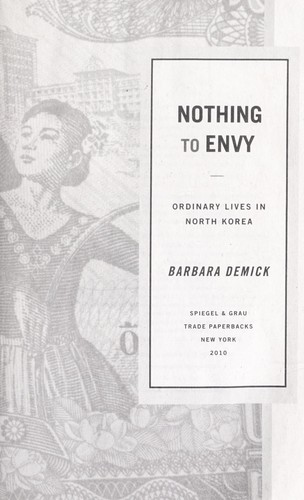
Barbara Demick · Buy on Amazon
"In her book, Demick interviewed several North Koreans who are now living in South Korea, and then told their stories so that we can really understand their experiences both inside North Korea and afterwards, once they had escaped. She includes great details that show everyday life in North Korea, including descriptions of a couple who have a secret relationship, as well as a doctor and an elementary-school teacher. They all live in Chongjin, which is North Korea’s third largest city, so it’s an area that people might not be so familiar with. There are still people living in Pyongyang who are very poor, because it’s the capital and black markets, or what we call ‘private markets’ are forbidden there. In other provinces people have more freedom, and there are many other cities. The rich one percent who live in Pyongyang are completely atypical of the rest of the population. They are so different – afforded so many other privileges – it would almost be impossible to outline the distinctions here there are so many. But they have so much more luxury, relatively. When I first visited my uncle’s house in Pyongyang, I was really shocked. I thought my family was rich, but Pyongyang was on an entirely different level. That was the first time I knew there could be a different kind of life."

Daniel Tudor & James Pearson · Buy on Amazon
"This new book covers a range of topics about North Korea today. There are chapters on private commerce, leisure activities, crime and punishment, and even fashion trends. Some of the information is revelatory, especially about black market trade with China that has allowed goods and information to come into North Korea, for example foreign films and books smuggled in on USB sticks. It explains how many of these developments happened after the famine in the 1990s, when many North Korean people realised they had to depend on themselves and not the regime to survive. The outside world has transformed, and although the pace of change is much slower in North Korea, life is changing there, too – hugely. When I was growing up in the eighties and nineties, we didn’t have landline phones – only companies had them. But new technologies have come over the border from China, including mobile phones, which became desirable objects for North Koreans. “Developments came after the famine, when many North Koreans realised they had to depend on themselves and not the regime to survive.” The regime always told us we were the best country, but we didn’t even have cell phones, so that’s why they had to bring them in. Also the North Korean government needed the money from trade with China. The use of cell phones influences the way the country is changing, but it doesn’t mean there will be a revolution. There is still no internet."

Michael Breen · Buy on Amazon
"The book gives readers unique insights into the personal life of North Korea’s second dictator. I hope it book is loaded onto the USBs that are smuggled into North Korea to give the people a sense of the true nature of their ‘Dear Leader’. In comparison with his father, Kim Jong-il was mostly disliked among the North Korean populace, but he was a cunning propagandist and political strategist who maintained power and ruled the country with an iron fist. Get the weekly Five Books newsletter Breen’s book helps us understand how he gradually rose to power, and deceived not only his own people but many in the international community as well. During a period of rapprochement between North and South Korea in the early 2000s, Kim Jong-il actually managed to convince some South Koreans that “I am not like a man with horns on the head”. After reading this book, one is likely to disagree. Just last year several such books were published. The publishing market has changed. In the past, foreign journalists were writing our stories but now we defectors are speaking for ourselves, which proves how the international community is giving us more attention. That frightens the regime, who think we are dangerous. It’s a trend that only started a few years ago, and it’s really encouraging, though often nerve-wracking. Now I’m hoping that real action for change will follow. Actually I hate it when people say that. I know the country has changed in some ways, but the fundamental things never change in North Korea and we have to focus on that. The regime hasn’t changed, the dictators haven’t changed, the public executions and political imprisonments haven’t changed. People are still oppressed, denied their human rights such as freedom of movement – in essence they are imprisoned within the country. Having a cell phone or a little bit of money from the private markets does not count as real change."
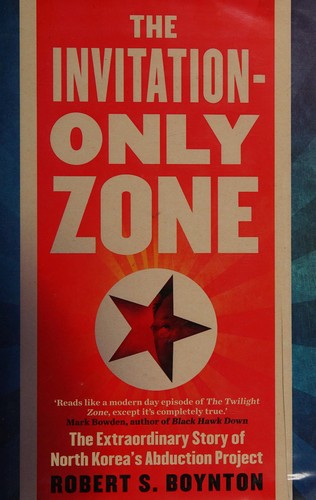
Robert S. Boynton · Buy on Amazon
"This paints a frightening portrait of North Korea’s abductions of Japanese citizens and North Korea’s efforts to use them to train spies. The stories are heartbreaking, and a constant source of tension between North Korea and Japan, even today. Boynton draws on a wide variety of interviews from defectors, diplomats, abductees and even crab fishermen to explain how North Korea was able to carry out its abduction program, and the fight to bring the abductees home. “The regime hasn’t changed, the dictators haven’t changed, the public executions and political imprisonments haven’t changed.” The book is particularly relevant these days, as North Korea appears to have abducted some South Korean citizens in China in retaliation for the defection of some North Korean restaurant workers, which North Korea claims were “abducted” by South Korea’s National Intelligence Service. We give too much attention to the nuclear issue, which detracts from the issue of the denial of even the most basic human rights in North Korea. The suffering of the North Korean people is more important to me than the nuclear issue, which I think is a distraction from the more pressing concerns, including swathes of the population still starving, undernourished and malnourished, and this just the tip of the iceberg. Kim Jong-un knows that if he used nuclear weapons against other countries, his regime would be obliterated. He is using the nuclear issue as a threat to protect his hold on power, and – what is more – as domestic propaganda, showing the North Korean people how great he is, and to reinforce the falsity that the outside world hates North Korea."

Paul French · Buy on Amazon
"This is an excellent introduction to the history and politics of North Korea, including its complex relations with South Korea, Japan and the USA, and provides a good general overview of where the regime is coming from, and what it might do next. I am always interested in the perspectives of foreigners writing about North Korea, although sometimes I feel it’s not always correct. They can only present the theory on the surface, not the inner understanding. Support Five Books Five Books interviews are expensive to produce. If you're enjoying this interview, please support us by donating a small amount . My grandfather was from the elite, and had many books by Marx and Lenin, which was uncommon at the time. But when Kim Jong-il started to gain power in the 1970s, our ‘Dear Leader’ removed most of the books and had them burned. In South Korea, I saw a movie about Nazi Germany when they were burning the books. That reminded me of what Kim Jong-il did. His regime then replaced most of the books with multi-volume Kim Il-sung memoirs. “Swathes of the population are still starving, undernourished and malnourished” We did have some detective and spy novels though, about North Korean spies in South Korea. There were a few foreign books, such as The Count of Monte Cristo , but often they had pages that were stuck together with glue. We wondered what could be inside. We did have some foreign films as well, but only from China and India. And it was very obvious when something had been cut, like a kissing scene. When I first went to China, there weren’t many books in Korean. But I found a book about marshmallows, and I read it over and over. I had no idea what a marshmallow was, and I had never eaten one. I ate my first marshmallow in 2013, and now whenever I see a marshmallow it reminds me of that book. I also read a lot of history, and recently I’ve been reading about the re-unification of East and West Germany, to compare it to the situation in Korea. Of course. Nobody expected the German reunification to happen when it did. Many experts have been expecting re-unification between North and South Korea for some time, yet our peninsula remains divided. Who knows? It will be very difficult, but the German example has inspired me. Sometimes I like to imagine that it is happening in my country instead, and I hope that day will come."