Hester Blum's Reading List
Hester Blum is Professor of English at Pennsylvania State University. She is the author of The View from the Masthead: Maritime Imagination and Antebellum American Sea Narratives and The News at the Ends of the Earth: The Print Culture of Polar Exploration , as well as several edited volumes, including a forthcoming edition of Moby-Dick for Oxford World's Classics. Blum is past president of the Herman Melville Society, and her honors include a Guggenheim Fellowship. She participated in the 38th Voyage of the Charles W. Morgan, the world's last surviving wooden whaleship and the sister ship to
Open in WellRead Daily app →The Best Herman Melville Books (2021)
Scraped from fivebooks.com (2021-10-08).
Source: fivebooks.com

Herman Melville · 1851 · Buy on Amazon
"In recent decades, many scholars have been committed to reexamining declarations of literary and historical greatness, primacy, or supremacy, recognizing that notions of transcendence have always been rooted in subjective and structural biases. To call a work timeless may be a shorthand for elitist judgments, but it can also suggest how each time period brings a fresh perspective to the text. This is what makes reading Moby-Dick exciting now, whenever your now is. “The humming restlessness of his writing speaks to me” Lovers of nature writing may not have seen in Moby-Dick’s cetological chapters an explicit rejection of extractive fossil fuel industries, for instance. But present-day readers can read the novel as attending to natural resource depletion. Ishmael sees “honor and glory” in whaling even as he wonders—in a chapter entitled “Does the Whale’s Magnitude Diminish?—Will He Perish?”—whether “the humped herds of whales,” like the “humped herds of buffalo,” face “speedy extinction.” Ahab’s visible and invisible physical and psychological disabilities have had a new explanatory power within current conversations about disability; Ahab’s wounds in this sense are less deformations or determinants than opportunities for adaptation. Understanding the special violence and horror inherent in whiteness, which Melville writes about at length, has new urgency as critical race theory attends to the historical invention of whiteness and the Black Lives Matter movement calls for renewed attention to structural racism. These examples can go on and on, and I haven’t even talked about the novel’s chapter focusing on homoerotic sperm squeezing as a man’s height of “attainable felicity.” I’m continually discovering phrases and sentences that I had not noticed before, or had not fully assimilated, or had not fully appreciated. Here are some that leapt off the page in my most recent rereadings: “ostentatious smuggling verbalists” (those who borrow/steal the ideas of others); “His pure tight skin was an excellent fit” (a commentary on Starbuck’s tense righteousness); “how I wish I could fist a bit of old-fashioned beef in the forecastle” (Flask’s regret, now that he is an officer, that he can’t eat more casually with the common seamen); “pale loaf-of-bread face” (the hapless steward of the Pequod); and the “anonymous babies” strewn throughout the world by an imagined Lord Whale. I’m also particularly alert to the novel’s riot of odd phrases thanks to a Moby-Dick version of Cards Against Humanity created by Tim Cassedy . As the card game made me realize, there are a surprising number of references to cheese and butter in the novel."
Herman Melville · Buy on Amazon
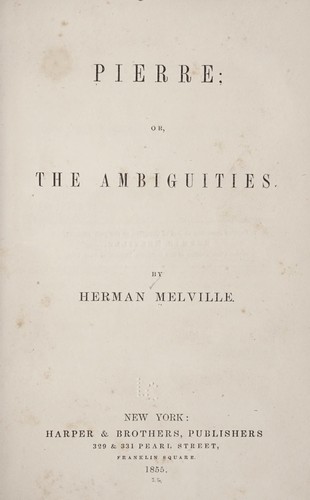
"Pierre is so bananas that a contemporary reviewer’s headline read “HERMAN MELVILLE CRAZY.” It’s an incest novel in which the titular Pierre is variously entwined suggestively with his mother, a portrait of his father, his cousin Glen, his half-sister Isabel (whom he pretends is his wife), and his fiancée Lucy (whom he pretends is his cousin). In addition to listing all the made-up words that Melville had inexcusably included in his novel (see image below), another reviewer declared it “A bad book! Affected in dialect, unnatural in conception, repulsive in plot, and inartistic in construction.” But I could not love the novel more: it’s so densely, perversely strange, so elaborately, bombastically contrarian. The pressures of patriarchal expectation, compulsory heterosexuality, and professional writing have never been so outlandishly portrayed. (Also, see Maurice Sendak’s jaw-dropping and, um, revealing illustrations of a version of Pierre, featured here .)"
Herman Melville · Buy on Amazon
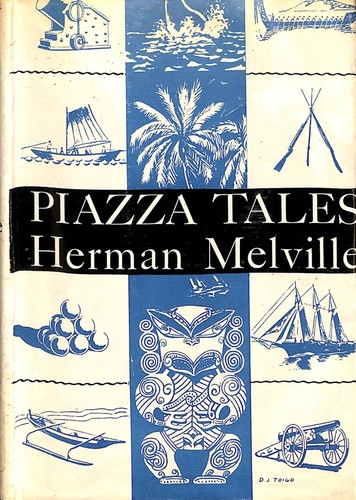
"This volume of short fiction includes three of Melville’s most widely-read works: “Bartleby, The Scrivener,” “Benito Cereno,” and “The Encantadas.” If you last read “Bartleby” in high school, it’s time to revisit it—in an age of economic precarity and the gig economy, it’s a haunting representation of what happens when a worker prefers not to continue with a dehumanizing job. “The Encantadas,” a series of sketches of the Galapagos Islands, feature some of Melville’s most dreamy and meditative writing—it’s gorgeous. And “Benito Cereno” is one of the most amazing and challenging fictions ever written: thorny, mysterious, violent, deceptive. It haunts and harrows a reader, and should. The short fiction features more narrative economy and unity without sacrificing Melville’s still-dazzlingly ornate prose. What I especially love about these stories is how tricksy and untrustworthy the narrators are—it’s hard to get a handle on who is telling the stories, and how their narrative limitations affect how the reader receives the stories. Melville is calling attention to how easy it is to swallow the account given by an authoritative voice, no matter how blinkered, biased, or harmful that voice might be. Throughout his longer novels, too, Melville certainly destabilizes expectations about the narrative voice—most of his novels have first-person narrators whose real name the reader never learns. But in the short fiction this challenge is all the more acute, all the more central to making meaning. Get the weekly Five Books newsletter"

C.L.R James · Buy on Amazon
"In the mid-20th century, C. L. R. James made the brilliant argument that Moby-Dick’s real hero—the novel’s central interest—was not Ahab, or Ishmael, or Moby Dick himself, but the multiracial, multiethnic, multinational crew of the Pequod. In James’s view, Melville imagined (but was not fully able to realize) a novel that elevated and celebrated the polyglot crew over its white officers and white totalitarian captain. James, a Trinidadian intellectual and anti-Stalinist Marxist, wrote Mariners, Renegades and Castaways: The Story of Herman Melville and the World We Live In (1952) while interned on Ellis Island awaiting deportation; he sent a copy of the book to every member of the US Senate. If only they had read it—it resonates still."

Geoffrey Sanborn · Buy on Amazon
"There are dozens of scholars today who write about Melville’s works with fierce insight and intelligence; Geoffrey Sanborn is one of the best of these, and a critic and scholar whose work I return to again and again. His most recent book does a marvelous job of addressing both new readers of Melville and his longtime scholars—it’s a terrific, accessible, and searingly smart introduction to how to read Melville and how to think about his “value” not as something transcendent, but negotiated by each wave of readers. Yes. As Sanborn writes in describing the novel’s voice, “What it wants above all else is to be in a meaningful relationship with you, and it will do almost anything—tell jokes, coin words, switch genres, change moods, share dreams, kill characters, hint at blasphemies, fly into rhapsodies, go spinning off into the ether of philosophical speculation—in order to make that happen.” It’s a superb point. In Moby-Dick Melville expostulates “God keep me from ever completing anything. This whole book is but a draught—nay, but the draught of a draught.” In reading Herman Melville’s works, the reader is invited at every stage to join in the collective work of drafting meaning, but always deferring completion. It’s an endlessly productive ferment."