Helen De Cruz's Reading List
Helen De Cruz holds the Danforth Chair in the Humanities at Saint Louis University. Her research is focused on philosophy of cognitive science, philosophy of religion, and experimental philosophy. Recent publications include Religious Disagreement (Cambridge University Press, 2019) and Philosophy through Science Fiction Stories: Exploring the Boundaries of the Possible (co-edited with Johan De Smedt and Eric Schwitzgebel, Bloomsbury, 2021).
Open in WellRead Daily app →The Best Illustrated Philosophy Books (2021)
Scraped from fivebooks.com (2021-01-22).
Source: fivebooks.com

Antoine de Saint-Exupéry & translated by Katherine Woods · Buy on Amazon
"I’m going to start with a book that I only read last month. It’s Le Petit Prince . I know people who love this book, I know people—non-philosophers typically—who say, ‘this book is my Bible. This book is so deep.’ I was struggling with what to read to my son next, so I thought, ‘Let’s read him Le Petit Prince .’ Also, he is learning French so I thought that’d be nice, we can read it in French. And I was really delighted with it. The book is interesting because it uses pictures, not just to illustrate philosophy, but as an actual part of its philosophy. For instance, here, at the beginning, it starts with the protagonist, the author. The author, by the way, did the illustrations himself and is Antoine de Saint-Exupéry, who was an airplane pilot. And he says, ‘Look, I made this first drawing, and this is the first drawing I ever did as a child. Now, what does it look like?’ Now, if you haven’t read The Little Prince , then you’re going to see what most adults see and they say it looks like a hat. ‘No,’ says Antoine de Saint-Exupéry, ‘it’s not a hat. It is actually’ —and this is the second drawing—‘a boa constrictor that is swallowing an elephant.’ He says grownups just don’t get this. But then he meets this strange little creature, a little prince who comes from a faraway planet. And he shows him the drawing and asks, ‘What is it?’ And the little prince says, ‘Of course, it’s a boa constrictor eating an elephant. This is obvious.’ The whole story is like that. It’s sort of whimsical. There are so many themes, but one of the themes of the book is the idea of being an authentic person. The Little Prince travels from one planet to another and he meets different people. He meets a businessman who is only interested in counting, and he meets a king who is only interested in people obeying him. But the king makes very reasonable laws and he will change his laws so that you will do whatever he says. If you say, ‘I’m going away’ he says, ‘Okay, I command you to go away.’ It’s a story about authenticity, and the drawings bring draw you in to help the story along. They’re not just illustrations, they really are an integral part of the story, part of the philosophical interest of the story. Yes, I think the best way to do philosophy through pictures is the combination of words and pictures. They complement each other. I’m actually quite happy with the more radical idea that philosophy can be done through pictures alone, like, for example, in Picasso’s Guernica , or the memento mori paintings we discussed earlier. But supplementing your philosophical ideas with pictures, and those pictures playing a role in the argument, is something that Le Petit Prince does very well. That’s right. Thought experiments are typically very barebones. Particularly if you read thought experiments from the 1950s and 60s, you have Jones and Smith as the protagonists. My colleague Eleonore Stump calls these ‘philosophical crash dolls,’ like the dummies that you put in a car. They have no feelings. Similarly, the fat man that you push off the bridge. People worry about the fat phobia—which is a thing—but I’m also thinking, just as a human being standing there unsuspectingly on that bridge…. Yes, if you’re with John Norton. He thinks that’s what thought experiments are, just arguments prettily dressed up. Then, obviously, you don’t need that amount of detail. But I think there is a sense in which the detail of a picture adds something to the philosophical quality that can’t be reduced to argument. I think that, in general, philosophical thought experiments are more than just arguments, they are like mental models. When I’m doing a thought experiment, I’m not just trying to think of generic stick figures, I’m trying to think, ‘if this was an actual situation, what would these people be like?’ I think it does add something to the philosophical idea. I was prejudiced against The Little Prince . I thought it was sentimentalist, from what I could gather. The people I knew who liked it were sentimental people. I thought, ‘I will not enjoy this book.’ And actually the ending—I don’t want to spoil it—but it’s terribly schmaltz, it totally descends into hyper-sentimentalism. But I think overall it’s a wonderful book. Get the weekly Five Books newsletter I don’t think I would have read it, if I hadn’t treated it as a bedtime story for a seven-year-old . However, having read it, I do feel there are lots of interesting philosophical points in there, particularly about being an authentic person. You have all sorts of plans when you’re a little child, and you want to grow up, and those plans get thwarted. There’s an almost Sartrean idea there, of somebody who plays a role – this idea of the waiter, he’s just being too waiter-y, that was Sartre’s problem. Similarly, in The Little Prince , the prince visits all these people on their planets, and they just play their role. You have this guy who closes and opens the gas lights. It’s a wonderful image. And because the planet is so small, he has to do this all the time, he has no rest, because there’s sunrise and sunset every minute. He’s just there, opening and closing the gaslights all the time. He does this because this is his job. This is just what he does. The Little Prince talks to him and says, ‘Why didn’t you do this or that? Why didn’t you skip a turn?’ So, I do think that even for adults there are all these insights about being an authentic person in The Little Prince . The imagery complements it so wonderfully, too, by showing all these people that you meet in a story. It’s pretty great. I’m happy I read it."

Lewis Carroll & Martin Gardner (Editor) · Buy on Amazon
"My second choice, just staying in the children’s sphere, is The Annotated Alice. One reason to choose it is not only that it has both volumes in it— Alice’s Adventures in Wonderland and Through the Looking Glass together—but it also has annotations by Martin Gardner, who wasn’t a philosopher, but a mathematician. The annotations are really so cool. Since the author Lewis Carroll —whose actual name was Charles Dodgson— was a mathematician you have many mathematical ideas in it. But you also have weird philosophical ideas about the philosophy of language , like, ‘Do cats eat bats or bats eat cats?’ If we didn’t know the meaning of ‘cats’ and ‘bats’ you might as well flip it around… That’s right. And then he interprets the Jabberwocky so well. But it all makes sense. It’s almost a self-fulfilling prophecy because so many of the words in the Jabberwocky actually made their way….it’s good that we have a word like ‘slithy’ for lithe and slimy. Exactly. And it’s interesting. I once asked people, ‘What can you recite from memory?’ And for many people, it’s Jabberwocky. There’s something really enduring about it. Lewis Carroll illustrated the very first version of Alice in Wonderland himself. At that time, the manuscript was a lot shorter than it ended up being – it was under 20,000 words and there were fewer than 20 drawings, done by Lewis Carroll himself, who was not bad as an illustrator. They are really quite accomplished drawings. The book started out as a story that he told to Alice Liddell and other children, but he knew that if he wanted to publish it—and he was strongly encouraged to publish it—then he needed a professional illustrator. His own illustrations weren’t the sort of thing that people were interested in, and he wasn’t that well-trained. So he asked Sir John Tenniel, who was a well-regarded illustrator and had done other illustrations, like a collection of Aesop’s Fables . Carroll thought that he would be very good. Also, in the 1860s, there was this real taste for detailed drawings. People didn’t like cartoons, they wanted something that was realistic. You had the whole Pre-Raphaelite movement. That was part of that movement of the 1860s, having really very delicate, very well-developed drawings. If you look at the book, take just one example, the famous drawing when Alice meets the dodo… That illustration of a giant Alice trapped in a house is very interesting, because it was almost certainly based on the one by Lewis Carroll. I looked at the one by Lewis Carroll recently, and it’s not the same, but the idea of it is very similar. Also, even though we don’t have direct evidence, there is good reason to think that John Tenniel saw the drawings by Lewis Carroll: it’s not unusual if you illustrate something that you’ll talk to the author and you’ll ask things about what he or she wants. For Lewis Carroll, it was really important that this was a book with pictures – because, after all, you even have the quote, “What’s the use of a book without pictures or conversations?” early in Alice in Wonderland . He really wanted those illustrations. And I think this particular picture, as you can see, has a lot of the detail that is typical for the Tenniel drawings: in the window etc. But, at the same time, it does feel horribly uncomfortable. “If you look at philosophy as it’s done through history, it’s very open and pluralistic” It’s interesting to note that Judith Jarvis Thompson has a thought experiment in her famous abortion paper. You have the well-known example of waking up plugged into a violinist dependent on you for his existence, but you also have the people seeds that grow out of the carpets. Suppose that you live in a house and you don’t want children, but people seeds drift in the air, and if they catch in your carpets, they’ll grow there, and a child will develop. Now, since you don’t want children, you have put a fine mesh—you can see how this is an analogy for something else—on your windows, but very occasionally, a seed slips through. Should you let that child seed grow? That’s the thought experiment. But she also has a thought experiment of the child growing in the house, this child that just keeps on growing. And to me this, this feels like she must have had the Alice illustration in mind at some level. While you could read it without the pictures, it somehow feels like the drawings really help to embody the character of Alice, her attitude. I have another version as well: I have the John Tenniel, but I also have one that is illustrated by Helen Oxenbury, who made the wonderful We’re Going on a Bear Hunt . And she also makes a delightful Alice. I feel it’s really important to have an Alice in your Alice’s Adventures in Wonderland , who is a physical girl. I really enjoy comics . Before I moved to the US and thought, ‘Oh, dear, it’s going to cost a fortune to move them,’ I had a lot of comics. In Belgium, there is a very established comics tradition. Lots of really famous comic artists are Belgians, like, for example, Hergé , who did the Tintin series . You have François Schuiten and steampunk comics, they do really very substantial, philosophically cool stories. There’s one I could have chosen about a girl who suddenly starts walking at a different tilt to the axis of the Earth L’enfant penchée (I don’t think it’s translated yet, literally the translation in English would be “The leaning child”). Everybody walks straight, but she walks at a 45-degree angle. She has no problem with it, but it is very disorienting to everybody around her and they try to pull her straight, and give her breeches, and various games. There’s actually nothing wrong with her, it’s just that she’s at odds with the rest of the world. I think that a lot of serious philosophy can be done in comics, even those that I don’t particularly like, like the superhero comics of the Marvel universe. I do see why other people like them, because through superhero stories you can have a lot of deep philosophical themes, about supererogatory action for example. Also, in Asian comics, you find lots of philosophical ideas, like the CLAMP writers. They have short philosophical stories about love that I think are really quite deep."
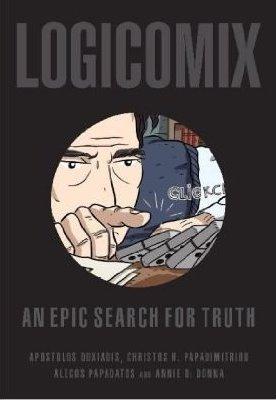
Apostolos Doxiadis and Christos H Papadimitriou · Buy on Amazon
"The first is Logicomix: An Epic Search for Truth . I got this because I was interested in graphic novels a long time ago, I was still in grad school, or even before. I found it really so remarkable on two levels. On one level it’s just a story about logicians. They’re looking for fundamental truths about the foundational quest in mathematics, which people in the 1930s were really concerned with. But, at the same time, if you look at the language of the drawings, it’s really very much like the classic language used in comics. So, you have large pictures where the action has to stall a bit. And you have the whole physicality of turning the page, where something new happens. And it’s completely in that idiom, but at the same time, you have this meta story of the people who are writing this comic, and they’re even asking, ‘Why should we make a comic about logicians?’ And then you have somebody who says something like ‘they’re superheroes.’ Logicians are superheroes because they’re driven by passion, they want to find the truth, they are in pursuit of great goals. The story starts with a lecture by Bertrand Russell . You have Russell standing there on the podium and he starts his lecture by saying, ‘Okay we’re now in this situation, should we fight against the Nazis? Yes, or no?’ It’s 1939, and there is this whole thing in the UK, should they or shouldn’t they? Should they be trying to keep the peace with the Nazis? And that didn’t go very well, it didn’t last very long. Russell was a pacifist and the audience knew that. And he says, ‘Well, before we do that we have to think about the rules of thoughts, to make such a decision.’ And then you go back in the past, and you see Russell and the people around him. “I really enjoy comics” It’s just marvellous, it really gives a sensitive portrait of the introspective person that Russell was, with all these different things—his atheism, his pacifism, the people he was around, his interest in mathematics and logic, how as a boy, he got into this this stuff about mathematical foundations. It’s really brilliantly done. Throughout the book, you have, on the one hand, this immediate urgency of World War II , but you also have, on the other, this more cold, dispassionate thinking about the quest for truth. It’s interesting because now we’re running from one drama to another, ‘Oh, the election drama here. The Covid drama there and yet another lockdown’ and so on. But, at the same time, we do have this enduring quest for truth. We want to learn true things and we don’t want to believe false things. And I think this book does a great job of showing why that is important, even as you have a lot of drama that unfolds. The other stuff, the rational, cool, dispassionate—but at the same time passionate, because you can be really passionate about finding the right rules in mathematics and in logic—that’s just as valuable, if not more valuable, than all this history drama."
Zhuangzi (aka Chuang Tzu), C. C. Tsai (illustrator) and Brian Bruya (translator) · Buy on Amazon
"Staying with comics sector, I want to talk about Zhuangzi, The Way of Nature. This illustrated version was published in 2019. There are two books like this. There’s this one and then there’s The Analects . Both have been published by Princeton University Press. And basically, when you look into it, you have the original Chinese up here. And then you have the translation by Brian Bruya, which is put into a comic format. Because lots of the things in Zhuangzi lend themselves to the short comic format, of half a page or a page like in Peanuts , because you have just one story. For example, you have the story of Zhuangzi meeting his friend Huizi. There are lots of those discussions, and they’re just walking over the river, and they see fish in the water. And Zhuangzi says, ‘Oh, these are such delightful fish, look how happy they are!’ And then Huizi—he’s a logician and he is always sceptical about this philosophy of following nature and being aligned with nature, of Daoism, basically—he says, ‘You can’t know how these fish are feeling. You’re not a fish. So how can you know?’ And Zhuangzi says, ‘Yes, but you’re not me, so how can you know that I don’t know what fish feel?’ This goes on in that way and, eventually, he doesn’t quite convince Huizi but he makes a point about how there are certain limits to perspective taking. Get the weekly Five Books newsletter If you look at C.C. Tsai’s drawings in this book, they are really cute and humorous. They’re interesting for the following reason. You don’t have the entire Zhuangzi, because the entire Zhuangzi is quite big, and if you were to illustrate that you’d have a book three times the size. And there’s only very recently a book, that came out in 2020, with the complete Zhuangzi, that is a recent translation, by Brook Ziporyn. Now you have more and more Westerners who are interested in this kind of philosophy and doing philosophy globally. But there is a sense in which Zhuangzi is profound, but also funny and light-hearted. There are a lot of really silly moments, almost. And I think that this version of Zhuangzi—and I have three different versions—is the only one that really captures this playfulness, helps to remind you, when you’re reading it, that, ‘Okay, this is a serious philosophical text, but it’s also a silly and playful philosophical text.’ I think that this format does that very well. Yes, and there is something about philosophy that isn’t sufficiently recognized—because it’s hard to capture—and that is the idea of mood. Mood is a bit different from emotion , because emotion is always directed. If I’m angry, I’m going to be angry for a reason or if I’m happy, usually, there’s a reason. But mood is not directed as such. There are some philosophical works that when you read them give you a certain mood. It’s very hard to articulate, but when you read Wittgenstein , or Nietzsche, there is a certain sort of undirected mood that emanates from them. And that’s something that I think a lot of contemporary analytic philosophy loses a little bit. I think continental philosophy does this better, it does capturing a certain mood quite well."

Lisa Whiting & Rebecca Buxton · Buy on Amazon
"What’s your last book choice? The Philosopher Queens by Rebecca Buxton and Lisa Whiting. It’s an edited volume and it’s about 20 biographies of women philosophers. And one interesting feature about this is the drawings that were done by Emmy Smith, who is an illustrator and usually does women’s poetry. You get a sense of these women. You have Mary Midgley and Mary Wollstonecraft , and so on. But you also have several non-Western women philosophers in there, and ancient philosophers like Hypatia. The pictures convey a sense of the tremendous range and diversity of these voices. Next to the pictures, you then have a short biography of each of these women philosophers by an expert in the field. So, for example, the one on Simone de Beauvoir was done by Kate Kirkpatrick who is a Simone de Beauvoir expert. It’s also written in a wonderfully accessible way, each of these contributions. So that is really nice. Support Five Books Five Books interviews are expensive to produce. If you're enjoying this interview, please support us by donating a small amount . But I want to think about these images. Could they have done this book without these bold images? I’m sure they could have. But I think there is a way in which it’s important to have these images, because when you think about philosophers, the default is still going to be the image of Socrates or Plato or Aristotle… But here we have these really monumental-looking women. The way they’re drawn is really wonderful. They’re done in a classic monumental style that really helps to give the idea that philosophy has been something done by women too, not just recently, but for a long time. The pictures really help to underscore that point. They are definitely not just like, ‘Oh, that looks nice. It’s got pictures, you can give it as a gift for Christmas.’ I think it’s genuinely that those pictures add something. That’s right. It’s great. And what you said about icons is just right. They do have this seriousness. I think it’s really well done. Also, the fact that they went with diversity in terms of ethnicity and geography and time also helps to make that narrative, I think. It’s an excellent book all round."