Harry Mount's Reading List
Harry Mount is the Editor of the Oldi e , and an author and journalist who regularly contributes to a range of national newspapers, including the Telegraph , Daily Mail , The Guardian and the Spectator . Educated at Oxford and the Courtauld Institute, he is the author of the international bestseller Amo, Amas, Amat... And All That .
Open in WellRead Daily app →British Buildings (2010)
Scraped from fivebooks.com (2010-08-13).
Source: fivebooks.com

John Betjeman · Buy on Amazon
"Well, this is his verse autobiography and I’ll tell you why I think it’s fantastic. Most people write about buildings in a very, very dry way – ‘There’s a buttress from 1490’ – but he does it in a much more human way, like he’ll talk in the same way about them as he does about the girls he loves or his great friends, in a beautiful, wonderful, moving way and he doesn’t use the jargon, even though he knows the jargon inside out. He just communicates the beauty of buildings much better than a dry, stiff, architectural historian does. Also, in that particular book he talks about growing up and the way he first sees buildings as a child, and he drops things in all the time. He was brought up at the foot of the hill down towards Kentish Town from Highgate and he talks about the church where he was christened, a big Victorian church. And he wrote some fantastic poems in Summoned by Bells and elsewhere about Kentish Town which I love. It’s where I live, but not many people do write poems about Kentish Town. “He just communicates the beauty of buildings much better than a dry, stiff, architectural historian does.” He gets it exactly right and he’s not being patronising about rundown parts of London. He gets the beauty and the feel of places and who goes there and what it looks like from the top of a bus and just observing. So, I think he’s an absolute genius when it comes to talking about buildings in human terms. Well, he talks about going to Marlborough which he absolutely hated and he talks about going to Oxford which he was chucked out of for failing his exams, and he loved the buildings, particularly Magdalen, where he was, and he imagines himself as an old don in New Buildings occasionally taking a book of poetry down from his shelves. But he was plucked away from this Elysium by failing his exams. So, it’s always like that – he’ll describe a beautiful building but it will be related to his life as well."

Osbert Lancaster · Buy on Amazon
"He does a sort of equivalent thing but in pictures. He’s got a brilliant thing in that he knows inside out your buttresses from your perpendicular churches but the drawings he does are very simple and beautiful and funny. It’s very hard to be funny about architecture, but he’s good at doing funny drawings of whatever it might be – a Norman church or a Roman temple with a slightly hungover legionary in front of it. He mostly does British stuff but he spent a lot of time travelling. He’ll do a picture of an English Renaissance church and outside it a crane about to knock it down and 30 workmen. Or he’ll do a picture of an Oxford college and have two stuffy dons walking by. He’ll always make it human and not dry and the actual building will be done in a cartoony way but with all the details done perfectly. So it’s easy to look at but you can’t fault him. When I teach, I show the details from this book because he’s fantastic at illustrating the individual details of the British buildings he draws. He died in 1986 and he was a friend of Betjeman and Evelyn Waugh and all that lot and was most famous as the pocket cartoonist at the Daily Express, and he was very funny as a cartoonist, but his other love was buildings."

Alec Clifton-Taylor · Buy on Amazon
"Now that one is a bit drier, but it’s fantastic for anyone interested in buildings. You realise that, until about 100 years ago, every single building was built out of the stuff that was in the ground beneath it. And he’s brilliant at saying what all the bits of stone are that are under the ground across Britain. So, for example, there’s a big, big broad sash of limestone that comes all the way down from Yorkshire and through the Midlands and down into Dorset and all along there you get that fantastic creamy building stone, so you’re able to build huge stone buildings, much taller church spires and as soon as you go off that stone sash you’ve got to turn to brick or mud or whatever else there is beneath the ground. “The planners after the Second World War got rid of quite a lot of what remained of 17th-century pre-Fire London. But there is still that pleasure of winding streets on a medieval pattern.” He brilliantly describes every part of England and the different building stone there and the different brick you get from the earth. If you’ve got lots of iron in your earth you’re going to get much, much redder bricks and once you take this in you start to see that England is built out of what’s underneath and in bits of Yorkshire and Lincolnshire you can see where this band of stone runs out. You see dry stone walls and then it suddenly runs out and you get hedges. It’s a brilliant view of England from underneath. The best picture in it – and who’d have thought geology was so interesting? – is a picture of England but with all the geological bits underneath and then what the buildings on top look like. Once you think of it like that you can never think of it in any other way."

John Summerson · Buy on Amazon
"I did a term of architectural history as part of history at Oxford, and I’d been interested in buildings in a very unformed way and this was the first book that made me see the order of architecture in Britain. Elizabethan architecture with a very strong English, medieval feel to it and how Inigo Jones came in the early 17th century and classicism completely took over for 100 years and then Palladianism, then Victorian Gothic and it all started to click together like a series of rooms in a long corridor, the order of things. It’s quite a dryish academic book but it puts things together beautifully. I know. Isn’t it tragic? And part of it is the Second World War , of course, but the planners after the war actually got rid of quite a lot of what remained of 17th-century pre-fire London . But there is still that pleasure of winding streets on a medieval pattern, but it’s not like the real thing. You know that Christopher Wren wanted to redesign the city after the fire on a Parisian/New York grid system, but thank God he didn’t. So we still have higgledy-piggledy streets but it’s not the same as having the buildings."
Nikolaus Pevsner and Bridget Cherry · Buy on Amazon
"The Pevsner Guide to North London. He’s exactly the opposite to Betjeman in a way because he went round every county in Britain doing these guides and so they are quite dry, but they are absolutely fantastic for the facts and the dates and who built what when. It’s not only brilliant about famous British buildings like Kenwood, but it will also tell you something about places like my street, Caversham Road – it will tell you exactly when it was built and there’s a church next to my house and he tells me who built it and when. Get the weekly Five Books newsletter Yes. It would be fantastic, wouldn’t it? And how incredibly stupid and nice of Lord Iveagh to give it away. Cycling back from parties I regularly put my bike over the railings and cycle through and there’s never anyone there and you can think: this is as good as mine. Robert Adam built it in the late 18th century and I’ve always loved that sham bridge and have always been amazed it’s not a real bridge. It was built for Lord Mansfield, the Lord Chief Justice, and it was a private estate and then it was given to the country in the 1920s. Who’d want to live in the countryside if you could live there? It’s called A Lust for Window Sills and it’s a guide to British buildings from the Normans to the Second World War. There’s a strange thing in Britain: we love buildings and the National Trust is the biggest membership society in the world, but the moment you say to someone ‘Ionic’ or anything like that their eyes glaze over and they think it’s so impenetrable. But actually there aren’t that many words like that and if you introduce them gently they will stick in the mind. We also suffer from a slight cultural cringe and we think that Tuscany must be much more beautiful because that’s where all the best stuff comes from. But that doesn’t mean that there isn’t fantastic stuff here and some very original new things. In fact, the British terraced house is based on Palladio, you know, Palladian palaces, and once you know a thing like that you start seeing little things all over the place. We do ourselves down when it comes to buildings."
Learning Latin (2017)
Scraped from fivebooks.com (2017-07-24).
Source: fivebooks.com

Benjamin Kennedy · Buy on Amazon
"Yes, there’s the blue one, which I’ve got here and there’s a later one, with a red cover. They’re both fantastic. It is the Bible because it has all the conjugations of the verbs and the declensions of the nouns. It also has, in very concise form, practically all the rules of grammar and syntax. It’s a very dry book. You’re not going to find any jokes in it, but absolutely everything is there. It’s the ultimate rulebook of Latin. It’s actually very short. It’s a very thin volume, because there’s no excess verbiage at all. It’s amazing. Kennedy was, I think, a Latin master in Liverpool. My father told me that because every year whole new generations of school children bought the book, the borders of Lake Geneva were filled with huge villas lived in by people like Kennedy, Hillard and Botting — all these people who wrote Latin grammar books before it had this great decline. They became, very early on, standard books, because they were beautifully worked out to be extremely efficient in the delivery of information. Kennedy is very concise, but it has the answer to every problem in Latin in it. It doesn’t go that far, but I’ve written seven books and six of them have sold two copies. The only one that sold at all well was this one. I could probably have bought, not a villa, but a very, very small flat on the outskirts of London on the proceeds. There’s an incredible appetite. There’s a great Philip Larkin poem called, “Church Going,” about what will happen to churches when no one goes to them anymore and they fall apart and we all become secular and atheist. He imagines people going, in the future, to these rundown churches and still trying to find the altar and touching various holy stones. He thinks of himself as an agnostic, I think, but he says that there is a hunger for seriousness in all of us. I think there really is. Latin and Greek and an awful lot of difficult things were thrown out of most British schools in the 50s and 60s, but that hunger still survives. I think that’s why Amo, Amas, Amat did well, although it’s delivered in a jokey way. There are an awful lot of parents who learned Latin and Greek who are concerned that their children no longer are. Even if they hated it, they have a memory of this serious and difficult subject. It is difficult to learn properly, but I do think people patronize children. Perhaps not all, but a lot of children quite like difficulty. It’s also the one time—I don’t know about you, but when I was a small boy, I did things dutifully—when if you’re asked to learn 100 pages of vocab, you go and do it. I wouldn’t do it now, but as a little boy I would. That’s the time to force the mind full of these things. There’s no two ways about it, it’s quite boring, but the pleasure that comes from having learnt all this is enormous."

NRR Oulton · Buy on Amazon
"The Latin argument in the last couple of years has become very, very furious — as often happens with arguments about slightly obscure subjects. There’s a whole school of thought that because Latin is difficult to teach, you should therefore give up and teach a dumbed-down version. I’m afraid I’ll have to mention it: the Cambridge Latin Course would never be in my top five in a million years. It wouldn’t be in my top 5 million. It’s extremely patronizing. I see you’ve brought it along tonight, Katie, shamefully. For those who don’t know it, the Cambridge Latin Course spoon-feeds children, patronizes them, it expects them not to learn all these things—like conjugations and declensions—so they’re forever feeling in the dark, because they haven’t learned the basics. It’s like playing football without knowing the rules. I’m all for Latin being taught in a jolly, funny way. There is something very funny about Latin. Listeners who’ve seen the Life of Brian will remember the extremely funny scene with John Cleese and Graham Chapman and the badly spelt graffiti. You can be funny, but you can teach the rigorous stuff at the same time. That’s what the Nick Oulton book does. It has lots of jolly bits of history, nice pictures done in an easy-going way, but all the proper rules are there: the declensions, the conjugations, properly taught, in the right order. I, like you, teach Latin and tutor children of 9 or 10. You can do it by being an amusing, good teacher. But I’m afraid the brutal truth is that learning stuff is quite boring. People don’t expect, when you’re teaching maths and learning long division — no one’s suggesting that that should be fun. It’s something we think our children should know. It’s quite boring, but it’s extremely useful. It’s the same with Latin. Only Latin and Greek were treated in this way — I think because of the associations with elitism and public school. They were given different treatment. Somehow it was shameful that these subjects were difficult to learn, and so they had to be dumbed down. I think that’s a non-sequitur. I disagree with the premise of your question. I’m afraid I don’t think it should be entertaining to learn, necessarily. I didn’t find it particularly entertaining learning 100 words of vocab every night when I was 10 or 11. It’s not fun. Education shouldn’t always be fun. It’s about things that are useful or things that later on bring incredible pleasure by knowing them. There are only 2 or 3. But I feel it strongly. The really unfair thing is that if you’ve been to expensive private schools in Britain like you or I have, that expectation of difficulty is completely expected. Parents bloody love it. They don’t want their children to have a particularly enjoyable time, they want them to know stuff. It’s extremely patronizing—largely in the state sector, although it’s fed into the private sector as well—this idea that because it’s difficult and boring, therefore your children shouldn’t do it, even though it’s extremely useful and wonderful for the mind. I just fundamentally disagree with the idea that the learning of it should necessarily be pleasurable. Yes. Over the last century you’ve had these two paths. You can either have the old-fashioned serious books of the 19th century, the 1920s, 30s which are a little dull and dry. Then there are ones like the Cambridge Latin Course , which fall over themselves to be nice and easygoing and therefore useless. Oulton is in the middle. It has all the hard stuff—and, as you say, it’s very heavy on grammar—but his examples are a little lighter and more pleasurable than the 19th century ones. So it squares the circle. Yes, if you’re either an adult or a child, from those two books between them—it’ll take quite a long time, most children being taught properly at school will have years and years of this—you could learn Latin. I think there are three Oulton books, and there are some answer books as well. You could learn Latin from those books plus Kennedy’s Latin Primer. No. It’s funny, I was asked the other day by a middle-aged person, ‘What’s a good book for English grammar?’ I replied that I’d never been taught English grammar, I did Latin and Greek. You could’ve been taught English grammar. There’s nothing particularly magic about Latin grammar, but just because, for historic reasons, it was taught in a rigorous way, you then learned what a noun, or a verb was — and you naturally thought for yourself about the differences. There is a famous cliché that you should learn Latin because it teaches you English grammar— the implication being because they’re very similar. Actually, as you said, it’s because they’re so incredibly different. There is no English equivalent of the ablative absolute. You could have been taught some other form of grammar rigorously—you could be taught Spanish grammar rigorously—it’s just that on the whole British schools don’t. There was a story the other day that at Brighton College, a very good private school, the English teachers got in trouble because they didn’t know their grammar. So the headmaster got in the Latin teachers to teach them English grammar. It’s not a magic quality of Latin, it’s because of the old-fashioned qualities of Latin teaching at its best, that grammar was taught. It is, and there’s an incredible pleasure in that. An example I give in my book is the Latin word ‘candidus,’ the adjective meaning white, pure, unvarnished. That’s where we get the word candidate from — and I don’t know when was the last time you heard the word political candidate and white, pure, unvarnished in the same sentence? They don’t go together. The reason why that word is what it is is that if you were standing for an election in Rome, you would sprinkle yourself with chalk dust — to be the prominent person in the market place. So you would be the candidus, the candid one, the white, pure, unvarnished one and ultimately the candidate. But, actually, if you went purely on your Latin, you couldn’t say that candidus has a direct connection with a candidate. But isn’t that incredibly pleasurable, to think about the journey?"
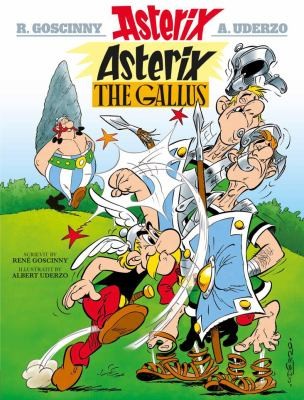
Albert Uderzo & Rene Goscinny · Buy on Amazon
"It’s the Latin version of Asterix the Gaul , Asterix Gallus . The Asterix books, for those who haven’t heard of them, by Goscinny and Uderzo, are a brilliant, brilliant series of comic strip books about Asterix, a little Gaul from a village that holds out against Roman occupation in the 1st century BC. It’s extremely funny in English and actually the English version has some very, very good Latin jokes in it. It’s very sophisticated. There’s a set of pirates who constantly sink and whenever they do, there’s an old pirate who always makes little jokes in Latin. So if you’re pleased with yourself you can congratulate yourself on translating the Latin to English. I think the books are a really good introduction into Rome, the Roman Empire, Roman Gaul, and also Roman Britain. Asterix in Britain is an extremely good book. Asterix Gallus , the Latin version, has good, easy Latin and, particularly if you’ve read Asterix the Gaul in English first, it’s a really good way of learning your first proper Latin sentences. Like all cartoons, there’s only one or two sentences in each speech bubble. So once you’ve got your Oulton and your Kennedy by your side, perhaps buy Asterix Gallus and Asterix the Gaul alongside each other. A lot of it is quite straightforward Latin and they have very good vocabulary lists, as well, in the book. There were all sorts of words that I didn’t know. Anyone who reads Asterix knows that Obelix, his fat friend, is very interested in eating wild boar. I didn’t know the Latin for boar was ‘aper, apri.’ And he’s obsessed with carrying menhirs, big stones. The Latin for a menhir is ‘cipus,’ a stone block. But otherwise the Latin is really quite simple. I’m afraid I’ve read Harry Potter neither in English nor in Latin, but I have read Winnie Ille Pu . I’ll be honest, the books are more enjoyable in English. But they are really nice, easygoing ways for grown ups, as well as children, to do their first translations. Like all great children’s books , the English is simple and so the Latin is simple. It’s incredibly popular. I’ve painted a picture of doom and gloom, which I still think is true of the decline of rigorous study of Latin over the last 50 years. It’s massive and it hasn’t been reversed. But, the increase in the informal study of Latin—which I’m all for, any Latin is better than no Latin—over the last 15 years has been enormous. The number of state school students doing Latin has doubled in the last 15 years and for the first time, possibly ever, there are now more state school students doing Latin than are doing it in grammar schools or private schools. Probably not to the same level of rigour. People sometimes think this is an amazing new dawn. I still think it’s very depressing how standards have slipped, but there is a great contemporary boom in translations and English books about classical culture. Mary Beard and Boris Johnson just did a brilliant debate in London, Greece versus Rome. Mary Beard represented the Romans, Boris represented the Greeks. It was completely packed out, 1000 people, voting one way or the other. Mary Beard won, but they were both brilliant and the audience was largely under 30. So there is a massive, massive interest."

Nicholas Ostler · Buy on Amazon
"It’s by Nicholas Ostler. It’s a more obscure book called Ad Infinitum: A Biography of Latin. It’s just a brilliant, brilliant book explaining how and why Latin became the European language and the ultimate world language, in a way. It explains that until about the 3rd century BC, Latin was spoken in a tiny area of Italy in Latium, the modern province of Lazio, near Rome. There were all sorts of other dialects with wonderful names like ‘Oscan’ spoken very nearby. But because this small group of Romans beat the neighbouring tribes, Latin became the language of the Roman Empire. Who learns Oscan now at school? No one. Because Latin was the language spoken by this brilliant tribe who defeated the other Italian tribes, it became the dominant language of the Roman Empire, and then, later, the spark for all Romance languages. There’s also brilliant stuff on how Latin mutated into Italian. It’s extremely close, and like any language that’s spoken regularly, it’s spoken more quickly, and the more difficult bits were dropped. So consonants at the end of words were dropped. So here’s a perfect example — in Latin, to say a good person sings a song, you’d say ‘Bonus cantat canticum.’ The Italian is ‘Buono canta cantico.’ Almost identical, but they’ve dropped the consonants from the end of all those words, so you get that more fluid Italian. It’s very consoling to anyone who does Latin and finds it a bit difficult that Romans got it wrong too. There’s another straightforward bit of graffiti from Pompeii which says ‘Marcus Spedusa amat,’ which means ‘Marcus loves Spedusa.’ Anyone knows that should be Spedusam. It’s comforting that Pompeiians also had problems with the accusative. Because it’s been treated as this grand language, we have this crazy idea that the Romans were always talking in very high-minded ways, but of course they used Latin to swear, to say how much they loved their girlfriends, or to bet on Ben Hur in the 3.30 at Circus Maximus. And the graffiti at Pompeii is fantastically obscene, a lot of it. Very, very funny too."