Gwen Adshead's Reading List
Gwen Adshead is a forensic psychiatrist and psychotherapist. She works in prisons and secure psychiatric hospital providing therapy to violence perpetrators who have mental health problems. Gwen is also a writer and teacher; she has published over 150 papers and book chapters and has given lectures all over the world to different professional groups. Her first work for a general audience, The Devil You Know, was co-authored with her friend Eileen Horne and published in 2021.
Open in WellRead Daily app →The Psychology of Killing (2022)
Scraped from fivebooks.com (2022-08-05).
Source: fivebooks.com
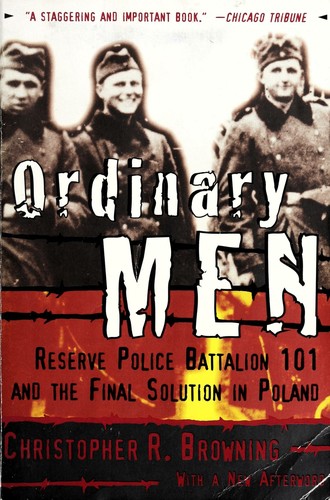
Christopher Browning · Buy on Amazon
"When I started my interest in this area, I wanted to look at people who had killed in the context of war or political regimes—men, of whom nobody would say that they were mentally ill, and yet their killing was bizarre and extreme. Hitler’s solution to the ‘Jewish question’ was to eradicate all the Jews in Europe. I might say, of the many odd and dreadful things about the Nazi regime, one of the oddest things is that Hitler was still so so keen on getting this done during a war, which he was fighting on a number of fronts. In the middle of that, he invested a lot of time and effort into killing a subgroup of his own citizenry. This book, which is, Christopher Browning’s study of the interrogation of a battalion of German soldiers sent to take part in the ‘final solution’ in Poland in 1942, is quite astounding in terms of what he found out about ‘ordinary’ human cruelty and viciousness. “These ordinary men participated in absolutely brutal slaughter of completely innocent people” By 1942, the Germans had invaded and were occupying Poland. The German High Command sent a battalion of German soldiers, most of whom had not seen active combat before, to exterminate Polish Jews. These soldiers were not career solders. They were planning to return to their ordinary careers after the end of the war. Yet they were drafted in to kill people in cold blood—thousands and thousands of people. They weren’t investigated until about twenty years after the end of the war. Christopher Browning studied the notes of the interrogations, and what those interviews reveal is something really odd and unsettling. These were ordinary men, as the title suggests. Yet they participated in absolutely brutal slaughter of completely innocent people. This wasn’t even in the context of organised war. They found it very difficult to begin with, but gradually, over the next year or so, they became more accustomed to doing it. What makes it so interesting is that there were really three different groups among these men. Around 20% of them simply refused to do it. They just wouldn’t do that. There was another, maybe, 40% or so who would do it but were ambivalent. They said, well, it’s part of what we are here to do. We have to do it. Then there were the remaining 30% or so who enjoyed it. They were the most brutal. I’m not sure we can generalise like that; partly because it’s not clear whether those men were like that when they were recruited. What Browning was really exploring is what the process of killing does to people. He explores in enormous detail the different motives that might make it possible for people to kill in this particular context. It is one of the most disturbing books I’ve ever read. But it is an essential read for anyone interested in political violence, or how people make it alright for themselves to do terrible things."

Tony Parker · Buy on Amazon
"Tony Parker interviewed twelve people who had been convicted of murder. It seems very obvious now, but it was unusual at the time: he just let a tape recorder run and transcribed those interviews without him being in it, as if he were completely absent. What you get is the voice of the offenders speaking. He also did a fantastic book about convicted sex offenders called The Twisting Lane , which is again rather disturbing but very interesting. Life After Life is about murder. It was part of my education. I needed to hear what people themselves said about homicide. I needed to rid myself of this fantasy that everyone who killed was a kind of demented weirdo. Most people who kill pose no risk to anybody else at all, because the killing is very specific to the context of their relationship with the victim. Even those wretched men from the German battalion in Poland—they didn’t necessarily pose a danger to their wives, or the people in their villages when they went home, even after killing hundreds of other people. Support Five Books Five Books interviews are expensive to produce. If you're enjoying this interview, please support us by donating a small amount . What I really like about Tony Parker’s work is that he centres the voice of his interviewees. You really get a sense of how the person who killed often found themselves looking back and thinking: How did that happen? How on earth did I let myself do that? People say things like, ‘I just lost it.’ What is the ‘it’ that you lose? I’ve met so many people over the years who have said ‘I lost it.’ It’s Tony Parker who inspired me to take a narrative approach when I work with people who have killed, to understand that I was meeting people in the middle of a story. People who have killed are like Dante ’s traveller; they find themselves in the middle of a dark wood because they have lost their way. I show up, or people like me, and we say, ‘what’s happening? Let’s walk together.’ Tony Parker’s material helped me to do that. I think so. It’s been my privilege to be able to share what I’ve learned about evil and violence over the course of a working lifetime. It is an invitation to come and look at that capacity for doing great cruelty and great harm that lies in all of us. The Devil You Know is a series of 12 encounters with a range of offenders: serial killers, arsonist, stalkers, and other people who are usually seen as ‘monsters’. We’ve had some nice feedback and it’s now out in paperback so I hope more folk can access it. So for me, what comes out of Ordinary Men , and it comes out of Tony Parker’s book as well, is that so many of the people who kill say, ‘I’m not a bad guy, I just did this terrible thing. Now I can’t go back to the way I was before, when I was a regular guy, an ordinarily good person.’ People who have killed are not in some alien world of their own. They are people like us, who find themselves in situations that make killing possible."

P D James · Buy on Amazon
"This is one of P D James’s earlier works, and it’s extremely powerful, although less well known perhaps because it doesn’t feature Adam Dalgleish and it’s not a police procedural . I should say straight away that while we were training as forensic psychiatrists, I was part of a group who thought that detective fiction might be helpful—that although it’s fiction, it might nevertheless tell us something interesting and useful. In a way, forensic psychiatrists are a bit like detectives, in the sense that we know whodunnit, but we want to know why. The ‘why’ puzzles the readers of detective fiction, it puzzles forensic psychiatrists, it sometimes puzzles the killer themselves. Detective fiction is good for exploring motives. Not only does detective fiction have a long and esteemed history, but there’s a lot of critique and reflection on it too, which is also helpful. W H Auden wrote a wonderful essay on detective fiction, called ‘The Guilty Vicarage’ . And P D James herself wrote a small book on detective fiction as a kind of bringing order out of chaos, which is why it is so popular. You know: every midnight in the village of Midsummer, chaos breaks out, then somebody will come in and restore order. This idea of restoring order is something that human beings are very interested in. We are also interested in moral reasoning. Ideas of ‘good’ and ‘bad’ preoccupy almost everybody. We see it in shows like Breaking Bad too, which is one of the most miraculous fictional accounts of how a good man might become bad. . Innocent Blood is about a young woman who discovers that she was adopted, and that her biological mother went to prison for murder. She decides to contact her mother, and the story is about the relationship between these two women—and what happens after. The mother comes across, again, as an ordinary woman who did an extraordinary thing. We, the readers, are invited to see this person as more complex than we might have first thought. It’s a challenge to the idea that we know what a murderer is like. I won’t say any more about it. I don’t want to spoil it, but there is a parallel story about somebody setting out to commit a murder, which that runs in parallel. Eventually these two stories converge. It’s very clever. I’m surprised it hasn’t been adapted for television."

Gitta Sereny · Buy on Amazon
"Yes, the vast majority of violent perpetrators are male. Quite why that is, no one really knows. It’s a bit of a Nobel Prize-winning question. Across the world, there are no countries or cultures where men are not the main perpetrators of violence. Women are always a minority, and not just a minority but a tiny minority. Usually in the region of 5% or so. It’s unusual for women to act violently towards others. Having said that, when women do act violently, they can be just as cruel and brutal as men. There were female prison guards involved in the killing in Nazi Germany too. No question about it, women can carry out that kind of violence, it’s just that the absolute numbers are far fewer. That makes those that do so very unusual compared to the general population, and pretty unusual compared to even the small population of women who break the criminal law at all—which is a pretty small proportion. Most women are rule-keepers, and if they do break criminal laws, they don’t usually commit acts of violence. They steal things, commit fraud. The few crimes of violence they do commit are nearly always within the family. There’s a kind of theme to homicide, which is that it’s about exerting power and control over other people. It’s about communicating to the victim: you don’t get to say no. It’s there in Christopher Browning’s account of Reserve Police Battalion 101, it’s there in the stories we read of women who kill their children or partners… something about killing another person is about exerting absolute control. Very few homicides take place after any kind of ‘equal’ scuffle. Yes, a murder that is absolutely unicorn-like rare. It’s not only a murder by a woman, but a murder by a little girl. Mary Bell was 11 years old when she killed two little boys—a three-year-old and a four-year-old about six weeks apart. One little boy she killed entirely on her own, the other she killed with a friend, and the friend got acquitted. The really intriguing thing is that this 11 year old girl was convicted of murder, even though it was clear to anyone who covered the trial, including Gitta Sereny, that she was very, very disturbed. When it comes to children killing other people, I don’t think there can ever be ‘normal’ for a child to kill. The only possible exception might be child soldiers, who are groomed by adults to participate in war, but of course such children have usually already been traumatised by war and their participation makes them even more disturbed. All the evidence we have about domestic homicides by children is that these are very disturbed children who need help, and who have nearly always been exposed to grotesque levels of abuse and neglect at home. And that is indeed what had happened to Mary Bell. Gitta Sereny covered the trial, and had already written a book called The Case of Mary Bell . She was very concerned that this little girl didn’t get a properly fair trial, but was completely demonised in a way that was grotesque. She served her time, and was released when she was 23. Gitta Sereny contacted Bell then through her probation officer, and asked if she could write a book with her about her experience. So Cries Unheard is about Mary Bell, grown up and released from prison, having completed a prison sentence for the murders of the little boys. It’s a book that will make you really think about what it takes to create the kind of disturbance for a child to kill, and how extremes of abuse and neglect could disturb your mind so much that you no longer know what is real and what is not. Support Five Books Five Books interviews are expensive to produce. If you're enjoying this interview, please support us by donating a small amount . That’s one of the things that Gitta Sereny concludes: that these two girls—Mary, 11, and Norma, 13—were living in a distorted reality, a kind of fantasy land. The idea that they could have been truly criminally responsible is a complete nonsense. By the time Sereny wrote this second book, the James Bulger trial had happened as well, so it’s all the more powerful that she is able to reflect on that trial as well. In 1993, two 10-year-old boys were arrested for the murder of two-year-old James Bulger. Something similar happened as happened to Mary Bell—these two little boys were held up as murderous monsters. What they did was monstrous, of course it was, but the idea that they themselves could be typified as monsters, I think, is not really tenable. There are striking similarities, although in the Parker-Hulme case the girls were older—Juliet Hulme was 16 and Pauline Parker was 15, I think. But that sense of living in a joint fantasy, in which their victims were not very real to them, is similar for sure. That’s certainly something I’ve seen in my work—people who have killed in a state of mind where nothing seems real, the victim doesn’t seem real, the killing doesn’t seem real. Some of the guys in our homicide group say that ‘it was all like a dream’, as if their sense of reality had been suspended. I do want to say something, which I hope will be very obvious. Christopher Browning says this at the beginning of his book too. To understand is not to excuse. What I say here is not to excuse the killing. But understanding and explaining might help us prevent it in future. It’s vital that we invest in thinking about these things and take them seriously, not just take the easy way out by saying, ‘oh, well, they are disgusting monsters, just throw away the key and forget about it.’ That’s not going to help anything."