Emma Smith's Reading List
Emma Smith is Professor of Shakespeare studies at Oxford University. Her book The Making of Shakespeare's First Folio (2015), tells the story of the birth of the First Folio and Shakespeare's First Folio: Four Centuries of an Iconic Book (2016) describes its reception over the four hundred years of its history.
Open in WellRead Daily app →Shakespeare's Reception (2023)
Scraped from fivebooks.com (2023-07-18).
Source: fivebooks.com

Jonathan Bate & William Shakespeare · Buy on Amazon
"Shakespeare editing has gone through different phases. It’s had different projects at different points in its history. Is the aim trying to make a perfect text? Or is it trying to imagine the text as Shakespeare wrote it? Of course, the whole discipline is haunted by the fact that there are no manuscripts. We’ve only got these printed texts. Do we think Shakespeare might have revised his plays? Or do we think that if there are differences or problems in the text, it must be because somebody has copied it down wrong or misheard or transcribed it differently? Above all, what’s the role of the theater? In some ways, the whole project of editing a book of plays is contrary to the fluidity that those texts would have in the theater. What to do with theatre and drama as part of editing has long been a question. We haven’t decided yet. Editing continues and people make different choices. What Arden Three tries to do is to bring a sense of theater—both in the Shakespearean period and since—into questions of ongoing performance traditions. The series looks at how the text enables those and what the text of the play gains from that context. Theater is really important to Arden Three . The Arden Three series has also moved on slightly from previous editions, where the introduction started in quite a dry way, with a history of how we got the text. For most people, that’s just a turnoff. Arden Three editors have tried to set up why this play has mattered and then come to those sorts of questions later. So if you just want one play—a play that you’re studying or a play that you’re interested in—I would get the edition in the Arden Three series that you need. If you’re looking for the complete works of Shakespeare, there is a complete Arden which is absolutely fine, but it doesn’t have all the notes and all the material which I think makes the individual plays so valuable. The series is good because it acknowledges that shift in how we see Shakespeare that we talked about right at the beginning. The Shakespeare text isn’t just a product of what went before, in some interesting ways it’s the product of what comes afterward and that’s the point of interest. Absolutely. Why would you? They can seem really dry. I still think they’re not necessarily absolutely introductory texts. If I were recommending a Shakespeare series to someone at school, I might not choose these, because they’re quite serious and they’re quite hardcore. There are a lot of notes on the page, and you might sometimes open up the pages of the play and think there’s more commentary than there are actual Shakespearean lines. That can be exciting but can also be very off-putting. Sometimes I suggest to people who are maybe reading Shakespeare for the first time that they read without notes. In a funny way, it can build your confidence to think, ‘I don’t exactly know what that means, but I get the gist: this is angry, or this is romantic.’ That’s probably what you need if you’re reading Shakespeare for the first time. The play that came to define the series was Jonathan Bate’s edition of Titus Andronicus . That was a play that no one had really thought much of before and Bate did a really, really good, critical rehabilitation job on it. So, I think that’s a good example."

Gary Taylor · Buy on Amazon
"It’s a very lively book. It’s a novel, in a way. It’s not quite as if Virginia Woolf’s Orlando were Shakespeare but it kind of is. There’s a sense of our hero moving through time and having different adventures along the way. That’s the narrative of this book. I think Taylor is a brilliant scholar, probably one of the most brilliant Shakespearians of our time. What he’s done in this book is condense a huge amount of work into something which is readable and interesting. He shows how people just wanted different things from Shakespeare at different times. Maybe at certain times they wanted him to be more classical, at others more English and his Englishness became important. Or they wanted to argue about whether the comedies or the tragedies were better, or whether he was good at women characters or not. Taylor takes these themes through history and shows that there isn’t an answer. This isn’t a historical progress, where we’re getting closer to an answer. It’s a really good reminder that what you can see at historical distance is that we invent the Shakespeare that we want or that speaks to our time. Sometimes you can’t quite see that when you’re doing it. You think, ‘This is objective Shakespeare’ or ‘This must be true.’ This book makes it quite clear that’s what we’re doing and what we’ve always done. There’s a great chapter where he talks about Shakespeare in the 18th century. Academic prose is not often the loveliest thing to read but this book really has fun with its own writing. Taylor writes the 18th-century chapter as if it were a novel. He talks about the encounter of Shakespeare with these different editors—this sequence of men who really did care about Shakespeare and argued about him. Other accounts make this seem deadly boring. It’s really hard to make it feel relevant or interesting now, but Taylor really brings it to life. Then he has a great chapter—which I suppose comes right up to his present—about a big argument at an American Shakespeare conference in the 1980s. The argument was about whether Shakespeare had revised his own plays. Do the two versions of King Lear that we have from 1608 and 1623 represent Shakespeare’s own revisions? It’s hard to think that that would have been such a hotly contested issue, but he talks about why that was such an electric moment in the scholarly discussions."

Ayanna Thompson · Buy on Amazon
"I wanted to include one book by Ayanna Thompson, so I chose this one. She is one of the leaders of the most interesting work on Shakespeare that’s being done now, which is part of a collective called RaceB4Race . It’s how Shakespeare’s works have been part of the invention and reification of racial categories. This book is about how 19th and then 20th century America took on Shakespeare’s plays and re-engineered them to speak to the two sides of the Civil War , for instance, as well as post-Civil War questions. It looks at how black theatre companies and black actors, from Ira Aldridge (1807-1867) to Paul Robeson (1898-1976), became prominent in Shakespearean theater. She gives us not an alternative history—that would suggest that there is a true history—but shows us that Shakespeare has been, and continues to be, a part of discussions about race right through the history of America. When I went back to this book, it gave me a context for why American culture wars are still preoccupied by Shakespeare and why when your graduate school takes down a picture of Shakespeare and puts up a picture of Audre Lorde or Zora Neale Hurston (say) it becomes a crisis. She helped me to see how it is that at a point of extreme polarization in American politics, Shakespeare is always part of the discussions. Yes, and whether taking out particular lines is an appropriate thing to do in contemporary theatre. Thompson is a big fan of Aaron the Moor in Titus Andronicus as a figure of black empowerment rather than Othello , the character these productions tended to move towards. I think this is a place where reception helps us, because reception can’t really tell us anything about what Shakespeare intended. That’s not interesting to reception. It doesn’t say, ‘Shakespeare is this or that.’ It says, ‘these plays come forward at these points in history, and they make these kinds of waves.’ The question of the Merchant of Venice is a really interesting one. There have probably been more calls for The Merchant of Venice to be suspended from the canon than there have been Othello . I suppose with both plays, one of the critical questions has been, ‘Is this play racist, or is it about racism? Does it have any distance as we look at the characters or structures or societies that are producing these racist stories? Or is that distance just collapsed and we’re right there saying, ‘Hurray! Antonio is saved and Shylock is forced to convert.”"

Judith Buchanan · Buy on Amazon
"This is a great book about one of the liveliest art forms that has been stimulated by Shakespeare, which is film. Judith Buchanan is an expert on silent Shakespeare film, which is a brilliant paradox. One of the things she shows is how the new technology of film—which was somewhat associated with peep shows or slightly sensationalist, saucy material—tries to lift itself up by engaging with classics and particularly with Shakespeare. It’s an interesting observation because it helps you see that just about all new technologies have a go at using Shakespeare to raise the cultural credentials of what they do. We’ve seen that with apps and various kinds of modern technologies. She isn’t just talking about silent Shakespeare in this book, she’s talking about film, right up into the 21st century. She talks about some classic films like Orson Welles’s Macbeth and Othello and more recent films like Julie Taymor’s Titus (it’s on the cover). “Reception can’t really tell us anything about what Shakespeare intended” In the book, Buchanan moves us away from a language that we used to have, which was, ‘How close is this to the text? How faithful an adaptation is it?’ Instead, she comes at it more from a film background to ask, ‘How successful is this film at translating or transforming a 16th-century play into a 20th-century film?’ That means cutting a huge amount of dialogue and using the visual, not just to tell the story, but to carry the metaphorical content of the language. She writes about how Orson Welles’s film of Othello has all these images, like shadows cast in a cage or net pattern. Although it doesn’t always have the language that Shakespeare uses, nevertheless it’s got the same metaphors as the language has. She’s really brilliant at showing how films translate into cinematic language some of the complexity of what Shakespeare is doing. Yes, it is. The book looks at films from different backgrounds. It’s not just about arthouse films. There’s more about Hollywood films towards the end of the book."
Alexa Alice Joubin (editor) · Buy on Amazon
"In some ways, this is a bit of a cheat. It’s when you’re on Desert Island Discs, and you choose ‘the complete works.’ I was really struggling to think of a book that both registers the enormous energy and creativity of non-English language Shakespeare and Shakespeare reception and is also attentive to some of the potential problems about that spread. Oxfam is a global organization, but so is McDonald’s. It is Shakespeare or is it McShakespeare that what we’re getting by spreading this product around? Was it originally a colonial and now a neo-colonial engagement? How do societies and cultures make Shakespeare into their own property? Do they? Or does it always carry the slight otherness of having been originally in the English language and sometimes imposed on different cultures? This is a book that I wouldn’t expect anybody to read from cover to cover. But if you wanted to look at this whole international, trans-historical issue of how Shakespeare went from being a glover’s son in a one-horse town, Stratford-upon-Avon, to being probably the most globally recognized author of all time, it traces some of those tracks. It’s looking at the history, although it’s not organized chronologically; it’s also looking at the geography. For example, ‘What are the traditions in Japan and Japanese? What parts of Japanese theatre does Japanese Shakespeare pick up?’ The Kurosawa film, in a way, is a blending of the Shakespearean story and aspects of Samurai and other cultural narratives that are more specific to Japan. Support Five Books Five Books interviews are expensive to produce. If you're enjoying this interview, please support us by donating a small amount . Where and when did these texts go? What was the role of translation? We learn that quite a lot of translations into non-European languages go via French or German, not directly from English. There are lots of interesting things about that. In some ways, the spread of Shakespeare could be your history of globalization itself: the routes, the media, the individuals, the financing, the consequences. It’s almost as if you had one of those dyes that are used to see an X-ray. Shakespeare would be like that dye, and you would see how England, Britain and America extended their influence around the world. One thing about translations is that they seem to date more quickly than the original which—not just in Shakespeare—often seems to have a timeless quality. Translations keep being redone, not because they’re not good, but because they have to be of their time. You can’t get away from that. I did once watch the beginning of Kurosawa’s Macbeth film with a group of Japanese students. I was talking about Shakespeare to them, but I thought it’d be interesting to include something they’d be able to tell me about. So, there’s a prologue to the film and there’s a translation in the subtitles. I asked what it meant, and they said it was such a weird form of Japanese they couldn’t understand it. They preferred the English. I found that interesting. As quite a monoglot person, I like to learn more about how these things work."
Shakespeare's Best Plays (2018)
Scraped from fivebooks.com (2018-03-25).
Source: fivebooks.com

William Shakespeare · Buy on Amazon
"This is going to sound heretical, but I think that—particularly in the theatre—a lot of Shakespeare is too long. I think Act 4 in a lot of Shakespeare plays is a bit of a bum-number, and not much happens. I like to see Shakespeare intelligently cut, often to speed it up. Macbeth is a play that may have been cut. We don’t really understand the provenance of that text. It’s very short by Shakespearean standards and it’s very powerful because of that. There’s no subplot, there’s no parallel plot. Just this really intense journey through a psychological drama. It’s a really punchy play because everything is tightly headed in the same direction: the language, the imagery, the plot, the way the characters work. It’s a really superbly powerful, compact, condensed play. The textual history has changed a lot very recently. In the last ten or fifteen years we have come to think that the play as we have it probably represents a revision by Middleton of a Shakespearean original. We don’t know the extent of Middleton’s work on the play. We don’t know whether it’s merely that he slotted in some extra witchy material that he had from his own play, called The Witch . Did he bring in the Hecate scene? This is an interesting moment where witches become spectacular in a way that’s not primarily frightening, but visually compelling: they sing and they dance. What Middleton seems to do with Shakespeare’s play is to bring in some of that more fashionable material. So, we don’t know what the play that Shakespeare wrote in the first place was like and that may explain why it’s so short. It may be that Middleton streamlined it, or took certain bits out. In certain ways the psychological drama of Macbeth , which is a drama about temptation and ambition, doesn’t need the witches to set it off. It doesn’t need the supernatural backdrop. You could use an idle moment of someone in court saying, “you must be thinking you’d be a good king.” But the play, I think, is really ambivalent about whether the witches cause things. One of the things I like about it is that it’s about the question of agency. Who makes all these terrible crimes happen: Macbeth, Lady Macbeth, or some supernatural elements? The play seems to present all those as possibilities but not endorse any of them."
William Shakespeare · Buy on Amazon
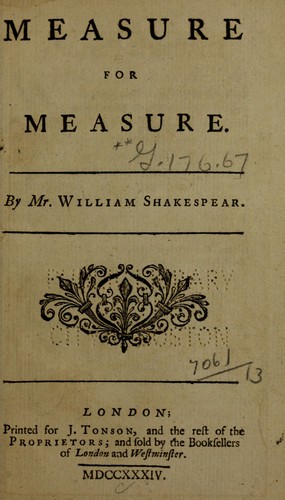
"It’s not a likeable play, they’re not likeable characters, it’s not a warm play. I think it’s a different side of Shakespeare, writing a philosophical, ideas-driven play. One of the things I’ve enjoyed about it is a sense that it seems like a mash-up. It feels to me as though all the characters are off-cuts from other plays. Claudio, Isabella’s brother who’s imprisoned, wants to be Hamlet. He wants to have big long speeches about death and the unknowability of it. The Duke wants to be in a romantic comedy where he can say at the end, “Hey presto, here we all are and we’re getting married.” Angelo, I think wants to be Brutus, or a tragic figure. And Isabella wants what lots of women in Shakespeare’s comedies want, which is to be independent and not to have a husband. We always know that if that’s what a woman says at the beginning of the play, she is not going to be able to say it at the end. Shakespeare sees a woman who says she doesn’t want to get married as a challenge. He’ll throw the most extraordinary plot at that woman in order to make her marry. It’s about the impossibility of compromise, or people who won’t compromise. In Measure for Measure , Isabella and Angelo are puritanical fundamentalists who deserve each other. That’s a deeply unfeminist thing to say, because she doesn’t want him and he’s an aggressor, I can see that. But the play has got all this sex in it and all these marriages at the end, and the only scenes that could possibly count as courtship scenes of back-and-forth conversation between a man and a women—as we get in comedy—are the interviews between Isabella and Angelo. They’re a really perverse kind of wooing scene. Get the weekly Five Books newsletter My academic training is very resistant to the implications of that question. Given that Shakespeare’s plays depict such different things, it’s a category error to think that any one of them tells us what he thinks about a single topic. I think the problem plays are part of a rather bleak moral world view right at the end of Elizabeth’s reign, during the plague, and a sense of corruption that we’re going to see rather interestingly developed in Jacobean plays. It may tell us something about the times rather than about him."
William Shakespeare · Buy on Amazon
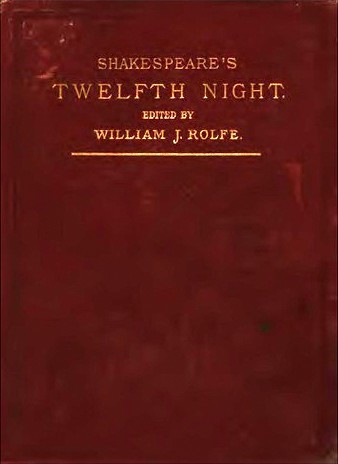
"If you’ve got Measure for Measure in your mind, Twelfth Night looks a bit darker. What I really like about this play is its sexual playfulness. It seems very modern in that way. There’s no way to play it straight. You’ve either got Orsino in love with Cesario, or you’ve got Olivia in love with Viola, and you’ve always got Antonio in love with Sebastian. It feels to me as if its subtitle What You Will , is a cheeky way of saying ‘whatever, anything goes’. I like the fact that quite often you see productions where at the end Olivia and Orsino are still mixing up the twin they are with and there’s still playfulness. Why do you like it? Yes, because if you believe in the Orsino/Cesario relationship, which says that someone’s externals don’t matter, and what matters is how you get to know them, then the Olivia/Sebastian relationship seems to give exactly the opposite message. It’s really hard to reconcile them. There’s a very dark view of the play, which is that Olivia is being punished like Katherine in The Taming of the Shrew , even like Beatrice in Much Ado About Nothing , or Isabella, for opting out of the marriage world and for running her own household. She’s bought out of that in a very extreme way. I wonder, yes. We tend to think a woman dressing as a man must have been a great transgression of social order, but that doesn’t seem the case in Twelfth Night . Viola is the only person who’s really rewarded in the play. She knows who she wants and she gets him, and everybody else’s ending is a little more compromised. Think about how Viola is treated for pretending to be a man against how Malvolio is treated for pretending to be rich, or for wanting to marry advantageously. I think comedy is quite a conservative form. Shakespeare is much more sexually liberated than he is in terms of social class. He seems to feel it’s impossible for people to change where they’re born. Yes, gender inversion is ok. Though the idea of the master waiting on the servants, the social inversions which were part of Twelfth Night, are not ok. I remember reading an interview with Zoe Wanamaker, when she played her, saying Viola is a catalyst, she comes into this very static world where people are fixed in their roles, and she breaks things up. But I think scientifically a catalyst is itself quite inert. It acts on other people and other things but isn’t itself active. That would fit with that idea."

William Shakespeare · Buy on Amazon
"Two Noble Kinsman is not in the First Folio either. Because it distills a lot of the elements of the late plays: romances like The Tempest and The Winter’s Tale and Cymbeline . It’s a very retro play, it’s looking backwards. Its form is nostalgic, its language is pretty nostalgic. It seems like a very odd little piece of almost medievalism. Also, I think that the reunion between Pericles and Marina at the end of the play is probably, when I’ve seen it in the theatre, the most moving moment in Shakespeare that I have experienced. There are lots of problems with it. It’s not realistic except emotionally. It’s got emotional realism in this unbelievable, fairytale structure. Absolutely. It begins with incest and can’t ever quite get away from it. Pericles meets Marina at the end because somebody says, “there’s this very chaste woman who works in a brothel and can cheer anyone up, go and see her,” and it’s his own daughter. Contemporaries loved it. There’s a line in Ben Jonson, where he talks about plays that are too popular, and therefore can’t be very serious. He talks about a “mouldy old tale like Pericles.” It gets reprinted. It’s not in the Folio, either because it’s not completely Shakespearean or because they didn’t think it was very good, which is what we tended to believe. But it may be that it’s not in the Folio because it was too commercially alive a product for them to get the rights to reprint. There are lots of references to Pericles in the period which suggests it’s a really popular play. There’s a really tantalising piece of performance history where we know a group of Catholic travelling actors in North Yorkshire around 1609/1610, were arrested for performing Pericles and King Lear for Catholic households. It was popular, though I think it became old-fashioned quite quickly. It’s nostalgic and knows that it’s outdated, but quite quickly it just came to look outdated without that irony. I think it struggled to find a place. Again, the First Folio is important, it’s struggled to find a place in the canon since then. It may be that only recently it has got some performance history and is starting to recover the ways in which it can be powerful. There have been some really interesting projects where refugee groups have done Pericles . It is a play about being homeless and being in movement. These people moving about on the sea, separated from family. It may, horribly, turn out to be one of the more topical Shakespeare plays."

William Shakespeare · Buy on Amazon
"Richard II is an amazingly poetic play, all in verse. It has very beautiful, formal language all through. It has the quality of a dramatic poem. I love the fact it’s so politically balanced that you can see a production that makes you really despise Richard for his self-indulgence and his passivity, or that makes you really sympathise with him for the impossibility of the position he’s in. I think Shakespeare has given us a script within which you can find a pro-Richard play, or a pro-Henry play. I think that’s quite different from the other history plays, that tend to be a little clearer where the emphasis is. For me, if we call it a tragedy, Richard is our focus, and Richard’s demise is the end of our interest in the other characters and in the play. That’s how tragedies work. Our dramatic sympathies are really clear if it’s a tragedy. If it’s a history, the emphasis on Bolingbroke is quite different. There is going to be something after Richard, that’s a given. Like everyone in the play, we have to transfer our interest to the new man in order to go forward. Is Bolingbroke like Fortinbras in Hamlet: a sideshow nobody cares about? Or is he the person who is going to take a whole sequence of plays forward? I think it is really different if you’re reading it in a sequence going from Richard II to Henry V than if you’re reading it, as people did when it was first printed, as a single stand-alone play, emphasised by the idea of being a tragedy. Absolutely. In some ways those questions don’t arise out of Marlowe’s play as we don’t have any sequels. That comparison between Richard II and Edward II used to be something criticism was interested in. It’s fallen away because we’ve tended to focus on the idea of the histories as a sequence. That’s been really prominent in performance. It feels rare to see these plays as standalone plays now. They’ve become a part of a commemorative culture. If there’s a big anniversary or a big event, you do a block and get people to go to all of them, whereas I think that sense of Richard as a single play is why I like it. Looking again at the Folio, I think a more expected way to organise the plays would have been by authorial chronology. Of course, that puts certain plays into conversation with each other, but it also tends to marginalise early plays as juvenile, or immature. Whereas the division by genre is completely uninterested, apparently, in an idea of authorial development, or even the development of the genre. And I think that is something which we could do with going back to, rather than being so focussed on chronology."