Edward Ayers's Reading List
Edward Ayers is Tucker-Boatwright Professor of the Humanities and President Emeritus at the University of Richmond. In 2004, he won the Bancroft Prize for his book, In the Presence of Mine Enemies . He has also served as the president of the Organization of American Historians and the founding chair of the board of the American Civil War Museum. In 2013, he was awarded the National Humanities Medal by President Barack Obama for his "commitment to making our history as widely available and accessible as possible."
Open in WellRead Daily app →Best Books on the History of the American South (2021)
Scraped from fivebooks.com (2021-09-02).
Source: fivebooks.com
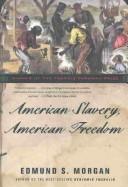
Edmund S Morgan · 1975 · Buy on Amazon
"By the time he released this book, Edmund Morgan had been known as a historian of the American Revolution for decades. In exploring the story of Virginia, the true pioneer colony, which began before the Puritans arrived in Plymouth, Morgan is exploring the paradox or the irony of the fact that it was largely slaveholders who wrote the American Revolution’s most eloquent documents about freedom. I’m referring, of course, to Thomas Jefferson, the author of the Declaration of independence and James Madison, the author of the Constitution, both of whom were born as slaveholders and died as slaveholders. Get the weekly Five Books newsletter We like to imagine that our history was the history of freedom, and that slavery was a footnote. Morgan turned that upside down. American Slavery, American Freedom argued that it was no accident that the men who wrote these founding documents came from a slave society. He argues that it was because they came from a slave society, in which the working class was marked by their skin color and held in perpetual bondage, that they could imagine freedom for all white people. The only way that the founders of Virginia could get British people to come here was through indentured servitude. In the 17th century, there was very little chance for young men in Bristol or Liverpool to succeed, so it made sense that they take a ship to the New World. If they survived for seven years as indentured servants, they would get what was called a ‘right of land,’ 50 acres. After generations, the indentured servants, who had supplied so much of the labor in the early years of the Virginia colony, were not enough and were considered too difficult to control. So, they started to tap into the vast Atlantic slavery system. Nell is right; the great majority of people in Virginia, in the first decade of settlement, would have been in some form of servitude. One of the great things about American Slavery, American Freedom is that it shows us that it was only after great trial and error that these English people—who had no experience enslaving people, although they had been active in the slave trade—adapted their law, religious practices, and customs for slavery. It took them decades to say, ‘it doesn’t matter if you become Christian, you’re still going to be in bondage.’ It took them decades to settle on the idea that the children born to slaves would be slaves. Laws had to be changed before skin color became a badge of enslavement. It took the English a long time to convert from a world of many kinds of servitude to a system in which African Americans were in perpetual servitude."
Ira Berlin · Buy on Amazon
"In the 1970s, a great efflorescence in the study of slavery began which produced a series of great books, among them Roll, Jordan, Roll and Many Thousands Gone . Ira Berlin helps us understand that many tributaries flowed into what became American slavery. After Virginia established this system of slavery, enslaved people were brought into South Carolina, Maryland, and Georgia from many different regions of Africa. Each had a different experience of what it was like to be ripped out of their homes and brought to British North America. Ira Berlin shows us that slavery was a vast and complex system. In the Presence of Mine Enemies is a story of the American Civil War that includes Black and white people, men and women, soldiers, and civilians, and Northerners and Southerners in the same story. It focuses on two communities in the Shenandoah Valley who were alike in every way, except one. They had the same soil, the same climate, the same ethnicities, the same religions, but there was a line on the ground and south of that line there was slavery and north of that line, there was not. I asked: How could Americans who shared so much have a difference on the issue of freedom which was so great that they would engage in a war that ended up killing the equivalent, if it happened today, of 8 million people? All this was a way to show the human side of the Civil War. Everybody knows that slavery ended with the Civil War. But if you read polls today, 40% of Americans still believe the Civil War was caused by a battle over states’ rights. We were taught the Civil War was a conflict between an industrial North and an agrarian South. That’s a gross distortion. At the time of the Civil War, 75% of Northerners were farmers. In 1860, Southern agricultural meant agribusiness based on the bound labor of 4 million people."
Amy Murrell Taylor · Buy on Amazon
"This book won more prizes than any other book about the Civil War that I know of. Full disclosure, Amy is a former student of mine. The subtitle of Embattled Freedom is Journeys Through the Civil War’s Slave Refugee Camps . Amy recovered the stories of people fleeing slavery for the protection of the United States Army, with an uncertain future before them. She shows us that two years before the Emancipation Proclamation, enslaved people were risking everything to make themselves free. This moves us from a story where freedom is bestowed on people to a story where freedom is seized by people in slavery. There’s no doubt that white Southerners went to war to create a new nation in which slavery would not be challenged. But, at the beginning, white Northerners were not going to war to end the system of slavery. In the beginning of the war, that goal seemed impossible. Slavery accounted for 80% of all American exports. What happens is Lincoln comes to recognize that he can’t defeat the South without defeating slavery. And, as you just suggested, it’s also the case that many Northerners, who had not had contact with Black Southerners, came to know them in these camps and came to see their determination to be free and their capacity for freedom, their hunger for literacy and their resourcefulness. So the refugees helped make emancipation a war aim and prepared the United States to embrace that aim. One of the most astounding things in American history was that Abraham Lincoln was able to persuade the white North to go along with expanding the purpose of the war from putting the United States back together to ending slavery."
W E B Du Bois · Buy on Amazon
"W.E.B. Du Bois, born in Massachusetts, educated at Harvard and in Germany, cast his lot with Black Southerners by moving to Atlanta and relays what he saw here. It’s a series of vignettes. The writing is so powerful. From the perspective of the white people in Atlanta, he’s no different from the people who’ve been held in 250 years of slavery. He tells a heartbreaking story of when his young son dies in Georgia. He’s walking down the street, with his heartbroken young wife, imagining white people’s disdain for them. He refuses to have his son buried in what he calls the “strangely red” earth of Georgia. It is Southern history, but it’s also a reflection on the history that shaped what followed its publication in 1903. It is important for its testimony but also for the work on Reconstruction that Du Bois began with this book. He then writes a great book in the 1930s called Black Reconstruction in which he argues that Reconstruction, which was widely considered a failure, showed the promise of a society in which Black people had the opportunity to succeed independently. The Souls of Black Folks is literally pivotal. People call the South ‘the Bible Belt.’ The South is deeply identified with Black and white evangelical Christianity . Enslaved people were not eager to adopt Christianity until evangelicalism took root, in the late 18th century. Evangelicalism conveyed two things: One, all people are equal in the eyes of God and all people can have salvation through Jesus Christ. Two, the people who suffer the most get special favor in the great beyond. Black people rushed to that message. Then, white Southerners took the message of the Bible and twisted it so slavery was a path toward salvation. You have the paradox of Christianity being both the explanation for why slavery is just, and a great resource for people in slavery. The Reverend Dr. Martin Luther King taps into that evangelical tradition, pride, patience and determination to launch the Civil Rights Movement. Some argued, like Du Bois, that the Black church was focused too much on eternal salvation and not enough on secular rights. The great accomplishment of Dr. King was to make the church an engine of Black liberation."

C. Vann Woodward · Buy on Amazon
"This is probably the most influential book ever written in Southern history. It began as a series of lectures at the University of Virginia in the 1950s, during the time of segregation. The defenders of segregation in the 1950s talked about it as an inevitable byproduct of two races living together. Woodward said, ‘no, segregation was created only 50 years ago.’ Segregation was not inevitable; it was invented recently and so segregation can be destroyed. The Promise of the New South was written in conversation with Woodward’ s Origins of the New South , published in 1951. Woodward had told the story of how the early 20th-century South came under the control of demagogic white politicians. I took the very last class Woodward ever taught. When I read this book, my knees grew weak. It was history that read like literature. The Promise of the New South takes a broader look at the same period. I often ask people, ‘Name something that happened in the American South between the end of Reconstruction and the start of the Civil Rights Movement’, and they’ll just draw a blank. I’ll say, ‘Well, nothing happened except the invention of the most widely recognized brand name in the world, Coca-Cola, the emergence of the most rapidly spreading religious denominations in the world, Pentecostalism, and the invention of America’s only truly original cultural contributions to the world: blues, jazz and country music. “You have the paradox of Christianity being both the explanation for why slavery is just, and a great resource for people in slavery” The Promise of the New South was trying to evoke that world. To get down to the ground, I traveled 12,000 miles in a $400 car, staying in motels. I went to every archive I could find and said, ‘I want to see everything you have from 1890 to 1910.’ They’d say, ‘this schoolgirl’s diary?’ I’d say, ‘Oh yeah.’ They’d say, ‘this sharecropper’s account book?’ And I’d say, ‘Gosh, yeah.’ I went through all of these records from folks no one ever heard of to evoke a South that had gotten left out of history books, to include the half of the population that was female and to show that African Americans were not only people to whom things were done, but also people who were creating their own lives and culture. It aims to be a tapestry of life in the South during that period. The leading historians of the South, in prior generations, worked outside of the South. During their time, the South was a segregated South. After generations of struggle, the South is different. I’m a native Southerner. I grew up in East Tennessee. Appalachia is an unusual background for an academic. I chose Southern history because I thought it was clear that slavery was the great American sin and that we’re not going to be able to move forward until we address that directly. Support Five Books Five Books interviews are expensive to produce. If you're enjoying this interview, please support us by donating a small amount . One reason that I was interested in going to Richmond is because I knew there was important work to be done there. I’ve been an expert witness for Virginia as they considered the removal of the (Confederate commander General Robert E.) Lee monument. If you want your work to matter, be careful what you wish for. As we’re learning now, it turns out the causes of the Civil War and where the cult of the ‘lost cause’ comes from matters a lot. Like all people, we interpret the past from where we are today. We’ve come to see that the structures of injustice and the practice of injustice extended across the United States. But if we don’t understand the wellspring of that injustice, we’re not going to be able to address it. And the wellspring of racial injustice lies in the creation of a system of perpetual bondage in the South. Almost all Black people in the United States came through the crucible of slavery in the South. So, to understand the America of today, you must understand the South of the past."