Diane Purkiss's Reading List
Diane Purkiss is Professor of English Literature, Fellow and Tutor at Keble College, Oxford. She was formerly Professor of English at Exeter University. She is the author of the highly acclaimed The Witch in History , Troublesome Things: A History of Fairies and Fairy Stories , and The English Civil War: A People's History . She specialises in Renaissance and women's literature, witchcraft and the English Civil War.
Open in WellRead Daily app →The History of Food (2023)
Scraped from fivebooks.com (2023-05-12).
Source: fivebooks.com

Molly Harrison · Buy on Amazon
"Weirdly, a lot of food history ignores food preparation, and particularly the material needs of food preparation. There are only a small number of books that focus on the kitchen and utensils, but they’re very important in terms of what you can and can’t cook. The main reason people choose the foods they do is material. So: Do you own a cake tin? Do you have enough resources to get an oven hot enough to bake a cake? Have you heard of cake? I chose this book because it’s one of the best accounts of the way we eat and how that is shaped by what we have and what we inherit in the way of equipment and expectations. I have a story that explains this, although it’s not from the book. I had an acquaintance, who used to be senior in the Food Commission. She taught an adult cookery class in England, and at the end of the course, she said to the women: ‘To celebrate we will make a cake next week, so everyone remember to bring in a tin.’ Nothing more than that. The next week, they all came in with their idea of a tin. One brought a beer can, another brought a washed-out tin of sardines. They didn’t really know what a cake tin was, nor did they have the money to go and buy one. This was only in the 1990s. It just perfectly illustrates the fact that our food horizons are shaped by materiality. That was inspirational for me while researching and writing my book. Absolutely. Right. It’s interesting that the kitchen is a gendered space. Even in a world of male master chefs, it’s still a feminised space, a space where women are allowed to dominate. It’s marked off as this space that you’re allowed to have. But there’s something confining about that too; it can come to seem like a prison, something you’re stuck with. So we make massive efforts to turn it into a social space. We eat in the kitchen, or make it open plan—make it less like a trap. But in actuality, most women probably still feel there’s some kind of inner super-ego inspector who’s in charge of assessing whether they’ve done a good job of Christmas dinner, or a good job with the birthday cake. I think that’s right. And I think it’s uncomfortable because, in my view, domestic labour still isn’t arranged in an egalitarian way in the majority of households. Cooking is often something women are supposed to do. You could be like my own mother, and find it deeply boring; she was from a generation where cooking was meant to be thrilling and exciting. You were meant to be inventive with it. But she was one of those people who felt trapped in a kitchen."

Lizzie Collingham · Buy on Amazon
"I think I do dare to misquote Kipling and say: What do we know of English food, who only English food know? This is a country where the national drink comes from a plant that won’t grow here: tea. It’s flavoured by another plant that won’t grow here: sugar. (Sugarcane, not sugarbeet—sugarbeet is mostly German, and didn’t get going until the nineteenth century, a long time after our sweet tooth established itself.) English food culture is contingent on our status as a mercantile empire power. The food culture we live in now is one where people identify a stir fry, or chicken tikka masala, as their favourite dish. Most people know what sushi and ramen are. The openness and plurality of food culture, especially in towns and cities, is an uncomfortable but ongoing reminder of the importance of empire. And the converse of that, of course, was why we nearly starved to death in both world wars. We were a week away from starvation in World War One due to bad planning, and it was only relentless planning in the Second World War that saved us. Support Five Books Five Books interviews are expensive to produce. If you're enjoying this interview, please support us by donating a small amount . It’s interesting that the food revolution in Britain has been modelled on food cultures of France, Italy, Iberia: it’s all about the local, the local cheeses, breads, growers. That’s lovely, I’m not against it. But one reason it hasn’t percolated far down the food chain—we still eat more ultra-processed food than any other country in Europe—is because it’s inimical to the food culture we’ve historically tended to have, which is creolized dishes of the kind highlighted in Collingham’s book. That book is a wonderful introduction to, in a way, the irrelevance of trying to build for ourselves belatedly the culture that Elizabeth David thought we should have, rather than embracing what we’re actually good at, which is grabbing and reinventing things brought here by other people. Fish and chips is the English national dish, but it’s not English—it’s a weird mishmash of a Jewish dish—where they serve the fish cold—and an Irish potato leftovers dish. So: not English. I think what I’m trying to say is that what we mean by Englishness needs to be redefined. Not as mince and mashed potatoes, but as a willingness to taste and try."

Steven Kaplan · Buy on Amazon
"I just love this book, and I love all his work. I keep banging on about how overrated Elizabeth David is in food history, but David writes—in English Bread and elsewhere, that French cuisine has been something so sacred that it’s just inevitably marvelous. But, actually, Good Bread is Back goes firmly against that narrative, because it’s the story of Kaplan’s efforts to save the baguette from industrial bakers. It led to an actual piece of legislation called l’ordinance Balladur which put in place the criteria for what a baguette could and could not contain. That’s now recognised by Unesco World Heritage. But it wasn’t before Kaplan’s intervention as an American in Paris; the French had been perfectly willing to allow the baguette to run downhill and become a much more ultra-processed kind of bread than we think is good nowadays. That’s right. Although it depends on the boulangerie. There’s a chain called Éric Kayser boulangeries —I think there are more than twenty now—which all craft a thing called the baguette Monge or sometimes the baguette tradition , which uses what the French call ‘old dough’ as the basis for the fermentation. So there’s an element of sourdough. But virtually every other grocery will be selling something pretty indistinguishable from what is sold in upmarket supermarkets over here. And if you go to Carrefour, or somewhere like that, you will smell the fresh bread , but it will be what’s called ‘bake off’ in the trade—it’s also called the ‘Milton Keynes process’ that produces the dough, hilariously—essentially they just push a lot of additives into it. It qualifies as an ultra-processed food because of the enormous amount of gluten it contains, and the preservatives, the stabilisers, the fat… it can just about be sold as ‘bread’, but you’re not supposed to sell it as a ‘baguette’. But it’s wonderful in places, and you can also get fantastic bread in Britain now. But around 90% of the bread flour sold in Britain is augmented with high gluten flour from the Canadian wheat belt. The average gluten content of a loaf made in the 19th century would have been around eight or nine percent. Now, that’s more like eleven to fourteen percent. If you use low-gluten flour, you have to put way more time into baking, spend longer kneading it, give it longer periods of rest, a much longer rise. It’s a much heavier workload for the baker. Basically, Canadian wheatbelt flour is a shortcut. And like all shortcuts, it has its disadvantages. It’s been argued that the higher gluten content is one of the reasons that we’re seeing so much celiac disease and so much gluten intolerance. People’s systems have just been overloaded with gluten that they are not genetically equipped to handle—in the way that many Asians can’t tolerate dairy. Bannocks, yes. That’s very standard. It’s what cake used to be. The cake started as a bannock, and our idea of something puffy and sweet is very recent. It was basically something crisp and kind of hard. There’s also an interesting argument as to whether that’s when our teeth went bad."
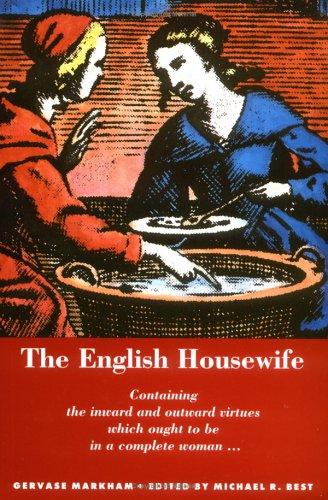
Gervase Markham · Buy on Amazon
"This is at least partly a work of fantasy; it’s Markham’s idea of how a household ought to be run, rather than what anyone actually did. Nonetheless what it reminds us of is the attenuated role of the modern housewife in comparison with what it used to be. It used to be like running a small business—you might typically have a staff of between five and five hundred people working for you to manage. And what Markham really clarifies is just how much knowledge this involved. If you wanted to ever have fruit, you had to be acting to preserve every tiny scrap of it. They’re preserving not only peak, ripe, glossy apples, but gathering up what they call the greenings, the windfalls that dropped before they were ripe. There are dozens of uses for those—you can make them into a kind of vinegar for salad dressing, or into a relish, or into a sugar paste as a dessert. All this thinking and planning and oversight is hugely interesting. It wasn’t like the weirdness of being a housewife in the 1950s, where inessentially you were confined to a tiny, not very interactive, space. It was more like running an enterprise of reasonable size. Among other things, she would need to be a shrewd bargainer, who could manage her own time and everyone else’s. She would assign tasks to people according to their skills, provide training for people coming through. It’s extraordinarily sophisticated. The reason I say this, is that we’re often rude about the past, and its food ideas. As if they were somehow just grovelling around on a muck heap. Sometimes people will casually say: ‘This brings us back to the Middle Ages.’ I’m like: ‘You wish! You don’t have the skills to survive in the Middle Ages. Tell me about your crop rotation plan.’ Just look at the number of physically demanding tasks that had to be performed by an ordinary yeoman, his wife, and the rest of his household. It’s gobsmacking. So we should always have respect for the people who did that, even if they didn’t do it in the ideal way environmentally, or in terms of animal welfare. Don’t forget that they were the people who were getting up at five in the morning—or three in the morning if they are bakers—to make sure the rest of us can eat."
Witches and Witchcraft (2019)
Scraped from fivebooks.com (2019-10-31).
Source: fivebooks.com

Alan Garner · Buy on Amazon
"I first read Red Shift when I was 15. I’d first read his earlier (and much more accessible) books The Weirdstone of Brisingamen and The Moon of Gomrath . What I remember about reading Red Shift is that it was completely unlike any book I’d ever read, in that it trusted the reader to make sense of things without holding one’s hand at all, or explaining anything ever. There’s no info dump; there’s no narrator; there’s no Dumbledore figure who in the last chapter plods in and says ‘Harry, I’m going to tell you everything.’ None of that ever happens. And at 15, I was so flattered by this book that seemed at once very exciting but unwilling to explain itself. So I read it over and over and over again. (I know lots of people who are driven back by its difficulty, but I really wasn’t.) One reason for that is that it’s emotionally very clear, even though there are stumbles about what’s really happening and who’s speaking. It’s about three couples in three different periods. The oldest story concerns the lost ninth legion in Roman Britain. A member of the legion, whose name is Macey, eventually gets involved with a local tribal girl. The second couple are of the English Civil War era, and the third couple are modern. It starts with the modern couple, who are really the voice of the story. Support Five Books Five Books interviews are expensive to produce. If you're enjoying this interview, please support us by donating a small amount . All the men are called Tom, which is also kind of interesting. Some of the women are called Janet, and some are called Marjorie or Meg. What Garner is doing there is drawing on the Tam Lim ballad; in different versions, the girl’s called Meg, and in other versions, she’s called Janet. It’s like all these different figures are incorporated into a single story. The Tom characters start having glimpses of one another’s thoughts. One character—the modern character—is saying goodbye to the modern Jan on the bus, and the bus is blue and silver, and the Roman Macey starts seeing blue and silver in his epileptic fits. I was fascinated by this idea that time and context, though totally meaningful, could be abrogated or ripped away. That seemed to me to be a pretty good definition of what magic is: that magic is about being able to remove the constraints on a person. But Garner’s really quite pessimistic about the results of that. He really makes it clear that particularly the modern couple can’t cope with what happens to them. Eventually, it ends with—as if to make things just a tiny bit trickier, but I love this, too—a letter in code. You can find a translation of it now on the internet, but that’s not very interesting. So I sat there with a complete Lewis Carroll trying to work out what the keyword was. Interestingly, I had a student who worked it out from scratch a few years ago by working out that the first sentence must be ‘I love you’. Absolutely. That’s right. It’s actually really touching. It’s also potentially a suicide note, but the novel is open-ended. If Janet in the 20th century manages to read the letter, she can prevent the suicide, but you don’t ever know whether that’s going to happen. So it feels like it’s on you, as the reader. “I was fascinated by this idea that time and context, though totally meaningful, could be abrogated or ripped away. That seemed to me to be a pretty good definition of magic” The other recurring character that I absolutely loved is this , pictured on the cover. Even though this isn’t the edition I first read it in, I love it, because it features the Neolithic hand-axe. All three of the couples possess this hand-axe and use it in different ways; it’s the unity of power between them. Artifacts, things, actually last much longer than people, and can be passed on from one person to another—reused, reinterpreted, redeployed. So it feels really magical that you might come across such an object, as the modern Tom and Jan do, hidden in a fireplace. I was incredibly drawn to the idea of the very old item that you might suddenly come across one day, with nobody knowing it was there at all. One of my very favorite witches uses what’s described as a dried piece of flesh for fortune-telling. It’s not very clear how she uses it, nor do we ever learn in the course of the trial what the flesh was. Was it animal flesh? Was it human flesh? What was it, actually? But it’s an interesting emblem—as is the hand-axe, I would suggest—of the fact that witches necessarily have to have dealings with the dark and the dead. Even if they don’t say they do, that’s actually what supernatural thinking nearly always comes down to. It’s nearly always about birth and copulation and death, the big human preoccupations. And the greatest of these is death . So an object that can transcend time is intrinsically very powerful. Yes! But particularly the special artifact of an individual codex. The fairy tale collection that I own originally belonged to my mother, and it now belongs to my daughter. That sort of transmission of an individual item down the generations is in a way a denial of death, and an affirmation of human beings’ power to make things—which is also a big part of writing, obviously."

Neil Price · Buy on Amazon
"The first thing to say is that everybody’s been waiting with bated breath for the second edition to appear, because for about ten years it was one of the most sought-after books on secondhand book sites. And it’s been revised, too. Why I’m glued to it is because I think Neil Price does a fantastic job of explaining to a modern, post-Enlightenment person what is a very strange series of cultures. He particularly focuses on the Viking idea of magic and its relation to the Viking idea of the person. Today, we tend to think in broadly Cartesian terms: we think of the human being as a thinking being. Even when people talk about the AI singularity, what they nearly always mean is the AI’s thinking capability. Will they be self-aware? Will they be able to play Go better than Go masters? That kind of version of the self. “Behind the obvious and the everyday is a world that you can’t see, but which in some sense corresponds with your emotions” But what I think Price understands (as Garner does) is that actually, a person is often a walking bag of complex relations to a body and to emotions—all of which won’t really be reproduced by uploading yourself to a giant computer somewhere. Particularly, Price’s take on the incredibly strange practices of what he calls ‘circumpolar shamanism’, is just endlessly fascinating. He retells dozens of stories, but the one that I’d really like to draw attention to is called ‘The Invisible Battlefield’. The story begins with “the nornir , or the terrible women of Darraðarljóð , [who] are spinning the web of war that will decide the outcome of battle”: On looms of power, perhaps made from human bodies, the grey cloth is slowly taking shape, dyed with blood. Each thread is a man’s life, weaving in and out of those around him. In Valholl and Sessrumnir, benches are being cleared and a reception prepared for those who will shortly be taking their places in the halls of the gods. “Those who will shortly be taking their places in the halls of the gods”—in other words, the dead. And then he depicts the valkyrjur arriving on the battlefield to collect them, with “their swan-wings spreading white behind them”. We see the increasingly visible presence of the supernatural on the battlefield to the magicians that accompanied every fighting force from Scandinavania, and tried to boost its supernatural capabilities by changing form, fighting in bird-form in the sky, often against these incredibly powerful deity entities: The sorcerers change form, their spirits fighting in the sky in constantly shifting animal shapes, sometimes even transforming into weapons or sharpened objects to pierce their opponents’ toughened hides. They try to overcome each new choice of form, thinking ahead to gain an advantage. Some try to block the route home between body and spirit, forcing the free souls of their enemies to drift to shapeless destruction. Increasingly, you’re seeing the visible battlefield, but also the invisible battlefield occupied by the dead, by armies of the dead, and by the armies of those who seek dead bodies and want to collect them and take them back to Valholl, or want to use them to make looms or to tell the future or to do magic. “The Angels of Mons was based on a short story about Agincourt bowmen written by the fantasy writer Arthur Machen. But people took it for a real report, and then started saying they’d seen it, too” It’s the idea that behind the obvious and the everyday is a world that you can’t see, but which in some sense corresponds with your emotions. It’s the fear you feel of death . If you visit any battlefield—even battlefields that are now quite old, like those of the First World War —there’s a haunting sense that here the dead still are, and they’re not going away. For instance, there’s this vast ossuary at Verdun, which has the bones of 55,000 unidentified men in it. There are still trenches where men were buried alive and they haven’t been reburied yet. That kind of haunting of the landscape means that a narrative where the landscape is always haunted, by supernatural entities that transcend death, makes a lot of sense. Nor is it insignificant that World War One was a war in which people were heavily invested in the idea that those entities were present in battles. The very famous instance of that was the idea of the Angels of Mons; really, that was based on a short story about Agincourt bowmen written by the fantasy writer Arthur Machen. But people took it for a real report. And then they all started saying they’d seen it, too, because it fitted with the way the war felt to them—the explosive power of war to destroy people’s sense of who they were. And particularly taboo, in war, because you’re not actually supposed to acknowledge that you’re terrified. You’re not actually supposed to announce to your friends and relations that you really don’t want to go back, and that you’d rather hide under the sofa for the duration. There’s some sense in which the fear and horror evoked by battle itself is often the thing that people can’t bring themselves to talk about. And when they do talk about it, it’s often with a sense of guilt, because it induces survivor guilt in people who didn’t, for instance, get taken after Valholl—the lucky ones. Yes. He talks about the feminization of sorcery and the extent to which sorcery effeminizes some of the shaman figures. I think all of us have a post-Victorian, romanticized view of sorcery. “It’s a famous urban myth that there are now so many people on the planet that they outnumber the dead. They really don’t. The dead outnumber us twenty to forty times” What Price is trying to do is push that aside in favor of something that’s much more about telling the truth than saying what we think we ought to say. Part of the power of these figures of sorcery is their willingness to acknowledge the perpetual presence of the dead in the landscape. The dead still outnumber the living. People often get this wrong—it’s a famous urban myth that there are now so many people on the planet that they outnumber the dead. They really don’t. The dead outnumber us twenty to forty times. It’s part of the reason that London’s so much higher up now, geologically and archeologically, than it was. But we’re nothing like as terrified as we once were. That, in a way, is what all of these books are about. What these writers are trying to do is encourage people to face truthfully the fact that mortality is still a problem the human race has not solved. We mostly now manage our feelings about death by pretending it’s not happening. And that’s not really managing your feelings—that’s actually just burying your head in the sand. I think it could be a recognition of what our society doesn’t provide to us. And there’s not really a lot of point in a society—or a religion—that’s so delicate in its sensibilities that it doesn’t provide anyone with any emotional equipment to deal with challenges that they will end up facing. Challenges like bereavement. I think one of the reasons that we find elderly women so horrifying is that they are literally a kind of dead end. We’ve now created a culture—good old us!—that is far, far more rigorously ageist than any culture previously on Earth. Girls at fifteen are having Botox before they even get any facial lines. On the other hand, you have to argue, what is it that terrifies us so much about the spectacle of age? I think it’s actually a sign that we’re no longer managing our feelings about death in any way. Nor is it insignificant that the witch trials begin at pretty much the same moment as the European Reformation in religion, which radically resets relations with the dead by deleting purgatory and the cult of the saints. Whereas previously you could be useful to the dead by praying for them. That’s useful if you were rude to Aunt Maud the day before she died; it helps alleviate guilt. Or, alternatively, the dead could be useful to you, because you could ask them to act on your behalf in front of God, just as you’d ask a local rich person to act. Get the weekly Five Books newsletter But the Reformation nixes both of those relations with the dead. And sometimes it makes things really, really violent and dramatic. My favorite story concerns the ossuary at St. Paul’s Cathedral—old St. Paul’s, before the Wren cathedral was built. In the middle of the night, this huge group of carts pulled up outside of the cathedral, and they took all the bones in the ossuary, loaded them into the carts, took them down to the local marsh, threw them into the marsh, and threw dung on top of them. It’s this obviation of the dead, because they decided they want to stamp out any Catholic tendency to pray for the dead. That’s right! Absolutely that. It’s so gobsmackingly insensitive. How would you feel, if your relatives were buried in a graveyard, and you got up one morning and realized the graveyard had been turned into a theme park? And that all the bones had vanished from the cemetery and been replaced by swing sets? It’s that. Most people would feel a very personal sense of violation. But that’s simply one of the kinds of events that people had to face. “In Norse myth, old age is an old woman” The consequence was that in deleting good relations with the dead, people were inspired to a greater level of fear than before about the passing of time. The visible figures of the poor, elderly, disabled trundling around, looking as though they weren’t long for this world, came to represent old age and death for them. Let’s not forget that in Norse myth, old age is an old woman. And she beats Thor at wrestling because even Thor can’t top old age! Arguably. Additionally, one of the effects of the Reformation is that over time it tends to delete the grey areas of folklore. Everything is black or white. You’re either going to the hot place or you’re going to heaven—there’s no in-between. There’s no purgatory; there’s no limbo. Similarly, every supernatural entity has to come from either heaven or hell. All those middling beings like fairies and ghosts also get dropped. Anything that does bad stuff is, therefore, a demon. Previously, it’s quite likely that some of what witches describe in the trial literature as ‘familiars’ were originally household fairies, brownies and hobs. Some of the practices that witches describe in their confessions are very like the practices associated with such entities: the notable one is leaving out a bowl of cream or milk for them, which again is a trans-national custom. (Scandinavians also do it for trolls and elves.) There are a lot of descriptions of people doing it for their demon, and the demons often sound quite a lot like fairies or elves—bearing in mind that fairies and elves are hobs. If they’re household brownies, they’ve got hair all over their bodies. The word ‘hobbit’ in Tolkien derives from the term ‘hob’, so they’re hairy and small. Interestingly, the reformed Church won’t have a bean of this. From its point of view, all these entities must be demons—because they’re not angels, so what else could they be? They can only either be delusions of strange old women or demons. I think so. Certainly, prior to the Reformation, they’re much more flexible and overlapping compared to after the Reformation. The Reformation really happens at different times in different places, and even happens differently to different individuals. If you look at the Lancashire witch trial of 1612, the two older women in their nineties accused in that trial are, according to their own children, using charms that we would probably think of as Catholic prayers. They’re getting people to invoke the five wounds of Jesus Christ, and to say a Pater Noster and an Ave Maria afterwards, in those terminologies, in Latin. For a very theologically up-to-the-minute Protestant, those prayers are themselves kind of diabolical, because by that stage, they’ve decided in their own minds that the Catholic church is all about Satan. “One of the effects of the Reformation is that over time it tends to delete the grey areas of folklore. Everything is black or white” Again, if you’re doing stuff that Protestants think is bad, there’s no grey area. There’s no room for tolerance. You’re either right or wrong. In that sense, it’s quite terrifying. It’s a terrifying worldview. And it persists to this day—it’s very similar to what we saw when the Harry Potter books were published in America. It’s horrifying, isn’t it? But alternatively, there are also all those people who believe stories of how their children were possessed by Satan after reading those books, which is the flipside of that, the other kind of crazy. This is where I should probably shut up, but I find the determinism of the sorting hat quite troubling. The idea that you are a Slytherin, you are a Gryffindor. Especially when you’re eleven years old, for God’s sakes. Adults, too. Don’t you find it a bit worrying? It reminds me of Calvinist pre-destination, where from the beginning of time you’re destined to go to the hot place or not. You’re right about less sophisticated. As though you can’t be cunning and brave, as though you can’t be both scholarly and intelligent and loyal. The absolutism of the categories does my head in."

Rane Willerslev · Buy on Amazon
"This is about a particular group of Siberian shamans. Now, I lay claim to no fluency of the language of Siberian tribes, but it might be worth noting for the record that the word ‘shaman’ actually comes from a Siberian tribal language. There’s now a locution among anthropologists and social scientists, the ‘California shaman’, which has obviously not a lot to do with what the Siberians thought it was. So there are people selling their services on the internet as shamans, they’re probably not from Siberia. “Being a shaman is nearly destroyed by Stalin and his policies” Actually, this book is fantastic is because it’s about the way in which being a shaman is nearly destroyed by Stalin and his policies. He wants to wipe it out for the same sort of reason that Protestants want to wipe out the grey areas that I’ve been describing in late medieval culture: because he wants everybody to have exactly the same mindset. Of course it fails, which is the good news. The bad news is a lot of people die, but the good news is that it fails. The book is about the revival of Siberian shamanism since the fall of the Berlin wall and the way that these groups of tribes are coming back together and trying to rediscover the traditional practices of their forefathers. Which is great. On the other hand, being a shaman is really, horrifyingly difficult. I’d be keen to ask some California shaman if they’ve really tried the full-on method, because it’s not just about the occasional tap on a drum. Really, to be able to become a shamanic healer, you have to be able to contract the disease you’re trying to heal and nearly die of it. The closer you come to dying, the greater your power. It’s important to remember that it’s not just something that goes on in your head; it’s also something you do with your body. It’s something you have to invest in as an embodied and fleshed entity. So again, that’s me not liking dualism very much, and not being very comfortable with the idea that people aren’t their bodies. People are their bodies. Nor can you really control every function of your body in the way you can maybe control electric lights. It’s increasingly to do with the relation between the Siberian people and their environment. As you probably know if you read the papers, the environment in Siberia—just like the environment all around the poles—is changing much faster. The further up you go, the more strongly climate change is happening noticeably. In Siberia, they’re dealing with incredibly scary stuff, like fields of bubbling methane. How can you manage totally non-traditional climatic events with traditional material? The answer would appear to be that only traditional material offers you the chance to give something back to the landscape. To see yourself as a creature within that landscape—rather than as something separate that’s using or digging into or mining that landscape, which is how Western man tends to see it. What I think we’re seeing is the rise of practitioners that want to promulgate not even a green idea, but more an idea that reduces the dominance of a human to something that’s much more intersectional and relational. Shamanism is a violent religion. It’s also what we would think of as self-harm. In order to induce the appropriate state of mind, self-harm is sometimes involved. In terms of whether we can really say that there’s acts of violence perpetrated by shamans, I would probably want to call them acts of resistance, because they’re never going to be the dominant force in the area, even. There’s always going to be an overlay of big business, and mining companies, and various globalized entities that militate against that sense of the local and the engaged. Support Five Books Five Books interviews are expensive to produce. If you're enjoying this interview, please support us by donating a small amount . I get the tendency of the California shaman to want to resist some of those forces. I also think that there’s something to be said for all of us opening up to some sort of idea where we allow nature to win some battles. Rather than insisting on making every single thing in our lives perfect for us, irrespective of other stuff. Now, you could call that violence. That’s right. And the responses to Greta Thunberg struck me as very much a callback to some of the kinds of rhetoric that we see associated with the young children caught up in the witch trials. The easy equation of autism with madness was one of the most nightmarish aspects of the response to her. My eldest daughter is autistic, so I have to come out and say I have a vested interest in neurodiversity. But equally, I thought that a lot of it was about the same kinds of issues that crop up repeatedly in the witch trials, most famously at Salem, where little girls actually seize the opportunity to get their annoyingly, obstreperously bossy elders into tons of trouble. There’s a wonderful ballad by one of the descendants of the Salem witches called ‘I, But a Little Girl’. This is one of the things that the accusers at Salem say: “we be but little girls”. The point that the ballad makes is that the adults let them do it. The adults don’t fight back. The fact that eleven people are executed has nothing to do with little girls per se, and everything to do with the adults who indulge them. But it’s also strikingly about a fightback by the little girls against the abusive power of adults. Adults in Salem, because it’s isolated, have total power over children. I’m not talking about clerical sexual abuse or anything along those lines—I’m talking more about the complete disregard for the feelings, the imaginations, or the emotional needs of children. It’s the effect of creating a situation like that. To some extent, Greta Thunberg is a side effect of the industrialization and globalization that we’ve imposed on the planet and basically left our kids to deal with. The town, yes. But have you been to the village? The village renamed itself in the nineteenth century, so many people don’t know it’s there. It renamed itself Danvers. It’s got a memorial to the Salem witches that lived there. The one that lived there that many people know about is Rebecca Nurse. Her house is still there and you can go visit it. Unlike the town, it has this hushed quality. It’s like walking with death. You’re right—the town of Salem is this creepy monetization of the terrifying aspects of the past. That to me is a little uncomfortable. I sometimes want to say to people: you realize actual people died here, right? This isn’t fun. “The Salem witches were trapped in the same kind of way that you could be trapped on Love Island” Those people were trapped—the Salem witches were trapped in the same kind of way that you could be trapped on Love Island. People don’t really realize this, but Salem was this tiny clearing in the woods. There was a town in the sense that it was a port, but it’s reasonably distant from the village. If you only had your feet, it would be very distant from the village. Say you’re Abigail Williams and you’re ten years old (she’s one of the principal accusers). You’re living with maybe 200 people and they’re the only people you know. They’re the only people you’ve ever known. There’s no television. There are no books except the Bible. And that’s your world. It’s horrifying! But I do want to say—Abigail Williams was ten years old. I want to say it again, because in Arthur Miller’s play, she’s somehow made into a lustful teenager. That’s Arthur Miller’s explanation for the entire phenomenon. Which is, frankly, absolutely gross. Gross in a particular kind of way that often masquerades as liberalism and is actually the opposite."