Davis Kedrosky's Reading List
Davis Kedrosky is a writer, student, and researcher at the University of California, Berkeley. He is interested in the economic history of early modern Europe and publishes the newsletter Great Transformations: Writings and Research in Economic History.
Open in WellRead Daily app →The Best Economic History Books of 2022 (2022)
Scraped from fivebooks.com (2022-12-14).
Source: fivebooks.com

Brad DeLong · Buy on Amazon
"There are two in-jokes among economic historians—one of which is, ‘when is Brad going to finish that book of his?’ But now, three decades after he first promised it, he’s actually done! Slouching Towards Utopia is a history of what DeLong calls the ‘long 20th century,’ the period from approximately 1870 to 2010. You might be able to detect a not-so-subtle reference to Eric Hobsbawm’s book, The Age of Extremes , which is subtitled ‘the short 20th century’ and covers 1914-1991. Delong decides to extend it, for the reason that instead of focusing on the cataclysm of the two world wars and the fall of the Soviet Union, he is looking at the great enrichment that occurs over this period. It’s about the transformation of first the North Sea region, then the North Atlantic, and finally parts of the rest of the world into an economic and industrial powerhouse. He points to three main factors that drive this transformation: the first wave of globalization during the late Victorian and Edwardian eras, the industrial research lab, and the modern corporation. These were the prime instigators of a new wave of innovation that economic historians call the second industrial revolution—when applied science began to accelerate technological progress and economic growth through new, innovative sectors like steel, chemicals, and electricity. Get the weekly Five Books newsletter For DeLong, this surge forward in living standards and technology was what allowed humanity to finally escape the Malthusian trap and achieve sustained economic growth. Had these factors not come into play, DeLong hypothesizes that we would today inhabit a significantly less populous world—with perhaps around 5 billion people—and have steampunk technologies, maybe 1895 vintage. It’s a book of titanic scope, covering not just the economic axis, which he emphasizes, but also the effects of the wrenching social changes of the period on North Atlantic political economy and the rise of neoliberalism. He’s tying together this great economic transformation with the dynamics of this period’s most important political movements, including the rise and fall of fascism and socialism. Particularly important to Brad is the three-sided intellectual debate between the two Austrians, Friedrich von Hayek and Karl Polanyi , and the British economist John Maynard Keynes . Hayek emphasized the importance of the market as a mechanism for coordinating economic activity; Polanyi, that markets create and sell “fictitious commodities”—land, labor, and money—that should actually be protected as rights. Keynes, who advocated state intervention in defense of the market mechanism, oversaw a “shotgun marriage” between the two that resulted in the “developmental social democracy” that prevailed in the Trente Glorieuses after World War II. Yes, absolutely. DeLong readily acknowledges the enormous forward surge in living standards that transpired over the course of his ‘long 20th century’—from a society threatened by Malthusian catastrophe to (at least in the Global North) one of affluence and abundance. “Slouching is better than standing still, let alone going backward,” after all. But escaping “the realm of necessity” isn’t the only component of the utopian vision, and many other parts have not been fulfilled. DeLong cites the collapse of the Hayek-Polanyi alliance—postwar Keynesian social democracy—and the withdrawal of the United States as guardian of representative government in the 21st century as critical ways in which the utopian project has been derailed. Economic outcomes are still mediated by the market, which is a superb coordinating device, but does little to protect property rights other than those strictly defined by the government. And large inequalities of income and wealth persist within and between countries. Our mistake was abandoning the postwar compromise of allying markets with tactical state guidance under the crises of the 1970s."

Jared Rubin & Mark Koyama · Buy on Amazon
"This book is perhaps the first book to extensively survey recent trends in the economic history academic literature. Over the last 20 years, as I noted above, economic history has become more aligned with economics, and particularly its empirical econometric tradition. Economic historians have become more like empirical microeconomists, using historical data to create ‘natural experiments.’ That basically means using historical situations to simulate the control and treatment groups that you might see in laboratory tests of drugs, based on what you know of the historical period, to identify some sort of causal effect. What effect did historical force X have on Y historical—or often modern-day—outcome? The canonical example that founded this literature was a 2001 paper by Daron Acemoglu, Simon Johnson and James Robinson, “The Colonial Origins of Comparative Development: An Empirical Investigation.” The paper leveraged variation in settler mortality in the developing world to show that institutions have a positive effect on economic development. That spawned a new wave of literature over the following two decades, of which this book by Koyama and Rubin is really the most accessible and comprehensive introduction. They categorize all these papers into five major categories of explanation for why economic development happens. These are: geography, institutions, culture, demography, and colonialism. “Over the last 20 years…economic history has become more aligned with economics” Koyama and Rubin are by no means indifferent between the five factors. This book is not just a literature review, but also presents an original theory of economic development, explaining the Industrial Revolution , the Great Divergence (the separation of incomes between the Global North and Global South over the last two centuries) and then, finally, the recent convergence of leading parts of the developing world. They believe that while geography is important, it is mediated by culture and institutions, which can act to reverse the negative curse of geography, of having (say) limited access to the sea, which one might think would inhibit a country’s ability to participate in foreign trade. The central claim revolves around the role of representative institutions in limiting the ability of executives to arbitrarily interfere with entrepreneurs and innovators—a staple argument of the ‘new institutional economic history.’ Koyama and Rubin suggest that Britain succeeded in achieving modern growth because she possessed all of the advantages often mooted by historians as the factor explaining her take-off. So I think that this book is something incredibly novel in the economic history literature. While the discipline has always been in the vanguard of using quantitative methods to study the past, most works have relied upon earlier research, and few recent books have the ecumenical scope that How the World Became Rich does."

James Belich · Buy on Amazon
"Belich, unlike the authors of the two preceding books, is very much a historian. His interest is in the early history of globalization and the expansion of European settler economies. He takes this into studying the Black Death and its consequences. One paradoxical but widely-held view among economic historians is that while the Black Death was an absolute calamity in the short run—killing as much as half of the European population in the worst affected regions—it had positive long-run economic effects. Belich’s book is the most comprehensive survey and coherent theory of how economic development—in particular, the differentiation of Europe from the rest of the world—may have resulted from the Black Death. His argument revolves around the stunning figure that 50% of Europeans died of the plague, revised upward from earlier estimates of a third or 30% mortality. That doubled the number of things that people owned per capita and this doubling of disposable incomes drove economic development from the demand side. People demanded more luxury goods: silk, sugar, spices, furs, gold, and also slaves. Demand for these things led to the expansion of trade from Europe because many of these goods are not found in Europe and needed to be sought from Asia and, eventually, the Americas. Manpower shortages, meanwhile, induced the development of labor-saving technologies, such as the water mill. These forces of innovation and globalization helped to turn Europe into a prosperous and commercialized society and he ties that in, at least in origin, to the Black Death. Economists have long held that there are diminishing marginal returns to the application of any factor of production—so the more workers you have in agriculture, the less additional output each new person creates. In some regions of Europe, the centuries preceding the plague had seen an economic and demographic boom, with population densities increasing markedly from the low levels of the early Middle Ages. This mass of surplus labor meant lower demand for agricultural labor and reduced incomes for the workers themselves. Indeed, living standards declined to such an extent that it’s possible that the plague’s severity was exacerbated by poor nutrition. The loss of labor did, in some places, lead to a reduction in the cultivated area, but that effect was outweighed by increased worker productivity and greater demand for labor, which both served to increase real wages—which, in England, were greater than at any point prior to at least the eighteenth century. Secondarily, Belich also argues that mortality created incentives for the adoption of labor-saving technologies that substituted for human activity, helping to fill the gap. And the change in the relative price of labor merely meant that it paid to use more animals for plowing, transport, and milling, and to raise sheep rather than cultivate cereals."

Jan Luiten van Zanden & Maarten Prak · Buy on Amazon
"This is a very interesting book about the development of the Netherlands during the early modern period, culminating in its 17th-century Golden Age. You’ve actually just done an interview with one of the authors, Maarten Prak . I find this period particularly fascinating because the Netherlands appeared to be close to an industrial revolution that never was. The region possessed a commercialized, capitalistic society with the world’s highest standard of living and a relatively advanced degree of political and economic liberalism. At the same time, there was an efflorescence of art, literature, intellectual culture, and philosophy. One good reason to find an explanation for why this happened is the paucity of data points for the pre-industrial era, in terms of episodes we can use to explain why, eventually, one country—Britain—did start to achieve sustained economic growth. The Netherlands had many of the indicators of impending development and, indeed, Britain in many ways imported Dutch institutions and culture (even its monarch!) in the years preceding the Industrial Revolution. There is good reason to believe that this cultural diffusion had some positive effect for economic growth. So we should probably do more to understand the Netherlands. There are fewer people studying this period than there should be, just because, as an English language scholar, it’s hard to engage with French and Dutch sources. This book is an enormous contribution. Support Five Books Five Books interviews are expensive to produce. If you're enjoying this interview, please support us by donating a small amount . Prak and Van Zanden are trying to explain why the Netherlands is the birthplace of modern capitalism. They want to refute three traditional arguments for why this happened: the Marxist view of enclosure and exploitation, often applied to Britain; Jan De Vries’s claim that the Dutch were free of feudalism; and, the strict institutionalist explanation—that liberal semi-democracy is better for growth than autocracy. They find all of these factors wanting. Instead, they look at the long-run origins of Dutch economic development, starting with its feudal, almost republican institutions during the late Middle Ages. They include cooperative institutions like guilds and urban associations, as well as the empowerment of independent cities in the region’s governance structure. These institutions were ultimately protected by the Dutch revolt from Spain. Whereas many other European countries during this period experienced a consolidation of absolutist rule, the Dutch managed to escape. This allowed them to preserve a relatively open society in which cities were autonomous and ruled by local merchant elites. They cooperated and competed with one another in producing an economically open society. This was coupled with ecological crises that damaged the ability of the Netherlands to feed its own population, forcing the Dutch to engage in foreign trade to acquire the grain it needed. They had to industrialize to pay for that grain. That basically drove the center of European capitalism from Northern Italy to the coast of the North Sea in the Netherlands."

by Debin Ma and Richard von Glahn (editors) · Buy on Amazon
"These two colossal volumes cover much of the recorded history of China, from about 1000 BC to the present. Dutch economic history may be understudied, Chinese economic history is much more so. Chinese economic history is important, not only because China has historically been one of the world’s largest and most powerful states, but also because, up to the late Middle Ages, it had experienced precocious economic development, responsible for many key innovations that only surfaced in Europe centuries later. In these two volumes, Ma and von Glahn put together a massive collection of essays on thematic topics throughout the economic history of China. As an early modern economic historian, I’m most interested in the first volume. There are some really fascinating essays, for example on the early development of Chinese fiscal capacity. While Western Europe had barely experienced any state formation, China was already building a fairly advanced state that collected quite a lot of taxes. The volume is influenced by the legacy of Kenneth Pomeranz’s The Great Divergence , which argues that because of ecological bottlenecks, China was unable to experience the breakthrough to industrialization that Europe did at the end of the early modern period. So the latter part—maybe two-thirds of the first volume—summarizes the research inspired by and evaluating that book, and looking at how China’s advanced market economy interacted with its agrarian institutions and its ecological resources. Pomeranz himself authors an excellent chapter on Chinese agriculture, detailing the transformation of the country’s crop mix toward cotton, tobacco, and maize; irrigation and crop rotations; and the factors contributing to stagnation during the eighteenth century. The second volume is looking primarily at economic development surrounding the Opium Wars and the advent of Western adventurism into China, then moving on into the Communist period and, finally, its post-1978 economic transition into modern economic growth and semi-capitalist institutions. It’s animated by two fundamental questions: first, about the results (positive and/or negative) of European influence on China; and second, about the causes and nature of China’s late-20th-century growth miracle. This book is the most comprehensive survey of China’s economic history ever written and by poring through all of it, you’d be pretty close to becoming an expert. Part of our best books of 2022 series."
The Great Divergence (2022)
Scraped from fivebooks.com (2022-08-18).
Source: fivebooks.com

E L Jones · Buy on Amazon
"While this is the oldest book on the list, obviously the Great Divergence debate does not start with Eric Jones. The first thinkers to really tackle the question were two Germans, Max Weber and Karl Marx , in the 19th century. Their debate was on the causal factors behind the rise of capitalism. Capitalism was then, in turn, associated with the economic growth that differentiated Europe from the rest of the world. Weber was interested primarily in endogenous factors, like culture and institutions, that made Europe particularly special. He particularly cited Protestantism as a motive force in making Europeans much more likely to accumulate wealth and be entrepreneurial. Marx stresses free wage labor and capital accumulation, and particularly the dispossession of European peasantries. I see Jones as being very much in the Weberian camp. He’s looking at factors that are internal to Europe, for the most part. His concept of ‘a European miracle’ is an attempt to codify a scientific theory of the factors that differentiate Europe. That’s different from previous books on this subject, which were not quite as systematic. I think that’s what makes Jones special. Also, he’s just a really beautiful writer. “The ‘West’ was moving ahead of the ‘rest’ at least by the beginning of the 18th century” The basic idea behind The European Miracle is that Europe was highly differentiated from and ahead of Asia from an early date (Jones doesn’t bring Africa and North America into the question). One of the major indicators of Europe’s early success was the fact that, on a per capita basis, it had a very large capital stock. That basically means livestock. Europe had a lot of sheep, cows, and pigs. More livestock, in turn, meant more traction power and manure (and thus higher productivity) in agriculture . The reason that capital accumulated is that Europe had a special demographic regime, which the demographer John Hajnal called the European Marriage Pattern. Fewer Europeans marry than in the rest of the world and they marry later, which means they have fewer children. This reduced the demographic pressure on European wages. Whenever incomes rose in Asia, by contrast, fertility increased more rapidly, and incomes fell back down toward the subsistence level. In Europe, because of this demographic restraint, wages either don’t fall back down to the subsistence level or are just much slower to do so. So European living standards remain higher for longer and this allows capital to accumulate because people have more purchasing power. That ultimately leads to the rise of cities because when people have more disposable income, they’ll buy goods that are produced by urban artisans. For Jones, the rise of cities leads to the rise of parliaments and the fragmented European political system, which protected the freedom of intellectual and economic enterprise, and you can see things spiraling from there. Many scholars have taken Jones as a starting point for thinking about the Great Divergence, though not all have agreed with him. Also, he’s not just examining Europe in isolation. He looks at the Ottoman , the Chinese and the Indian Mughal empires . He tries to explain why these similarly advanced civilizations don’t succeed in reaching industrialization first, because it seems that these commercial societies, with high levels of trade integration and often advanced intellectual cultures, should be much better sites than violent, often backwards-seeming Europe for producing industrialization. His comparative perspective is something that has borne fruit and is exemplified in many of the other books that we’re going to talk about, too. One of the debates in the Great Divergence is how backward Europe was. Was Europe backward at all? Jones is of the opinion (at least partly correct in my view) that it’s not so backward and living standards were pretty high and that people who look at Asian empires as being particularly prosperous are actually just looking at the magnificence of their courts and not at the immiseration of the average person. Other authors that I’ve cited will disagree with that."

Kenneth Pomeranz · Buy on Amazon
"This book sets up the modern question of the Great Divergence in an economic history sense. Jones’s book is a little bit more ad hoc, presenting a more traditional stylized history. Pomeranz puts the debate into rigorous quantitative terms. I won’t say he comes up with a grand theory, but he sets the terms of the debate such that everyone who is attempting to research this question knows what side they’re taking. Pomeranz particularly takes issue with Jones, who is arguing that Europe was markedly different from Asia on a number of cultural, social and political indicators that predicted its growth. Pomeranz takes the opposite perspective. He argues that prior to 1800 the advanced parts of Europe and Asia were on very similar trajectories. He calls it “a world of surprising resemblances,” a term that’s stuck. In Europe, the advanced regions are England and the Netherlands. In East Asia it’s the Yangtze Delta and the Kantō Plain of Japan, as well as Gujarat in India. Prior to 1800, all of these places have relatively similar economic structures. They are characterized by relatively free and open markets, lots of mercantile activity and increasing population growth. They also have similar ecological bottlenecks, as he calls them, where increasing population and economic activity run up against the constraints of their own fuel consumption and resource needs. For Pomeranz, if these are left unchecked, this eventually results in these societies falling into a Malthusian equilibrium, because the soil is going to be exhausted, and agriculture is going to be less productive. You’re trying to fit more people onto a finite area of land and, ultimately, no modern economic growth emerges. Get the weekly Five Books newsletter Pomeranz doesn’t like Jones’s comparison of Europe, China, India and the Middle East as macro regions. He says that these sweeping perspectives are wrong and that they conceal a lot of heterogeneity. The poor regions of Europe are very poor, and the poor regions of Asia are very poor. But there are smaller regions within these larger spheres that are comparable with one another up till the very end. So the question then is, how exactly does Europe become so prosperous if the advanced parts of Europe and the advanced parts of Asia are just about the same in 1800? If you remember the phrase “coal and colonies,” you will be able to remember the essence of Pomeranz’s book for the rest of your life. He argues that the windfalls from Britain’s large coal deposits and the vast land spaces of the Americas relieved these ecological bottlenecks. He talks about the ‘ghost acreages’ provided by the Americas and by British coal, a concept that is in Jones, and that he borrows, but that he exaggerates the importance of. By using coal as your source of fossil fuel for power you don’t have to maintain large forests to provide wood for your industries. By using the Americas as your source of raw materials—particularly cotton, but also other crops like sugar and tobacco—you don’t have to grow these crops in your own country. You can use the land for food and then use your population for manufacturing, which is what he correctly sees as being the motive force behind industrialization. So whereas China does not have access to coal because it’s in the interior, far away from its commercial areas, and it doesn’t have access to the Americas, it has no relief for its ecological bottlenecks. Britain gets this colonial and geological windfall and that is what triggers its industrialization. It’s the received wisdom among some historians. However, I would say that the empirical evidence has moved against it in the last 20 years. Pomeranz’s main contention is that the advanced regions of Europe and Asia are at the same level of economic complexity, free market activity and living standards prior to 1800. This isn’t really the case. Empirical work has been done getting real wages in Britain and several European cities and then also cities in the Yangtze delta, which is Pomeranz’s leading region in China. It turns out that in England silver wages were three times those in the Yangtze delta and five times those in India already by 1600. So the latest you can probably put the Great Divergence is 1700, which means that Pomeranz’s story about it being all about colonial windfalls and British coal use is probably misguided. These were definitely important factors and it’s possible that European industrialization would not have continued without them. But there was definitely something different about Europe from an earlier stage. There are also other questions. One historian, Deirdre McCloskey , has pointed out that if coal was so important, Chinese industries could just have moved closer to coal because they have tons of it. Also, if Britain didn’t have coal, it simply could have imported it from other countries, which is what ended up happening during the Industrial Revolution itself. Britain exported a bunch of coal and continental countries imported it."

Joel Mokyr · Buy on Amazon
"Mokyr is absolutely right. This book was the first economics book that I ever read. My dad pushed it on me when I was in high school, and I loved it. It took me a surprisingly long time to read given that it’s not very long, but I was captivated. I decided, ‘This is what I have to do in life. I have to study these questions.’ It is just brilliantly and sharply written. He immediately captures the reader by attacking the received wisdom that ‘necessity is the mother of invention.’ He says, ‘Well, no, many societies have not successfully innovated when they really needed to.’ For me, as a young person, that was incredibly fascinating, and it makes him such a compelling author. Mokyr is different from the previous two authors who are looking at much more mundane economic factors behind the rise of the West. Mokyr notes that there’s really no way to explain the emergence of modern economic growth without reference to the technologies that bring it about. There’s no world in which we would be as rich as we are today if everybody was making cotton cloth with handlooms. Technological progress is the basis of economic growth because it makes the individual worker much more productive, and consequently able to earn a higher wage in the modern economy. That is the basis of our present standard of living. Mokyr develops a theory of technological progress that is incredibly compelling. He is addressing some older questions in the economics literature, about whether it’s big inventions that make economic growth happen, or whether it’s continuous chains of small inventions that are the most important. Mokyr says it’s both. Without what he calls macro-inventions—these seminal leaps forward, these strokes of genius, these completely original ideas—no change ever happens. But without micro-inventions, which are generally small, economically motivated refinements on existing ideas, these macro-inventions will remain just what they are: great ideas with limited economic application. “Technological progress is the basis of economic growth” The classic example is the steam engine, an early version of which was invented in the early 18th century by Thomas Newcomen. It was an enormous and inefficient pump for getting water out of mines. For the next 150 years, engineers (famously James Watt) improved it, increasing its fuel efficiency, allowing it to be applied to rotary motion, so that it was able to power machinery, trains, and ships. All these subsequent micro-inventions were necessary to take this fantastic and innovative concept and turn it into a machine that people can actually use. Until those micro-inventions happened, very few steam engines were applied in Britain. So Mokyr sees both of these strands of invention as important. In that light, he has an explanation for British growth residing not in material factors, but in people. Britain, he says, had a class of skilled artisans and inventors that were able to take all of the ideas produced by other countries in Europe, and apply them to economic problems that they faced, and then make iterations upon them whenever technical problems were presented. British engineers, when they were faced with, say, providing a particular kind of iron for the construction of tracks, were very good at refining their production processes such that they could make a particularly hard kind of iron for producing a rail system. What I’ve discussed so far is the opening chapter of the book where he lays out his theory. At least half of the book is a narrative: first of technological progress through the last several centuries of history, and then a series of comparisons between first medieval Europe and the classical world and then between Europe and China. He is endeavoring to explain why China, which during the Song dynasty from 900 to the late 13th century seems to have been the most scientifically and technologically advanced civilization in the world, responsible for a whole slew of independent inventions that are incredibly important, then falls behind. The Chinese had wet field rice cultivation, dams for drainage, iron ploughs, fertilizer, and pest control. They invented blast furnaces for smelting iron a millennium-and-a-half ahead of Europe. They invented spinning wheels, cotton gins, used waterpower and water wheels. They independently invented the water clock, the compass, paper, porcelain, wheelbarrows, crossbows, and trebuchets. Yet all of this basically disappears during the early modern period and China becomes strangely unreceptive to science and technology. Their early use of gunpowder and rocketry does not translate into later use of cannons. All of these technologies have to be imported from Europe during the 17th and 18th centuries. Mokyr is trying to discover what made China less inventive after the 13th and 14th centuries. He doesn’t settle on anything in particular but suggests that the overly large role of the Chinese state in promoting technological change made Chinese invention very vulnerable to withdrawal of that state support. So, whenever the state decided that technological change was too destabilizing for society, invention was more likely to cease than it was in, say, polycentric Europe, where a competitive state system ensured that inventors who were in a repressive society could flee to a more liberal one, and set up their trade there. It’s probably not a coincidence that two of the most liberal societies in Europe, the Netherlands and the United Kingdom, were also particularly inventive. They both took on many, many refugees from other countries in Europe. Huguenots from France, for example, helped to set up textile industries and also the watchmaking industry in Britain."
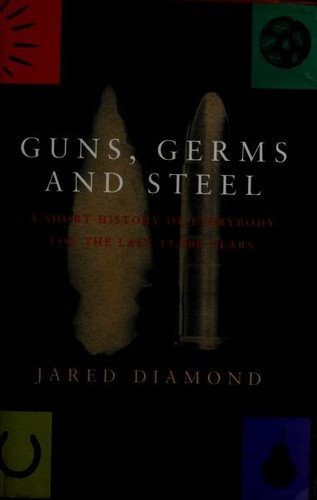
Jared Diamond · Buy on Amazon
"Definitely. In choosing my books I’ve tried to give a balanced perspective on the Great Divergence but I’m an economic historian so the economic viewpoint and analyzing the rise of capitalism are what I know best. Diamond is very much outside that box. He doesn’t see the rise of capitalism as being particularly important at all. This is something I would criticize him for, but in general I admire him so much. He’s one of my intellectual heroes. I admire this particular work for its grand theoretic scope—its ability to encompass so many different factors and to spin them all into one coherent narrative. That narrative is based on what he calls “Yali’s question.” Yali is a New Guinean who asks Diamond why Europeans visiting there have so many material goods and great technologies while New Guineans have very few. Why were Europeans able to conquer these societies? Diamond answers this question by looking back to the very beginnings of human civilization. He starts with the origins of agriculture. He shows that in Eurasia—particularly in the Near East, which is the Eurasian cradle of civilization—there are more domesticated varieties of crops. Europe has barley, two wheat varieties and three kinds of pulses that can all be domesticated and turned to farming. Farming leads to food surpluses, which allow larger portions of the population to specialize outside agriculture and lead to population growth. This settled farming society also allows for cumulative social and technological innovations—from writing to bureaucracies and stable governments. It also allows societies to remember technologies. In small societies without writing—one of his examples is the Inuit—technologies arise and are forgotten because the ability to have collected knowledge is limited to the memory of individuals. In a large, writing-based society social and technological progress can be cumulative. “The lateral axis of the Eurasian supercontinent allowed both agriculture and animal domestication to spread easily in both directions” Diamond’s second major point is that there are other cradles of civilization: in Africa, in North America, and also in Polynesia, but that these areas lack fundamental components whose absence would delay the development of an advanced civilization. North America has fewer domesticable crops and animals. Of the 14 different types of domesticable animals, 13 are in Eurasia. One is in South America, the llama, and there are none in the rest of the world. Many were killed off by early Pleistocene hunter gatherers. As a consequence, Eurasia had a relative bounty of cows, sheep, goats, and horses and these animals could be used for traction in agriculture. Living next to these animals allowed Europeans to contract their diseases, which turned out to be particularly deadly. The lateral axis of the Eurasian supercontinent allowed both agriculture and animal domestication to spread easily in both directions, uniting all of Eurasia into a single disease pool. Eurasians were forced to develop immunities to all these animal-based germs or die. Also, the strong pro-growth traits that result from an agrarian society also spread—that’s the guns and the steel. The upshot of this is that whenever Europeans arrived in North America and Africa, where the spread of agriculture and animal domestication was limited by the available crops and animals and by the North South orientation of the continents (since biomes follow latitudes and not longitudes it’s very difficult for crops and technologies to diffuse) the European landfall hit like a hurricane. There was no reciprocal exchange of germs and technologies because there were simply fewer in North America. I do see this as a weakness of the book. Yes, he presents a compelling argument for why Eurasia is differentiated. Empirically speaking, it is: almost all of the advanced civilizations in the early modern period were Eurasian civilizations, and we’ve marked them out: the societies in northwest Europe, the Ottoman Empire, the Mughal Empire, the Chinese Empire. These kinds of civilizations are not really present in the rest of the world. But in terms of differentiating Europe, he basically points to geographical factors like large rivers and high mountains that balkanized Europe, creating many independent populations that are not easily conquered. This leads to that polycentric state system we described earlier, where the presence of many different rulers stops the easy suppression of ideas. He does and he may be right about these things, but it’s definitely a limited way of explaining the massive gulf in incomes between the two poles of Eurasia, particularly because geographical factors are static: Europe didn’t suddenly get many rivers and high mountains and jagged coastlines. Economic status, however, is dynamic. Europe has been variously ahead of and behind other parts of Eurasia. There was no geographical shock that propelled that to happen. It’s incredible. Also, I get the sense that a lot of the people criticizing it—calling it crude geographic determinism—have not actually read the entire book. In fact, it is exactly the opposite of crude. It is the opposite of Eurocentric. For me, its biggest failing is its inability to explain the rise of Europe with regard to other civilizations and the sheer number of factors that it endogenizes, as economists say. Diamond’s assertion would be that every single factor that Mokyr, Jones and Pomeranz discussed is endogenous, caused by continental axis orientations and the location of domesticable crops and animals. The previous factors we discussed would, to Diamond, be proximate causes—whereas the factors which he is emphasizing are ultimate causes, the deep forces that make all the surface-level stuff described by us economic historians happen. I think it’s critical to sometimes step back, as Diamond does, and consider a whole host of different disciplinary approaches to studying this big question. As a historian, it’s easy to get bogged down with minutiae, but that has never been one of Diamond’s flaws. He’s been incredibly influential, at least implicitly, for a lot of the economic history that’s done today."
Jared Rubin & Mark Koyama · Buy on Amazon
"This is effectively a readable textbook. The authors are economists and economic historians in a very modern sense. Many economic historians in the past, and several of the ones that we looked at earlier, were primarily history -focused. Many were actually historians working in history departments, and their goals were to ask historical questions to understand why this great gap in incomes, living standards and technology emerged between the West and the rest. Rubin and Koyama, while they are similar in motivation, are reviewing a vast body of literature that has emerged primarily in economics and is a little ambivalent on how to treat history. There is some debate on what the purpose of historical research is, whether it’s to flesh out economic theories—so using historical data to test hypotheses that are put up by economists and using history to understand the present day—or really to ask historical questions. Koyama and Rubin synthesize a lot of these different strands of research which, unlike the other books that we studied, is primarily econometric, using different kinds of regressions on large and creatively constructed datasets. For example, an economic historian might go into the archives of some old foundation and get tons of observations about the balance sheets of hundreds of different companies in late Imperial Russia, and then analyze the statistical properties of that dataset and come out with a conclusion that to some extent reflects the history of business activity in Russia , to some extent makes generalizations about the importance of market concentration and rent-seeking in slowing down economic growth, and then partly draws conclusions about how this likely affected subsequent Russian development. That’s the central tension. “It’s probably not a coincidence that two of the most liberal societies in Europe…were also particularly inventive” Rubin and Koyama synthesize all this literature and discuss five major ways to explain the Great Divergence: geography, demography, imperialism, culture and institutions. Both authors are really interested in culture and institutions, which has received a lot of emphasis in the newer work that they survey. They categorize many different books and papers that have been produced by economic historians using this highly empirical, what I call the ‘natural experimentalist’ method. The methodology is inspired by randomized controlled trials in medicine, which are used to look at the effects of a treatment (e.g. a drug or therapeutic program) on a treatment group by comparison with a control group. What economic historians do now is look at the effects of historical treatments on certain hypothetical treatment and control groups. You have to make the argument that these are comparable to one another and that assignments of individuals to the groups are pseudo-random. So Rubin and Koyama place many papers and books into these different categories, and then try to compare their relative importance. Then, in the second half of the book, they take on the question of explaining, first, the rise of Eurasia, then the rise of Europe, the rise of Northwest Europe, the rise of England, and then finally how growth spread to the rest of the world. What they do is take every single factor that we’ve talked about today and give it some little weight in the overall explanation. They say that you cannot explain the rise of Britain without taking into account everything that we’ve discussed. So you need geography, you need political and social institutions, you need cultural factors. You don’t really need colonization, but you do need coal. And they try to attach it all together in a coherent theory. Broadly speaking, this is probably one of the most sensible ways that you can approach the subject because if you have so many different thinkers coming from different perspectives and finding that their particular favorite factor had some importance, it’s unlikely that 99 per cent of them are completely wrong and that one of these factors has all of the explanatory power. Big historical events are overdetermined. Most of the factors cited probably do go some way to answering the question. I would say geography is probably the most important (if by no means the only) explanation for the rise of Europe. As I said, I think the geography definitely explains much of the rise of Eurasia. I also think Diamond is probably onto something when he describes the geographical factors underlying Europe’s polycentrism. Geography can also in part explain, through coal and colonies as Pomeranz argues, the rise of Britain in Western Europe. Britain’s industries were relatively closely located to its coal deposits and where they weren’t you could sail down the coast and ship coal to locations that needed it. As it’s situated on an island off the west coast of Europe, it’s also in a good position to exploit both trade with the rest of Europe and with the Americas. So it has good access to raw materials. Get the weekly Five Books newsletter Britain, through its privileged trading location, also has a head start in developing a commercial society, leading to higher living standards and more people who are focused on invention and economic rationalization. Even culture, to some extent, can be tied to geography, for example how soil suitability for plough agriculture has influenced female gender norms. All of these factors ultimately do lead to the things that Jones, Mokyr, Pomeranz, and Rubin and Koyama discuss, but I do think that in many cases you’ll find that geography is behind it."