David Allen's Reading List
David Allen is one of the world’s leading authority on personal and organizational productivity. His 30 years of research, coaching and education of some of the world’s highest-performing professionals earned him recognition from Forbes magazine as one of the top five executive coaches in the United States. Allen is the author of three books including the international bestseller , Getting Things Done: the Art of Stress-Free Productivity . A perennial business bestseller since it’s publication in 2001, Getting Things Done (also known as 'the GTD method') is now published in 28 languages. Time
Open in WellRead Daily app →Productivity (2019)
Scraped from fivebooks.com (2019-08-22).
Source: fivebooks.com
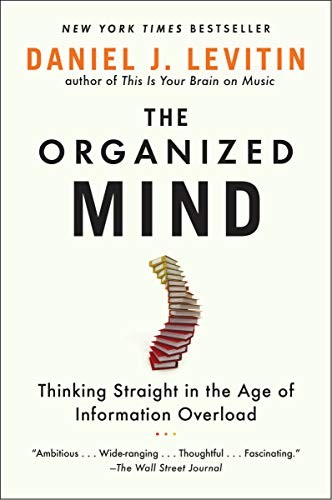
Daniel J Levitin · Buy on Amazon
"Well, it’s kind of a funny story. I’ve met Dan—he’s a great guy. When he was halfway through writing his book, he came across mine and freaked out, and he went to his editor to say: ‘Oh my God, maybe I should just stop—because David did it.’ So it’s very simpatico. I’m glad he didn’t stop because he has accumulated and curated a whole lot of really cool research that basically just validates the need for an external brain. Your head is not designed to remember, remind, prioritize, or manage relationships with more than four things—and that’s new cognitive science data. I’ve known this experientially for the last 35 years: your head is for having ideas, but it’s a terrible place to hang onto them. I mean, your head is a crappy office. Get the weekly Five Books newsletter So he validated that in a very rigorously researched book. He’s Professor Emeritus at McGill University, Fellow of the Haas School of Business at Berkeley . . . I mean, this guy’s got creds up the wazoo. I thought that was great—and it’s a good reminder for anybody who thinks that you should just carry stuff around in your head to grow up. It recommends you should have a system. I mean, Dan’s got some tips and tricks and techniques in there that are useful, but we all kind of know them. Put stuff in front of the door, so you don’t forget it in the morning. You could call that a system, but that’s just kind of obvious. In the book, he points out that our brains have a daily processing limit and we may be wasting it on looking at funny pictures on our phone or reading articles online. Just in speed and volume, that’s all. And the accessibility and the ubiquity of it. If you were out in the forest, it would take you a while to find things to distract you, but you still could. But now it’s in your pocket. In the next book, as you’ll see, Theo Compernolle’s got a major rant about how shallow people are thinking now. Just having your iPhone in your pocket or your purse or your pack creates a dopamine rush, wondering who might be pinging you. Support Five Books Five Books interviews are expensive to produce. If you're enjoying this interview, please support us by donating a small amount . It’s highly addictive, all that stuff is. But the issue is old as dirt. If you know what you’re doing, it’s a great time to be alive, because wow, how cool is it that you and I can talk on Skype from the other side of the world? You’ve got a huge network of people globally that you can chat with, and hang out with, and get value from, and share with. How neat is that? But it’s very easy to get hooked into it if you’re not sure what you’re doing, or if you want to find a way to avoid doing the tough, ugly thing you know you need to do."

Theo Compernolle · Buy on Amazon
"Well, you should understand just a very simple idea that Theo talks about: there are three parts of your brain. The most evolutionary, oldest part is the limbic part—that’s the survival one. That’s the one that lives in the present. That’s the one that recognizes tigers and bears and thunderstorms and berries and things to eat and so forth. It’s the execution part of your brain that works extremely well to keep you alive on the savannah and in the jungle. Then, later on evolutionary-wise, you developed the forebrain. The forebrain is the thinking part, the future part, the part that can make plans, set goals, have visions and so forth. As Theo pointed out, that’s the part that can actually get tired. Two other friends of mine, John Tierney and Roy Baumeister, when they wrote Willpower: Rediscovering the Greatest Human Strength— which is another book that could have made it to the list—talked about decision fatigue: the forebrain only has a certain amount of horsepower that it can use before it gets tired, frankly. But Theo points out that there’s a third part of the brain, a very important part that I don’t think most people are aware of, called the archiving brain. The archiving brain is the part of you that takes all the multitudinous inputs that we get 24/7, and starts to knit it together. It works beyond your conscious mind. Therefore, sleep is the best place for your archive brain to reinforce and reinvigorate all the other parts of your brain, and it’s absolutely necessary. “You need to daydream, you need to let your mind rest, or take a nap” It’s also why it’s necessary, every 90 minutes, to get up and walk around for five minutes. You need to daydream, you need to let your mind rest, or take a nap. And Theo curated in BrainChains over 600 of the latest cognitive science research studies to pull together his basic rant on this point. I just love to sleep. Every night I look at my calendar to see how late I can sleep in the morning, because I just love it. I thought I was lazy. Now after reading all the new cognitive science, I’m just sophisticated. I’m just optimizing my cognitive function by sleeping whenever I can and taking a nap whenever I can afford to! Great stuff. As a matter of fact, I’d be quite concerned if you’re not getting seven to nine hours of sleep a night. There are a few people, I think he mentions that, there are a few people that can get by with less. But most people need at least that much sleep in order to really optimize your cognitive functions. Yeah, well, they’ve got it wrong."

Atul Gawande · Buy on Amazon
"Yes, that’s been out there for quite a while, as you know. But it’s just such a classic. Atul—who is a great guy, a super smart, major well-known surgeon in the US—quite simply said, ‘Pilots have checklists, but surgeons don’t.’ The reason is that the pilots are in the plane, right. So I guess if you were operating on yourself, you’d be pretty damn well sure you had a checklist because you’re experiencing the effects of that. Just the simplest kinds of things—surgeons neglecting to wash their hands, for example. Atul is really talking about how absolutely powerful checklists are, and I think he makes a very creative point: that checklists are not just some static, boring thing. They actually allow you to do excellent work and free up your brain by not having to keep remembering what you need to do when. That then allows your brain to be a lot more creative about whatever it is you’re doing. As an example—well, for instance, do you like to cook? Yeah, ever read recipes? Yeah, so that’s a checklist, you read the recipe. But I’ll bet you don’t stick to it. Right, but it gives you the freedom to be creative and spontaneous and do really cool stuff. Right, right. You need some sort of a checklist. I mean, I’ve got tons of checklists. You could call anything a checklist. Your calendar is a checklist. What do you need to check to know where you need to be when, and to locate yourself in space and time? So everything, every kind of a list that’s a reminder list, is some sort of a checklist. Even your someday-maybe stuff. Even the food I might want to cook at some point, books I might want to read at some point, movies I might want to see, cities I might want to visit, et cetera. Those are all checklists. Anybody who thinks checklists are boring and unnecessary—oh, come on, do you even have a calendar? You’re already admitting that your brain can’t do it, and that you need some external reminder to allow you to feel comfortable about where you are and what you’re doing."

Kevin Kelly · Buy on Amazon
"Kevin’s a cool guy. He was the initial editor of Wired magazine. Kevin said that the reason it’s called ‘ The Inevitable’ is that these are 12 trends that are going on, and whether you like them or not, they are not going to stop. Maybe he overstated the case a little bit, I’m not sure, but he said: ‘We’re at a time right now, an apex in our culture, that is more significant than the Industrial Revolution, in terms of how much it’s going to change the world.’ He talks about artificial intelligence and virtual reality, things like that. He said: ‘Artificial intelligence is only the stuff that hasn’t been implemented yet.’ He said: ‘You don’t know how much is already going on. As soon as you drive and use Google Maps, artificial intelligence is already taking that data and updating everybody’s calendars and everybody’s GPS and everybody’s traffic patterns that you’re seeing. It’s already on.’ So it’s fascinating to see his 12 trends. I love his first chapter. He said, ‘You’re never going to get really good at anything, because everything keeps being updated. You’re going to have to constantly update your refrigerator, your washing machine, your computers, your phones, maybe your relationships, God knows.’ A good example is Quicken. I used to be able to ignore the Quicken upgrades and say, ‘Oh, come on, Quicken works fine.’ Until at a certain point, if you didn’t upgrade, the whole thing wouldn’t work, given all the new stuff that they were doing. So they got me. I have to upgrade. So every time a Quicken upgrade shows up, I go, ‘yes, okay, install.’ Life’s like that. Oh, I’m not sure yet. There are quite a number of studies I’ve seen that basically state that productivity has not increased in the last 10 or 15 years, whereas technology has exponentially increased. So an increase in technology does not necessarily mean an increase in productivity. As a matter of fact, for some people it’s like, ‘Oh my god, I got a new computer program I have to learn. Geez, my productivity just went down the drain because of trying to understand and how to optimally use the technology.’ So it’s both good and bad news. The good news is that way cool stuff is out there that you can use; the bad news is, it’s not free. Yes and, quite frankly, there’s really nothing new that’s been game-changing since really the word processor and the spreadsheet. Because those things changed the game . . . I mean, there are so many people running their whole life and their business with Excel, right? Do you use Word to write your stuff? I’m old enough to remember erase tape on a manual typewriter. It damn well better be right before you start to write. Oh my god, erase tape was a pain in the butt. But word processors work much more like your brain works. You like to have ideas, then later on figure out what to do with them. So that was game changing, truly game changing, as well as when WYSIWYG showed up with the word processor—what you see is what you get. In 1970, if you were going to write a letter, you needed a programmer on the computer. So those things were game changing. Everything else for the most part has just sped up and added volume to our source materials. That’s pretty much it, so in a way there’s nothing really new except the speed and volume of the content. That’s what a lot of the technology has really done. And I think that’s to Kevin’s point: we’re still waiting in the wings for cool stuff we haven’t seen yet, that may truly impact all that. What I did was unhook a lot of my references to technology, because new things were now showing up weekly. At last count, there were over 300 apps that were built around my Getting Things Done methodology (GTD)—not mine, just other people who say, ‘Wow, all I need are lists, let me find a cool way to make a list manager with different bells and whistles.’ So they’re just showing up regularly. I mentioned the technology in the first edition because most people weren’t aware of how they could use their technology at hand to implement getting things done. So I mentioned Outlook, I mentioned Lotus Notes. I mentioned the PalmPilot. You old enough to remember the PalmPilot? You must’ve been a tiny baby. I mentioned those simply because it was a new way to think about how to use the technology—to manage lists in an appropriate way. In the new edition, I decided to unhook a lot of those references, because it would date it by the week. People then focus on the tool, not the methodology, which is really the essence of GTD. Once you get the getting things done methodology under your belt, any tool can work."
Oliver Burkeman · Buy on Amazon
"Because my wife kept reading it and laughing out loud, which she almost never does. He’s such a great writer and he’s got such great stories in there. For those of us who’ve been around the self-improvement, self-development, personal growth game for 40 years, it was such fun to read. “Happiness For People That Can’t Stand Positive Thinking” is a fun subtitle. But the content, as you know, is much more sophisticated than the title represents. He describes Stoicism , the philosophy of accepting current reality so that you can move past it. That is such a key, key element. It’s a real key element of getting things done, in a way, because a lot of people resist what I teach because they don’t want to look at all the commitments that they’ve made, face up to them. Hey, it takes most people one to six hours just to identify all of the ‘would,’ ‘could,’ ‘should,’ ‘need to,’ ‘ought to’ tasks that are banging around in their psyche. Most people don’t want to engage with that reality. That’s a very good example of what Oliver’s talking about. This is not nah-nah-nu-nu-fru-fru stuff. This is: can you just deal with what you’ve committed to, what’s up and what’s in your face? Because if you don’t do that, it’s very difficult to move forward without resistance. Everyone. Anybody who is into improving their life. Anybody who wants their life, 18 months from now, to be better or more creative or more expansive than it currently is. Any life-long learner—that’s my broad definition. Anybody who wants to be able to do more, better; have less stress; have more fun; have more anything, as opposed to just being complacent."