Dan Hooper's Reading List
Dan Hooper is a senior scientist and the head of the Theoretical Astrophysics Group at the Fermi National Accelerator Laboratory and Professor of Astronomy and Astrophysics at the University of Chicago.
Open in WellRead Daily app →The Best Books on the Big Bang (2020)
Scraped from fivebooks.com (2020-03-31).
Source: fivebooks.com

Steven Weinberg · 1977 · Buy on Amazon
"First of all, Steve Weinberg is arguably the most brilliant physicist of the last many decades. He’s an absolute luminary. I’ve had the opportunity to meet and talk with him a few times and it’s an incredible experience. He’s a genius in every measurable way. He also happens to be a really good writer and communicator. I’ve liked all of the books of his I’ve read, but I picked The First Three Minutes because it is the classic book about the Big Bang and the first three minutes of our universe’s history. “When people hear about the Big Bang, they’re tempted to think of an explosion, something that happened somewhere in space. That’s not what we mean.” The book describes the quark-gluon plasma that existed and how it underwent phase transitions and how different kinds of particles and energy transformed through this and eventually created light elements and nuclear fusion in the first minutes and seconds. When I set out to write At the Edge of Time , I was giving myself the task of writing an updated version of The First Three Minutes, because it was written before we discovered a number of things about the early universe and about cosmology . As I carried out the task of writing it, my book evolved into something quite different, but that’s really what motivated me: I felt that somebody needed to write the 21st century version of Weinberg’s classic story. When Weinberg was writing no one knew about inflation, no one knew about dark matter or dark energy. A lot has changed, but it’s the same basic picture. The funny thing is that when he wrote that book, it was strange for a particle physicist to do cosmology. He was an outsider to that field and that was really out of the ordinary. Today, a lot of cosmologists are particle physicists. I’m one. I trained as a particle physicist and I gradually meandered my way through scientific subjects to cosmology, but I’m not rare. There are lots of us doing that today. Particle physics played an enormous and important role in the early universe and there are lots of parts of cosmology you simply can’t do without a background in particle physics. There are other parts of cosmology you can’t do without being an expert in relativity. There are other parts of cosmology you can’t do unless you’re an expert in computer simulation. It’s a multidisciplinary subject and takes many different expertises to do well."
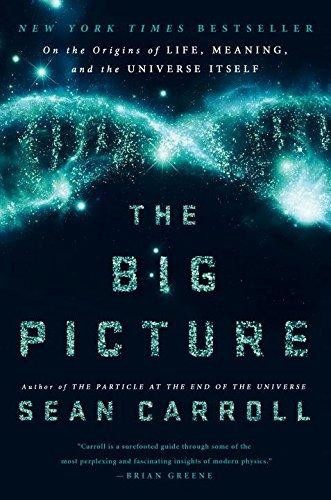
Sean Carroll · Buy on Amazon
"Sean is a cosmologist. He and I have similar backgrounds, though he’s a little more on the relativity side and I’m a little more on the particle physics side. I’ve always liked Sean’s writing. I used to read his blog regularly and now I listen to his podcast . He’s a really great science communicator. His first books two books were about physics. The Big Picture is about physics and cosmology, but with a big dose of philosophy on top of that. I read a lot of philosophy and it’s really refreshing to read a physicist writing about philosophy in a reasonably competent way. Most physicists think they’re good at philosophy when they’re actually terrible at it. That’s why I thought The Big Picture really stood out. It’s asking questions that philosophers of science might ask, from the perspective of a physicist who is also informed as a philosopher. Sean writes a lot about the anthropic principle. This is an idea that goes back several decades, but stated in its simplest form it’s that an observer will always find themselves living in a situation where observers are possible. It sounds uncontroversial and it’s basically a tautology. It just has to be true by definition, but it actually leads to some really interesting conclusions. First I’ll give you a really uncontroversial usage of the anthropic principle and then I’ll give you a controversial one. The non-controversial one is we find ourselves living on a planet that has the chemistry and temperature to potentially support life. By definition we couldn’t find ourselves living on a planet that couldn’t support life, so we’re not surprised that 0.00001 (etc.) per cent of the volume of the universe is a planet with life-supporting conditions, and we happen to be on it—even though it seems unlikely, when you put it that way. Support Five Books Five Books interviews are expensive to produce. If you're enjoying this interview, please support us by donating a small amount . The more controversial version of the anthropic principle is maybe looking at something like the strength of the electromagnetic force. We notice that if the electromagnetic force had been a little bit stronger or a little bit weaker, life couldn’t exist in this universe. I forget the details, but I think if it were a little bit stronger than certain processes happen among nuclei that would cause stars to implode and if they were a little bit weaker, you couldn’t have certain kinds of key stable atoms. The details aside, the basic idea is that this number fits the value you need for intelligent life—or any kind of organized life or biology to exist at all. So some physicists have said this is probably because there are many universes, and in most of those universes life doesn’t exist because this number isn’t the right number. But of those many, many universes we of course find ourselves in one where things seem tuned to life. This doesn’t require a designer or any theistic explanation, it’s just something that we shouldn’t be surprised about—in the same way that we’re not surprised we live on a life-supporting planet. There’s a lot of interesting philosophy behind this question and Sean does a very good job of exploring those sorts of issues. Different people respond to these discoveries in different ways. I gave a talk earlier today where one of the questions I got in the Q&A session was, ‘If there are an infinite number of universes or space goes on for an infinite distance (which it may or may not) then doesn’t that mean everything is pointless?’ I don’t think I’d reach the same conclusion, but for him a profound sense of pointlessness came from that discovery. My advice to him was, ‘Then you shouldn’t think about it very much.’ But I don’t know. The psychology is really interesting. I definitely get that sense of awe and wonder that people talk about when they’re thinking about these sorts of things. I experience that profoundly, and not just at cosmology. When I learned about relativity or quantum physics for the first time, it was the most amazing stuff I’d ever encountered in my life. It really motivated me to become a physicist. So I get that. I’ve never felt that by learning more about the universe things seem more pointless. I don’t think the universe provides meaning, but human beings create their own meaning, when they value things. It’s nothing about any law of physics, but the way that I feel about my friends and loved ones, the way I feel about fellow human beings, the reason I love certain kinds of music or some of the experiences I’ve had, you can’t take all that away from me by saying there’s a multiverse. That doesn’t change that at all. Those feelings are profound and real. No fact I could ever learn about the universe would take them away from me."

Janna Levin · Buy on Amazon
"I put this book on the list because there’s not another book out there like it. It is truly unique. I read it when I was a postdoc. I read a lot of popular science, but I read this book and thought, ‘this is an entirely different genre of science writing!’ It’s very personal. She interweaves stories about her science and her science research from a first-person perspective with stuff going on in her personal life—her troubles with her relationship or when she feels depressed or lonely. That’s all in the book. You understand more what it is like to be a human being doing science from this book than anything I’ve ever read. I still think it’s profound. I occasionally go back and reread a chapter of it, also just to be inspired as a writer. “I don’t think the universe provides meaning, but human beings create their own meaning, when they value things.” She’s also a brilliant scientist. The title of the book, How the Universe Got Its Spots, is of course a play on How the Leopard Got His Spots, and it refers to the light that was produced a few hundred thousand years after the Big Bang. When you look at maps of it, it’s full of patches of hot and cold spots. She explains how the universe got those spots and explores the possibility that there might be an interesting topology to our universe. It might not be just a simple space that goes out in all directions, it might wrap around on itself in interesting ways. That’s what she was doing research on at the time and she wrote this book about looking at data and trying to learn those things about our universe. It’s a fantastic book. That was what she was exploring. Scientists very rarely say what they ‘believe.’ It’s not a phrase we use very comfortably. She was certainly hypothesizing that we might live in a finite universe and was trying to devise tests to find out. I’d have to ask her whether she would use the word believe, but we all think it’s possible. It’s also possible it’s not finite. We don’t know. It’s a totally open question."

Stephen Hawking · 1988 · Buy on Amazon
"This is another classic, it had to be on the list. This is a book that came out after Weinberg’s, but before the others on the list. It was one of the few books written about this stuff at the time. As with Weinberg, it’s interesting to read a book by one of the 20th century’s greatest scientists. Everybody knows Hawking’s greatest contributions: understanding that black holes radiate light and other particles, that they contain entropy and all these things that no one imagined before him. Hawking and Roger Penrose also worked out the Big Bang singularity, the very moment of creation. To hear him describe some of these things with his own word choices, his own phrasing—not to mention his own personal biography and his disability—there’s no other book like it. He’s very witty and has a profound sense of sarcasm too. Given all the struggles he had in his life, you might expect him to have a somewhat darker outlook on things, but not at all. He’s just witty and clever and always making a joke. Certainly the stuff about black holes hasn’t changed, though we’ve discovered more things about black holes. No, but he was writing about them before we knew they existed. The idea that black holes could exist as a theoretical construct goes back to Karl Schwarzschild in the late 1910s. But, in the 1960s, physicists started to take them seriously as something that might actually be out there and probably was out there. The Cygnus X-1 black hole was finally discovered in 1971. At the time Hawking made a famous bet about it and I forget if he won or lost that bet, but it was still a controversial question at the time. Now we know of a large numbers of black holes. Every galaxy has a supermassive black hole in the center. We’ve observed the gravitational waves of merging black holes. Black holes are no longer a questionable subject. But a lot of the stuff we think about black holes and how they work is exactly what Hawking wrote down back when he was a young scientist. Yes, he wrote a book called Relativity that he intended to be a popular discussion of it, but if someone were asking my advice about a book to get a feel for the theory of relativity at a non-scientific, non-expert level, I wouldn’t pick that one. It’s incredibly important historically to hear it from Einstein’s own pen and there is something special about that, but there are probably more accessible ways to learn about relativity. There are tons of things in physics I don’t understand. Tons of things. Life is finite. You can learn a finite number of things in a finite length of time and I’m okay with that. I get to learn a lot of cool things and how disappointing would it be to find out you just learned the last thing! Now you know everything. There’d be nothing exciting to do ever again. That sounds terrible. I don’t want to live in that world. Let’s just pretend he did it that way. So what Isaac Newton worked out in the Principia , his masterpiece (he had many masterpieces, but if you had to pick one, that would be it), is that the force with which, for example, the Earth pulls on an object is proportional to the mass of that object. His most famous equation is force = mass x acceleration. So in the force, there’s a mass and in the m x a, there’s a mass. So those divide out. You can remove them from both sides of the equation and now you have, on one side, just a number and that equals ‘a,’ the acceleration. So as far as gravity is concerned, that hammer and that feather are going to be accelerated towards the Earth in exactly the same way. Now, like you said, there’s air resistance so that complicates things. But let’s say you did it in a vacuum where you’ve emptied all the air out, or on the Moon where there’s no air resistance. When I drop that hammer and that feather, they’ll just fall in unison together. They’ll be accelerated in exactly the same way. Another way to think about it is connected to something called ‘the equivalence principle.’ This was something Einstein thought about when he was constructing his theory of relativity. Physicists use the word mass to mean two different things. On the one hand, there’s the quantity which says, ‘the more mass something has, the more it feels gravity and the more it pulls on things gravitationally.’ So big, heavy objects attract things through the force of gravity more than light objects. We call that gravitational mass. The second kind of mass is inertial mass. Something with a lot of inertial mass takes a lot of force to accelerate or decelerate. “In 1905, Einstein introduced relativity and the first ideas of quantum physics. These things didn’t just build upon Newtonian physics, they tore Newtonian physics to the ground” What Einstein was concerned about is why it is that all the things with a lot of gravitational mass also have a lot of inertial mass. In fact, why does something always have exactly the same amount of gravitational mass and inertial mass? Why aren’t there giant objects that are really hard to accelerate but that don’t pull on things gravitationally? Or why aren’t there things that are small and easy to accelerate that pull a lot gravitationally? But there aren’t any. And Einstein worked out this is because all mass is is energy. And if you understand, as Einstein showed us, that all gravity is, is the geometry or curvature of space and time, then these two things have to be the same. Now I don’t expect that to make sense the first time you hear it. It’s a lot to unpack. But that’s the profound idea that was built at the foundations of Einstein’s theory and, really, is the same thing that Galileo was messing with. He said a heavy thing and a light thing are going to be accelerated by gravity in the same way and for the same reason a really heavy thing is going to take a lot of force to accelerate, a light thing is going to be very easy to accelerate. I think everything worth understanding takes some going back and revisiting. I read a lot of things in fields that are not my own and all the best stuff I missed the first time around. It takes a while to get the best ideas."

Kip Thorne · Buy on Amazon
"This book is just plain fun. I said before that if somebody asked me for a book to learn about relativity, I probably wouldn’t pick Einstein’s: I would pick Kip Thorne’s. This book introduces the basic ideas of relativity. He talks about how distances in space and lengths of time appear different or are different to different observers in different frames of reference. Then he talks about how gravity is really just the shape and geometry of space. “If somebody asked me for a book to learn about relativity, I probably wouldn’t pick Einstein’s: I would pick Kip Thorne’s” Then he goes into the modern stuff about relativity, which is so weird and cool and different. This is stuff no one thought about in Einstein’s lifetime. I’m talking about questions like, ‘Can you build a wormhole that allows you to travel from one place in the universe to an entirely different place in the universe traversing a very short distance?’ He talks about black holes a lot, and how time itself passes differently as you get near the surface of a black hole. It’s all the stuff that you’ll find illustrated in the storyline of a movie like Interstellar . Kip Thorne was involved in the writing of that movie, but he wrote it first in this book (not in a narrative sense, but in a popular science sense). I read his book a long, long time ago and it’s what made me love relativity. It’s just such an incredible and vivid and exciting depiction of this strange thing that is the geometry of space-time. We’ve certainly never seen a wormhole. If a wormhole existed and it was the sort of wormhole that allowed you to get from point A to point B faster than it would take light to get from point A to point B, that would basically be a time machine. Now, I think it is unlikely that wormholes exist in our universe. For one thing, if there were, and you could use it for time travel, then you’d run into various logical paradoxes like, for example, the grandfather paradox. If there’s a time machine and I can use it to go back to a time before my grandmother met my grandfather, I can kill my grandfather and then he doesn’t have any kids and therefore I’m not born so I don’t go back in time. We’re back where we started and you can see how this falls apart. So the self-consistency of our universe seems to prohibit backwards time travel. We can go forward in time. We know how to do that, it just involves travelling near the speed of light. If you do that, time travels differently for you and you can move into the future. But you can’t go back. So, I suspect, if there are wormholes they function in some way that doesn’t allow traditional time travel. Right now, there’s a culmination of mysteries in cosmology that need to be told as a coherent story. The mysteries I’m talking about are: 1. What’s dark matter? We know it’s there and makes up 5/6ths of the matter in our universe. We thought we had good ideas for what it is, but we’ve done the experiments to find those things and they haven’t come up. So we haven’t found it yet or at least we’re not confident we have. That poses enormous questions about how it was formed in the Big Bang and that first fraction of a second. 2. We still don’t know how matter survived the Big Bang. This is a story people have written about in books before, but not recently, to my knowledge, and it points to the same period of time that dark matter was formed in. I think there’s a real chance these puzzles are intertwined and that whatever the solution to one might very well be the solution to the other. Exactly what the solution looks like is still unclear, but it’s pointing to this first fraction of a second after the Big Bang where we don’t have any direct observations. It’s possible things played out really differently to what cosmology textbooks currently describe. 3. Third is the issue of dark energy. We don’t know why space contains this energy that makes it expand at a faster and faster rate, but something about how the universe was set off seems to have that built into it. We don’t know how or why. It is truly perplexing. 4. Then there’s the whole issue of cosmic inflation. The uniform nature of our universe, its homogeneity, suggests that shortly after the Big Bang there was a burst of cosmic expansion where space tore apart from itself much faster than the speed of light. If that’s true, we want to know why and how that happened and if that had anything to do with these other mysteries. Did inflation leave the universe in a state that gave it the right amount of dark energy or does it explain how dark matter was formed and why it is so elusive? Does it explain why matter beat out antimatter somehow? Get the weekly Five Books newsletter We don’t know the answers. Don’t expect to read my book and get the answer in the final chapter. It’s not that kind of mystery. But all that stuff together points to something being incomplete—or maybe just flat out wrong—about the way we’re thinking about the first millionth/billionth/trillionth of a second after the Big Bang. Yes, there’s all this exciting new stuff to talk about, and I happen to work in an area where I know as much as anyone about these mysteries. I thought I could tell the story well, but there’s also the narrative that these things might be interconnected. I really do think it’s plausible, and perhaps even likely, that that’s true. I like to use this analogy, where I ask other physicists as a hobby, ‘What do you think it would be like to be a physicist in 1904?’ I picked that year because it’s a point in time where physics seemed to be all wrapped up. We had this incredible paradigm of Newtonian physics, which just worked. There were a few questions that remained like, ‘How do atoms work?’ ‘What’s the nature of light? Why does it always travel at the same speed?’ Mercury’s orbit also wasn’t quite right. We didn’t understand how the sun worked, how it generated so much energy. People just thought of these things as loose ends that would all be wrapped up in the years ahead. “We can go forward in time. We know how to do that, it just involves travelling near the speed of light” But, in 1905, Einstein introduced relativity and the first ideas of quantum physics. These things didn’t just build upon Newtonian physics, they tore Newtonian physics to the ground, to rubble, and then built an entirely new structure that has been the foundation of physics ever since. I don’t know, but maybe we’re in the 1904 of cosmology right now and we’re going to tear down everything we think we know to the ground and build something entirely new. I think it truly is. In 1900 physicists would think it was a silly question to ask scientifically. ‘What do you mean the origin of the universe? There’s no such thing as that in physics.’ They thought of space as a fixed, static thing that objects can move through. If you think of space that way, it can’t do anything. Einstein showed us it was not like that at all: space can expand, it can contract, it can warp, it can curve, it can begin, it can end. And, for that reason, cosmology was conceptually possible after his theory came out. There is a big bag of tools but, yes, particle accelerators are incredibly important. They are our best way to learn what the laws of physics are, especially the laws of physics that dictated how matter and energy behaved in the first fraction of a second. We also use a variety of telescopes. I don’t just mean what most people picture as a telescope—a long tube with some mirrors or lenses in it. Sometimes we use things like that, but we also use telescopes that are on satellites. Some of them detect things that aren’t even light, like neutrinos or cosmic rays. The ones that can detect light don’t just detect the light our eyes can see, they detect X-rays and gamma rays and microwaves and infrared and UV radiation, all these things. We put all this information together in a coherent way that makes sense together, with just a few loose ends…"