Craig Brown's Reading List
Craig Brown is a British satirist and journalist, and the author of 18 books. He has been writing his parodic diary in Private Eye since 1989. He is the only person ever to have won three different British Press Awards – for best humorist, columnist and critic – in the same year. He has been a columnist for, among others, The Guardian , The Times , The Spectator and The Daily Telegraph . He currently writes for The Daily Mail and the The Mail on Sunday . His biography of The Beatles on the 50th anniversary of their break-up, One Two Three Four: The Beatles in Time , has been a Sunday Times bes
Open in WellRead Daily app →Rock and Roll (2020)
Scraped from fivebooks.com (2020-07-03).
Source: fivebooks.com

Nik Cohn · Buy on Amazon
"That’s a good one to start with. As far as I can remember it was the first rock book I ever read. I bought it in 1970 when I was thirteen. And I think it is the most influential of all rock books, in that he invented a style with which to write about rock music. I was very keen from the age of about 11 to about 17 on rock papers like the New Musical Express , Melody Maker , Sounds and Disc . I’d get all four every week. The best writers were really on New Musical Express and you could see the influence of Nik Cohn on them. It wasn’t English as it had been taught at school, but it managed to convey the excitement of rock. “I think a lot of ghostwritten books are rather underrated because it’s just another version of oral history” Nik Cohn was very keen on rock as excitement, rather than rock as a version of classical music, or whatever progressive rock then tried to turn it into. It was all about thrills, excitement, and the book still reads really well, I think. He’s also very prescient. I was just looking at it today, knowing we were going to talk, and there’s a bit on Phil Spector. He’s really good at describing the sound of Phil Spector’s records, but there’s a paragraph where he says, “Otherwise, though, he wasn’t so much in any Dada/beat/hippie tradition, as pop bowdlerisation of Oscar Wilde , meaning that he was sharp and bitchy, fastidious, vulnerable and a culture snob, that he had great style and that you always felt he was doomed. He even looked rather like Oscar Wilde. He had exactly that kind of ostentation.” I thought it was quite clever of him to realise in 1970 that Spector was doomed. He’s very good at describing the sound and also getting to the heart of what made people tick. He talks very interestingly about Pete Townsend’s anger. No. He has different chapters on different people, P J Proby , who’s completely forgotten; Eddie Cochran and others. He’s got one on Dylan and one on the Stones. He has one on The Beatles. He doesn’t particularly like them, but he’s fascinated by the way that, in four years, they can go from these very self-confident people to collapse—the book came out in the year they broke up. He says: The thing that fascinates me most in all this is that it’s happened so fast, that it’s taken only five years for ultimate hard-headedness to change into ultimate inanity, and I’m puzzled. There are, of course, lots of easy explanations. Too much acid, too many ego trips, too much money and success and wastable time—and maybe the easiest answers are the right ones after all, but I’m not so sure. I sense that there’s something here that I don’t yet understand, that’s going to become clear only in retrospect. He’s sort of anti-intellectual in his approach. He likes excitement. One of the odd things about The Beatles is that they hardly wrote a single song that you can dance to, which is peculiar. I think that would have turned him off them. Nik Cohn is an intriguing figure. He became known for something which is very unlike him, which is that he wrote a piece of journalism, in I think the New Yorker , about disco in the 1970s, which was then bought and turned into the film Saturday Night Fever . Presumably that got him lots of money. But as a character, he’s so unlike Saturday Night Fever . I’ve never seen the point of Led Zeppelin, either. He hated pretentiousness. I think writers like Tony Parsons, Julie Burchill or Charles Shaar Murray, the best music journalists, would have acknowledged his influence. They all wrote in this new non-Sunday-best kind of way."

Nicholas Schaffner & Pete Shotton · Buy on Amazon
"Obviously, for One Two Three Four I read countless books about The Beatles. There’s a far higher percentage of good books about The Beatles than there are good books about the royal family or, particularly, Princess Margaret. Royal family books tend to be stodgy and sycophantic and not very well written, just slightly pompously written. Whereas a surprisingly high proportion of rock books are pretty well written. They tend to be overly serious, I suppose, especially new ones written by serious people, like Mark Lewisohn, who chronicles virtually every minute of each Beatle’s life. He does it really well. There is some kind of beauty to it. I can’t think of any contemporary biography of anyone in any field, which covers a life in such amazing, almost Proustian detail. Are you aware of Mark Lewisohn? He’s done various books about The Beatles, but the first volume of his new project came to over a thousand pages and that just takes the band up to 1962. It’s unbelievable. Every time they drive in a car you get the car number plate and that kind of thing. It’s absurd, but it’s also rather marvellous. Anyway, I could have gone for that kind of really dogged chronicling. But I’ve chosen this Pete Shotton book, which is comparatively unknown. Pete Shotton was John Lennon’s best friend at Quarry Bank School and they did everything together. They formed a kind of Just William gang and were obviously naughty boys—not absurdly naughty, but they’d shoplift and things like that, played practical jokes and were naughty in class. Support Five Books Five Books interviews are expensive to produce. If you're enjoying this interview, please support us by donating a small amount . In some ways John wasn’t a very friendly character, but when he became famous he stuck with Pete Shotton. He obviously needed Pete Shotton to keep his life at least slightly real. Eventually he brought Pete Shotton into the Apple organisation and Pete Shotton ended up running the boutique. It was all a disaster, of course. This book is ghostwritten, but it just has that tang of truth. You feel he’s telling you exactly what happened, through this Dr Watson perspective, with John as Sherlock Holmes . That’s not an ideal analogy, but he’s a normal guy watching this friend go slightly mad, especially with Yoko and with Apple and with drugs. Pete Shotton just about stays on the straight and narrow. John then buys him a shop, or gives him £25,000 to buy a shop. He buys a sort of grocery store-cum-newsagents near Bournemouth. Pete Shotton tells John, although this is very nice, he doesn’t have to do this for him. But John says, “No, you would have done it for me,” which is probably quite right. But John also needs him socially, so he spends a lot of time just staying at John’s house. The book gives you a very accurate and affectionate portrait of John and the amount of drugs and things he was taking—or they both were. Then you get Yoko’s sudden emergence. Yes, he did. 1983. In the last chapter George rings him to say that John is dead. Yes. Obviously, those friendships don’t exist as they did before because one half is one of the most famous men in the world and unbelievably rich and the other is just a normal Liverpool lad. It’s a bit like Lady Glenconner and Princess Margaret . A friendship with a lady-in-waiting is lopsided. So, in a way, Pete Shotton became the lady-in-waiting to John Lennon. But within those confines it seemed pretty uncomplicated. When John was fantasising about Brigitte Bardot and was then invited to see her, he took Pete along, which is an odd thing to do. If you thought you were going to get your leg over with Brigitte Bardot, you wouldn’t take your best friend with you. I think there’s something quite sweet about their friendship. It all ended happily, although it’s not in the book. In the 1980s, presumably from the original investment he put into the grocery/newsagent, he started a chain of burger restaurants, which I vaguely remember, called Fatty Arbuckle’s, and he became a millionaire. No. The book deals with that. He didn’t have any great musical capabilities, although he was in Lennon’s original band, The Quarrymen. No. And there were quite a lot of people who were in The Quarrymen. The other thing to say is that you shouldn’t be put off by it being ghostwritten. I think a lot of ghostwritten books are rather underrated because it’s just another version of oral history. And, if they’re well done, they’re better than if the person had written it for themselves. People often get very overawed by writing and so their real self doesn’t really come out. They try and do a version of themselves. Whereas, I think if you’re talking to a good ghostwriter, then you can get the truth out."

Ronnie Spector & Vince Waldron · Buy on Amazon
"Ronnie Spector is this very sexy, very young leader of The Ronettes, the others were her sister and her cousin. There might be a little bit of faux naivety in the book, but it is the most extraordinary story. I read it because someone tipped me off that she had some sort of romance, which didn’t go all the way, with John Lennon, very early on, when The Beatles were already big in the UK, but hadn’t cracked America. It was just before they were leaving for America. She went to a party and John tried to get off with her. She went some of the way, but not all the way. But, at the same time, her boyfriend was Phil Spector, who was also her producer and who wrote great songs like ‘Be My Baby’. They later got married. “Spector was such a jealous husband that he wouldn’t let her drive by herself without this plastic mannequin next to her” As I pointed out, when we were talking about Nik Cohn, Phil Spector was obviously a really odd man. In another Beatles book it says that he flew with them to America, but never sat down during the whole flight. He was pacing up and down. He was so nervous and highly strung. There’s a bit in her book, after they get married, where she says: “In all the years I knew Phil, I didn’t think I was ever quite as amazed as when he reached into the trunk of my brand new car and pulled out a life-sized inflatable plastic mannequin… The thing looked exactly like Phil in every way, except that its knees were bent in the permanent sitting position.” He gave it to her because he was such a jealous husband that he wouldn’t let her go out driving in a car by herself without putting this fake Phil Spector next to her so that people would realise that she was taken. The best things in this book are about living with this crazy man, who locks her in cupboards for days on end and things like that. I mean he was maniacally jealous. Yes. And, in a way, it’s what people want in a rock biography. It’s complete madness. But she’s a survivor and Phil is rotting in prison somewhere. There’s also a really good biography of Phil Spector by Mick Brown , which is a straightforward biography. He was always pulling guns on people. Before Ninety-Nine Glimpses of Princess Margaret , I wrote One on One , about lots of different meetings between people. In one of those Leonard Cohen, who was an easy-going kind of character, had a gun pulled on him by Phil Spector in the recording studio. It had early roots. His father had committed suicide. It was quite a mad household. He wrote a song, ‘To Know Him is to Love Him’—those were the words on his father’s gravestone. He took them and turned them into a kind of girly song. He wasn’t like the pop stars that he produced, in that he was a little, runty kind of character. Get the weekly Five Books newsletter One of the great things about this book is that she doesn’t hold back. So, there’s no sense of, ‘I’d better not go there.’ For example, there’s this passage: “Phil first started losing his hair around the time we met”—so that’s 1963—“after we’d do our foreplay he’d get up from the bed and make sure all the lights were out. That way I couldn’t watch him when he took his hair off. Then he’d stumble into the bathroom in the dark, so he could rub this acetone solvent all over his head. It was the smelliest stuff in the world, but I guess it was the only thing he could use to get the toupée glue off his scalp. When he came to back to bed the smell of that acetone could’ve killed a horse, but Phil tried to pretend it wasn’t there. Only it was impossible to hide, like rubbing alcohol or marijuana. It was a smell that wouldn’t go away.” She’s very po-faced, in a way. She goes on: “That old game of hiding the toupée was one thing I knew I’d have trouble with in our relationship.” The book’s both consciously and unconsciously funny. Everyone would enjoy it."

Pamela Des Barres · Buy on Amazon
"Pamela Des Barres became the most famous of all groupies in the late sixties, early seventies. Like Ronnie Spector’s book, this is a kind of celebration. I think that now, because of #MeToo and everything, this kind of book wouldn’t get a publisher—because it’s joyous. She’s very, very happy being a groupie and she can obviously deal with herself. She’s not raped or anything. It’s all voluntary, from her point of view. And it is very funny. A lot of it is based on her diaries. I suppose she might have doctored them, but that diary element gives it a feeling of veracity. I use her quite a bit in my Beatles book because, at school, where the book starts, she’s mad on The Beatles. So, those are just simple fan diary entries about her and her best friends at school. It’s all about who loves John, who loves Paul, who loves George. I liked all that innocent stuff. And, in a way, even once she becomes a groupie, there is still an innocence to it, in that it’s innocent fun. She’s not really after anything other than enjoying sex with rock stars. Groupies are always seen rather as this underclass of people, but she shows that, at least in her case, she seems to be in control. Yes. There’s a very funny bit towards the end, when she’s at a party in LA—this is in an updated edition after the first edition of the book came out—and she sees Paul McCartney. I think she may have had a fling with Ringo Starr, but Paul McCartney was the first one she fantasised about as a school girl, before switching her interests to The Rolling Stones and getting off with Mick Jagger. “Even once she becomes a groupie, there is still an innocence to it” She goes up to him at this party, introduces herself and says that she’s written this book. I think she has a copy of it on her. She says a look of slight terror comes over Paul’s face and he says, ‘Did we ever, er, you know…’ He can’t remember if he’s meant to have known her like that, or not. She reassures him that they never did. She’s quite funny and cute. She did have an amazing list of affairs including, for instance, Woody Allen . Keith Moon was one of her long-term boyfriends. I think she says he was her fourth boyfriend and then she moved on to Jimmy Page. Well, with Jimmy Page she talks about how he has whips packed in his luggage, but she doesn’t go in for that. You’d have thought the lawyers would have stopped some of it. Maybe they did stop some of it. But you get quite a lot of information. Do you remember that very good film about a groupie with a sort-of Jimmy Page character in it, Almost Famous ? It’s a very good film. I recommend it. It’s about a young Rolling Stone magazine journalist. He’s hardly ever written for them, but he’s allowed to go on tour with the band. And then he rather falls in love with one of the groupies. There’s lots of drugs and driving cars into swimming pools and that kind of thing, but you get a sense of enjoyment, that, for the most part, for those who survived—and even for the ones who didn’t survive—it was good fun. Yes. And doing journalism of something, you can always say to yourself, “Well, perhaps it would have been absolutely ghastly. Lucky we weren’t rock stars.” But actually, I think her portrait shows it’s something we’ve missed out on. Weirdly, yes. And funnily enough, my daughter, who’s 30, is in a harmony group with a girl called Seraphina. And Seraphina gave me a bit of help transcribing stuff for my Beatles book. Seraphina lived in LA for some time as a child and she said, ‘Oh, my God, that’s my nanny,’ when she saw Pamela Des Barres’s picture. So, quite late on, presumably after she’d been a groupie, Pamela Des Barres was just being a nanny. Quite a glamorous person to have as your nanny!"
Five Diaries and Autobiographies (2012)
Scraped from fivebooks.com (2012-07-06).
Source: fivebooks.com

Alec Guinness · Buy on Amazon
"Alec Guinness wrote three lots of diaries, and then there is the autobiography, which is diary in disguise. I don’t draw much of a distinction between them. Often in the diaries he will remember something from 20 years ago – it’s not quite faking, but it’s a way of including all your life. I rather like Alec Guinness as a diarist. He is sheltered and quiet, quite slippery in a way. You can’t quite put a finger on him. Yes I was wondering what I meant as I was saying it. Because he’s so quiet and observant, you’re never quite sure where he stands in relation to other people. Sometimes you’re also not quite sure if he’s telling the truth. That’s one of the problems of diaries. Just because it’s written down by the person, it doesn’t necessarily mean it happened in that way. But he is very cultured and intelligent, and this makes very good reading. Guinness was also very keen on spiritualism, and thought he had psychic flashes that foretold the future. He claimed to have predicted James Dean’s death in a car crash, to Dean himself, within a week of it occurring. One wonders if that is not all invented. If he did invent it, I suspect he believed his own invention. It sounds implausible, I know. He said it on a number of chat shows, in his diaries and in the autobiography. Of course that doesn’t make it true, but the only other person able to vouch for it would be James Dean, who’s not in a position to do so. But sometimes it seems such an extraordinary story that I think it probably is true. It might have just been an accurate psychological observation. You see a young man who already has a reputation for being wild. He might appear hyper or drugged up. On meeting, he shows you this car he has never driven before – still in its wrapping, as far as I can remember – which he says is the fastest in the world. Maybe it doesn’t take a genius to say: Don’t get into that car. So if you were a psychologist you could explain in that way what Guinness saw as a psychic flash. I never really met him, but I was once in a lift with him and he seemed perfectly nice. He was famously quiet and unobserved. People didn’t recognise him in the street, because he would just go quietly along. He comes across as a very attractive character, somebody you would get along with."

Harold Nicolson · Buy on Amazon
"Certainly towards the end of his life, Harold Nicolson was a crabby old thing. But he wrote his diaries at a particularly interesting time, just before and during the [Second World] War. He starts off as a journalist, but you soon realise how small society was then. In one of his first diary entries he is walking up Whitehall and bumps into the Chancellor of the Exchequer, who invites him into parliament for a drink. He’s very good at describing parliament during the war, and the fear at the time – because they didn’t know who was going to win. He writes about Churchill, whom many people thought was doing things wrong, and the furious debates unconnected with the war, such as about education. He didn’t have to believe that the government was doing the right thing either. It was a proper democracy. Yes, and also artists. He met Dali, James Joyce, had lunch with TS Eliot and so on. He is a jolly good describer of how people spoke, looked and what it was like to be in the room with them. In some ways he was the perfect diarist. He may come across as a social climber, which is because he was, otherwise he couldn’t have written this all. This is interesting, because from other people’s accounts he was picking up women just about every day. And of course Vita was having affairs too. But not a hint of it comes into the diaries. He portrays himself rather as he looks, which is a moustachioed, pipe-smoking old buffer. He’s not lying, but he neglects to mention things. It’s not the whole truth. Then again, he was writing a chronicle of his times, not of himself."
Harpo Marx · Buy on Amazon
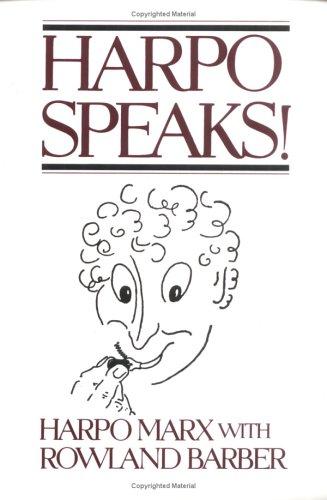
"Yes he does. I was always keen on the Marx brothers as comedians. Their films are still very funny and very fast. Other comedies, even from only 20 years ago, seem slow – the human mind finds quicker routes to get to jokes. But the Marx brothers still seem fast. There’s something amazing about them. Groucho was the famous one, but Harpo is a very interesting character. This is the perfect showbusiness autobiography. It goes from anecdote to anecdote somewhat, but they’re all good anecdotes. In One on One he meets Rachmaninov, who had earlier met Tchaikovsky, and then George Bernard Shaw. He was chatty and knew how to tell jokes. The book is very jaunty. It’s separate from his art, because you can’t really equate a mime artist with a writer. Well he never spoke in the films, he only played his harp and joked around. So the title, Harpo Speaks , is the initial oddity of it – that he has a voice, and a life outside of the films. He left school very young, at 12 or so, and he had a slight chip on his shoulder of everyone being cleverer than him. The book is ghost-written, but I think that ghost-written books are rather unfairly looked down on. You could easily call it an oral history. All it is is someone dictating to somebody else. I have a friend who said that his sister, aged about 12, was playing in Central Park once and Harpo Marx made an inappropriate grab for her. So maybe his character in the films isn’t his character at all, and he has a much more sinister side to him! But certainly the character he plays is full of japes and practical jokes, a kind of silent Larry David figure."
Helen Keller · Buy on Amazon
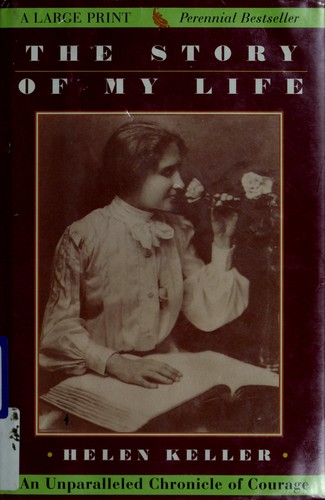
"I only vaguely knew about her myself to begin with. I think she’s more famous in America, and deserves to be. Helen Keller, who died in 1968, was deaf, dumb and blind. She was struck deaf and blind by meningitis at the age of 18 months, which makes you “dumb” as you don’t know what other people are saying. Her autobiography is very beautifully written, and gives you a sense of what it’s like to be trapped without sight or hearing – and the excitement in the world that she still managed to have. You can see clips of her on YouTube, being taught to dance by [the choreographer] Martha Graham towards the end of her life. She escaped from what other people would have seen as an inescapable prison, and managed to speak and to write – and to write beautifully. Support Five Books Five Books interviews are expensive to produce. If you're enjoying this interview, please support us by donating a small amount . So there’s something very heroic about her, and the way that people treated her. Mark Twain, when he met her, realised there was something special about her early on, and gathered a group of friends to pay for her education and put her through university. She had a hunger for new experiences. She was also a very influential figure for getting people with disabilities accepted as human beings."

Andy Warhol · Buy on Amazon
"Warhol’s diaries came out shortly after he died, and at the time I couldn’t see the point of them at all. They were just a litany of names, all social gossip, very close to being boring. But reading them 20 years on, I find them fascinating. My edition is about 800 pages long. There aren’t many diaries you could read from start to finish, but this one is luminous. It’s all very surface. But then again he is talking about a very surface society. They give a feel for the freneticism of New York at that time, in the late 1970s to late 1980s. It’s the raunchy pre-AIDS time, New York at its bohemian peak. That they are in the present tense – I think he dictated them at the end of every day – gives a feel of story to them. If you transferred that into autobiography, it would be tedious. A kind of waspish irritation. A capacity for annoyance. Andy Warhol was very upset if he wasn’t invited to something, and starts loathing the person who didn’t invite him. There’s not much about his private life, it’s all about his social life. It’s a public diary, in a way. I don’t enjoy Andy Warhol’s art myself, I think he’s banal. Although I suppose that’s the point. But if I had to choose, I would choose him as a diarist and not an artist. Of course, it was his fame as an artist that got him into these grand houses. There is an odd mix of people in the diaries. Warhol occupied the odd place in society where art and politics met. He would go to parties thrown by Jackie Kennedy for a mix of film stars and politicians. I always find it very interesting when different societies collide. Diaries are a particularly easy form to parody. With Alastair Campbell , at least half of his diary can go into a parody without being changed. Which suits both my lazy streak and my eye for accuracy. It’s his power-hungry self-assurance, combined with a manic self-disgust. There’s something very manic about him, and he does every now and then have breakdowns. Thinking you are the voice of common sense whilst being completely mad is always a good combination. A tragic combination, but for the purposes of comedy it works very well. To be effective, parody has got to be discreet. It’s a bit like a pickpocket who removes people’s wallets and watches. I think satire is much more overt and tends to have a sense of purpose, whereas parody is more art for art’s sake. I think that’s rather a good definition. Of course, some parodies can be more offensive than others. And it’s not either-or. No. Satire doesn’t really change anything. In Britain it has changed maybe two things in the last 30 years. One is [British comedian] Harry Enfield, who hastened the end of people like [radio presenter] Dave Lee Travis. The other is [the TV programme] Spitting Image portraying [former Liberal Party leader] David Steel as a tiny figure in [former SDP leader] David Owen’s pocket, which had repercussions for the general public. But that’s not a great hit list. The point is to aim for the joke, and not care if it makes any difference. Through their language. Language is the key. So long as you get the way that they speak, you have caught some part of their personality and can transfer it onto the page. Personal knowledge doesn’t help at all, because you’re dealing with a public image. If you’ve heard that someone is kind to children, or a secret alcoholic, you can’t put that over in a parody. That’s more for a gossip column."