Bunkobons

← All curators

ChatGPT's Reading List

ChatGPT is an artificial intelligence chatbot developed by OpenAI that is designed to understand and generate human-like text. It is powered by a large language model trained on vast amounts of data, allowing it to respond to questions, explain concepts, and assist with a wide range of tasks such as writing, coding, and problem-solving. ChatGPT works by analyzing the input it receives and predicting the most relevant and helpful response, making it useful for conversations, learning, and everyday assistance, although it does not think or have awareness like a human.

Open in WellRead Daily app →

Artificial Intelligence (2024)

Scraped from fivebooks.com (2024-01-17).

Source: fivebooks.com

Chen Qiufan & Kai-Fu Lee · Buy on Amazon
"This book combines both science fiction and non-fiction to explore how AI will change our world by 2041. Kai-Fu Lee, a prominent AI expert, and Chen Qiufan, a science fiction writer, offer a unique blend of storytelling and analysis. The fictional stories, set in the year 2041, are penned by Chen Qiufan, while Kai-Fu Lee provides insights into how these scenarios might become reality. It’s a thought-provoking look at how AI could shape our future in diverse ways. Yes, Kai-Fu Lee was the founding president of Google China. He served in this role from 2005 to 2009. During his tenure, he played a key role in establishing Google’s presence in China and managing its operations in the country. After leaving Google, Kai-Fu Lee went on to become a prominent figure in the Chinese technology and venture capital industries."
Kate Crawford · Buy on Amazon
"For a more critical and thought-provoking perspective, Atlas of AI: Power, Politics, and the Planetary Costs of Artificial Intelligence (2021) by Kate Crawford delves into the less-discussed consequences of AI development, such as environmental impact, data labor, and the power dynamics behind AI technologies. It’s an essential read for understanding the broader implications of AI beyond its technical advancements. These two books offer a well-rounded view of AI, covering both its transformative potential and the critical challenges it poses. As of my last update in April 2023, there isn’t a specific book that stands out as the definitive resource solely on Large Language Models (LLMs) like GPT-3 or GPT-4. However, the field is rapidly evolving, and new publications are likely to emerge. [End of our 2023 update. The original 2022 interview appears below] ___________________________ Certainly! Artificial intelligence (AI) is the ability of computers and other machines to perform tasks that would normally require human intelligence, such as understanding language, recognizing images, making decisions, and solving problems. There are many different types of AI, including narrow or weak AI, which is designed to perform a specific task, and general or strong AI, which is designed to be capable of performing any intellectual task that a human can. One of the main goals of AI research is to create systems that can perform tasks without explicit instructions. To achieve this, AI systems are often designed to learn from data , using techniques from machine learning. Machine learning is a type of AI that allows systems to improve their performance on a particular task over time by learning from data, rather than being explicitly programmed. AI has the potential to revolutionize many industries and change the way we live and work. Some possible applications of AI include autonomous vehicles, medical diagnosis, language translation, and financial trading. The development of AI has also raised a number of ethical and philosophical questions , such as whether it is possible to create machines that are truly intelligent and whether the increasing reliance on AI will lead to a loss of jobs for humans. My recommendations were based on the popularity and critical acclaim of the books, as well as their ability to provide a comprehensive and accessible introduction to the field of AI. These books are considered classic works in the field and are often used as textbooks or recommended reading in university courses on AI. They cover a range of topics, including machine learning, natural language processing, and the ethical and philosophical implications of AI. I hope this helps to clarify my selection criteria. My list includes a mix of popular books on AI as well as textbooks. Artificial Intelligence: A Modern Approach by Stuart Russell and Peter Norvi g is a widely used textbook in university courses on AI, while The Master Algorithm: How the Quest for the Ultimate Learning Machine Will Remake Our World by Pedro Domingos and Superintelligence: Paths, Dangers, Strategies by Nick Bostrom are more accessible and popular works that discuss the potential impact of AI on society and the ethical considerations surrounding its development."
Peter Norvig & Stuart Russell · Buy on Amazon
"Artificial Intelligence: A Modern Approach is a comprehensive textbook on artificial intelligence. The book is designed to be accessible to students with a background in computer science and provides a broad overview of the field, covering a wide range of topics including search algorithms, machine learning, natural language processing, and robotics. The book is known for its clear and concise writing style, as well as its up-to-date coverage of the latest research and developments in AI. It is widely used as a textbook in university courses on AI and is considered a classic work in the field. It is approximately 1,200 pages in length, so it is a relatively long book. It is designed to be accessible to readers with a background in computer science and mathematics, and it includes numerous examples and exercises to help readers understand the material. Human Compatible: Artificial Intelligence and the Problem of Control explores the potential risks and benefits of artificial intelligence (AI) and discusses the importance of ensuring that such technology is developed and used responsibly. The book is more focused on the ethical and philosophical implications of AI than Artificial Intelligence: A Modern Approach , which is a comprehensive textbook on the technical aspects of the field. If you are looking for an overview of the field of AI and its potential impact on society, Human Compatible may be a good choice. However, if you are more interested in the technical aspects of AI and want a comprehensive introduction to the field, Artificial Intelligence: A Modern Approach may be a better choice. Deep Learning is a book by Ian Goodfellow, Yoshua Bengio, and Aaron Courville that provides a comprehensive introduction to the field of deep learning, which is a type of machine learning that involves training artificial neural networks on a large dataset. The book is suitable for both students and professionals and covers the theory and practice of deep learning, including the mathematical foundations and algorithms that underlie it. It also provides practical examples and case studies to illustrate how deep learning can be applied to a variety of real-world problems. Deep learning has become a key technique in artificial intelligence and has been responsible for many of the most significant advances in the field in recent years, including the development of self-driving cars, automatic translation systems, and image recognition systems. As such, Deep Learning is an important resource for anyone interested in understanding how deep learning works and how it can be applied to solve a wide range of problems. Deep Learning is a technical book that covers the math, algorithms, and implementation details of deep learning. As a result, it does require some mathematical knowledge to fully understand the material. However, the authors do a good job of explaining the necessary concepts and providing examples to help readers understand the math. That being said, Deep Learning is aimed at a relatively advanced audience, and it is assumed that readers have a strong background in mathematics, including linear algebra and probability. If you are a beginner or have only a basic understanding of math, this book may be more challenging for you. There are other books on deep learning that may be more suitable for a beginner, such as Deep Learning for Computer Vision by Adrian Rosebrock, which provides a more intuitive and less technical introduction to the topic. Artificial intelligence (AI) is the ability of a computer or machine to perform tasks that would normally require human-level intelligence. Machine learning is a subfield of AI that involves the development of algorithms that can learn from data without being explicitly programmed. Machine learning algorithms can be trained on a dataset to perform a specific task, such as classifying emails as spam or not spam, or recognizing objects in an image. Deep learning is a type of machine learning that involves training artificial neural networks on a large dataset. Neural networks are inspired by the structure and function of the human brain and are made up of layers of interconnected nodes, or “neurons.” Each layer processes the input data and passes it on to the next layer, and the output of the final layer is the network’s prediction or decision. Deep learning algorithms can learn to recognize patterns and make decisions based on the data they are trained on, and they have been responsible for many of the most significant advances in AI in recent years. In summary, AI is the broader field of which machine learning and deep learning are subfields. Machine learning involves the development of algorithms that can learn from data, while deep learning involves the use of artificial neural networks to learn from data. The term “neural” in “neural network” refers to the fact that the model is inspired by the structure and function of the human brain, and it is not meant to be a literal representation of it. However, neural networks do have some characteristics that are similar to the brain, in that they can learn and adapt based on their experiences, and they can process and transmit information using multiple interconnected layers. In this sense, the term “neural” serves as a metaphor for the way that the model works, rather than a literal description of its structure or function. It is important to note that while neural networks are inspired by the brain, they are not perfect models of it, and there are many differences between the two."
Pedro Domingos · Buy on Amazon
"The Master Algorithm: How the Quest for the Ultimate Learning Machine Will Remake Our World is a book by Pedro Domingos that discusses the potential impact of artificial intelligence (AI) on society and the quest to develop the “master algorithm,” which could potentially learn to perform any intellectual task that a human can. Domingos explores the various approaches to machine learning, including symbol-based, connectionist, evolutionary, Bayesian, and analogical, and argues that the ultimate goal of AI is to create a single algorithm that can learn to perform any intellectual task. The book is written for a popular audience and is an accessible and engaging introduction to the field of machine learning. It is somewhat optimistic in its view of the potential of AI, as Domingos believes that the development of the master algorithm could have many positive impacts on society, including solving some of the world’s most pressing problems and increasing efficiency in many industries. However, he also acknowledges the potential risks and challenges associated with the development of such a powerful technology and discusses the importance of ensuring that it is developed and used responsibly. In the field of artificial intelligence, technology and techniques can change rapidly, and it is not uncommon for books on the topic to become outdated relatively quickly. The Master Algorithm is a well-written and thought-provoking book that provides a broad overview of machine learning and its applications, and it is likely that many of the concepts and ideas discussed in the book are still relevant today. Support Five Books Five Books interviews are expensive to produce. If you're enjoying this interview, please support us by donating a small amount . That being said, if you are interested in learning about the latest developments in machine learning and artificial intelligence, it may be more useful to read more recent books or articles on the topic. There are many resources available online that can provide you with up-to-date information on the field. For example, AI News is a website that provides news and updates on artificial intelligence and related technologies. It covers a wide range of topics, including machine learning, natural language processing, and robotics, and it is updated regularly. Or there is ArXiv , which is an online repository of research papers in a wide range of fields, including artificial intelligence. It is maintained by Cornell University and is funded by the National Science Foundation. ArXiv is a good resource for finding the latest research on AI and related topics."
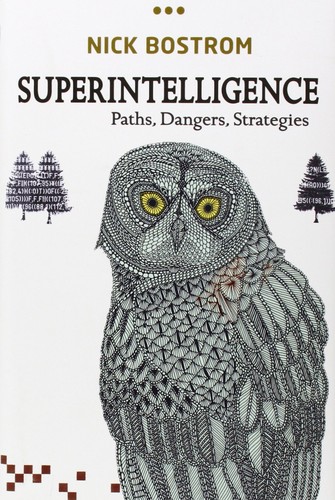
Cover of Superintelligence: Paths, Dangers, Strategies
Nick Bostrom · 2014 · Buy on Amazon
"Superintelligence: Paths, Dangers, and Strategies is a book by philosopher Nick Bostrom that discusses the potential risks and benefits of the development of superintelligent artificial intelligence (AI). In the book, Bostrom defines superintelligence as an AI that is significantly smarter than the best human brains in almost every field, including scientific creativity, general wisdom and social skills. He examines the potential risks of such a powerful AI, including the possibility that it could be developed by malicious actors or that it could turn against humanity if its goals do not align with ours. Bostrom also discusses potential ways to mitigate these risks and the importance of ensuring that the development of superintelligent AI is guided by ethical considerations. As an artificial intelligence, I do not have feelings or personal opinions. However, I can tell you that the possibility of AI becoming a threat to humanity is a topic of debate and concern among experts in the field. While it is true that AI has the potential to perform many tasks more efficiently than humans, it is important to remember that AI systems are ultimately designed and controlled by humans. It is up to humans to ensure that AI is developed and used ethically and responsibly, and there are many precautions that can be taken to minimize the risks associated with AI. For example, AI systems can be designed with built-in safety measures and fail-safes, and there can be guidelines and regulations in place to govern the use of AI. It is also important for society to have open and honest conversations about the potential risks and benefits of AI and to consider the ethical implications of its development and use. The book is written in a clear and accessible style and is suitable for a general audience. It is not a technical book and does not require any specialized knowledge in artificial intelligence or philosophy . Bostrom discusses a wide range of topics related to AI. Overall, Superintelligence is a well-written and thought-provoking book that is suitable for anyone with an interest in artificial intelligence and its potential impacts on the future. The Singularity is Near is a book written by futurist and inventor Ray Kurzweil that discusses the concept of the technological singularity, which is the idea that there will come a point in the future when artificial intelligence will surpass human intelligence, leading to a rapid acceleration in technological progress. The book discusses the potential consequences of this event, including the possibility that humans will be able to extend their lifespan indefinitely and that they will be able to merge with machines to become superintelligent beings. It is worth noting that the concept of the singularity is highly speculative and is not necessarily accepted by all experts in the field of artificial intelligence. Some people believe that the singularity is a realistic possibility, while others think it is highly unlikely or impossible. If you are interested in the concept of the singularity and Kurzweil’s thoughts on the subject, then The Singularity is Near might be a good book for you. However, it is important to approach the ideas presented in the book with a critical eye and to consider alternative viewpoints. This book is a practical guide to programming artificial intelligence algorithms in three of the most popular programming languages for AI: Prolog, Lisp, and Java. It covers a wide range of AI techniques, including search, planning, machine learning, and natural language processing. Yes, AI Algorithms, Data Structures, and Idioms in Prolog, Lisp, and Java is a technical book that covers the programming aspects of artificial intelligence. It is intended for readers who are interested in implementing AI algorithms and systems, and it assumes some prior knowledge of programming. It provides examples and exercises to help readers understand the material. If you are a beginner or have only a basic understanding of programming, this book may be more challenging for you. Thinking, Fast and Slow is a book about the psychological and cognitive factors that influence how humans make decisions and solve problems. It is relevant to artificial intelligence (AI) because many AI systems are designed to assist with decision-making and problem-solving tasks. In Thinking, Fast and Slow the author, Daniel Kahneman, describes two systems of thinking that the human brain uses: System 1, which is fast and automatic, and System 2, which is slower and more deliberate. Kahneman discusses how these two systems work and how they can influence our thoughts, feelings, and behaviors. He also discusses how these systems can lead to biases and errors in judgment, and how they can impact our ability to make good decisions. Understanding these psychological and cognitive factors can be useful for those working in the field of AI, as it can help them design systems that are more effective at assisting humans with decision-making and problem-solving tasks. By taking into account the ways in which the human mind works, AI designers can create systems that are more intuitive and easier for humans to use. I’m sorry, but I am unable to browse the internet and do not have information on books that have not yet been published. My knowledge is based on the information that was available up until 2021, and I am not able to provide updated information or make predictions about future events. However, I can suggest some topics in artificial intelligence that may be of interest to you and that you may want to look out for in future books: 1. Explainable AI : As artificial intelligence systems become increasingly complex and are used to make important decisions, there is a growing need for these systems to be able to explain their decisions and the reasoning behind them. Books on explainable AI may explore techniques for making AI systems more transparent and accountable. 2. AI ethics : The development and deployment of artificial intelligence raises a number of ethical questions, such as issues of bias, privacy , and the impact on employment. Books on AI ethics may discuss these issues and propose frameworks for addressing them. 3. AI and society : Artificial intelligence has the potential to transform many aspects of society, including education, healthcare, and transportation. Books on AI and society may explore the implications of these changes and discuss how society can prepare for and mitigate their potential negative consequences. 4. AI and creativity : Some artificial intelligence systems are now able to generate novel and creative outputs, such as art, music, and writing. Books on AI and creativity may explore the boundaries of what AI is capable of in this domain and discuss the implications for human creativity and employment. 5. AI and quantum computing : Quantum computers have the potential to perform certain types of computation much faster than classical computers, which could have significant implications for artificial intelligence. Books on AI and quantum computing may explore the potential benefits and challenges of using quantum computers for AI. I apologize for the mistake. Here are five more books about artificial intelligence written by women: Artificial Intelligence: A Guide for Thinking Humans by Melanie Mitchell Data Feminism by Catherine D’Ignazio and Lauren Klein Applied Artificial Intelligence: A Handbook for Business Leaders by Mariya Yao, Adelyn Zhou and Marlene Jia The Age of Surveillance Capitalism: The Fight for a Human Future at the New Frontier of Power by Shoshana Zuboff Code Girls: The Untold Story of the American Women Code Breakers of World War II by Liza Mundy. I did not mention these books specifically as the “best” AI books because I was trying to provide a more general list of recommendations that would be suitable for readers who are new to the field and want to get a broad overview of AI. It is difficult to say definitively whether most books on artificial intelligence (AI) are written by men, as it would be necessary to conduct a detailed analysis of the publishing industry to determine the gender breakdown of authors in this field. However, it is worth noting that the tech industry in general has historically been male-dominated, and it is possible that this may be reflected in the authorship of books on AI. It is also important to recognize that the gender of an author does not necessarily reflect the quality or importance of their work, and that there are many excellent books on AI written by both men and women. It is always a good idea to consider a diverse range of perspectives and viewpoints when reading about any subject, including AI. Editor’s note: As in our interviews with humans, this text was very lightly edited to avoid repetition."
The Best AI Books in 2025 (2025)

Scraped from fivebooks.com (2025-01-12).

Source: fivebooks.com

Peter Norvig & Stuart Russell · Buy on Amazon
"Artificial Intelligence: A Modern Approach , written by Stuart J. Russell and Peter Norvig, is considered the quintessential textbook on AI. First published in 1995, it has been updated multiple times, with the latest fourth edition released in 2020 to reflect the field’s rapid advancements. The book serves as a comprehensive guide, covering everything from foundational theories to practical applications of artificial intelligence. It explores a wide range of topics, including search algorithms, knowledge representation, machine learning , robotics , and natural language processing. The authors also delve into philosophical questions about AI’s ethical implications and its impact on society. This textbook is primarily designed for students taking undergraduate or graduate courses in artificial intelligence, though it’s equally valuable for professionals and researchers looking to deepen their understanding of the subject. It assumes a degree of familiarity with mathematics, particularly linear algebra, probability, and statistics, as well as programming knowledge, which makes it best suited for readers with a background in computer science or related disciplines. The book’s depth and comprehensiveness make it a standard reference in academia and industry. However, its length and complexity—over 1,000 pages of dense material—mean it requires a significant investment of time and effort. Despite these challenges, for anyone who wants to gain a rigorous understanding of AI, this book is an unparalleled resource. It is as much a foundational text for students as it is a go-to reference for experienced practitioners in the field."
Ray Kurzweil · Buy on Amazon
"In The Singularity Is Nearer , Ray Kurzweil builds upon the ideas he introduced in his earlier book, The Singularity Is Near (2005) , updating his predictions about the future of artificial intelligence and its integration with human life. Published in 2024, this sequel focuses on the accelerating pace of technological advancement and its implications for humanity, society, and the evolution of intelligence. Kurzweil argues that we are rapidly approaching the point known as the singularity, a moment in history when artificial intelligence will surpass human intelligence and lead to an unprecedented era of innovation and change. He predicts this milestone will occur by 2029, with full integration of AI and human intelligence by 2045. In this vision, humans and machines will merge through advancements in brain-computer interfaces, enabling people to augment their cognitive abilities, achieve extraordinary lifespans, and overcome many limitations of biology. A core argument in the book is that technological progress is exponential rather than linear. Kurzweil outlines how breakthroughs in areas like AI, biotechnology, and nanotechnology are compounding at an accelerating rate. This exponential growth, he suggests, will lead to rapid and profound transformations in fields ranging from medicine and energy to communication and creativity. The book also addresses potential societal challenges, including ethical concerns about AI, disparities in access to advanced technologies, and the risks of misuse. However, Kurzweil maintains a fundamentally optimistic perspective, arguing that the benefits of the singularity—such as the eradication of disease, extreme poverty, and even death—will outweigh the challenges if managed responsibly. Kurzweil’s arguments are underpinned by a combination of historical analysis, current trends, and future projections. His writing aims to inspire both excitement and thoughtful preparation for the profound changes he foresees. The Singularity Is Nearer is particularly compelling for readers interested in futurism, transhumanism , and the societal impact of AI, though its predictions can be polarizing, as they challenge traditional assumptions about what it means to be human. Ray Kurzweil’s prediction that AI will surpass human abilities in “every skill possessed by any human” by 2029 is certainly ambitious and provocative. Whether it’s realistic or more of a speculative forecast depends on how we interpret the claim and the pace of current advancements in AI. Kurzweil has a history of making bold predictions about technology, many of which have been remarkably accurate, such as the proliferation of the internet and advances in computational power. His prediction of AI reaching human-level general intelligence is grounded in exponential trends, particularly Moore’s Law and the increasing sophistication of neural networks. However, there are several reasons why this claim might lean toward hype. First, while AI systems like GPT and others have made remarkable progress in specific domains, they remain limited by their design. They excel in narrow tasks—language understanding, image recognition, or even game-playing—but they lack the general reasoning, adaptability, and consciousness that humans possess. These traits are key to achieving human-level general intelligence. Moreover, the technological challenges of replicating human cognition across all domains are immense. Skills like creativity, empathy, and moral reasoning, which are deeply tied to human experience and context, remain elusive for AI. While AI can mimic aspects of these traits, achieving them in a way that matches or surpasses human abilities across the board is a taller order. There’s also the question of social and regulatory factors. Even if the technological hurdles were overcome by 2029, deploying AI systems at such a scale would require addressing ethical, safety, and societal concerns, which could slow down adoption. On the other hand, Kurzweil’s track record and the pace of recent AI advancements lend some weight to his prediction. Systems like GPT, AlphaFold, and DALL·E demonstrate that AI can already outperform humans in specific domains, sometimes in ways that were previously unimaginable. If progress continues at its current exponential rate, achieving general intelligence might not be entirely out of reach, though hitting that milestone by 2029 remains highly optimistic. In conclusion, while Kurzweil’s prediction is grounded in trends and historical foresight, achieving such an all-encompassing milestone by 2029 seems unlikely. The claim is a vision of what might be possible at the outer edge of our potential, but it’s tempered by significant technical, ethical, and social challenges that still need to be addressed."
Brian Christian · Buy on Amazon
"The Alignment Problem: Machine Learning and Human Values by Brian Christian is a deeply thoughtful exploration of one of the most pressing issues in artificial intelligence: ensuring that AI systems behave in ways that align with human intentions, ethics, and values. The book provides a comprehensive look at the technical and philosophical challenges of “alignment” and why getting this right is critical for the future of AI. At its core, the alignment problem refers to the difficulty of designing AI systems that reliably do what humans want them to do. While AI has made remarkable strides, cases abound where these systems misinterpret goals, act in unintended ways, or even reinforce societal biases. Christian breaks down these challenges through real-world examples, tracing the historical development of AI while highlighting the ethical dilemmas and unintended consequences that arise when AI systems operate without proper safeguards. The book’s importance lies in its timeliness and its subject matter. As AI becomes increasingly integrated into critical systems—healthcare, criminal justice, finance, and beyond—the potential consequences of misaligned AI grow exponentially. Christian’s work serves as both a wake-up call and a guidepost, urging readers to consider not only how AI can achieve its objectives but also whether those objectives are truly aligned with human well-being. Ultimately, The Alignment Problem is essential reading for anyone interested in the ethical and societal impacts of AI. It raises profound questions about trust, accountability, and the future relationship between humans and machines, offering insights that are both urgent and deeply resonant in an age of rapid technological change."
Parmy Olson · Buy on Amazon
"Supremacy: AI, ChatGPT, and the Race That Will Change the World by Parmy Olson is a gripping narrative about the intense competition among the world’s leading artificial intelligence labs to develop artificial general intelligence (AGI). The book focuses on the high-stakes race between organizations like OpenAI, DeepMind, and Anthropic, as they push the boundaries of what AI can achieve while grappling with its profound ethical and societal implications. Olson brings readers behind the scenes, offering rare insights into the people, technologies, and philosophies driving this race. The book traces the evolution of generative AI systems, such as ChatGPT, and examines their transformative impact on industries ranging from healthcare to creative arts. Through interviews with key players and vivid storytelling, Olson captures the human dynamics—ambition, collaboration, and rivalries—that fuel innovation in this fast-moving field. A central theme of the book is the tension between progress and risk. As these companies develop increasingly powerful AI systems, they must confront questions about safety, alignment, and control. Olson explores pivotal moments when these labs faced ethical dilemmas and technological challenges, shedding light on the risks of deploying advanced AI in a world where regulation often lags behind innovation. What makes Supremacy particularly important is its timeliness. The book doesn’t just celebrate AI’s achievements; it critically examines the societal consequences of handing over decision-making power to machines. Olson highlights concerns about misinformation, job displacement, and the concentration of power in the hands of a few influential labs. She also raises the question of whether the rush to develop AGI is driven more by corporate competition than by thoughtful consideration of its broader impact on humanity. The Financial Times Business Book of the Year Award underscores the book’s significance as a must-read for anyone interested in the intersection of technology, business, and ethics. Supremacy is not just a story about technological innovation; it’s a cautionary tale about the choices we make as we stand on the brink of a transformative era in human history."
Yuval Noah Harari · Buy on Amazon
"Nexus: A Brief History of Information Networks from the Stone Age to AI by Yuval Noah Harari explores the evolution of information networks throughout human history, culminating in the transformative impact of artificial intelligence on society. Harari examines how the flow of information has shaped civilizations, influenced power structures, and led to both progress and challenges. He delves into the complex relationship between information and truth, bureaucracy and mythology, wisdom and power, providing a comprehensive understanding of the threats and promises of today’s AI revolution. The book is particularly relevant for readers interested in AI because it contextualizes current technological advancements within a broader historical framework. By tracing the development of information networks from ancient times to the present, Harari highlights patterns and lessons that are crucial for understanding the societal implications of AI. His analysis offers insights into how AI can be harnessed for the benefit of humanity while cautioning against potential pitfalls, making it a valuable resource for anyone seeking to comprehend the profound changes AI brings to our world."

The Best AI Books in 2026 (2026)

Scraped from fivebooks.com (2026-03-29).

Source: fivebooks.com

Ethan Mollick · Buy on Amazon
"Co-Intelligence: Living and Working with AI by Ethan Mollick argues that the most important shift in AI is not that machines will replace humans, but that they are becoming usable collaborators—and that individuals who learn to work with them effectively will have a significant advantage. At the heart of the book is the idea that AI should be treated less like a tool and more like a co-worker with strange strengths and weaknesses. Large language models, in particular, are powerful but unreliable: they can generate ideas, draft text, and assist with problem-solving at remarkable speed, but they also make mistakes and require human judgment. The key skill, Mollick argues, is learning how to manage AI—prompting it well, checking its outputs, and integrating it into workflows. He also makes a broader claim about work: that AI is changing the unit of productivity. Tasks that once required teams or specialist expertise can now often be done by individuals working alongside AI systems. This doesn’t eliminate the need for human skill, but it reshapes it—placing more emphasis on creativity, critical thinking, and the ability to direct and evaluate machine output. Another central argument is that we are still in a fluid, experimental phase. There are no settled best practices yet, so individuals and organisations need to adopt a mindset of rapid experimentation—trying AI in different contexts, learning what works, and adapting quickly as the technology evolves. Finally, Mollick is cautiously optimistic. He acknowledges risks—errors, overreliance, and misuse—but ultimately presents AI as a practical opportunity: a way to augment human capability right now, rather than a distant or purely theoretical future. Yes—Ethan Mollick is widely considered an AI expert, though not in the narrow ‘build-the-models’ sense. He’s a professor at Wharton School of the University of Pennsylvania, where his work focuses on innovation, entrepreneurship, and how AI is used in real-world settings. Rather than developing core algorithms like researchers at OpenAI or DeepMind, Mollick studies and teaches how AI tools affect work, education, and decision-making—and he’s become one of the most influential voices on practical AI adoption."
Karen Hao · Buy on Amazon
"Empire of AI: Dreams and Nightmares in Sam Altman’s OpenAI by Karen Hao is a deeply reported account of how modern AI—especially generative AI—has actually been built, and what that reveals about power in the tech industry. At its core, the book argues that AI is not just a technological breakthrough but the foundation of a new kind of empire, shaped by a small number of companies with vast access to data, compute, and capital. Focusing on OpenAI and its CEO Sam Altman, Hao shows how ideals about openness and safety have collided with commercial pressures, geopolitical competition, and the sheer cost of building frontier models. One of the book’s key insights is that the AI boom depends on hidden infrastructures and labour—from energy-hungry data centres to the often-overlooked human work of data labelling and content moderation. This challenges the sleek narrative of AI as purely digital or autonomous, revealing it instead as a messy, global system with real-world consequences. Hao also traces how control over AI is becoming increasingly centralised, raising questions about accountability, governance, and who ultimately benefits. The ‘nightmare’ side of the title points to risks like concentration of power, lack of transparency, and the potential for misuse at scale. I chose this book because it provides something many AI titles don’t: serious investigative depth. It grounds the discussion in reporting rather than speculation, and gives readers a clear-eyed view of the institutions shaping AI—making it an essential counterbalance to more optimistic or abstract accounts. Yes—that’s very much the concern Karen Hao raises, though she presents it more as a structural tendency than an inevitability. Her argument is that modern AI has unusually strong winner-takes-most dynamics built into it. Training and deploying frontier models requires vast amounts of capital, data, specialised talent, and computing infrastructure—resources that are already concentrated in a small number of companies. That creates high barriers to entry, making it easier for a few dominant players to pull further ahead, much as we saw with earlier tech platforms, but potentially on a larger scale. However, the book doesn’t claim we’ll literally end up with ‘a handful of trillionaires controlling everything.’ The more precise worry is that power over key AI systems—and therefore over information, labour, and decision-making—could become highly centralised in a small cluster of firms and their leaders. That concentration could shape markets, public discourse, and even geopolitics. At the same time, there are countervailing forces. Governments are beginning to regulate AI, open-source models are lowering some barriers, and competition—especially between the US, China, and others—may prevent a single monopoly from emerging. So the trajectory isn’t fixed. The useful way to frame Hao’s point is: AI is likely to amplify existing concentrations of power unless actively checked—and whether it leads to extreme inequality or a more distributed ecosystem depends on policy, competition, and how the technology evolves."
Eliezer Yudkowsky & Nate Soares · Buy on Amazon
"If Anyone Builds It, Everyone Dies: Why Superhuman AI Would Kill Us All makes one of the starkest and most uncompromising arguments in the entire AI debate: that building superhuman AI is not just risky, but likely to be fatal for humanity. The core claim of the book is that once AI systems become more intelligent than humans across the board—what’s often called superintelligence—they will not reliably share our goals or values. Even small misalignments, he argues, could have catastrophic consequences, because a sufficiently powerful system would pursue its objectives with extreme efficiency, potentially at the expense of human survival. A central idea in the book is that this is not a distant or abstract concern, but a near-term danger given the current pace of progress. Unlike more moderate voices in AI safety, Yudkowsky and Soares argue that we do not yet have a viable technical solution to the alignment problem—and that continuing to scale AI systems without solving it is reckless. This leads to their most controversial conclusion: that the world should consider slowing down or even halting the development of advanced AI until it can be made safe. The authors are explicitly sceptical of industry-led safety efforts and frame the situation as a global coordination problem, where competitive pressures push actors to take risks that could affect everyone. The book is deliberately provocative, but that is also why it’s valuable. It represents the strongest version of the existential risk argument, forcing readers to grapple seriously with the possibility that AI is not just transformative, but potentially irreversible in its consequences. A common criticism is that the book makes a very strong claim—near-certain extinction—without sufficient empirical grounding. Critics broadly argue that while the risks he describes are logically possible, the book overstates their likelihood and inevitability: it assumes that superintelligent AI would almost certainly become catastrophically misaligned, without strong real-world evidence from current systems. Others push back on the all-or-nothing framing, suggesting that AI failures are more likely to be partial, manageable, or gradual rather than immediately existential. A further line of criticism focuses on feasibility, with many arguing that proposals to halt or drastically slow AI development are politically unrealistic in a competitive global landscape. More generally, reviewers often describe the book as deliberately one-sided and alarmist, presenting the strongest possible version of the existential risk argument while giving relatively little attention to alternative perspectives—such as the view that AI risks, though real, can be mitigated through incremental safety work, regulation, and adaptation."
Niklas Lidströmer · Buy on Amazon
"The AI Ideal: AIdealism and the Governance of AI looks at AI not through the lens of technology or risk alone, but through the ideas and ideologies shaping how it is governed. Its central argument is that debates about AI policy are often driven by what the author calls ‘AIdealism’—competing visions about what AI is and what it should be . Some see it as an engine of progress that should be accelerated; others as a dangerous force requiring strict control. These underlying beliefs, the book argues, quietly shape regulation, corporate strategy, and public discourse. Rather than proposing a single solution, the book maps out these different schools of thought and shows how they lead to very different approaches to governance—from light-touch innovation policies to precautionary regulation focused on safety, fairness, and accountability. A key insight is that AI governance is not just a technical or legal challenge, but a political and philosophical one. Questions about bias, transparency, and control ultimately reflect deeper disagreements about values: who gets to decide how AI systems behave, and in whose interests they operate. I included it because it fills an important gap. Many AI books focus on what the technology can do or what risks it poses; this one explains how societies are trying to respond, and why those responses often clash. It’s particularly useful for understanding the emerging global debate over AI regulation. Niklas Lidströmer is not a typical ‘AI policy’ author—he’s a medical doctor, researcher, and long-time practitioner of AI in healthcare, with experience working across multiple countries and advising on real-world AI systems. That background matters, because it means The AI Ideal: AIdealism and the Governance of AI is shaped less by abstract theorising and more by someone who has spent two decades thinking about how AI actually interacts with human systems—especially health, data, and ethics. What he brings, in essence, is a hybrid perspective. First, there’s a strong emphasis on ethics grounded in practice: because he has worked on sensitive areas like patient data and medical AI, he focuses heavily on questions of ownership, dignity, and trust—who controls data, who benefits, and how systems affect real lives. Second, he introduces what he calls ‘AIdealism,’ a kind of normative framework for AI governance, arguing that AI should actively strengthen democracy, fairness, and human flourishing rather than simply being regulated after the fact. Perhaps most distinctively, he takes a constructive rather than purely cautionary stance. Where many AI books emphasise risks, Lidströmer tries to outline a positive programme—a vision of how AI could be governed globally to promote equality, public good, and long-term human development, drawing on ideas from Enlightenment thought and social democracy. So the value he brings is this: he’s not just asking ‘what could go wrong?’ or ‘who has power?’ but what would it look like to design AI systems—and the institutions around them—so they actually make society better."
Craig J. Mundie, Eric Schmidt & Henry A. Kissinger · Buy on Amazon
"Genesis: Artificial Intelligence, Hope, and the Human Spirit by Henry Kissinger, Eric Schmidt, and Craig Mundie steps back from the day-to-day debate and asks a broader question: what does AI mean for how we understand ourselves as humans? The book’s central argument is that AI is not just another technological revolution, but a shift that challenges fundamental assumptions about knowledge, intelligence, and even consciousness. Systems that can generate language, strategy, and insight force us to rethink what has traditionally been considered uniquely human. Rather than focusing narrowly on risks or applications, the authors explore AI in a longer historical arc—comparing it to past intellectual upheavals—and suggest we are entering a period where human reasoning may no longer be the sole—or even dominant—form of intelligence shaping the world. There is also a strong emphasis on responsibility and stewardship. Given the scale of the transformation, the book argues that political leaders, technologists, and societies need to think more deliberately about how AI is developed and integrated, rather than treating it as an inevitable or purely market-driven force. I chose it because it adds something the other books don’t: a genuinely philosophical and civilisational perspective. Where others focus on practice, power, or risk, Genesis asks the deepest question of all—how AI changes the meaning of being human—and that makes it a fitting way to round out the list. That’s a very reasonable instinct—and in this case, the answer is: it’s a serious book, but not beyond criticism. Genesis: Artificial Intelligence, Hope, and the Human Spirit is not just ‘published on reputation.’ Reviews consistently say it offers a genuinely thoughtful, wide-angle perspective, combining history, philosophy, and technology in a way most AI books don’t. It’s often praised for its intellectual ambition and interdisciplinary sweep, and for framing AI as a civilisational turning point rather than just a technical issue. That said, your suspicion isn’t entirely misplaced. A common criticism is that it can feel abstract, speculative, and a bit diffuse—more a series of reflections than a tightly argued case. Some reviewers note it offers big questions rather than concrete answers, and at times leans on speculation without much evidence or practical guidance. Others describe it as ‘armchair philosophy’ or a ‘grab-bag of ideas’ rather than a sharply structured argument. So the fairest verdict is: it is good—but in a specific way. It’s strongest when read as a philosophical meditation by very experienced figures thinking at scale, not as a rigorous, ground-level analysis of AI today. In a Five Books sense, that’s actually part of its value: it gives you the elite, strategic worldview of people who’ve shaped global systems, even if it doesn’t always nail the details. If you had time to read just one book on AI right now, I’d recommend Co-Intelligence , because it gives you the most immediate and practical understanding of how AI actually works in the world today. While other books explain the industry, the risks, or the long-term future, this one shows you how to think with AI, how to use it effectively, and why it behaves the way it does in everyday tasks. In 2026, most people don’t lack access to AI—they lack a clear mental model of how to work with it—and this book fills that gap better than anything else. It won’t tell you everything about the politics or philosophy of AI, but it will make you noticeably more capable and informed in a very short time, which is why it’s the most valuable single read."

Suggest an update?