Bunkobons

← All curators

Caspar Henderson's Reading List

Caspar Henderson is a writer, journalist and editor. His work has appeared in the Financial Times , Nature , New Scientist , the New York Review of Books and openDemocracy . He is a past recipient of an IUCN-Reuters award for best environmental reporting in Western Europe. His debut book, The Book of Barely Imagined Beings , won the Roger Deakin Award from the Society of Authors and the Royal Society of Literature's Jerwood Prize. A New Map of Wonders followed in 2017. The Book of Noises is out now, published by Granta in the UK and the University of Chicago Press in the US.

Open in WellRead Daily app →

Science and Wonder (2017)

Scraped from fivebooks.com (2017-11-02).

Source: fivebooks.com

Richard Holmes · Buy on Amazon
"It’s a splendid book. Richard Holmes is a literary biographer. He is well known for a two-volume biography of Samuel Taylor Coleridge , which was published 5-10 years before this. It’s a group biography of writers and scientists in the late 18th and early 19th century—Herschel and Humphrey Davy on the science side, and the Romantic poets, mostly in England, and their engagement with the sublime and with science. Among Holmes’s qualities are his warmth, his extraordinary depth of knowledge and the fluency in his writing. It’s just a really enjoyable read. It’s particularly germane to the topic of science and wonder because the period he’s writing about—which is roughly the 1770s through to the 1830s—is the time of the Romantics. In Britain, if not necessarily elsewhere, we tend to think of the two cultures—C.P. Snow’s phrase from the 1950s—that there’s a culture of the arts and a culture of the sciences and never the twain shall meet. People will go back to William Wordsworth, for example, saying “we murder to dissect”—this loathing of the medics who will just tear apart a body and do not appreciate its integral beauty. Or John Keats’s line about how the touch of cold philosophy unweaves the rainbow. There’s a sense that science is inimical to beauty and wonder of life. But one of the things that figures in Richard Holmes’s book is Coleridge’s great enthusiasm for science. Coleridge was friends with Humphrey Davy, a leading chemist of the age, a great discoverer and a scientific entrepreneur. Coleridge was asked, ‘Why do you go to to all these lectures that they run at the Royal Institution?’ and he said, ‘to improve my stock of metaphors.’ He said that science being necessarily performed with a passion of hope is poetical. So this book is enlightening to read if you still had this idea of the two cultures, to see that the same false dichotomy was playing out around the 1800s. In fact, it wasn’t a dichotomy at the time either, and it isn’t a dichotomy today. You even hear people today talking about the one culture. Even we arts graduates have some reasonable grasp of the second law of thermodynamics as well as the late plays of William Shakespeare. It’s an accepted part of our culture, that you need to know both — or at least that’s hope."
Rachel Carson · Buy on Amazon
"Yes, it started as an essay and she was going to turn it into a book but died of cancer before she could. I had a hard time choosing merely five books on this topic, and I would have liked to talk, among the American writers, about many others including, of course, Henry David Thoreau but also Loren Eiseley, Lewis Thomas, Annie Dillard. In the end I chose Rachel Carson for several reasons. She was a very good scientist and a good writer. Also, she continues to be traduced by the anti-environmentalists. They claim she was a Luddite and responsible for the deaths of millions of people because she opposed the use of DDT. This is a grotesque lie. So I think it’s important to celebrate her work. She’s best known for Silent Spring , which is about the poisoning of terrestrial ecosystems and, of course, the extirpation of birdlife, but she was actually a marine biologist and before that, she wrote two marvellous book called The Sea Around Us and The Edge of the Sea. “One of the things that science—wisely applied—can do, is blow that open to the radical openness that I was talking about, the sense of wonder. It makes us a little bit more humble and I think that’s what wonder’s about.” The Sense of Wonder is a short piece, barely more than an essay really, though it exists in book form, and it’s essentially just a celebration of being in the world. As far as I know, it’s not often read but a few familiar lines from it tend to get trotted out. ‘If I had influence with the good fairy who is supposed to preside over the christening of all children,’ Carson writes, ‘I should ask that her gift to each child in the world should be a sense of wonder so indestructible that it would last throughout life, as an unfailing antidote against the boredom and disenchantment of later years, the alienation from the sources of our strength.’ It’s a fine sentiment. Some people find the way it is expressed a little cloying. I think I find it a bit cloying myself. But if you read the whole, it’s very fresh, it’s very immediate, and yes it is, it’s partly a love letter and some advice to her nephew. I’d like to quote another passage: ‘One stormy night when my nephew Roger was about twenty months old, I wrapped him in a blanket and carried him down to the beach in the rainy darkness. Out there, just at the edge of where-we-couldn’t-see, big waves were thundering in, dimly seen white shapes that boomed and shouted and threw great handfuls of froth at us. Together we laughed for pure joy, he a baby meeting for the first time the wild tumult of oceanus, I with the salt of half a lifetime of sealove in me. But I think we felt the same spine tingling response to the vast, roaring ocean and the wild night around it.’ So it starts with her baby nephew but ends touchingly with a letter she received from an 83-year old woman who she describes as still having that very intense sense of wonder about life. It’s a beautiful piece. And it’s important that it is written by somebody who was a very fine scientist, whose scientific work is still being denied in the context of a concerted strategy by vested interests to deny a lot of vital science with regard to environment and block action that is urgently required for the good of humanity and all life. We like to think so, but some people might say we have an over romantic idea of what children are about and it’s a little bit dangerous to generalise. I had a short but interesting conversation when I was writing A New Map of Wonders with the film maker Phil Agland, who has made a number of superb documentaries with the Pygmy people of the Congo and also in both remote and urban parts of China. One of the things he captures brilliantly in his recent series Between Clouds and Dreams is the revelatory wonder on the faces of children when they see film of an endangered little bird on the mudflats off the coast south of Shanghai. When I was talking to him, he told me that you see this in these kids but then, when they go to the equivalent of secondary school, they enter this super intense system where they are beginning the long hard preparation for the gaokao exams and they get this wonder just thumped out of them. So maybe we can generalise, that, broadly speaking, kids in industrialised cultures have this sense of wonder and it gets a little beaten out of us."
Jacob Bronowski · Buy on Amazon
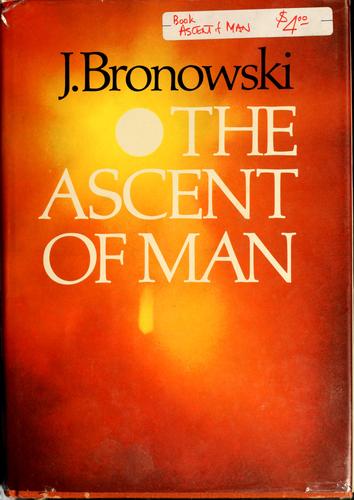
"Yes, the BBC published the book I have here. It’s pretty much the script of the TV series. The Ascent of Man was broadcast first at a remarkable time in British television. There was Kenneth Clark’s Civilization and John Berger’s Ways of Seeing in 1972, which I rate very highly, and, in 1973-4, Jeremy Isaacs’s The World At War . The Ascent of Man is extraordinary television, and the book is a valuable document of it —-a way of accessing part of what Bronowski achieved. Some of the science he refers to —say with regard to DNA—has of course moved a long way forward since his time, but so much about the book remains relevant. Part of the reason I chose this book is that in the past few years, the Israeli historian Noah Yuval Harari has published two books— Sapiens and then Homo Deus . They’re enjoyable but quite pessimistic and unforgiving in many ways. Harari is, perhaps, almost enjoying that bucket of cold water he’s pouring on your hopes and dreams, though he does it well and often convincingly. I gather he’s now writing a book on how to live in the 21st century, and I look forward to it. But after reading Sapiens and Homo Deus , Bronowski comes to mind because of his warmth and hope. That’s right. The title is an allusion to The Descent of Man , Charles Darwin’s hugely important work of 1871. It’s an attempt to look at cultural evolution—what it is, where it’s come from, where it’s going. And I think that one of the things that makes the book and TV series an enduring document is his optimism and the fact that he had earned the right to that optimism. Bronowski was from Poland, and he was Jewish. He was a mathematician and he worked for the British during World War II. He was a friend of Leo Szilard who first proposed the idea of the atomic bomb to the British before the whole thing went to the US and became the Manhattan Project. At the end of the final episode of the series—which you can find on YouTube —he goes to Auschwitz, and in his suit and his dress shoes he walks into a wet ditch. It’s where the outflow from the crematorium was, where the ash sludge flowed—so that mud contains a trace of ash from millions of people including members of his family. He bends down and he picks up a handful of this slimy crud. And he says that when people believe they have absolute knowledge with no test in reality, this is how they behave. In other words, they become slaves and ghosts in the service of a terrible, evil idea. “Attentiveness alone can rival the most powerful magnifying lens.” And I think one of the central themes in the series is the importance of realising that we don’t have absolute knowledge, that patterns of social organisation tend to fall into a rigidity of doctrine and ideology over time. This often very dangerous. One of the things that science—wisely applied—can do, is blow that open to the radical openness that I was talking about, the sense of wonder. It makes us a little bit more humble and I think that’s what wonder’s about. Of course the danger is when science is tied to evil ends as it often was in World War II, obviously. Science and technology and logistics and the rest of it made possible mass slaughter in Europe and East Asia and elsewhere. It’s just a marvellous book and a wonderful series. It’s one of those things where you find you’re watching these faded, slightly strange-coloured 1970s images with this odd narrator who was actually an incredibly brilliant speaker and communicator. It’s a historical document now but it’s beautiful and wise. He says, “We are all afraid for our confidence, for the future, for the world”—he’s saying this in 1972, but many people feel it today.“That is the nature of the human imagination. Yet every man, every civilisation, has gone forward because of its engagement with what it has set itself to do. The personal commitment of man to his skill, the intellectual commitment and the emotional commitment working together as one.” That’s optimistic. He also says that“knowledge is not a loose-leaf notebook of facts. Above all, it’s a responsibility for the integrity of what we are as ethical creatures.” There is a very strong moral message there, which I think only comes out of hope. It’s not a facile hope, it’s a hard-earned hope."
Robin Wall Kimmerer · Buy on Amazon
"Yes, it’s just about moss. Here’s the cover, it’s got moss on it and it’s got lots of pictures of moss inside. It’s a lovely book, and it inspired a rather good novel called The Measure of All Things by Elizabeth Gilbert. So, it’s a natural and cultural history of moss. Kimmerer writes, ‘we poor myopic humans with neither the raptor’s gift of long distance acuity nor the talents of a housefly for panoramic vision.’ We’ve got all this technology—she’s saying—and that’s great, but the power of our devices can lead us to distrust our unaided eyes. Attentiveness alone can rival the most powerful magnifying lens. She writes vividly about what it’s like to walk across moss in bare feet and to notice it for the first time and to notice the incredible world within moss and the creatures that live within it. So there’s a favourite of mine, a creature I wrote about in The Book of Barely Imagined Beings called the tardigrade, or water bear, which is this extraordinary tiny para-arthropod. It’s not an insect, it’s a bit like an insect and it’s probably the most indestructible animal on the planet. You can put it in space and it can survive cosmic rays, but you can find them living happily deep on the ocean floor or in almost any moss. If we went outside and looked in the gutter, we could probably find them. They’re there in this extraordinary micro-forest and we just don’t think about them. She talks about that forest very well. It can be bad; it can be good. It’s a question of how we manage our attention. The analogy only goes so far, but perhaps the new technology is a bit like alcohol. There is this video where some monkeys get into a holiday resort and start stealing the tourist’s drinks and they’re throwing themselves around and behaving like you know, teenagers. Alcohol brings euphoria, and technological devices can be a bit like that. They bring connection, the little supposedly endorphin hit you get every time you get a like on your Facebook feed. Because it’s a very powerful technology and it can be a powerful technology for good, we just haven’t yet learned to control it and manage it—and, indeed, to take it out the hands of the corporations who want to addict us and manipulate us and sell our data. Like drink, we’ve just got to learn to control it. So I say look at the moss as well as use your iPhone to find out more. There could be incredible applications on your phone to help you learn. Probably, there already are some and I just don’t know about them. People talk about augmented reality, or AR, so as well as spending time to relax in completely manufactured virtual worlds, and I think augmented reality technologies could be tremendously powerful learning tools and attention-supporting tools. So in Britain you go out to the hills, say, and you look at some rocks and you call up on your augmented reality device and it will tell you about the geology, and what’s under the ground, and what’s growing here and how it changes over the year, and maybe it can superimpose some maps and changes and bring that all to you. So you see the landscape in more depth. But then, of course, hopefully you also then take off that device and just be in that place, because I think that’s absolutely vital. Because we are embodied creatures and we smell and feel the temperature and the breeze on the skin. We have this 4 billion year history as embodied beings and it’s still in us in every respect. So we need to be present for that as well as the devices. Yes. I recently tried out an augmented reality device developed by Microsoft. You put on a big pair of goggles and it superimposes dynamic images onto objects around you, which you can also still see. I was almost crying actually not so much because it was already quite impressive but really because you can see it will get a whole lot better. So for example, the object might have been a globe, an old globe from 200 years ago and it would impose patterns on that and bring things out and help you appreciate them. One can see a tremendous power for good there as well as something to divert, and mislead, and distort and control. There’s a bit of that too. Is this the new science writing? Here’s a real scientist writing about science and also writing about her personal experience and asserting that it’s okay to bring the two together. People talk about ‘the new nature writing,’ this genre that, in the British case, has come to the fore in the last twenty years or so—from Roger Deakin’s Waterlog (1999) through Helen Macdonald’s H is for Hawk (2014) and so on. But, as Rob Macfarlane argues, maybe we shouldn’t call it good ‘nature writing’, just good ‘writing.’ It’s refreshing when there’s this idea that you can combine writing about science with writing about yourself. As that’s what Kimmerer has done here, and done very well. Something also to say about Robin Wall Kimmerer, is she’s an American citizen and a biologist, but she’s also a member of the Potowatomi nation, which is a Native American tribe. More recently, she published a book called Braiding Sweetgras s (2014). It’s partly about natural history, but she also talks about investigating her own cultural background. There are about 7 people left who speak the Potowatomi language, they’re all old ladies so the language is nearly extinct: the culture’s almost gone. But she went to investigate the nature of the language and the culture and she talks about how it opened a window to her for another way of seeing. You might think what’s this got to do with science? Well, she observes that English is a noun-based language, in which only about 30% of the words we use are verbs. But the Potowatomi language is about 70% verbs. Things happen, rather than are. “We are a bunch of atoms, but that’s not all we are.” Kimmerer takes the example of a body of water that we call a ‘bay’ in English. She says a bay is a noun only if water is dead. When a bay is a noun, it is defined by humans, trapped between its shores and contained by the word. But the verb in the Potowatomi language—which is wiikwegamaa , ‘to be a bay’—releases the water from that bondage and lets it live. To be a bay, she says, holds the wonder that for this moment, the living water has decided to shelter itself between these shores, conversing with cedar roots and a flock of baby mergansers., because it could do otherwise, become a stream, or an ocean or a waterfall. And there are verbs for that too. I think this is lovely. It’s not mystical, but it’s a more generous and insightful realism that respects and pays attention to process, cycle and change. It’s a different way of thinking, a different way of framing and it’s actually very useful to think of scientifically: to think about process and not just object."
Cover of Reality Is Not What It Seems: The Journey to Quantum Gravity
Carlo Rovelli · 2014 · Buy on Amazon
"I know what you mean. I’ve read a number popular science books about physics over the years and acquired an elementary grasp of physics but I struggle with some of the maths. At one point, after reading Max Born’s book, I thought I had just about understood the theory of relativity, and I think I could get it again, but then I would probably forget it again. But I do think we’re all perfectly capable of understanding the essential concepts. Carlo Rovelli is one of the latest of among many to write about fundamental physics. He had quite a success with a book called Seven Brief Lessons in Physics , and this is basically the longer version of the same book. I think it’s actually a better book in some ways. He did. It goes right to the edge of his field—quantum loop gravity—but I found it a really enjoyable read for a number of reasons. For one thing he’s got a good, simple style, and he has a great capability to explain, as people know if they’ve read Seven Brief Lessons in Physics. He’s also informed by a strong literary and artistic imagination and appreciation of, for example, the mediaeval mind. There’s lovely stuff on Dante and one of the chapels in Florence, and how they inform our ways of perceiving the shape of the universe. He’s also great on Democritus. There are some simple pleasures in the book like there’s a list I’d never seen before. Democritus’s thought only survives in reported fragments from other people. All of his work has disappeared. And he wrote—it depends what you mean by a book: a book back then was different from what we think of today—something like 60 or 70 books, with these wonderful titles. Rovelli just lists them. Each one of them is like, ‘God if we could read that book, it would be just so fascinating!’ So there’s a kind of playful element to it. It’s like a serious brother to Italo Calvino’s marvellous Cosmicomics : these very funny stories, partly about cosmology but also about all kinds of other things. It has a great warmth to it. In fact, I owe the epigraph at the front of The New Map of Wonders to Rovelli, quoting Democritus:‘To a wise man, the whole earth is open because the true country of the soul is the entire universe.’ It’s about living with your fear, moving forward in spite of it, and being open to everything. Yes, he says, “The Italian policeman asked me politely if I was crazy to drive at that speed. I explained that I had found the idea I’d been seeking for so long. The policeman let me go without a ticket and wished me good luck with my book.” There’s a great generosity and humour in this, among other things. It’s delightful Quantum loop gravity. Please forgive my over-simplification and distortion but one of the great challenges, according to many people in this field, is the unification of quantum theory and general relativity. Rovelli’s thing, which is one among several contested theories, is quantum loop gravity, and the book explains what that could be. And does it in a way that’s actually quite easy to follow. That’s what he argues. He goes from pretty much the beginning of physics as we typically frame it with the Greeks. One of the things that’s quite unusual about the book is that, to my knowledge, there are few if any other popular treatments of quantum loop gravity, which is pretty much the very edge of our knowledge now. And he tries to make that clear. What he’s saying is that it’s all about relations. He finishes by saying the world should not be understood as an amorphous ensemble of atoms, but rather as a game of mirrors founded on the correlations between structures formed by the combinations of these atoms. I think even if you don’t get to the end of the book, there’s a lot in it that’s readily understood and enlightening. You will find that actually some of this stuff is really not that hard to understand, at least in general terms, and very enjoyable to read about. He stresses that quantum loop gravity itself is just just a hypothesis. It may present a way forward, he believes it does. I mean I’ve only read this one and the Seven Brief Lessons . They are refreshing and engaging treatments of a quite difficult topic. I enjoy reading about many areas of science and arguably one of the obvious choices for a discussion of science and wonder would be Oliver Sacks, writing about medicine and brain pathology and other topics related to that. So I don’t know if Rovelli is my favourite but this is a really good book. Towards the very end of the book he goes back to Democritus and he says that Democritus gave a strange definition of man, “Man is what we all know. At first sight this seems rather silly and empty but it is not so.” He cites a major scholar of Democritus who argues that it is not a banality that Democritus gave us: “The nature of man is not his internal structure, but the network of personal, familial, and social interactions within which he exists. It is these which make us, these which guard us. As humans, we are that which others know of us, that which we know of ourselves and that which others know about our knowledge. We are complex nodes in a rich web of reciprocal information.” We’re embedded. That’s what he’s saying. That’s also what he’s trying to explain in the physics. He thinks quantum loop gravity will integrate these two apparently inconsistent theories, relate them to each other and we can then, in a sense, find our place within the whole as emergent, complex phenomena—something that, wonderfully, come out of the world rather than (or as well as) being thrown into it. We are a bunch of atoms, but that’s not all we are. Reality is those atoms, but it’s many other things, including information and relationship."

The Best Books for Growing up in the Anthropocene (2013)

Scraped from fivebooks.com (2013-05-28).

Source: fivebooks.com

Pliny the Elder · Buy on Amazon
"The Natural History , written before 79 AD, is one of the key works of European Classical Antiquity, a foundation of the tradition that later became known as natural philosophy and that we now call science. Among Roman authors perhaps only Lucretius, who argued the world was made of atoms, has been as influential. The first thing to say about Pliny’s work is what a delightful and odd read it is. This huge compendium, which aims to describe the entire world, was, for the most part, taken as truth for nearly fifteen hundred years. To modern eyes it contains much that is bizarre or ludicrous as well as beautiful, and it shows a way of organizing knowledge that is very different from what we are used to today. Italo Calvino catches its essence in the introduction he wrote for the 1982 Italian translation, notably what he calls the Natural History’s “wealth of unexpected juxtapositions.” So, for example, Pliny classifies fishes as “Fish that have a pebble in their heads; Fish that hide in winter; Fish that feel the influence of stars. Extraordinary prices paid for certain fish.” A good example of bizarrely improbable claims is that the goby, a small fish that lives in a burrow on the seabed, could stop a fully manned trireme under full power from moving. But it would be a mistake to ridicule or belittle the Natural History . Yes, Pliny can be credulous. He reports that in Ethiopia there are winged horses with horns, and mantichora, which have the face of a man, the body of a lion, and the tail of a scorpion. There is also the catoblepas, to look into whose eyes causes the looker to fall dead. In India there are locusts three foot long and people use their legs for saws. But when it comes to matters he has seen with his own eyes, Pliny is generally a much better guide. He tries hard to get things right, and shows some very modern “common sense” in, for example, an outright dismissal of astrology. Pliny can be marvellously expressive. Calvino highlights, for instance, his account of the moon, “where the tone of heartfelt gratitude for this ʻsupreme heavenly body, the most familiar to those who live on earth, the remedy of darknessʼ joins with the agile functionality of the sentences to express [its] mechanism with crystal clarity.” For Pliny, Calvino writes, “nature is eternal and sacred and harmonious, but it leaves a wide margin for the emergence of inexplicable prodigious phenomena.” And it is his awareness of both that gifts us his over-riding quality: a sense of wonder. Pliny wrote of “magna ludentis naturae varietas” – “the great variety of nature at play” – and though of course ignorant of the mechanism of natural selection he had a sense of the grandeur of a process in which, as Charles Darwin put it, endless forms, most beautiful and most wonderful have been, and are being, evolved. And he would, I think, have agreed with Bertrand Russell’s observation of a “world full of magical things patiently waiting for our wits to grow sharper.” Russell, a mathematician and logician, didn’t mean magic of the abracadabra kind or mysticism, but the miraculous in the original sense of that word as that which should be looked at in wonder and astonishment. (The Latin root, mirus , is thought to be derived from the Indo-European smei – to smile or laugh.) Pliny fits my theme because enthusiasm and joy about the astonishing nature of actual existence – and, indeed, the astonishing existence of actual nature – are needed in dark times as much as in times of hope. I think the Anthropocene is both. Not coincidentally, Pliny was a Stoic who, if we are to believe the account by his nephew, showed courage and kindness as well as enduring curiosity when his expedition to investigate the eruption of Vesuvius led to his death."
Charles Darwin · Buy on Amazon
"Darwin’s books are a series of masterpieces. From early works such as The Structure and Distribution of Coral Reefs in 1842, to his last, which has the unpromising title The Formation of Vegetable Mould through the Action of Worms , published in 1881, he gives us a truly majestic view of the workings of even the smallest life forms which, however humble they may appear, have global consequences. But yes, as you suggest, the question of man’s place in, and relation to, nature was the big one. Darwin clearly understood the implications of the theory of natural selection from early in his career, writing in a private notebook in 1838, “Origin of Man now proved…He who understands baboons would do more towards metaphysics than Locke…” But he was, at least initially, deeply troubled by the implications of his proof – it was, he later said, “like confessing to a murder” – and he alluded to it only elliptically in 1859 in The Origin of Species , writing that “much light will be thrown on the origin of man and his history.” For a combination of reasons, which Jerry Coyne describes in his interview with Five Books , Darwin held off for another twelve years before publishing a detailed chain of reasoning in The Descent in 1871 and buttressing the case the following year in yet another masterpiece, The Expression of Emotion in Man and Animals. Darwin showed that man was continuous with other animals not just in his bodily form but in his mind and, for want of another word, soul. This was a hugely controversial idea in his day and it remains so for many people in ours (though it has never been a problem for animists or pantheists, among others). Even the co-discoverer of natural selection, Alfred Russel Wallace, and Darwin’s great champion, Thomas Henry Huxley, balked at it. They simply could not believe that the human mind and morality could, just like nipples and noses, have evolved without divine intervention. Perhaps the dark, Malthusian aspect of the theory of natural selection, expressed so vividly in chapter 3 of The Origin , and the “Social Darwinist” vision, which was not Darwin’s own but to which it was quickly linked, was too daunting, and unlike Darwin himself, they failed to appreciate it was an incomplete account. Support Five Books Five Books interviews are expensive to produce. If you're enjoying this interview, please support us by donating a small amount . The Descent of Man develops a fuller conception of how natural selection works. Much of the book focuses on selection in relation to sex – a phenomenon which we may be familiar with through the example the peacock’s tale: the extravagant tail feathers of the male result from female preference. (Interestingly, Darwin suggested sexual selection might explain human music, though most evolutionary biologists would now say that even if correct it is just one among several factors.) But more importantly, at least for my argument here, is what Darwin has to say about cooperation as a factor in evolution besides competition. The key quote, from chapter four, is: “any animal whatever, endowed with well-marked social instincts, the parental and filial affections being here included, would inevitably acquire a moral sense or conscience, as soon as its intellectual powers had become as well, or nearly as well developed, as in man.” Paul Seabright explains the implications well in his interview with you : “Darwin was clear that natural selection can select for cooperative and collaborative qualities. But he also points out that the process of selection for cooperative and collaborative qualities is not a serene parade of agreeableness – it’s the result of often violent conflicts. It’s because we live in a world which often has violent conflicts that our collaborative qualities are so important.” An understanding of this reality – the interaction and the tension between competition and collaboration – is crucial to our prospects for growing up in the Anthropocene. The science and mathematics may take us quite some way. Recently, Martin Nowak and others appear to have put a solid foundation under the claim that there is a “snuggle for existence” as well as a struggle for one. It follows, crucially, that it is possible to design systems and rules under which cooperators are more likely to thrive. The logic here applies as much to social and political institutions as it does to the natural world, so it follows that humans can – in the right circumstances and other things being equal – develop smarter systems that favour flourishing for both humans and natural ecosystems. This, at least, I take as the corollary of works such as Seabright’s own book The Company of Strangers: A Natural History of Economic Life and Steven Pinker’s The Better Angels of Our Nature: Why Violence Has Declined . Behind these important works stands Darwin’s The Descent , which I should add is also a very good read."
Claire Nouvian · Buy on Amazon
"After the massive, wordy tomes I’ve just mentioned it may come as a relief to turn to what is essentially a gorgeous coffee table book . Claire Nouvian’s The Deep: The Extraordinary Creatures of the Abyss is a large format, full colour bestiary of the real, containing photographs of a couple of hundred among the countless astonishing creatures that live beneath the shallow sunlit layer at the top of the world ocean. There’s a cockatoo squid – a semi-transparent, orange-spotted, pig-snouted cephalopod with long, feathery tentacles above its eyes. There are predatory fish such as the black swallower, the gulper eel, the squarenose helmetfish and the scaly dragonfish, whose faces are – at first sight – stranger and more hideous than anything in your worst nightmares, though closer inspection reveals how remarkable and, in a way, beautiful they are. There are siphonophores, jellyfish, crinoids and other unaccountable beings such as the ping-pong tree sponge which would embarrass the most shameless creators of schlock science fiction. No one could have dreamed up these animals. The Deep , then, has marvelous pictures and a readable, informative text. Also, it illustrates very well at least two points that I think are central to this notion of growing up in the Anthropocene. The first is that the real world is stranger – more astonishing, more disturbing, more beautiful – than almost anything humans imagined. And we need to enlarge and deepen the boundaries of our imaginations and our knowledge to comprehend as great a part of the dimensions and details of the real world as possible. In this way we can extend our sense of what there is to celebrate, and what there is to value. Henry Thoreau said “in wildness is the salvation of the world.” He was a visionary and a radical but he was not a wooly thinker. It was Thoreau who refused to believe that Walden pond was bottomless and actually took the trouble to measure its depth with a plumb line. He saw that there was a greater beauty in knowing than in ignorance and that knowledge does not lessen the mystery of existence. The second point is that the fate of the world ocean, and the variety of life it contains, are to a great extent in our hands. This enormous habitat – 1.3 billion cubic kilometres or more – is nine-tenths of the living space on Earth. For all the brilliant scientific advances in recent decades, our understanding of what we are doing to it and what the likely consequences will be remain very patchy. Only very recently, for example, have we begun to appreciate that carbon dioxide emissions in the last few decades are altering ocean acidity faster than at any time in at least 55 million years, and probably tens or hundreds of times as fast as happened back then, at a time of crisis and extinction. Only very recently have we begun to understand just how much of the heat from the enhanced greenhouse effect caused by our pollution is sinking into the deep oceans. And then there are the impacts of over-fishing, pollution, plastics and much else. Books like The Deep are among the tools that can help us expand our sense of wonder while we also reflect on our responsibilities."
James Hanson · Buy on Amazon
"There are many good books for the general reader about the science, the politics, the economics and the psychology of climate change, and it is invidious to single out one or even a few. The Discovery of Global Warming by Spencer Weart, Field Notes from a Catastrophe by Elizabeth Kolbert, Sustainable Energy Without the Hot Air by David McKay, Merchants of Doubt by Naomi Oreskes and Erik Conway, and Eaarth by Bill McKibben are among those worth attention. Greg Craven, a high school science teacher in the US, developed his excellent talks on YouTube into a book called What’s the Worst that Can Happen? , and I’d also recommend that. But if I had to recommend just one book it would be James Hansen’s Storms of My Grandchildren because it is, simultaneously, a good introduction to the science, a first-hand account of what it’s like to be on the receiving end of attempted sabotage by political operatives who know nothing about the science, and a very human call for action. The book is dedicated to his grandchildren, Sophie and Connor, for whose future he fears in a rapidly warming world. It also contains a manifesto for how to address the challenges which, whether or not one agrees with every detail, is as good as any of the necessarily brief outlines you can find in books of this kind. Hansen, who has just announced that he is stepping down as Director of the NASA Goddard Institute for Space Studies, is a distinguished climate scientist, but one of the things that really marks him out is his passionate commitment to making change happen. Hansen has been unusually outspoken among scientists for a long time. He first came to prominence in 1988, when he testified to the US Senate that he was “99% confident” that the Earth was warming because of human-made greenhouse gases. He stood up to the administration of George W. Bush when it tried to censor him. And he’s put himself on the line, being arrested for demonstrating against mountain top removal mining. He has been a clear and authoritative voice against the Keystone pipeline, which would bring oil from the highly polluting Athabasca tar sands in Canada to US refineries. It is precisely because he wants to commit himself full time to activism that he has stood down from his scientific work. Hansen has been criticised for giving undue stress to the more extreme scenarios within the range of probability if we fail to drastically reduce emissions greenhouse gases. He fears an extinction event comparable to the “great dying” at the end of the Permian period 252 million years ago is a real risk. He’s also criticised for being unrealistic in calling for emissions of greenhouse gases to be limited such that atmospheric concentrations do not exceed 350 parts per million – a goal adopted by the campaign group 350.org. These criticisms are worth entertaining but in an unreasonable world, where the functional stupidity of our societies and governments with regard to climate and environment is greater even than the dysfunction embedded in regulation of financial systems before the crash of 2007, a little unreasonableness may be the most reasonable thing. Hansen has earned the right to speak. We should listen."
Braden Allenby and Daniel Sarewitz · Buy on Amazon
"Climate change is likely to be a huge challenge in this century and beyond, but it’s unlikely to be the only one. Some challenges may come as a surprise but among those we think we can see coming are how we will feed nine to twelve billion humans, how we will keep a lid on deadly conflict and how we will increase the likelihood that what is most valuable and marvelous in the rest of the living world thrives. Responses and debate often focus on how science and technology can “save” us. Sure, there will be no solutions without advances in science and technology. Equally surely, science and technology alone almost never provide a solution. Technical advances usually bring unforeseen consequences. More importantly, poor political and social choices can lead to terrible outcomes. “Music, the arts and the sciences, which are making discoveries of surpassing beauty almost daily, can help us find plenty of space, amidst all the uncertainty, for wonder and celebration.” There is a large and serious literature emerging on how to “manage” the planet in the Anthropocene. Books for non-specialists include Mark Lynas’s The God Species and Al Gore’s The Future . There is also a growing array of writers and thinkers who are sceptical of the very idea of planetary management, often accusing the “managers” of overly simplistic analysis and recommendations. I recommend Allenby and Sarewitz’s book not because it is especially critical of, say, geo-engineering – in fact their first target is transhumanism – but because it can help the reader to think more clearly about the actual complexity and inherent unpredictably of the situation in which we find ourselves. They are not suggesting that we should cease to act rationally or ethically, just that we understand more fully our ignorance about most complex systems, not least the human context for science and technology and our frequent inability to control them. We need, they say, to “add a degree of psychological and institutional flexibility that acknowledges and dignifies our ignorance and limits. Rehabilitate humility.” This is, if you like, about thinking slow as well as thinking fast about the planet, and there is nothing here that a good and wise scientist would disagree with. Ken Caldeira, a climate scientist who has looked carefully into geo-engineering, stresses the uncertainties – and, by the way, emphasizes that other options such as reducing emissions are likely to be cheaper and more effective. The late Carl Woese, one of the most eminent biologists of recent times, argued that our first priority should be “not to engineer nature but to listen to its harmonies.” Science and technology are key to our future but even more important are the ethical and political challenges we have to overcome if we are truly to grow up in the Anthropocene. If Jared Diamond was right in Collapse , societies disintegrate when those in charge cease to think about the interests of the people as a whole. This looks like one of the clear and present dangers facing us today. To find the resources to fight the necessary battles we need to find strength inside ourselves. This means allowing plenty of room for the inner child to play. Music, the arts and the sciences, which are making discoveries of surpassing beauty almost daily, can help us find plenty of space, amidst all the uncertainty, for wonder and celebration."

Sound (2023)

Scraped from fivebooks.com (2023-10-05).

Source: fivebooks.com

Bernie Krause · Buy on Amazon
"Sure. As you say, Bernie Krause has had quite a career. He’s 85 now, and started his working life as a recording engineer and musician. He played Moog synthesiser on the Monkees’ song ‘Star Collector’ in 1967, but from the end of the 1970s he turned increasingly to recording sounds in the natural environment. Krause has become an influential figure in the world of soundscape ecology—the practice of using the best equipment available to record the sounds of the natural world, sometimes to use for artistic purposes but mainly for scientific purposes, to understand what’s going on. And, of course, trying to protect it. “While I was working on a book about the sense of wonder, I was entranced by the sound of thousands of birds flying overhead” Kruase’s been recording in the same places since the 1980s, and there’s a diminution and degrading of the natural sound environment as species have diminished or been eliminated altogether. He has made an important contribution to documenting that change, and The Great Animal Orchestra is an excellent introduction to his work. As a by-the-way, for anyone in or travelling to San Francisco, there’s an exhibition based on the book, with many of Krause’s recordings being played in these big spaces with beautiful accompanying visuals. So if you are anywhere near the Exploratorium up until 15 October, get there and have a listen."
Nina Kraus · Buy on Amazon
"Sure. So this book does get a bit crunchy, a bit difficult to chew on in places. It’s a work by a neuroscientist, written for the general public. Nina Kraus highlights some great starting points for somebody approaching this field. One of them is the extraordinary resolution and speed with which we hear. Auditory neurons, the cells in the brain that are processing sound from the ears, make calculations within thousandths of a second. And this gives us the ability to discriminate—to get a resolution on sound much greater than we have with images. Our brains are just extraordinary at processing sound. That’s just a starting point—one way to think about the miracle of hearing. We are all familiar with these funny looking dimpled flaps on the sides of our heads, these ‘pinnae’. And we may know about the eardrum, and the very small bones behind it that vibrate, and a little snail-like organ called the cochlea. Inside it are tiny hairs in there, which move in the liquid inside. So that’s hearing, but of course it’s only part of it. There is also a lot that goes on in the brain. There are around 86 billion neurons in the human brain, and a huge significant proportion of them—far more than you might think—are allocated to normal hearing. It’s an incredibly complex process with feedback and feed-forward. We don’t just hear sounds, we deeply engage with them. And this book is a great place to start, although it is a bit of a hard read in places. I’d also recommend Making Space: How the Brain Knows Where Things Are by Jennifer Groh. This book, which goes beyond hearing to the other senses, is very clear in its approach. Groh is very good on hearing and the profound connections between hearing and moving. They have a common evolutionary origin. The ears arose from organs designed to perceive gravity and find an organism’s place in space, with the goal of achieving movement. Yes, you pick up enormous amounts of information. We process that all the time. It’s actually amazing that humans can walk and chew gum at the same time! But, seriously, we tend to underestimate hearing. Writing my book has been an enriching process, and I appreciate this a lot more."
Michael Spitzer · Buy on Amazon
"This is one of the best single-volume books about the history of music and how humans engage with music that I’ve come across. It has a great combination of range and concision. There’s just so much to learn from it about the nature of music from the earliest archaeological evidence and written records right up to the present day. It’s about the extraordinary nature of music, which engages more of our brain than perhaps almost any other human activity: processing, movement, emotion… There’s a magical phrase from Thomas Browne, the seventeenth century physician: he said music is “an Hieroglyphicall and shadowed lesson of the whole world.” I think Spitzer’s book does a great job of taking us a little further on that journey of understanding. Yes, although there are some musicologists who will put up a warning sign here. ‘Music’ is a concept that is common to virtually every Western society, we all have a word that means roughly the same thing, but there are cultures where, for example, music and, for example, dance are seldom if ever separate from one another and there isn’t a distinct word for ‘music’ alone. This again reminds us that music is movement. But one can become unhelpfully pedantic with definitions. I don’t think there is any known culture that doesn’t have what we would think of as music, even if we might find it hard to relate to. I mean, I have a friend who just cannot stand classical Chinese opera. He finds it very challenging to listen to."
Thomas Mann, translated by John E. Woods · Buy on Amazon
"Sure. I read this decades ago when I was student, and then when I was preparing for this interview saw it had already been recommended on Five Books by Alex Ross . He describes the book brilliantly. Yes, it’s extraordinary. It’s set in Germany in the early decades of the 20th century. Adrian Leverkühn is this fictional German composer who has a likeness to Arnold Schoenberg in that he develops a 12-tone system. He also makes a deal with the demon Mephistopheles—to create wonderful music for a certain time before being taken off, like Faust in the legend, to a horrible fate. Thomas Mann was one of the pre-eminent figures in German culture in the first half of the twentieth century, and an outspoken opponent of Fascism . He wrote the book while he was in exile in California during the culmination of what, if we’re fortunate, will remain the greatest mass crimes in European history. So that’s implicit in the book, which as a novel has many levels. Mann was famously described as “the ironic German.” There’s a lot of complexity there. It is a challenging book to read. Having looked at it again for this interview I wonder if it is already receding into history. Not to sound like an old geezer, but I wonder if younger people, particularly, may find it hard to read. But I think it is at least worth being aware of. There’s a deeply unsettling passage where Leverkühn is visited by the demon Mephistopheles. Obviously that has resonance with what happened with the Nazis in Germany, but it still resonates today. This might be a stretch, but I’ll suggest it: we’re in this moment now, for example with artificial intelligence , where the power of the new technology and the ‘voices’ that things like ChatGPT synthesise may lead people down very dark pathways. As the American columnist Ezra Klein wrote back in the spring of 2023, this is an act of summoning: The coders casting these spells have no idea what will stumble through the portal. What is oddest, in my conversations with them, is that they speak of this freely. These are not naifs who believe their call can be heard only by angels. They believe they might summon demons. They are calling anyway. So that’s one resonance with where we are in time. Briefly, the other thing is that one of the culminating works of this fictional composer is an oratorio based on the life of Faust, and it’s a ‘taking back’ of Beethoven’s Ninth Symphony. It’s like the negative; the despairing cancelation of all the hope of, for example, the last movement of the Ninth, which is a hymn to joy, freedom, and universal brotherhood. But, remarkably, at the very end of it is a sense that in music not all is lost. Mann writes: But the tone, which is no more, for which as it hangs there vibrating in the silence, only the soul still listens, and which was the dying note of sorrow — is no longer that, its meaning change, it stands as a light in the night. I’ve talked about the remoteness of Mann’s novel from our times. But there are ways in which it remains highly relevant. A huge help for thinking about that relevance and those connections is Time’s Echo by Jeremy Eichler. This book, only published a few weeks ago, describes the context and creation of four great musical compositions in response to the atrocities of war and genocide in the early 20th century: ‘A Survivor from Warsaw’ by Arnold Schoenberg, ‘Metamorphosen’ by Richard Strauss, ‘The War Requiem’ by Benjamin Britten, and the Thirteenth Symphony, ‘Babi Yar,’ by Dimitri Shostakovich. Eichler is a superb writer and historian. His book is a towering achievement, and I cannot recommend it highly enough. There are a few novelists and others who write very well about music. Mann is one. Proust is another. In À la recherche du temps perdu he imagines the work of a fictional composer—perhaps based on Fauré—and you can almost hear the music as he describes it. It isn’t easy to do, but it’s another way of engaging imaginatively with music or sound."
Karen Bakker · Buy on Amazon
"Again, this does what it says on the tin. It’s a book about how new technology is opening up vast new areas of understanding. This folds us back to Bernie Krause. Karen Bakker, who died at a tragically young age earlier this year, was not an acoustic ecologist herself, but she was an outstanding scholar and an excellent writer, and it’s a very lively read that brings us back to the work of Bernie Krause and the rich field flourishing in the wake of his work and others’. One of the examples that stood out for me in Karen’s book concerns the North Atlantic right whales. In the recent years these animals have been moving north because the warming oceans mean the fish they like to eat have moved north, and are now living in the Gulf of Saint Lawrence. This a very busy shipping lane, and there have been a large number of ship strikes, with many whales dying. In response, biologists have led the deployment of underwater, autonomous acoustic gliders — essentially submarine versions of aerial drones equipped with hydrophones — that can detect whale song and other sounds. When a whale is detected its location is transmitted to government officials, fishers and ships’ captains, and the area is closed for a time to most traffic. With a system of fines in place for contravention of the closures, fatalities fell from over fifty in 2019 to zero in 2020 and 2021. Other exciting new ways to deploy acoustic technology in the service of conservation are described in the book, along with breakthroughs in the understanding and appreciation of the sound worlds of animals and other forms of life. This is, as I said, a rich field, and in addition to The Sounds of Life , I recommend Sounds Wild and Broken: Sonic Marvels, Evolution’s Creativity, and the Crisis of Sensory Extinction by David George Haskell. This is both a work of literature and science. There’s also An Immense World: How Animal Senses Reveal the Hidden Realms Around Us by Ed Yong, which covers the whole range of animal senses but has superb chapters on sound and hearing in the animal kingdom. Yong is very good at talking to researchers at the cutting edge and describing their discoveries. Even more recently there’s a book called The Voices of Nature: How and Why Animals Communicate by Nicolas Mathevon. It is fascinating and delightful. Well, I just have enthusiasm. There’s a beautiful a line I came across a few days ago from Langston Hughes. Reviewing Notes of A Native Son by James Baldwin in the New York Times in 1958, he said that Baldwin “writes down to nobody, and he is trying very hard to write up to himself.”I don’t begin to compare to Baldwin, but in a small way what I’m hoping to do is learn, and improve, through writing, and share what I learn. My book consists of 48 essays, and most of them are pretty short. So at the end of a tiring day, you can read a little, enjoy it, and collapse into bed. I hope it’s as entertaining as it is serious."

Suggest an update?