Cas Mudde's Reading List
Cas Mudde is Stanley Wade Shelton UGAF Professor in the School of Public and International Affairs at the University of Georgia and Professor II at the Center for Research on Extremism (C-REX) at the University of Oslo. He is also a columnist for Guardian US.
Open in WellRead Daily app →Populism (2017)
Scraped from fivebooks.com (2017-01-12).
Source: fivebooks.com

Margaret Canovan · Buy on Amazon
"Populism studies has two doyens. One is Ernesto Laclau, an Argentine philosopher who was important in a specific, critical philosophical tradition. The other is Margaret Canovan who wrote, already in 1981, the classic study called Populism . Margaret Canovan is a foundational scholar of populism. In this particular book, what she does that is so interesting is that she looks at the importance and the complexity of the concept of ‘the people.’ It is this importance of the people that connects populism and democracy. Both in a democratic discourse and in a populist discourse, the power of the people is central. What she shows is that ‘the people’ is a very complex and fluid concept, but what populists do, by and large, is make that mythical concept very concrete and thereby claim it. That is their strength. What I also like about the book is that it clearly shows how closely democracy and populism are related. In general, populism is seen as a pathology and pathologies are completely unrelated to whatever they’re a pathology of. This book shows that while democracy and populism are different interpretations of the people, they are both, essentially, about the power of the people. I think there are two key differences. The first is that for populists, the people are homogeneous, whereas in most understandings of democracy, the people are plural: they have different interests, different motivations. The second is that for populism, the people are pure. It’s a moral concept as well, whereas in a democratic context, the people don’t have a particular moral. It is both the homogeneity and the morality that sets populism apart. She goes through all kinds of different discourses in history about the people and how politicians have tried to mobilise populations with the concept of ‘the people.’ What she argues, by and large, is that while there is a kind of a global understanding of the people as humanity, in practice, the concept of the people can only really be successfully mobilised if it is relatively clearly conscribed to a certain geography. That used to be city-states, and nowadays it’s states or nation-states. The book is pretty complex. It really is a philosophical discussion and to me— and I’m sure for most readers—this will be the least accessible of the books I’ve chosen. But for anyone who wants to understand populism better, it is essential because it looks beyond populism today and puts it in a historical perspective. It is."
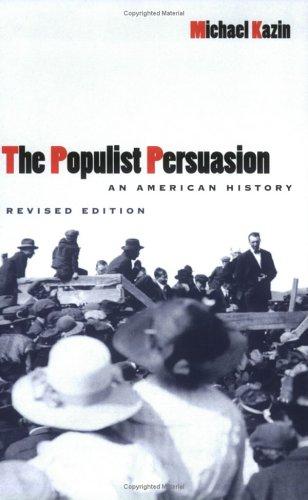
Michael Kazin · Buy on Amazon
"This book is the classic study of US populism. It was published well before populism got a lot of attention again. It really is a history of populism in America, going back to the 19th century and particularly to the so-called People’s Party. One of the things that it argues—which is important to remember today—is that populism has a very long history in the US and is, to a certain extent, part of the political mainstream. Whether it is expressed by specific political actors or not, populism is very much in line with the American understanding of politics, which has to do with the founding myth of “We the People” and a longstanding, deep distrust towards Washington. Yes, it does. On the other hand, what you see in the US is that there’s often a big difference between concrete and general values, and that even applies to politics. For example, Congress traditionally has a very low support rate. I think around 10% of the people think Congress is doing a good job. Yet the vast majority of the people traditionally believe that their representative does a good job. While it is difficult to govern well in Washington, there is a bit of a difference between Washington in the abstract and specific politicians in Washington. What the book also makes clear is that in a country that has, in a sense, a populist culture, it is not always easy to draw a clear line between who is populist and who is not a populist but uses some populist rhetoric. I think that Kazin, in the book, is too broad in what he includes. He has various chapters about progressive movements which I wouldn’t consider populist, even though they speak in the name of the people. It goes back to their interpretation of ‘the people.’ I don’t think it is a homogeneous interpretation of the people, and I don’t think it is moral. Many of these groups spoke for a certain class—the working class—and their discourse was mostly about interests, not about morality or values. Exactly. First of all, that it is very important to see that Trump is an American phenomenon. Yes, there are similarities with the rise of populism in Europe, but Trump is an American phenomenon that stands in a long tradition of American populism. So if we try to explain his success, we shouldn’t just look at the last couple of years or the rise of TV, or social media, or the shift to the right of the GOP. All of those things can play a role, but at the same time, Trump is the latest in a long line of populist politicians. He’s the most successful, because he does it at the national level, but populism has played a role in American politics at least since the late 19th century. I think that is crucial because to understand why something happens, you also have to understand when it happened before. No, and actually Kazin emphasises the progressive roots of populism. Particularly in his interpretation, the People’s Party, the original populists of the late19th century, were a predominately progressive force. He includes a lot of other progressive forces in his study of populism. As I said, I think several of them fundamentally aren’t really populist. But for him, as with quite a few progressive historians here in the US—not all—populism is positive and linked to progressive forces. Support Five Books Five Books interviews are expensive to produce. If you're enjoying this interview, please support us by donating a small amount . He does highlight the shift to right-wing populism that starts in the1960s, in particular with the anti-Communist movement and McCarthyism and the John Birch Society. You could see the Tea Party and Trump in that tradition of right-wing populism that became particularly successful in the 50s and 60s. This is a good segue to the book by Paul Taggart."

Paul Taggart · Buy on Amazon
"Taggart’s book is mostly a historical overview of populism worldwide, but it is full of fantastic, small insights. One of the ones I like the best is (paraphrasing) when he writes that populism is politics for ordinary people by extraordinary leaders. What he shows—and what we also discuss in our book—is that a lot of populist parties are led by people who are in no way descriptively part of the people. “Populism is not about who you are. It is not about class. It is about morals.” Silvio Berlusconi was one of the richest people in Italy. Ross Perot was one of the richest people in the US. Thaksin Shinawatra was one of the richest people in Thailand. In the Netherlands, Pim Fortuyn was a flamboyant gay man leading one of the most homophobic electorates in the country. And the reason for this is that populism is not about who you are. It is not about class. It is about morals. So the idea is that Trump—while being from New York, which is home to the East coast liberal elite—is actually, in terms of his values and his morals, part of the people. Yes. Exactly. Common sense is used by others as well, but it is central in populist discourse. Common sense is partly a critique of ideology and partisanship. It is a fundamentally apolitical term because by and large it argues that there is one solution that is good for everyone and that’s common sense. It also links to anti-intellectualism, which is very strong in the US, but generally also strong among populists. When you have common sense, you don’t need experts, you don’t need academics. We don’t need to think about whether a wall is good; that’s common sense. The other thing that Taggart introduces in his book that’s related to this is the concept of the heartland. The heartland is Middle America, or… The heartland is that subset of the people who are the authentic people. When populists—like Trump—speak about the people, they don’t include everyone. But they’re also not without any definition. So they tend to reference the real America, and that’s the heartland. The heartland is where the real people live, the salt of the earth. They are God-fearing (here in the US), they work for their money, they’re not pretentious, they have common sense, they know what is good, they’re pure. The heartland is a subset of the people, but are also, morally, the definition of all the people. Anyone who’s not in the heartland is not legitimately part of the people. Technically, populism doesn’t have to be xenophobic. Most of its successful representatives are, but if you look, for example, at Podemos or Syriza, at the moment, in Europe, they’re very inclusive towards immigrants. Occupy Wall Street had a strong populist discourse that was inclusive, at least in rhetoric, with regards to ethnic and racial groups even though the movement itself was incredibly white. The heartland is a stereotype. Popular stereotypes always have a kernel of truth, but it is a simplification. So yes, there are people that are exactly as the heartland is described. But many people who live in what is allegedly the heartland do not fit that stereotype. Similarly, many people living on the coasts fit the heartland stereotype better than the coast stereotype. That depends a lot on the country and the role of intellectuals. The US has always been very strongly anti-intellectual in general and particularly on the right. Intellectuals were always part of the elite. In Britain, that wasn’t so much the case. One of the reasons why the populist part of Brexit turned against experts was because experts featured almost exclusively in the ‘Remain’ camp. So they became part of the political struggle. What you see with populists is that often they will be very respectful when they write about a professor. They always indicate that he or she is a professor when they say something that is useful for them. When a professor says that the political system is rotten, they’ll highlight the fact that it is a distinct professor who said that. But when a professor says that it’s bad to leave the EU, then he or she becomes a ‘so-called expert.’ It’s all very opportunistic. This is a newer thing and, in part, about how the experts are both presenting themselves and are being presented. So many of these economists—as well as political scientists—came out in a political way and stated that Brexit was bad, not just for the economy, but for Britain. Then many of the ‘Remain’ groups would roll them out as evidence for their claim, and so that made them politicised. The problem with Taggart’s book is that he never really clearly defines populism. That might be one of the reasons why the book isn’t as influential as it should be. He speaks about six key features, but he doesn’t really say whether populism has all of them or how exactly that works. So it gives you a very good overview of different groups that have been described as populist, but, at the end, you’re still not completely certain what the core of populism is. He brings in the idea of crisis. Populism has pretty much always been linked to crisis. Taggart also links it to being episodic. He argues that populism really only emerges in times of crisis and just as crises are short-term, populism is episodic. It comes up in times of crisis and it disappears as soon as the crisis is over. This is a very powerful idea, which is the basis of Judis’s book."

John Judis · Buy on Amazon
"Yes, and specifically the Great Recession. Because Judis’s book, although it has some historical background, is really very much about the last couple of years. His key argument is that the populist explosion, as he calls it, is a direct consequence of the Great Recession, and so of crisis. The strength of the book is that it’s written by a journalist and, therefore, very accessible. It’s also, therefore, much more simplistic. It makes it more attractive for many readers because it tells a very clear story. But that story— that populism is predominately, if not exclusively, an effect of an economic crisis—is empirically not true. No. there were several very successful populist parties well before the economic crisis like the Front National in France, or the Freedom Party in Austria which, already in the 1990s, got really high percentages of support. Traditionally, right-wing populism does particularly well in countries that are the most affluent in Europe, like Denmark and the Netherlands. The problem is that there are very few concepts as vague as ‘crisis.’ When you look at the Great Recession you can empirically define that as a crisis. Clearly Europe is still in that crisis. But, on a day-to-day basis, while most people in Greece are fundamentally impacted by it, most people in Germany are not. Nonetheless, people in Germany or the Netherlands feel that they are in an economic crisis. It is also a kind of state. This is even worse with political crises. A lot of voters for Trump, for example, felt—and we saw in the polls—that the economy is doing terrible, that we’re going the wrong way, and that we’re in crisis: even though empirically the US is not. People act politically not so much on the basis of actual facts, but of what they think is the truth. In that sense, crisis is important. When people think that there is an economic or a political crisis, they will act accordingly. Not economically, but there are a lot of people in the Netherlands who feel that civilisation is in crisis because we are being threatened by global Islam and by European integration. They feel that it is a crisis because things are changing fundamentally for the worse and there’s a matter of urgency. That is what crisis does, and that’s what, for example, a lot of people on the right, including Trump but also others, were pushing all the time. This idea that this was the last election, that if Clinton won, it would be over forever. That’s the idea of crisis. It’s now or never. I don’t think that it helps to be reactive. In our discourse we’re always trying to convince people—who say that we are in a crisis and that Muslims are going to kill us, or that there’s a big conspiracy of east Cost elites—with our numbers or our rational arguments. We say, ‘Well, that’s not the case.’ The only way to get out of it is, first of all, to realise that in most countries the vast majority of people don’t believe that we’re in crisis, and to present a positive and effective programme. Let’s just take the US, because it’s the most pronounced example. A large portion of people who voted for Trump voted for the party they always support. They didn’t support a populist, necessarily. They had no choice but to vote for a populist, but they would have voted for Cruz or Rubio had he been the candidate for the Republican Party. While populism is important, we shouldn’t act as if it is the only game in town. Trump didn’t get the majority of the popular vote. Almost 3 million more people voted for a positive programme with regard to, particularly, multiculturalism, and, to a certain extent, politics, than for Trump’s populist version. There’s a certain group that has been excluded, which is largely white working class. A part of that you can get back by having better redistributive politics. Other parts you won’t get back because they’re Islamophobic or racist. The only way to get them back is by becoming Islamophobic or racist, and that is not the role of liberal democratic parties. It plays a role, but we’re talking, in the vast majority of cases, about a radical, right-wing populism. Left-wing populism is relatively minor. The economic anxiety is translated in a social-cultural way. It is translated, in American terms, racially. It is that racial translation that is essential because if it’s only about economic anxiety, then it would have been almost random whether you voted for Bernie Sanders or Donald Trump. Both took on moving jobs abroad, globalisation, etc. But very few voters went from Sanders over to Trump because of that racialized vision of economic anxiety. If you take away the economic anxiety, there’s a large portion of people who are not going to vote for these parties anymore. But others will still vote for them. There are a lot of people voting for Geert Wilders in the Netherlands, or Marine Le Pen, or for Donald Trump, who are affluent. But they’re still terrified about the Muslims. It’s the easiest introduction to the topic. It does so through a bit of an oversimplified lens, but it still provides a lot of good information. Yes. And left and right. It talks about the Netherlands and about France, as well as Spain and Greece. That’s particularly important because those are the two cases of left-wing populism that are successful. I think those cases are much better explained by the Great Recession than Front National and other far-right populist groups."

Jan-Werner Müller · Buy on Amazon
"This book combines Judis and Canovan in the sense that it’s political philosophy but it’s much more accessible than Canovan. It does a great job discussing the tensions between populism and democracy, and emphasizing the role of populism in highlighting problems that exist within democracy. Mueller is particularly negative towards populism, which he sees almost exclusively as right-wing. He doesn’t think Podemos or Syriza or Occupy Wall Street were populist. Against pretty much everyone else, Mueller doesn’t think that the People’s Party of the late 19th century—which is the foundation of Kazin’s study—was populist. For Jan-Werner, democracy is, by definition, liberal democratic. He argues that free and fair elections, free media, and an independent judiciary are fundamental aspects of any democracy. He argues that populism is against those independent spaces within a political system. I, personally, agree with his discussion of the tension between populism and democracy even though I have slightly different interpretations of both populism and of democracy. I think the tensions that he highlights are very much at the crux of the challenge that populism presents to what I call liberal democracy and what he calls democracy in general. He argues that democracy is based on pluralism, on the idea that there are different groups in society which all have a legitimate claim to power. I and some others would argue that that is specific to liberal democracy. Where Jan-Werner and I agree is that populism is fundamentally monist. It is fundamentally against pluralism and considers other actors as special interests that are non-legitimate. They’re traitors, they’re corrupt. Exactly. Where Jan-Werner also does a great job is showing that this idea that many people have, which is very comforting, that populists cannot rule, is empirically untrue. This idea is that because populism is essentially an anti-establishment position, as soon as a populist becomes the establishment, they’re destined to fall apart. But we actually know various cases of populists in power that are successful. They invent a new elite. You see that with Victor Orbán, the prime minister in Hungary. He says, ‘I’m the legitimate voice of the people.’ But there are some shadowy elites here—former social democrats, for example—who are conniving to undermine the people (read Orbán), together with the European Union. I think it has more to do with his understanding of democracy. Because, for him, democracy is the same as liberal democracy, populism goes to the core. The other thing is that some of the groups that many liberals and progressives would perceive as at least having good intentions—if not necessarily actions—like Podemos and Syriza, Jan-Werner doesn’t see as populist. So he really has virtually no group that has done relatively positive things that are populist. Populists, in terms of their fundamental view of society, see a corrupt elite versus the pure people. But the type of politics they want is based on the general will of the people. The reason why this is important is that populists believe that, fundamentally, “the people” share values and interests. Consequently, you can have politics that are good for everyone. That is what they sell. That is, of course, much more attractive than politicians who are honest and say, ‘This particular measure benefits this group, or, at the very least, benefits this group more than another.’ Think about environmental policy. Assuming that we all believe in global warming, then we all profit from politics that go against it because otherwise we all die. But the consequences of those environmental policies will be less painful for some people than for others. Say energy becomes more expensive. In relative terms, poor people will be harder hit than billionaires —because that’s how the world works. It’s complex and there are no policies that are equally good for everyone. There are always some people, even if it’s a small group, that either don’t profit or profit much less. Yes, although it’s much more complex than the aspect that is highlighted here. He argued that people are not just a collection of individuals, they’re actually also a kind of a unitary actor, and so they are one. There are many. Even Rousseau himself would disagree with certain parts. But most liberal and conservative thinkers, incuding John Rawls and Edmund Burke, would argue that the people are heterogeneous and that there are different interests and different values."
The Far Right (2019)
Scraped from fivebooks.com (2019-12-09).
Source: fivebooks.com

Hans-Georg Betz · Buy on Amazon
"We’re talking about the radical right as if it only started recently. Much of the analysis is linked to Trump, as if everything just began with him and with Brexit . And yet, here is a book that’s 25 years old that already describes a Front National in France and an FPÖ in Austria that are gaining around 15% of the vote. This book is a good reminder of how old the phenomenon is. More importantly, this book—which I believe is the best book ever written on the topic—started the modern study of the radical right, particularly in political science. Until Betz’s book, almost all the work written on radical right parties and politics was quasi-historical. It treated them as neo-fascist and looked at what they had in common with the former fascists. Betz looked at them as a new party. He approached them not from the viewpoint of the fascists of the 1930s, but of the green parties of the 1980s. He said, ‘Okay, to understand the rise of the far right, we shouldn’t look at the Second World War, but at developments in society that have given space to new parties—with the greens on the left and the far right on the right.’ Get the weekly Five Books newsletter This was a much more distant and neutral academic approach to the far right, which massively increased our insight, because for a long time it had been very hard to understand how a party that was seen as the modern version of Hitler could win 15% of the vote. How could 15% of the French support the Holocaust ? Because that would be the logic of seeing the far right as neo-fascist. So seeing the far right as a new group of parties that, to a large extent, acted the same as other types of contemporary parties—rather than the fascist parties of the 1920s, 30s—massively changed our view. The book also introduces a few important themes. It was one of the first to speak about populism and the politics of resentment. He focused on the resentment that people who voted for these parties felt. It was a protest, a frustration over immigrants coming in. It was connected to immigration, but these weren’t the old-school racist ideas. So the book is foundational in that way as well. Yes, and actually one of the weaknesses of Betz’s study is that it focuses only on the countries where the far right was successful. Almost all of these countries were the wealthiest ones, with the best functioning economies and the lowest unemployment rates—like Austria, Denmark and Norway. France would be one of the outliers, but even France wasn’t doing too badly at that time. He identifies two subtypes and distinguishes between neoliberal populism and national populism. The neoliberal populists are the progress parties of Denmark and Norway. They are against the establishment, but mostly they’re against the welfare state. The national populists—what we normally call the radical right—are the ones who are against the establishment but, moreover, against immigration. This distinction is still relevant today. I personally exclude neoliberal populists from the radical right because nativism isn’t central to them. But other scholars still include these types of parties. What we find in many studies is that they’re just different types of parties. They have different electorates and they act differently in government. And so Betz already notes that. “When people are frustrated, they like to see someone rattle the establishment.” The other way in which Betz is foundational is that he is the first to see what he calls a ‘proletarianization’ of the electorates of national populist parties. The old school interpretation of the far-right voter is that it’s small, independent business owners, farmers etc. Betz notices in the 1990s that particularly the Front National and the FPÖ are getting increasingly working class electorates. As a consequence, the parties also shift to more centrist, pro-welfare state politics. So the far right parties follow their electorate. Initially they were more pro-market, pro-small business, but as their electorate becomes more working class, they start to adopt welfare chauvinism, where you support the welfare state but only for your “own people”. All of these things are still highly relevant today. The electorates are now so big that by definition the working class can only be a small part of it. The people’s parties have moved towards more cross-class coalitions. The working class is still disproportionately represented within the electorate, but it’s only a minority. For many parties only about a third of its electorate is working class. It’s almost comical to read that, given how small these parties were then, compared to now, and yet how alarmed he was about them. That’s something I touch upon in my own book as part of the mainstreaming. We’re now happy when a far-right party wins only one third of the vote. In the 1990s, we were in the streets when they won seven per cent. But I think that position plays very little role in the book as a whole. It bumped up the sexiness of the topic, but throughout the book he is very clear that this is not a modern fascism. The threat is different and the circumstances are different."

Matthew Goodwin & Robert Ford · Buy on Amazon
"For me, there are two reasons why this is a really good book for a general audience. First, it’s an excellent summary of the key insights of 25 years of social science research on the radical right. They pull everything together just perfectly. It’s also a great example of a solid academic study that draws on both theory and data and addresses a highly topical issue in a very accessible way. It sold more than virtually any political science book—I heard around 8,000 copies, which is massive for political science—and I think it did so because it’s very well written. It’s not dumbed down, it’s still solid, but it’s understandable. The book puts the rise of a party, UKIP, into the much broader context of what they call a ‘revolt’ on the right. As a consequence, the book goes beyond UKIP and also provides a good insight into why Brexit could happen, because it’s part of that same thing. The revolt has consequences like UKIP, but it also pushes the Tories to the right and creates someone like Boris Johnson. So that, I think, is the strength of the book. It shows this societal change of which UKIP is more a consequence than a cause. It’s a broader revolt than that and is also about populism . There’s dissatisfaction with both political parties, of not taking care of key issues, of looking the same. Labour had become New Labour. Both parties had converged on the centre and certain issues were no longer really divisive. Both parties agreed on European integration, for example. Both parties agreed on immigration, to a certain extent. It’s a type of politics that clearly favours one type of Britain, which is to a large extent London. It’s an integrated city—in terms of ethnicity, in terms of Europe and also economically. The authors describe a large group of people who feel abandoned, who feel what they call ‘left behind.’ Now, I have a bit of a problem with that specific term. It’s a longstanding argument about what we refer to in the literature as the so-called ‘losers of modernization/globalization.’ It’s the idea that there’s a process of globalization that has created winners and losers. That is in itself true, however, it’s not an objective category. Whether you’re a winner or a loser is partly how you self-define. There are actually a lot of people who have objectively won from modernization, but who feel that they have lost. The state has invested a lot in them or in their towns, but they feel they’ve been left behind. So it is somewhat true that people who feel that they are losers of globalization will support the radical right more than others, but it’s a very vague category. “There’s a lot of money in the far right. Some in this subculture are believers, others are just people who want to make money out of it.” The other problem I have with the term is that it creates this idea that there are two groups, the winners and the losers who have been left behind. But actually there’s a third group, which has always been left behind. The current left behind are the white working class, the people who under industrialization were doing well. Now everyone else has gone further and they have stagnated. But under them is a third category, which is predominantly non-white, that no one ever cared about. They’re left out of that book. When ‘left behind’ becomes a normative category—as in the discourse of David Goodhart , for example, with his ‘somewheres’ and ‘anywheres’—then the poorest people are not even mentioned. That’s how poor they are. They are often immigrants who never had a steady position with protection."

Ruth Wodak · Buy on Amazon
"That’s a good segue to Ruth Wodak, because that’s one of the strengths of her book, The Politics of Fear: What Right-Wing Populist Discourses Mean. Most early studies of the far right and radical right parties focused on explaining the demand side. Why would anyone want to vote for them? Most of the explanations tended to be deterministic: it’s because of immigration or it’s because of unemployment or it’s because they’ve always been fascist. These explanations assumed that whatever the radical right offered was irrelevant. So it didn’t matter whether you had a charismatic leader or a monkey as a leader, the result would be the same. Obviously that is not the case. There’s a reason why Nigel Farage is successful and Nick Griffin, who lead the British National Party, wasn’t. It’s about what he offers. UKIP is more moderate and Farage is from a different class. He’s more successful, he’s smoother in his propaganda. Ruth Wodak is one of the most prominent discourse scholars. Discourse is about looking at propaganda in its political context. For example, one of the old slogans of the Flemish Bloc (VB) was “500,000 unemployed: why then guest workers?” If you take that literally, it’s just a question. If you take it in its political context, it’s an anti-immigration sentiment. Support Five Books Five Books interviews are expensive to produce. If you're enjoying this interview, please support us by donating a small amount . She shows that what radical right parties do is transgress norms and break political taboos. That’s the populism part and it’s very attractive. When people are frustrated, they like to see someone rattle the establishment. There’s also an element of fearlessness in it. Look at these people, who dare to go where we all want to go! There are a lot of people who would love to go out in the open and make racist or sexist statements, but they don’t want to pay the social cost. They admire the person who does. That’s the taboo-breaking. That’s what Trump does the whole time. He’s saying, ‘I don’t care about these things.’ Many people would love to be like that. The Front National had the perfect slogan in the 90s, “We say what you think.” It’s not that we’re smarter, we’re exactly like you, but we fight your fight for you, because we know the social cost you have to pay and we’re willing to do that for you. So Wodak shows that, on the one hand, you have the transgression of norms. On the other hand, you have the scapegoating and the politics of fear. Why would you vote for parties that scapegoat? Because they give you an explanation of why your life is bad. It’s not because you didn’t move from your area that no longer has jobs, or because you didn’t finish your education. Or something else complex, like the fact the economy has changed and your job is no longer needed. No, it’s because of immigrants. What immigrants do is give a very clear explanation of why things are going badly, and externalize guilt. The focus on immigrants also creates an in-group and an out-group. It’s not just you, an isolated individual. No, you’re part of a powerful nation that fights this out-group. And because of the politics of fear, you create a sense of urgency. We are being invaded. That makes you scared, and makes you look for radical solutions. We have to act now! The regular boundaries can’t be upheld, strong action is required. That’s where the far right gets in. A large part of the populist discourse in general, but the far right discourse in particular, is about creating a sense of crisis. Once there is a crisis, you have salience, you have urgency. The mainstream has failed; you need to look for someone outside of the usual. This far right party is kind of out there, but this is a crisis! Normally what they say goes too far, and I’ll stick with the Conservatives. But right now we need someone who really breaks it open, so I’ll vote for Nigel Farage. What I like particularly about the book is that she walks you through the examples. It isn’t just abstract. It’s almost like the book has exercises—and so it’s incredibly useful for education. In think tanks or NGOS or schools, you can use this book. You can either read it as the teacher or, if students are more advanced, tell them to read it and then take, for example, a Brexit party poster or a flyer or speech by Boris Johnson and say ‘okay, in what way does this do the same and in what way doesn’t it?’ The book is really empowering. It really makes you understand the mechanism of it rather than just describing it. Totally. She emphasizes two parts of the supply side of the far right. On the one hand, the internal supply side, which is what the far right offers. There’s also the external part, which is what others offer, and particularly what the media do. She shows how the media today—which has changed significantly and has become much more commercial—facilitates the rise of people like Haider or Farage. They are charismatic or mediagenic leaders, and are almost like a drug to the media. They just can’t resist them because they sell. They provide the type of scandalous quote that the media crave. What is important here is that the far right is not just passive: it’s part of its own success or failure. Haider was successful because the media was now open to someone like him. Britain has a specifically problematic media structure, and the media had been open to someone like Farage for quite a long time. But what it got was Nick Griffin, and groups like the EDL. There had to be the supply as well and then, when it all comes together, it’s powerful. So the media play a massively important role, but it’s complex. The media is seldom truly a friend of the far right. In the UK we had the Daily Express , which for a while was pretty much the UKIP newspaper, but in most cases newspapers push the issues and the frames of the far right, but are negative towards the far right itself. That can still help the far right, because as long as you talk about immigration as a threat, it doesn’t matter much if you say the far right parties are bad. If they’re the only ones talking about immigration as a threat, it will win them support."

Cynthia Miller-Idriss · Buy on Amazon
"Cynthia Miller-Idriss is a sociologist who focuses on education and on the youth. Both are very relevant to any politics and particularly the far right. We know that by and large our political attitudes are formed in our early 20s, and yet the youth are virtually never studied by anyone. This makes the book highly original, which is incredibly hard, because there are so many books and articles about the far right. The book focuses on fashion, which is very close to identity, and far right subculture. We have very few studies on this, and those that we do focus almost exclusively on Nazi skinheads, which were largely a 1980s/early 1990s phenomenon. Nowadays, there is a very broad variety of far-right subcultures and what she shows is that they mainstream that culture. That’s partly because far right themes are now part of the mainstream. So if you are in a suit or some other kind of acceptable outfit, you can fit part of what you believe into that and blend in while still stand out to those in the know. So whereas in the 1980s as soon as you said ‘immigration’ everyone would be shocked, nowadays as long as you don’t Sieg Heil openly you’re just being provocative. “The book is really empowering. It really makes you understand the mechanism of it rather than just describing it.” What she shows is the importance of symbols in subcultures and what I find particularly interesting is that the symbols are constantly changing. We still think of far right symbols as swastikas and perhaps the Celtic cross. But nowadays you have many different ones and the symbols have different functions. On the one hand, you have to avoid the law, which particularly in Germany is very strict. It’s a cat and mouse game. You’re trying to make a symbol that signals to those in the in-crowd ‘I’m far right,’ but isn’t recognizable by the state. It’s fashion too. This is the very visual culture that we’re in today, the meme culture, and the far right is part of that game. The style has just changed significantly. Everyone can recognize a Nazi skinhead, but we will walk past people who are dressed as far right on a day-to-day basis and not recognize them. This is not unique. It’s what football hooligans already did in the 1990s. They have all kinds of expensive brands—like Stone Island—that look normal and are normal. They allow someone in the hooligan subculture to directly recognize who is a hooligan, whereas your average policeman won’t. She’s not such a big fan of that term, because the media is obsessed with it. The Nazi hipsters, the Identitarian movement, get an insane amount of attention. What she is trying to show is how pervasive this culture is within certain circles. She focuses on vocational training schools in Germany. She interviews several of the students. Only some are in the scene, but almost everyone knows about it. They all recognize it, even though their teachers have no clue what is happening. Some of these brands are very expensive. Some you can only get through far-right online stores, but others, like Thor Steinar, have boutique stores. I was in Prague a few years ago and I walked past a very small high-end shopping mall, on one of the most expensive shopping streets. I was just flabbergasted to see a Thor Steinar store there. Two years later it was still there, so they must be doing good business because rents on that street are high. That’s the other part that’s interesting about this book. There’s a lot of money in the far right. Some in this subculture are believers, others are just people who want to make money out of it. I fully agree. Over the weekend our local student newspaper had photos taken before a big football game. There’s this rivalry between Georgia and Florida and all the students meet at the beach. There was a picture of a hunky guy with a girl and he had a tattoo on his left shoulder. It was the symbol of the Three Percenters, which is a far-right militia. The editors of the newspaper didn’t pick up on it, because it’s not a swastika. It reminded me how illiterate the media—but also teachers and law enforcement—are about the ever-shifting symbols of the far right. What Cynthia shows is how important those symbols are as signifiers and signallers within the community. As academics, we spend too little time on them, because we tend to study texts and difficult ideological things. Kids are not busy with that. Few neo-Nazis read Mein Kampf, but all love the Nazi flag. It’s hard. It’s strong. In the street, you’re not going to go around with a swastika because you’ll get pulled over, but instead we have these other markers that still have to look awesome, but are in the grey zone. That insight is important, particularly because what this book shows is that we’re dealing with a different far right. The far right parties are no longer small groups pushing from the outside. Far right supporters are no longer just working class white males. Increasingly, they’re Trump supporters. They’re at my college. They’re groups like Turning Point USA, rich white kids, who are well-educated and well-dressed and who are supporting the far right. We haven’t made that transition yet. When you see a picture of a far right rally in a newspaper, you still see the one skinhead who was at that meeting, because that’s what we think a far-right person is. As long as we do that, as long as we associate the far right with the symbols of yesteryear, we miss what she calls the mainstreaming of these very extreme right views. In her case, the young people she studies are not even radical right: they are pretty much neo-Nazis."

Chip Berlet & Matthew N. Lyons · Buy on Amazon
"I was a bit conflicted which book to choose. Since Trump there has been an explosion of new books on the far right in the US. Before that, there was virtually nothing, except some work in the 1960s, which was mostly about the John Birch Society and anti-communism. I’ve chosen Berlet and Lyons for a variety of reasons, but the most important is that it shows the long history of the far right in the United States. The far right didn’t start with Trump. They show this in a quasi-historical way. The authors are activist researchers rather than academics, but they use a very solid conceptual framework. They talk about conspiracism and the importance of conspiracy theories, which is very important, particularly in the US. They talk about demonization and scapegoating, something that Wodak also focuses on. Then they have a specific term, that is mostly used here in the US, which is producerism. I really like that concept. It’s a combination of nativism and populism. In producerism, you consider yourself part of the producing class, the people who create stuff. They’re squeezed from above by the bankers and the elites, who are mooching off their work, but they’re also squeezed from below by immigrants and non-whites who live off their work through the welfare state. What they show in the book is that while the far right never really had a successful party or politician at the federal level, they’ve always been around. As the subtitle suggests, they’ve always been “too close for comfort” to the mainstream right. There have always been these types of groups around the Republican Party and they have been very important at the state level in certain parts of the country: in the South, in Arizona, Mississippi and others. It’s one scene. Guns are so pervasive and so massively popular that there’s no distinguishing between the mainstream right and the radical right. What the US has had, which no other country has, is a separate tradition of an anti-government right which is heavily weaponized. Traditionally, the far right believes in the state. It wants a strong, central state to push things through. Here in the US, you have the anti-government militias and sovereign citizens who believe that the local level is the highest legitimate level. They distrust the federal government and this is one of the reasons why they have their guns: to protect themselves from the government. That comes out of the whole frontier mentality and the specific history of the US. “It’s just like old Marxism, with its false consciousness. Before people were misdirected through religion, now they’re misdirected through racism.” It’s relevant because the militia scene has always been alive. At the moment, we have a lot of different new militias—like the Three Percenters or The Oath Keepers. Right now, they’re kind of in an identity crisis, because traditionally they’re anti-government, particularly the federal government, but they love Trump. So now they’re with Trump but against the ‘deep state.’ They claim not to be racist and at times they even have one non-white person, but they tend to protect neo-Nazis and side only with radical right, nativist forces. But guns are a key aspect. Guns make a group of three people in the US potentially dangerous, which in Europe they’re not. Here you can get semi-automatics. I only have to drive five minutes to buy semi-automatic weapons in a shop, perfectly legally. Partly. It’s a very left wing statement, to which I’m sympathetic. But I don’t think all the supporters of the far right are necessarily the downtrodden. I believe there is a part of the far right which is white people who are in economic trouble and, rather than blaming neoliberalism, they blame immigrants. Those people are in line with what Berlet and Lyons argue. But there is a significant part of the far right that is very well off and well-educated. They’re not a victim of anything. They’re not misguided. They’re just racist or white supremacist. This is my problem with the ‘left behind’ rhetoric as well. It’s partly true, although even if you’re not that educated and you’re in financial trouble, it doesn’t necessarily mean you have no choice other than to become far right or racist. There are a lot of people who are less educated and in economically dire situations who feel solidarity with their non-white, fellow workers. So that’s what I don’t like. I think it comes out of the left’s tendency to see the far-right voter as an economic anxiety voter, a misguided worker. It’s just like old Marxism , with its false consciousness. Before people were misdirected through religion, now they’re misdirected through racism. It’s only a part of that electorate and I don’t necessarily even believe it’s the most important part. We haven’t talked about gender, which comes up in some of the books, most explicitly in Wodak. Yes, it’s probably the most original chapter in the book. To me gender is crucial, also because it shows the complexity of the contemporary far right. The contemporary far right is not just one type of movement—not in terms of ideology, not in types of organization nor in types of activity. We still have the classic, bullish, masculine leader like Trump or Bolsonaro, and we have, to a certain extent, the more classic female leader, like Sarah Palin or Pauline Hanson, who play to the ‘mother of the nation’ stereotype. But then you also have Marine Le Pen who is clearly a very successful, professional woman who is not playing that stereotype. She pushes boundaries, but not too many. We also have more modern men as leaders who are not particularly masculine or violent, like Jimmie Åkesson and others. What it shows to me is that, first and foremost, the far right is a product of the national context. Yes, there are some things that are happening more broadly, but if you want to understand why Bolsonara won, you first have to look at Brazilian politics before you look at the Dutch far right. Overall, in the national context, the far right always holds relatively conservative views on gender. However, what is conservative in the Netherlands is progressive in Brazil and so you can’t expect the same type of discourse and leader. Bolsonaro would never be successful in the Netherlands, but then Pim Fortuyn would never have been successful in Brazil or the US. Gender shows this diversity that you have in the far right, as well as the transition. The far right today is different. It allows for different kinds of people. It shows just how adaptable the far right is, which is one of the reasons why they have been around for about four decades now and why they will be around even when things change. This is not just stupid people who beat up other people. There are very smart people in it, there are zealots in it, and there are opportunists in it, men and women who make the most out of the opportunities. Men are still predominant, as they are in virtually every other political movement, but there are a growing group of women that are participating. That doesn’t necessarily mean that they are feminists. Many of these women are in it for exactly the same reason as the men, they feel that Muslims are threatening their nation. Their activism tends to be more prominent in northern European countries, which overall are more emancipated than southern European countries. Get the weekly Five Books newsletter It’s still largely a male and masculine world because masculinity plays an important role, but much less so in certain countries than in others. It’s not the 1930s. Women are not just babymakers for the nation. For every radical right group, they are still that, but there are also many on the radical right who are perfectly fine with women working outside of the household, with having careers, with being successful (as long as they take a few years off to provide babies for the nation). There’s a lot of media attention at the moment because there is so much going on. I hope my book will be around for at least 10 years, but that the far right will be less prominent by then, and that I can update it in time, because this is not about something that’s just happening now. It’s about a phenomenon that has been around for decades and will be around for decades. My book is just an introduction."