Carole Hillenbrand's Reading List
Carole Hillenbrand is Professor Emerita of Islamic History at the University of Edinburgh and Professorial Fellow of Islamic History at the University of St Andrews. In 2005 she was awarded the King Faisal Prize for Islamic Studies, the first non-Muslim to be awarded this prize.
Open in WellRead Daily app →The Best History Books: the 2018 Wolfson Prize shortlist (2018)
Scraped from fivebooks.com (2018-08-31).
Source: fivebooks.com

Robert Bickers · Buy on Amazon
"Most people don’t know much about it and, in view of the importance of China today, it’s a matter of some urgency that we learn about it. I think Out of China is a very ambitious and grandiose study of imperialism and anti-imperialism, and of the new nationalism in 20th century China. The narrative is very animated. At the same time, it’s very scholarly and well researched. It uses archival material from China as well as Britain and the US. The whole impression one gets is of clarity and depth of knowledge on the part of the author. “For me, the book helped me to understand modern China a lot better” The basic overarching theme is why China wanted rid of imperialist outsiders. I must confess to learning a lot about what happened in the 19th century, with the Opium Wars , and China and the Western powers, especially Britain, fighting over the question of commercial rights in China. These treaties that were drawn up between China on the one hand—and Britain, France, and Russia, and the US on the other—opened up a group of Chinese ports to the foreigners and, at the same time, legalised opium traffic. Shanghai, for example, became a British enclave. These treaties established a strong Western influence in China and helped to stir up Chinese nationalist sentiments, as far as I’ve seen from the book. But I was also intrigued to see that some aspects of European life were retained by the Chinese, such as the Boy Scouts movement, which they rendered more ‘Chinese.’ For me, the book helped me to understand modern China a lot better. It’s such an important country. And we have so many Chinese postgraduates coming to Europe and the United States to study with us. They obviously recognise the importance of English as the global language, but we should also have enough people who are learning Chinese."

Lindsey Fitzharris · Buy on Amazon
"If you like that kind of thing! This book is not for the squeamish. It’s rather visceral. It’s about Victorian surgery and it’s fascinating. I’m very intrigued and interested in learning about the history of surgery, and especially about Joseph Lister, the father of antiseptic. He was a real pioneer, working on the margins between science and medicine, and doing wonderful things to move us on. These early surgeons were operating on the dividing line between life and death—and mostly death, it would appear. This young scholar has a very lively style. She has used a lot of primary material, and made the work accessible, perhaps too accessible at times, for the general reader. Absolutely, but that isn’t the only thing that they’ve got to do, because they also have to be significant. You can be really keen on something which is of rather narrow interest to most people. It doesn’t mean that you’re not doing something worthwhile, if you do actually write such a book. But the Wolfson is about giving the possibility to large numbers of people to read very, very worthwhile historical books. Simply the courage and determination of scientists to take risks, to work on the margins, and to discover life-saving information from which we benefit today. Many of us wouldn’t be around, if Joseph Lister hadn’t been around and antiseptics hadn’t been discovered. It can’t possibly be regarded as abstruse, esoteric information. It’s bang in the middle of what keeps us alive. Oh my goodness me, absolutely. Look at the Crimean War and how many people died—not on the battlefield, but from their septic wounds."

Tim Grady · Buy on Amazon
"This book was such a surprise. I don’t think many people would expect, given the horrendous activities of the Germans towards Jews in the Holocaust , that there was a previous generation of Jews who actually fought for Germany during the Great War. Thousands of Jewish soldiers were killed in World War I, as this book tells us. I was totally amazed by that. It’s a very brave book I think, also. Because it’s going to surprise people that there was a generation or two before Hitler, where Jews were proud to be German, and not persecuted in such a terrible manner. I think it is a brilliant book, which presents a new view of the German Jewish community during the First World War. Get the weekly Five Books newsletter I was also surprised at what light is shed on the diversity of Jewish experience. However, the book also makes it clear that things did disintegrate as time went on. Nevertheless, there was this period in World War I, where Jews were awarded for bravery, and died in battle, on behalf of Germany. That appealed to me too. It was the first thing I noticed when I flicked through the book. Yes, this book well deserved its place on the shortlist. As do all the other five."
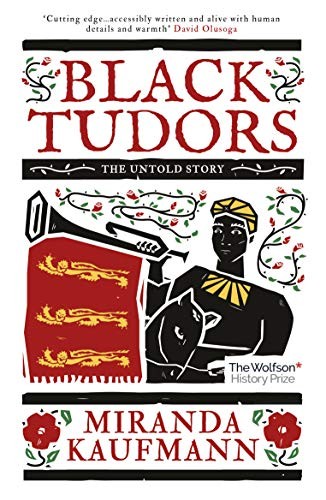
Miranda Kaufmann · Buy on Amazon
"It’s a very interesting book. The author, Miranda Kaufmann, found evidence, in the National Archives in London, of the presence of 360 black people, in the period 1500 to 1540, who lived in England. She chooses ten of these individuals and writes biographies of them. They’re ten very diverse individuals, and she writes about their lives in a very interesting way. The anecdotes are quite startling at times. She writes the biography of a Moroccan woman, who gets baptised as a Christian in a London church. There’s a story about a black porter who is asked, in a posh Englishman’s manor house, to whip a white Englishman. How that came about is rather extraordinary. The book really does uncover a previously neglected area of English history. When we think of black people in Britain historically, we automatically think of slaves. This preconception has to be slightly modified, I think. Yes. That’s what she’s arguing, certainly. They’re quite interesting people. One of them is a servant. One of them is a prostitute. She’s chosen 10 very different types of jobs for the people selected. She says that it was just part of life in Elizabethan times, with all the navigation that went on. One of them had sailed with Francis Drake. It was just part and parcel of life—at least that’s the impression I got."

Peter Marshall · Buy on Amazon
"I don’t blame you for asking that question, because we think we know it all, don’t we? And I suppose, in a sense, we all have our views about the Reformation. This is a book that I regard as excellent in terms of both scholarship and readability. It’s deep, it’s got gravitas, and yet it’s written in a very pleasing and lively style. In particular, Marshall talks about Henry VIII and the scale of social disruption he caused, when changing England from a Catholic to a Protestant country. Marshall’s book tells the familiar story again, but he talks not just about religion changing but also about how ordinary people felt and what their involvement was. It’s much more about people, as well as doctrine. So, the Reformation isn’t just an affair of state. The population of England suffered greatly. He emphasises this point. It was a bloody process. 10,000 men died in 1549. Marshall points out that that was a huge proportion of the English population at the time. He argues convincingly that the Reformation was not just religious—though of course that was the theme that was trumpeted at the time—but it also involved a nation deeply divided and, as a result of different views of religion, radicalised. You’re absolutely right. It’s well worth the reading. It’s as I said, very, very nicely written, and he’s a master of the material, definitely. And anything to do with Henry VIII, we love, don’t we? Oh, but he was so clever, intellectually. At least, this is the profile that he is given in history books. It’s not my field, so I’d better shut up!"

Jan Rüger · Buy on Amazon
"Yes. He talks about the island being a metaphor for Anglo-German rivalry. And what a turbulent fate this little rocky island in the North Frisian islands had! They spoke a language very few people know about, called Heligolandisch. It was probably a branch of Frisian. You can’t get much more remote than that, and to use the fate of this little island as a lens to look at Anglo-German relations is very bold, I think. And it works. It’s a serious work of scholarship, using primary sources, and very accessible. It was really fascinating. I learned all sorts of facts that I hadn’t heard before. For example, that Britain handed over Heligoland to Germany in 1890, in exchange for Zanzibar. It’s an extraordinary exchange. Certainly Zanzibar would have been a lot warmer, but quite apart from that, the people of Heligoland didn’t have much to say about it. They were just pawns in the game, weren’t they? It was a battle site, a point of issue in both World Wars. Also, I was horrified to read that in 1947 British forces set off the largest non-nuclear explosion in history there. So, a long tradition of rivalry between England and Germany comes to an end in the debris of what remains of Hitler’s island fortress. It’s a very unusual book. Again, it shows us the way in which a really good piece of scholarship can be made fascinating with primary sources, accessible to the ‘ordinary’ reader, and also be something that can be broadened into significance of a wider nature. Not just that, it’s mentioned in 5 am weather forecasts on Radio 4, if you’re up that early. I gather that it’s quite a popular tourist place now."
The Best History Books: the 2022 Wolfson Prize Shortlist (2022)
Scraped from fivebooks.com (2022-05-11).
Source: fivebooks.com

Marc David Baer · Buy on Amazon
"This is a very interesting book. The Ottoman Turks were a very long-lasting and important dynasty, who ruled for seven centuries. And the book unfolds a sweeping narrative stressing the importance of the Ottoman dynasty, both in relation to Middle Eastern countries, but also its role in European history. For many Europeans for about half a millennium, the Ottomans represented the exotic, dangerous and non-Christian Orient. They were the enemy to fear. The book draws out six key moments in Ottoman history as important. First, the foundation of the Ottoman state at the end of the 13th century, in northwest Anatolia, by the Turkoman tribal leader, Osman I, who gave his name to the dynasty. Second, the Ottoman conquest of the Balkans after 1354, which transformed the Ottoman state into a trans-continental empire. Third, the Ottoman conquest of Constantinople in 1453 by Mehmet the Conqueror, which ended the Byzantine Empire. Fourth, the reign of Suleiman the Magnificent from 1522-1566, which marked the peak of power of the Ottoman Empire . Then there is the siege of Vienna, in 1683, which ended in Ottoman defeat by the Habsburg Holy Roman Emperor Leopold I. That marked the beginning of the end of the Ottoman domination in Eastern Europe. Finally there is the successful Turkish War of Independence led by Mustafa Kemal Atatürk, which brought about the Republic of Turkey in 1923, and the abolition of the Ottoman monarchy. Get the weekly Five Books newsletter Ottoman tentacles stretched everywhere, not just politically, but also commercially. They controlled major trade routes by land and sea. This book delves deep into primary and secondary historical sources, but it is written very clearly and accessibly and will be accessible to general readers as well as scholars and students. He has a very global perspective. There is not an awful lot about what is going on domestically with the Ottomans. It is more about what they are doing abroad. It is about the Ottomans being a great colonial power, wanting to get more lands."

Malcolm Gaskill · Buy on Amazon
"The narrative of this book centres on the frontier town of Springfield, Massachusetts, in 1651, when there were rumours of witches and heretics, and the community became ensnared in a web of spite, distrust and denunciation. This was the beginning of colonial America, where newly arrived English settlers’ dreams of love and liberty could give way to paranoia and terror, enmity and rage. Gaskill uses previously unexamined sources to tell the tragic story of one family, and through it, to expose an entire society in agonised transition between supernatural obsessions and the coming of a more enlightened age. Gaskill has written several books on witchcraft, but this one is a little different. He focuses on one specific episode 370 years ago to teach broader lessons about superstition, mental illness and human cruelty. He examines the misery of the isolation endured by pioneers far from home, trapped in an alien and frightening environment. The book is beautifully and clearly written and it has received great reviews. I was quite surprised to find that I was interested in witches after reading it."

Clare Jackson · Buy on Amazon
"It is a highly original account of perhaps the most turbulent, and radical era of English history—if I can be that daring. It tells the story of a nation in a state of near-continual crisis and it will change our views of the 17th century. It is also extremely well written. It provides fresh insights by looking at England through European eyes. The author emphasizes that foreigners called England ‘devil-land’, a diabolical country, seriously damaged by religious extremism, royal collapse, civil war, and what I would describe as rabble-rousing disturbances. The book examines the complexity of England’s geopolitical involvements, and the perpetually anxious nature of life in Stuart times. The author paints England as a failed state, and its precarity is presented in great detail. During these 100 years, many of the chaotic events described by Jackson were triggered by England’s ‘quarrelsome relationship’ with Europe. Her book presents England as having a siege mentality. It is a country ill at ease with the idea of foreign influence and always at odds with itself. And, at a time when English was a peripheral language in Europe, the Stuart establishment was populated by multilingual, worldly cosmopolitans. Jackson writes about them wittily. She really brings Stuart England alive. However, despite her deep scholarship, her book is clearly accessible to interested general readers as well as specialist historians. All in all, it is a remarkable achievement."

Nicholas Orme · Buy on Amazon
"It is often moving. It shows us how religious life was woven into people’s everyday experiences, from Anglo-Saxon times to the Reformation . It is richly illustrated, too. These churches were crucial to English, religious and social life, for church services on Sundays weekdays and for feast days, such as the celebrations at Christmas and Easter. The recurrent cycle of baptism, marriage, funerals, the everyday existence of ordinary people in parish churches are at the very centre of the story. The book looks at who went to church and who did not. The last chapter discusses the English Reformation: which aspects of church worship changed, and which remained. It shows how, unlike today, religious practice was the very warp and weft of life—although parish churches still hold an important place in the English imagination, even as church-going has declined. In the modern era churches are part of national heritage. But medieval churches were more than pretty buildings. They were the heart of a community, the focal point of an unceasing cycle of feasts and fasts that make sense of a fragile and transitory life. Orme mainly focuses on the period 1200 to 1530."

Francesca Stavrakopoulou · Buy on Amazon
"Stavrakopoulou is a remarkable and unusual historian. Her attitude to the Bible in this book is controversial. It has a decidedly anthropological slant. She describes how, three thousand years ago in the Holy Land, the inhabitants knew of many deities, led by a Father God called El. Later, one such deity, known as Yahweh, had a human-shaped body and he possessed feet to walk on. He had a wife, offspring and colleagues. His body changed all the time. At one point, he was virile young, strapping, and emanated red hot light. However, in the book of Daniel, he had a more celestial colour. He had the white hair and the beard of an aged deity who possesses wisdom. “The book is steeped in unusual interpretations of how the Bible shows the divine” In this whole book God is anthropomorphised. Through a close examination of the Bible , Stavrakopoulou writes about the various gods depicted in ancient myths and rituals. They came from a particular time, and they were made in the image of the people who lived then, who were shaped by their circumstances and experience of the world. She argues that important people in the Hebrew Bible were not historical figures and that probably very little of the Hebrew Bible is historical fact. She bases this on arguments that ancient writers had an understanding of ‘fact’ and ‘fiction’ very different from a modern definition of those terms. The book is steeped in unusual interpretations of how the Bible shows the divine. The author argues that her arguments about the physicality of God enhance our understanding of the history of the great monotheistic religions and Western culture. It is a thought-provoking book and cannot fail to spark controversy."

Alex von Tunzelmann · Buy on Amazon
"Of all these six books this one is the most accessible to the general reader. It is fascinating. It examines the fate of fallen statues of famous figures from the past. In 2020, statues from around the world, from the United States to New Zealand, were pulled down and broken up by protesters. This book examines why statues were put up, what messages they conveyed, how those messages were challenged, what controversies these statues caused, and why and how they were destroyed. The book is very well-researched and looks at statues as a visible and public form of historical storytelling. Support Five Books Five Books interviews are expensive to produce. If you're enjoying this interview, please support us by donating a small amount . The choice of statues is very wide ranging, geographically, including among others Stalin, George V, Lenin, Saddam Hussein and George Washington. I cannot resist pointing out that it is not surprising that the statues are all of men. Above all, it is worth reading this book for the light it shines on the function of statues today, as well as yesterday, and the book does seek to discuss the contemporary debate and the rewriting of the past by the present. It also looks at the curious absence of historical awareness on the part of many of those who are still determined to topple statues. It is a kind of a commentary, if you like, on ‘wokeness’, I think. As the military historian, Dan Snow, so rightly put it, “Like all the best historians, von Tunzelmann uses the past to explain what’s going on today”. I found this book intelligent, illuminating and thoroughly enjoyable. Not a particular take. She just leaves us to decide what we think. So much depends on who the people are. But her view is that it doesn’t seem as if the people who are pulling these statues down really understand the historical milieu in which they were put up. Not really. She’s more interested in in the statues and why they were put up in the first place. It is a very interesting book. I found it quite thought provoking. Part of our best books of 2022 series."