Bruce Schneier's Reading List
Bruce Schneier is an American security specialist, cryptographer and writer, described by The Economist as a "security guru”. He has written several books, and articles and op eds for publications including The New York Times and The Washington Post .
Open in WellRead Daily app →Trust and Modern Society (2012)
Scraped from fivebooks.com (2012-02-23).
Source: fivebooks.com

Yochai Benkler · Buy on Amazon
"This could be considered a companion book to my own. I write from the perspective of security – how society induces cooperation. Benkler takes the opposite perspective – how does this cooperation work and what is its value? More specifically, what is its value in the 21st century information-age economy? He challenges the pervasive economic view that people are inherently selfish creatures, and shows that actually we are naturally cooperative. More importantly, he discusses the enormous value of cooperation in society, and the new ways it can be harnessed over the Internet. I think this view is important. Our culture is pervaded with the idea that individualism is paramount – Thomas Hobbes’ notion that we are all autonomous individuals who willingly give up some of our freedom to the government in exchange for safety. It’s complete nonsense. Humans have never lived as individuals. We have always lived in communities, and we have always succeeded or failed as cooperative groups. The fact that people who separate themselves and live alone – think of Henry David Thoreau in Walden – is so remarkable indicates how rare it is. Benkler understands this, and wants us to accept the cooperative nature of ourselves and our societies. He also gives the same advice for the future that I do – that we need to build social mechanisms that encourage cooperation over control. That is, we need to facilitate trust in society."

Robert Trivers · Buy on Amazon
"The Folly of Fools , by the biologist Robert Trivers. Trivers has studied self-deception in humans, and asks how it evolved to be so pervasive. Humans are masters at self-deception. We regularly deceive ourselves in a variety of different circumstances. But why? How is it possible for self-deception – perceiving reality to be different than it really is – to have survival value? Why is it that genetic tendencies for self-deception are likely to propagate to the next generation? Trivers’ book-long answer is fascinating. Basically, deception can have enormous evolutionary benefits. In many circumstances, especially those involving social situations, individuals who are good at deception are better able to survive and reproduce. And self-deception makes us better at deception. For example, there is value in my being able to deceive you into thinking I am stronger than I really am. You’re less likely to pick a fight with me, I’m more likely to win a dominance struggle without fighting, and so on. I am better able to bluff you if I actually believe I am stronger than I really am. So we deceive ourselves in order to be better able to deceive others. The psychology of deception is fundamental to my own writing on trust. It’s much easier for me to cheat you if you don’t believe I am cheating you."

David M Buss · Buy on Amazon
"There have been a number of books about the violent nature of humans, particularly men. I chose The Murderer Next Door both because it is well-written and because it is relatively new, published in 2005. David M Buss is a psychologist, and he writes well about the natural murderousness of our species. There’s a lot of data to support natural human murderousness, and not just murder rates in modern societies. Anthropological evidence indicates that between 15% and 25% of prehistoric males died in warfare. This murderousness resulted in an evolutionary pressure to be clever. Here’s Buss writing about it: “As the motivations to murder evolved in our minds, a set of counterinclinations also developed. Killing is a risky business. It can be dangerous and inflict horrible costs on the victim. Because it’s so bad to be dead, evolution has fashioned ruthless defences to prevent being killed, including killing the killer. Potential victims are therefore quite dangerous themselves. In the evolutionary arms race, homicide victims have played a critical and unappreciated role – they pave the way for the evolution of anti-homicide defences.” Those defences involved trust and societal pressures to induce trust."
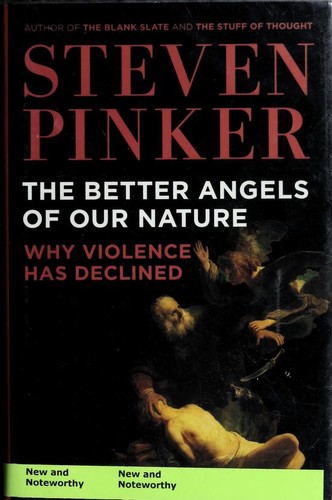
Steven Pinker · 2011 · Buy on Amazon
"The Better Angels of Our Nature is Steven Pinker’s explanation as to why, despite the selection pressures for murderousness in our evolutionary past, violence has declined in so many cultures around the world. It’s a fantastic book, and I recommend that everyone read it. From my perspective, I could sum up his argument very simply: Societal pressures have worked. Of course it’s more complicated than that, and Pinker does an excellent job of leading the reader through his analysis and conclusions. First, he spends six chapters documenting the fact that violence has in fact declined. In the next two chapters, he does his best to figure out exactly what has caused the “better angels of our nature” to prevail over our more natural demons. His answers are complicated, and expand greatly on the interplay among the various societal pressures which I talk about myself. It’s not things like bigger jails and more secure locks that are making society safer. It’s things like the invention of printing and the resultant rise of literacy, the empowerment of women and the rise of universal moral and ethical principles."

Patricia S Churchland · Buy on Amazon
"Braintrust , by the neuroscientist Patricia Churchland. This book is about the neuroscience of morality. It was published in 2011. This is a brand new field of science, and new discoveries are happening all the time. Morality is the most basic of societal pressures, and Churchland explains how it works. This book tries to understand the neuroscience behind trust and trustworthiness. In her own words: “The hypothesis on offer is that what we humans call ethics or morality is a four dimensional scheme for social behavior that is shaped by interlocking brain processes: (1) caring (rooted in attachment to kin and kith and care for their well-being), (2) recognition of other’s psychological states (rooted in the benefits of predicting the behavior of others) (3) problem-solving in a social context (e.g., how we should distribute scarce goods, settle land disputes; how we should punish the miscreants) and (4) learning social practices (by positive and negative reinforcement, by imitation, by trial and error, by various kinds of conditioning, and by analogy).” Those are our innate human societal pressures. They are the security systems that keep us mostly trustworthy most of the time – enough for most of us to be trusting enough for society to survive. Of course not. There are two parts to the question. One: Are we doing the right thing? That is, does it make sense for America to focus its anti-terrorism security efforts on airports and airplanes? And two: Are we doing things right? In other words, are the anti-terrorism measures at airports doing the job and preventing terrorism? I say the answer to both of those questions is no. Focusing on airports, and specific terrorist tactics like shoes and liquids, is a poor use of our money because it’s easy for terrorists to switch targets and tactics. And the current TSA security measures don’t keep us safe because it’s too easy to bypass them. There are two basic kinds of terrorists – random idiots and professionals. Pretty much any airport security, even the pre-9/11 measures, will protect us against random idiots. They will get caught. And pretty much nothing will protect us against professionals. They’ve researched our security and know the weaknesses. By the time the plot gets to the airport, it’s too late. Much more effective is for the US to spend its money on intelligence, investigation and emergency response. But this is a shorter answer than your readers deserve, and I suggest they read more of my writings on the topic . Like everything else, cloud computing is all about trust. Trust isn’t new in computing. I have to trust my computer’s manufacturer. I have to trust my operating system and software. I have to trust my Internet connection and everything associated with that. I have to trust all sorts of data I receive from other sources. So on the one hand, cloud computing just adds another level of trust. But it’s an important level of trust. For most of us, it reduces our risk. If I have my email on Google, my photos on Flickr, my friends on Facebook and my professional contacts on LinkedIn, then I don’t have to worry much about losing my data. If my computer crashes I’ll still have all my email, photos and contacts. This is the way the iPhone works with iCloud – if I lose my phone, I can get a new one and all my data magically reappears. On the other hand, I have to trust my cloud providers. I have to trust that Facebook won’t misuse the personal information it knows about me. I have to trust that my data won’t get shipped off to a server in a foreign country with lax privacy laws, and that the companies who have my data will not hand it over to the police without a court order. I’m not able to implement my own security around my data; I have to take what the cloud provider offers. And I must trust that’s good enough, often without knowing anything about it. Seven."