Brian Attebery's Reading List
Scholar and editor Brian Attebery has won multiple awards for his work on fantasy and science fiction, mostly recently the World Fantasy Award for his longtime editorship of the Journal of the Fantastic in the Arts . In 2019 he was the Leverhulme Visiting Professor in fantasy at the University of Glasgow. He is the author of Stories about Stories: Fantasy and the Remaking of Myth and Decoding Gender in Science Fiction , among other books, and co-editor with Ursula K. Le Guin and Karen Joy Fowler of the Norton Book of Science Fiction . As editor of Le Guin's work for the Library of America he i
Open in WellRead Daily app →Fantasy's Many Uses (2022)
Scraped from fivebooks.com (2022-11-25).
Source: fivebooks.com

E. R. Eddison · Buy on Amazon
"It is one of the classic works and you could say it’s important in the history of the genre. It got pulled back into circulation after Tolkien praised it in the 1960s, and Ballantine Books started republishing classic works that then became de facto fantasy works and part of a fantasy canon. Among the very first ones that were published, after Ballantine issued the Lord of the Rings , were the ER Eddison books, including The Worm Ouroboros . That was even before Ballantine started designating these publications as adult fantasy series, which finally was the collective title they came up with. Eddison came to some of the meetings of the Inklings , which is the group with CS Lewis and Owen Barfield, and others. The other thing Tolkien said about Eddison is that his philosophy was repellent! He’s not Christian. Not by any stretch. He had a kind of Nietzschean set of values, the superiority of the heroic individual over the values of society. But he was a great world builder, and probably like Tolkien, he was strongly influenced by William Morris , in that regard. It’s kind of a literary link, where The Worm Ourobouros came out in the 1920s, so it precedes even The Hobbit. It’s a link between the great 19th-century romances and modern fantasy. I see in the world around us fear being weaponised. We invoke fear of the unknown, and the other, and those are kind of the same thing. This is often done in order to foster some sort of emotional response and often overt oppression of the other. So fear turns to hatred, which turns to oppression. Not just now, not just here—though I see it in the political rhetoric today. In thinking about what can fantasy do for us—if it does work in the world as I claim—it should have something to say about this very powerful and very terrible force. So I started looking in my work for references to fear, and stories in which fear was built in. I wanted to distinguish fantasy from horror, because I think it does a different thing. The fear has a different purpose (and I don’t want to go into the whole theory of terror or an HP Lovecraft digression). But I really like an idea that I got from Canadian sci-fi writer John Clute, which is that the structure of a horror story is incomplete action. Whereas a fantasy goes beyond that point where the horror story would stop and makes you work out the implications and, if not actually solve the problem, at least confront it. If that’s the basic structure of fantasy, I think it’s something you can see in the critical writings of Tolkien and Ursula K Le Guin and many others. There’s that completed action, the second half of the story, that leads us beyond horror to something more integrative. Not necessarily happy, but a sense of moving beyond the point you started from. So I started thinking about books like The Worm Ouroboros and I picked up the distinction clearly here."

Ursula K. Le Guin · Buy on Amazon
"It’s also a central theme also in A Wizard of Earthsea by Ursula K Le Guin, the beginning of her great sequence of fantasy tales. I started looking for the sources of this and I remembered I was aware of one of Grimm’s Fairy Tales , which is also retold in Appalachia. I like the title that it’s given in the American South, which is “The Boy That Never Seen A Fraid,” as if ‘a fraid’ were a noun. The Grimm title is “The Story of a Boy Who Went Forth to Learn Fear.” When I started scouting around for comments about that story, or just information about it, I discovered it was a core example for Soren Kierkegaard in The Nature of Anxiety , in which he was trying to take a complex philosophical look at fear and distinguish it from dread and awe and all of these things. And what did he turn to? He turned to a folktale. Because the narrative works you through all those stages, from the boy who doesn’t know what fear is, and therefore can walk into horrific situations with ghosts, monsters, terrible death-dealing entities, completely unafraid, to someone who becomes more knowledgeable. Finally, after he gets through all of his tests and challenges and wins his bride, he discovers she’s a very clever princess. She says to him, ‘Okay, you need to know what fear is.’ So she pours a bucket of minnows over him and makes him shudder. And that’s how he learns what fear is. “A fantasy goes beyond that point where the horror story would stop and makes you work out the implications” I don’t think Kierkegaard had an expansive sense of humour, but he might have been amused by that. He uses it as an illustration of the difference between the unknowing and the knowing, which is the distinction between simple fear versus the more complex mode of dread. So I went off into reading all of this stuff, and I don’t claim to really understand all Kierkegaard or be a philosopher, but it seemed to me significant that the narrative itself was one of the ways of understanding the force in the world around us. I use that then to examine some of the other examples I thought of besides Eddison. The other thing about The Worm Ourobouros is it has a poem in it, which Eddison did not write. He liked to quote poems even though he’s writing about a fantasy world, a world in which evidently they have access to our publishing system because he quotes from John Donne and others such as William Dunbar , a 15th-century Scottish poet who wrote “Lament for the Makaris” (which means for the makers or poets). It has a repeated line at the end of every stanza which reads “Timor Mortis Conturbat Me.” It’s a line from one of the Latin offices for the dead and it’s usually translated as ‘ fear of death disturbs me.’ If ‘conturbat’ existed in modern English, it would be ‘conturbs me,’ which I really like because it’s a word that shows up for a while in English and then disappears. It suggests the way something can block you from moving forward. ‘Conturbat me’ is exactly what Eddison, Le Guin, and many of the other examples I found, keep coming back to. Yes, an absolutely Baroque style."

C.S. Lewis · Buy on Amazon
"These fantasy books all seem to fit together in my mind around this theme. Along with others I’ve included a book by Australian fantasy writer Patricia Wrightson, called A Little Fear , and Nnedi Okorafor’s Who Fears Death. They also demonstrate the structural approach that I was talking about, where you confront fear. In the CS Lewis book, Till We Have Faces, there’s a striking line which reads, “How can we meet the Gods face to face till we have faces?” But I think you can also invert that and ask, ‘how can we meet the Gods face to face till they have faces?’ Because it’s the facelessness that is so terrifying. This was a complex pattern that I kept seeing over and over in various ways and tried to thread my way through."

Patricia Wrightson · Buy on Amazon
"That may be why I was attracted to all of those. Wrightson is a writer who got in trouble eventually for using Australian aboriginal mythic materials. At the time she started writing, that didn’t seem to be controversial, appropriating another culture, but by the end of her career, she kind of got erased for having done that. She was a proponent of bringing back native cultures and her thinking was probably filtered through the kinds of narratives that she was familiar with. She was very interested in how you inhabit the Australian continent if you’re a European who’s come in and whose stories don’t quite fit there. They’re like ill-fitting garments. And, yet, you don’t have ownership or rights to the stories that are already there, on the land. So a lot of what she did was to try to find some sort of crossover, some sort of mediation. I think she was probably as successful in this little book, A Little Fear, as in any of them because it doesn’t try to make any claims for the indigenous materials. They stay unassimilated and independent, and yet have to be confronted. Le Guin was writing probably not intentionally Jungian structures but she has a creature or an entity called the Shadow, so it’s pretty hard to escape Jung on that. And then there’s a lot of Daoism , the kind of sense of the balance forces of the universe. What does a wizard do in that kind of a world? And again, especially with death, which is the ultimate fear that keeps coming back throughout the Earthsea books. The formulation of how you deal with it changes from book to book. I think one of the great things about that series is that she didn’t erase anything she’d done before, but she kept rethinking and complicating the relationships."
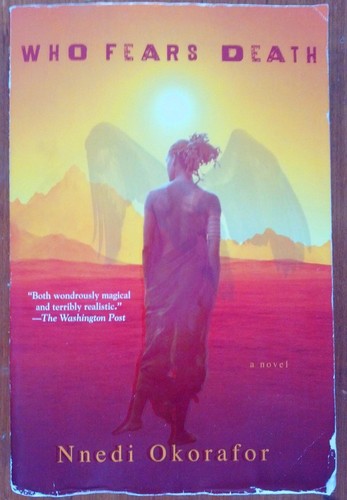
Nnedi Okorafor · 2011 · Buy on Amazon
"I think Nnedi Okorafor tends to think of herself as a science fiction writer rather than a writer of fantasy books. It’s one of those books where my question about ‘what happens when you read it as…’ works really well, both ways. For me, it does have that kind of post-apocalyptic, ‘what if the future turns out this way?’ but, at the same time, people can turn into vultures and come back from the dead and so on. It’s powerfully fantasy as well as successfully science fiction. Okorafor is American but her parents both came from Nigeria and she spent a lot of her childhood going back and forth. She was pretty much immersed in some of the cultures of her family and neighbours there, and often turns to them in her work. I think almost all of her work is rooted in African landscapes, tribal tensions, cultures, beliefs, and so on. Who Fears Death is clearly one of those stories on one level, although she has also said that it’s thoroughly contemporary. It’s drawn right out of today’s headlines because it has to do with ethnic wars and the terrible things that people do in those wars, including weaponised rape. That’s the central driver of the narrative in her story. In a way, perhaps, the book enables readers who might otherwise find it difficult to confront these contemporary realities with a way to enter into the terrible things that are happening around us right now. This goes back to that structural meaning I was talking about. You can take the structure of that situation—which is almost impossible to face directly in real-world situations—and you can see what’s happening. This is maybe where we can intervene and make it not happen. Very clearly, based on many measures, including the many movie and television franchises made recently. Superhero movies are a form of fantasy, as are the Lord of the Rings movies, of course. Or take a recent example like the new TV series, The Sandman . Even the Harry Potter series—which I always thought was fairly derivative but which had a lot of charm—became a global phenomenon. It used to be those of us in the fantasy field would have to stand up for or defend our subject matter, insisting that this is important, it is good stuff. I don’t feel like we have to do that kind of apology anymore. Most people will say, ‘Well, yes, of course!’ Even those who might have resisted a few years ago are starting to come around to Game of Thrones or Neil Gaiman and so on. It’s not only a boom in fantasy, it’s also a broadening of fantasy, and that includes bringing in writers from backgrounds who would probably not have taken part in it 20 years ago. I’ve been studying fantasy from the time when you could pretty much read all the fantasy books in the field, and there was a time that you could make general statements about it based on that. I don’t think I can do that anymore. If you say one thing about this branch of fantasy, somebody else can come along and say something quite different about African-based fantasies or Australian-based fantasies. There are ever-increasing numbers of Native American -based fantasies and a whole bunch of South Asian and East Asian writing that is excellent. All of this branching out has a lot in common. It tends to look back to the same kind of origins as the Eurocentric fantasy that many of us grew up with but it’s so different!"