Brent Glass's Reading List
Brent Glass is Director Emeritus of the Smithsonian’s National Museum of American History, the world’s largest museum devoted to telling the story of America. His latest book is Fifty Great American Places.
Open in WellRead Daily app →American History (2016)
Scraped from fivebooks.com (2016-11-23).
Source: fivebooks.com

David McCullough · Buy on Amazon
"David McCullough is a friend and mentor. His subjects range from the Johnstown Flood in Pennsylvania to the biographies of presidents to the Wright Brothers. The Great Bridge was, for me, a pivotal book in understanding how you could tell a story about a great engineering accomplishment in the context of the backdrop of urban history and the development of New York. He is such a masterful storyteller that he can engage you in what seemed to be an unlikely subject for a full-length nonfiction narrative and succeed in spectacular fashion. I was born in Brooklyn and grew up on Long Island so I have some personal connections with this particular site. But what suggested it to me was that this bridge is unique as an illustration of how nature and technology can be in harmony. When you see the Brooklyn Bridge, or you walk over the bridge, you feel as if it just belongs there. It has a sense of permanence, an enduring quality, a combination of beauty and functionality that has inspired artists and filmmakers and poets. Exactly. The way he used sources—remember that this book was published in the early 1970s so he did not have access to all the sources that we have now via the Internet—he was able to use photographs and drawings and illustrations from magazines as a way of augmenting his research. It’s a very powerful story. Even though you know what the ending is—you know the bridge was built and that it’s still there—he creates a dramatic sense of just what it took to bring this bridge into being and to complete it. He also is very skillful at developing the characters, the human element, of the Roebling family: John Roebling, his son Washington Roebling, and, finally, Emily, Washington Roebling’s wife, who played a crucial role in the final years of the construction of the bridge because Washington Roebling was disabled by caisson disease. He ended up watching most of the construction of the bridge from his apartment window. His wife Emily was the key communicator between Roebling and the engineers working on the site. That was an important role and David McCullough brings that out in the book. Yes, he was one of the first causalities, if not the first. While he was serving the site, he fell and later died of tetanus."

Ted Morgan · Buy on Amazon
"My next selection is Wilderness at Dawn by Ted Morgan. This book shaped my understanding of human geography. It reminds readers that America was settled by several different cultures and countries. It’s a triumph of storytelling about the different frontiers of America. We were often taught American history as going from East to West and the British settlement as being the preeminent story. Ted Morgan’s book emphasises the fact there were multiple settlements and multiple beginnings of American history. He spends the early chapters talking about American Indians and their presence on the landscape before European settlement. That influenced me quite a bit and shaped how I selected my sites for my book. The first two places I talk about are the Cahokia Mounds along the Mississippi river near St Louis in Illinois and the other is Mesa Verde in Colorado. Ted Morgan writes about both those places. But the Spanish presence, the French presence, and the Dutch—as well as the English later on—all play a major role in the settlement of North America. That is still debated by archaeologists today. Some of the most recent theories are that the first Americans may have arrived in the Americas by boat rather than by coming over the Bering Strait. If you attend any archaeological conferences, you will witness some very heated debates among archaeologists, who will stand by their different theories of how the first Americans arrived and where they first settled. I choose not to get into that debate, but it has been demonstrated that the original settlements were probably 15-16,000 years ago instead of 7000-8000 as had originally been thought. Ted Morgan has a gift for telling stories within stories. When he’s talking about the Spanish settlement in New Mexico, he will take a diversion, talking about the revolt of the Pueblo Indians in 1680 — the only successful Native American revolt against colonial rule in history. He provides important details around that revolt that clearly influenced the chapter I wrote about The Palace of the Governors in Santa Fe, New Mexico. I think that’s an important point to make. History is not inevitable. It is based on decisions and choices that people make. Morgan is very skilful at identifying those key decisions and key choices that people made that really affected the outcome. Sometimes we read back into history and say, ‘it had to turn out this way,’ but it’s not as clear to the people who are actually living in that moment, how history is going to unfold."
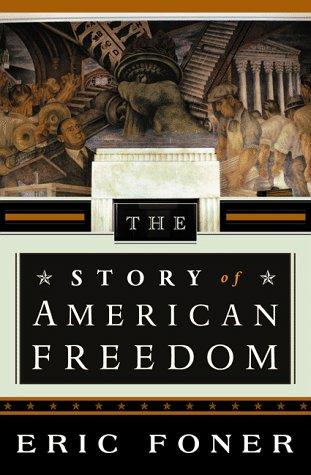
Eric Foner · Buy on Amazon
"This is a seminal work of historical scholarship. I have met Eric Foner on several occasions and he’s a distinguished professor at Columbia University and has published many books, most of them on the 19th century and some of the key issues of the 19th century. But this book is a survey of American history on the theme of freedom, and how that word has changed in meaning, depending on what period of time we’re talking about. He writes about freedom from the point of view of the revolt against colonial rule in the 18th century, the notion of freedom and the advocacy of ending slavery in the United States, the expansion of freedom to include women in the political life of the country, the ideas about freedom as it relates to who was going to become an American and the freedom to enter this country—a great debate still occurring in the country—as well as the influence of the Cold War when there was the Free World versus the Communist bloc — and how freedom was understood during that period. Then there is the personal freedom movement of the 1960s and beyond, where especially in Western countries—and especially the United States—the idea of personal liberty and personal freedom became very widespread. Support Five Books Five Books interviews are expensive to produce. If you're enjoying this interview, please support us by donating a small amount . You can see that in debates throughout American history. More recently, there is this notion that freedom has to do with the role of government in our lives. American history is punctuated by these debates about how intrusive we’ll allow the government to be in imposing constraints on our personal liberty. On the other hand, we expect the government to protect us from the encroachments of capitalism or the downturns of the economy. There’s an expectation that government has a role to play in ensuring our freedom as well as the limits of government. And that debate goes on today, especially during our election campaign. There are two central ideas that really characterise American history. Firstly, ‘inalienable rights’ — which are mentioned in the Declaration of Independence: life, liberty, and the pursuit of happiness. The second idea is ‘self-government,’ that we are governing ourselves. We are not subject to a monarch or a military dictatorship or a priesthood. We pride ourselves on self-government. But those two ideals come into conflict very often. This is a major theme running through American history and Eric Foner does a marvellous job of documenting that from the beginning of American history to the present."

Drew Gilpin Faust · Buy on Amazon
"The next selection gets back to the theme of death and dying. This Republic of Suffering by Drew Gilpin Faust was, to me, an extraordinary book because, as I said earlier, we have written so much and watched so many movies that we think we know all about the Civil War . But what the Civil War was about, when you break it down to its essential components, was mass killing on a scale that we had never ever dreamed of. I have seen one estimate that if we were to have the same number of people killed today, as a percentage of the American population, we would have lost six million people. The whole process of caring for the dead and burying the dead and documenting the dead was a totally new experience. There was no such thing as national cemeteries, for example, until the Civil War. Drew Gilpin Faust takes on this rather serious task of documenting and, through her research and writing, demonstrating just how impactful the Civil War was on the consciousness of Americans to deal with this rather grim reality of mass death and mass killing. Yes. Gettysburg is one of the sites that I write about in my book. The national cemetery there is one of the first that was developed in the country. Gettysburg National Cemetery was where Lincoln gave his famous Gettysburg address, so the task of reburying the Union dead at Gettysburg is directly connected to the speech that many believe is the greatest speech of American history. It gave new meaning to the Civil War. It wasn’t just about preserving the Union, now the civil war was going to be about giving us—to quote from the address—‘a new birth of freedom.’ This connects back to Eric Foner’s book. He has a whole chapter devoted to the Abolitionist movement, the Gettysburg address, and the new birth of freedom that resulted from the Civil War. Yes, she is able to use the Civil War as a platform to talk about a new understanding of the terrible cost of war in general, because this was a war on an unprecedented scale. The whole world came to understand just what the impact would be. There wasn’t another Great War until World War One . So we had nearly fifty years of peace. Not entirely of peace because, of course, there were wars in Europe and in Asia but not on the scale of the American Civil War."

Hampton Sides · Buy on Amazon
"This book is a surprising mix of great scholarship and great storytelling. Hampton Sides is well known as a writer about nature and the outdoors. He was able to put together, through an amazing use of source material, this incredible story of the efforts to discover the North Pole. In many ways, this was similar, in the 1870s and 1880s, to the efforts in the 1960s of going to the moon. The North Pole was one of those unknown areas that was fascinating to the scientific community and also became a goal of national aspiration. Which country could be the first to reach the North Pole? The United States, which had just come out of the Civil War and was achieving recognition for its technology and its scientific progress, took on the challenge of assembling an expedition. It was financed privately by James Gordon Bennett, Jr., who was the publisher of the New York Herald. He joined with the US Navy to commission this voyage by the USS Jeannette in 1879 to find a route that would take them to the North Pole. It’s a story of exploration, of survival and death, and it has many amazing characters. It’s an amazing story but a tragic one: only 13 out of the 33 men who were on the voyage survived. If you had to draw a line between all these books, it could be the notion of the frontier. Whether it’s the frontier of technology, in the case of Brooklyn Bridge, or the frontier of discovering the North Pole, or the frontier of freedom and the intellectual boundaries that are explored by Eric Foner. And then, perhaps, the final frontier—of death—which is reflected in Drew Gilpin Faust’s book. There’s the combination of the emotional and the intellectual in the realisation of the impact of death. There’s also the exploration of the human experience that these books represent. Perhaps exploration of new frontiers is the best way to describe the commonality of these books."