Barry Prizant's Reading List
Barry M. Prizant is among the world’s leading authorities on autism, with more than forty years of experience as a scholar, researcher, and international consultant. He is an adjunct professor at Brown University and coauthor of The SCERTS Model: A Comprehensive Educational Approach, now being implemented in more than a dozen countries. His book Uniquely Human: A Different Way of Seeing Autism , co-authored with Tom Fields-Meyer, was published in 2015 by Simon & Schuster.
Open in WellRead Daily app →Autism (2016)
Scraped from fivebooks.com (2016-02-22).
Source: fivebooks.com

Tom Fields-Meyer · Buy on Amazon
"Full disclosure here, Tom helped me write my book and there’s a reason I sought him out for that: I read this book about his son, which came out in 2011. Tom tells the story from when he and his wife had initial concerns about Ezra’s development all the way up to Ezra being thirteen years of age. The book ends at Ezra’s Bar Mitzvah which they never thought he’d be able to accomplish. Unlike so many books that parents have written over the years, Tom did not see having a child with autism as something that was an absolute crisis and totally devastating. From the very beginning he tried to connect with Ezra’s passions and Ezra’s interests. There’s a wonderful part in Following Ezra when he and his wife were taking Ezra for play therapy shortly after the diagnosis, he was around three or four years of age. Tom is a very grounded, quiet man and he was not speaking a great deal about all of the agony and pain involved in having a young child with autism. And the therapist said to him after a few sessions, “Tom, I think I know what the issue is. You have not grieved the loss of your typical child here.” She was responding to the fact that he was talking about how anxious he was and how scared he was. Tom’s response was basically, “This is my beautiful little boy, I don’t feel the need to grieve.” As I mentioned, the book ends when Ezra is thirteen—Ezra is now twenty and I know him. He’s a delightful, confident young man and he’s doing what he’s always loved to do: computer animation. His father, his mom and brothers have always nurtured that interest and what I’m seeing is a young man with autism who has a wonderful sense of who he is and a wonderful sense of what he’s good at. He’s aware of what he’s not so good at and he knows that he has autism and he’s able to talk about that. So, what I learned from Tom is that when you really appreciate a person for who they are and you support what they enjoy and you use those interests creatively, you can have, as a result, a person who happens to have autism who is an engaging, interesting person."

Steve Silberman · Buy on Amazon
"For years I had been saying to people that somebody needs to write a socio-cultural history of autism. The field has been controversial ever since Leo Kanner’s initial proposition of the diagnosis of infantile autism in 1943. There are strict divisions in beliefs about what causes autism and how best to treat autism. People really go at each other—I mean cut, slash, and burn when they talk about autism. Especially with the internet, every day we have dozens and dozens of new self-appointed autism experts who know everything. When I read Steve’s book I thought, not only is this a detailed history with so many untold stories, but it’s written with such compassion and it’s written with such depth of understanding of people with autism not being pathological but being people who are different. Steve uses the term neurodiversity, which basically means that the best way to understand people with autism and other differences is through neurological diversity—that we all have different brains and we process information differently—and that’s a more hopeful as well as productive way to understand people who behave and act and process information differently. Steve’s book reads like a novel. He’s a science writer but he tells wonderful stories. He writes about how Asperger’s work was never given the credit it should have been given, in terms of really identifying the autistic spectrum. He takes us through people who were famous scientists, physicists, engineers from hundreds of years ago who probably were on the autism spectrum and how a lot of their work was the foundation for great revelations in science, in some cases decades or even centuries later. Very often these people were thought of as reclusive or, in some cases, socially deviant. He takes us right up to the modern era. He talks about some of the controversies of treatment, such as the work of Lovaas and the traditional ABA behavioural perspective in autism, which still remains extremely controversial. Read this book if you want to get a sense, from the socio-cultural and also from the historical diagnostic perspective, of how this concept of autism developed, and how the concept of autism has changed over the years, and if there really is an autism epidemic. Steve believes that there is not. Steve believes that we are just recognising people with autism and the category has expanded so greatly that that can account for the numbers we’re seeing today that we’ve never seen before of diagnosed people. It’s a wonderful book. Neurotribes lays down the history and the philosophy of our need to respect people with autism, to understand them better, to understand the family experience and contribution of people with autism to our society, and the contribution of parents to our understanding of autism and advocacy for autism. The reason I was so blown away by his book was that it is so clear that our beliefs and values come from the same core. It’s considered to be a game-changing book in terms of our understanding of autism. And, if I might be so bold, my book has also been considered game-changing in terms of how best to support and treat people with autism and their families. One review from Nature magazine reviewed our books together and said “these books are serendipitous companions” and they must be read together. So, it’s one of those things that happens in life that out of nowhere this great coincidence happens. Steve and I know that our work complements each other’s and I’m very proud to talk about his book."
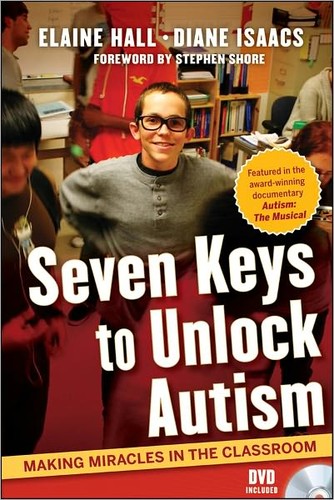
Elaine Hall · Buy on Amazon
"Elaine Hall is the founder of The Miracle Project, a theatre and musical arts programme for kids with autism that is now being replicated nationally and beginning to be replicated internationally. Elaine has a twenty-two year old son with autism, he is a very capable kid but very severely challenged by his autism. His name is Neil. Elaine adopted Neil when he was about a year and a half old, from Siberia, because she couldn’t have children, and brought him to the United States. A couple of years after she brought Neil back her husband divorced her. She was a single mom raising a severely challenged son with autism. Prior to having Neil, Elaine worked as an acting and dancing coach for children in movies in Hollywood. She grew up on stage as a dancer and as an actor. Being a single mom who was economically challenged, she needed to put that career aside and focus on Neil. But when Neil was about eight, she decided to develop theatre and musical arts programmes for kids with autism. That was eventually documented in a movie that came out in 2008 called Autism: The Musical, an award-winning documentary on HBO. Support Five Books Five Books interviews are expensive to produce. If you're enjoying this interview, please support us by donating a small amount . The Seven Keys to Unlock Autism is Elaine’s effort to share with us how she approaches autism, both as a parent and a professional. It’s her effort to help us understand the experience of autism so we can best support people with autism. When people go through the training for The Miracle Project programme, she takes them through the ‘seven keys’ training, which has to do with understanding what our intention is when we’re with the person with autism and how we are going to connect with them. It’s about understanding and appreciating people with autism as opposed to pitying them or just trying to make them change: understanding their sensory issues, understanding the importance of following their interests. It’s a big theme in autism now in general: let’s understand what people with autism are really good at and what their interests are and use that to help them navigate through life and through academics. It’s a wonderful book coming from both the parental perspective and the professional perspective and Elaine navigates beautifully between those two."

Stephen Shore and Linda Rastelli · Buy on Amazon
"This is the first of the last two books I recommended—both of which are written by people on the spectrum. Stephen has written four books, including his autobiography which is called Beyond the Wall. Stephen has a doctorate in Special Education, he is a professional and a special educator and currently works part-time at Adelphi University in New York, but he is a man with autism. He really tried to be as non-opinionated as possible in Understanding Autism for Dummies , where he speaks about a number of different treatments and approaches and does not really come out in favour or against any of them. He does have strong opinions but, in this book, he intentionally wanted to present information about understanding autism from as neutral a perspective as possible. The book is written primarily for parents and professionals new to the field but, unlike the other books I’ve mentioned, it covers a very broad landscape. Everything from some of the biomedical and physical issues you see in autism to how we understand autism. He asks: how do we understand the diagnosis? How can we help people with autism learn? How can we help them with their social skills? Then he goes into adulthood and asks what is it like for adults living with autism. What happens after you leave school? What happens in romantic relationships? Of the books I’ve recommended this is more of a survey book, talking about the different dimensions of autism. But what’s so nice with Stephen writing it, is that he can and does infuse that personal perspective— what’s been helpful for me? What’s not been helpful for me? It is written by a person with autism, which also communicates how successful some people with autism can be."

Michael John Carley · Buy on Amazon
"Michael was diagnosed with Asperger’s at thirty nine, when his son was diagnosed at four. Because they knew there were some issues with development, Michael and his wife took their son, Will, to an Asperger’s clinic at New York University which diagnosed him with Asperger’s. And then they turned to Michael and said, ‘Well, Michael, let’s talk about you now.’ Up until that time he was always a very bright young man but he went to a conservative school in Providence, Rhode Island. He was considered to have a significant behaviour disorder. In his own words he was “about to crash and burn” as a teenager and he didn’t know why people saw him that way. He thought he was being blamed and was misunderstood. He ended up transferring to a Charter School (back in those days they were kind of hippy schools). He found that for many of the same reasons he was ostracised in his previous high school, he became a leader and was celebrated in his new high school. He was considered to be unconventional, he was considered to be incredibly creative. Yes, he was on the edge a little bit, but everybody appreciated how intelligent he was. After that, he was a diplomat for an agency related to the United Nations. He worked in Iraq and Bosnia. He is a classical guitarist, he hosts a part-time classical music station in New York City. He is a playwright—he has written five plays. He was a Renaissance man! He got married and had his first child. Then the diagnosis came and it was, in Michael’s words, both ‘a sledgehammer and a revelation.’ His son is now a sophomore at Grinnell College in the United States—he is the star baseball pitcher. Michael believes that the more we understand people with autism and their perspective, the better we can support them. He basically says thank goodness I know what Asperger’s is like because I was able to raise a son with Asperger’s and raise a confident and successful young man with Asperger’s. His book is in part his autobiography, but a large proportion of the book is advice for people with autism and Asperger’s. In it, he talks about topics ranging from how to prepare for an interview for a job, to when you talk about the fact that you have autism and Asperger’s and when you don’t. He’s very focussed on helping people with autism and Asperger’s to succeed in life. He’s one of the many people who say that we put all of this money into early intervention but what about the appropriate support for people once they’re out of school? Another issue not too many people have focussed on in autism, and Michael is a leader in this area, is mental health issues that arise when people with autism are not supported appropriately. When he was based in New York he ran support groups with people on the autism spectrum who had problems with alcoholism, with drug addiction, were chronically depressed or bipolar. All of these additional mental health issues are sometimes a direct consequence of having autism and, in other cases, are called co-morbid conditions. For example, bipolar is a co-morbid condition that unfortunately is not uncommon for people with Asperger’s and more capable people with autism. I picked Asperger’s From the Inside Out because it focusses more on adult issues, is written by a person on the spectrum, and is written by a person who you are going to be hearing a lot more from. He is going to be a leader in the field and just another one of these wonderful engaging people on the spectrum who has been very successful and, like Stephen Shore, has found his mission in life and is very hyper-focussed on that."