Barbara Kiser's Reading List
Barbara Kiser is a commissioning editor and books columnist at Nature . An editor and writer for over three decades with a special interest in sustainability and environmental policy, she has worked at New Scientist, SciDev.net, UN agencies and the UK government.
Open in WellRead Daily app →The Best Science Books of 2018 (2018)
Scraped from fivebooks.com (2018-12-23).
Source: fivebooks.com

Sabine Hossenfelder · Buy on Amazon
"Lost in Math is a firecracker of a book—a shot across the bows of theoretical physics. Sabine Hossenfelder, a theoretical physicist working on quantum gravity (and author of the blog Backreaction ) confronts failures in her field head-on. The foundations of physics have not improved, she reminds us, for more than three decades. Hossenfelder contends that theoretical physics—specifically, theoretical particle physics—is in thrall to seductive concepts that act as hidden rules. Faced with new but untested theories, many physicists draw on aesthetic concepts such as naturalness, simplicity, elegance and beauty. ‘Naturalness’, for example, is the idea that a proposed theory should not have to have parameters tuned to tally with observations. “Theoretical physics—specifically, theoretical particle physics—is in thrall to seductive concepts that act as hidden rules” Hossenfelder notes that these concepts can be valuable—a “hard-earned intuition for what works”—while also being opposed to objectivity. She argues that their dominance has contributed to a crisis in the field. The development of theories needs to be guided by data, but where there is no data, many theorists fall back on these concepts. When that doesn’t work, she reveals, confusion ensues. Or, worse, rhapsodies. Of course, testing theories is beyond tough, and takes time. She reminds how it took 25 years for the neutrino to be detected, almost 50 to confirm the Higgs boson, and a century to detect gravitational waves. A scientist testing a new law of nature may not see results in her lifetime. So in deciding which research to follow, what Hossenfelder calls “empirical adequacy” may not be the only criterion; ‘beauty’ may become another, introducing “systematic bias”. Get the weekly Five Books newsletter This is a book of mordant wit and bold immediacy. Hossenfelder interviewed a number of physicists in the thick of this vast debate—including Steven Weinberg, Nima Arkani-Hamed and Frank Wilczek. Their frank exchanges are illuminating. As is Hossenfelder’s trouncing of theories such as wormholes in space (“pretty but useless” and nearly impossible to test), or the lack of evidence for dark matter particles. Hossenfelder is by no means trashing her own field. She is simply breaking away from the pack to examine it, and that has to be salutary for any scientific endeavour. She’s in worthy company, too. Lee Smolin trod this territory in The Trouble with Physics (although that focused far more on string theory), as did Jim Baggott in Farewell to Reality . But she adds a pungency all her own: We don’t use math because we want to scare away those not familiar with differential geometry . . . we use it because we are fools. Math keeps us honest—it prevents us from lying to ourselves and to each other. You can be wrong with math, but you can’t lie. Basically, we need to find the right maths."

David Quammen · Buy on Amazon
"Quammen is one of the great science journalists, and this is a monument of a book—a masterful retelling of how the ‘tree of life’ was recast in the twentieth century by a band of original thinkers. The tree, a model used to explore relationships between all organisms through time, was famously codified by Darwin in an 1837 sketch (Quammen dubs it a “thunderous assertion”). Among the scientists whose trajectories he follows were Lynn Margulis and Tsutomu Wantanabe, but the spotlight is on Carl Woese, the microbiologist whose research unearthed a new branch of life. Quammen manages to integrate leaps in understanding around this discovery with the plod of the research that triggered them. He wonderfully explicates what I think of as ‘linear collaboration’—that shoulders-of-giants element of science in which successive researchers essentially work together over time, as in a relay race. This is as much a book on molecular phylogenetics, the technique effectively used to redraw the tree, which involves looking at units (nucleotide bases and amino acids) in some long molecules—DNA and RNA, for example. The starting gun here, Quammen reveals, was an idea flung out by Francis Crick that amino acid sequences or chains might reveal evidence for evolutionary trees. After work by others, including Linus Pauling, Woese took up the thread. In the 1960s and 1970s, he came up with profound insights around ribosomal RNA. Some of the most ancient genes code for this molecule, so he saw it as the optimal “fossil record.” But which ribosomal molecule? In a stroke of genius, Woese pinned down 16S rRNA —a component of bacteria—and its variant. Extracting and sequencing ribosomal RNA was a herculean task in the 1970s—beyond clunky. Thousands of pieces of film had to be studied. Lab conditions were ridiculously risky, with scant regard for safety around, say, the radioactive phosphorus used in bacterial culture. But Woese, his postdoc George Fox and the rest of his team eventuall punched through. After years of precise, laborious work, Woese identified Archaea, the single-celled microorganisms that constitute the ‘third branch’ (bacteria and eukaryotes are the other two). The series of papers published by Woese, Fox and others in 1977 are seen by some as the most significant in the history of microbiology. Perhaps inevitably, doubt and dismissal followed. There are more aspects to this many-pronged narrative: endosymbiosis, horizontal gene transfer. There are subtleties and complexities (not least in Woese himself.) This brilliant, un-flashy scientist never won a Nobel and, Quammen asserts, was embittered by that. But he played a vital role in redrawing the tree."

Alan Stern & David Grinspoon · Buy on Amazon
"Rip-roaring space exploration is the name of the game here. It’s an account of NASA’s New Horizons probe, which zipped past Pluto on a July 2015 flyby 4.8 billion kilometres from Earth—a dynamic soup-to-nuts treatment of the mission by its principal investigator Alan Stern and astrobiologist David Grinspoon, who was also involved. Thus, it’s the ultimate insider’s account. Crewed flight is the apex in space, of course. But un-crewed probes are astounding feats of technological derring-do. After more than 40 years, Voyager 1 (in interstellar space) and Voyager 2 (now in the heliosheath) are still transmitting data. New Horizons is out there now, too, barrelling through the Kuiper Belt. “The scientific payoff has been profound. It has revealed a world.This demoted runt of a planet, a mere smear in former images, has emerged as a haunting beauty with extraordinary features” Stern and Grinspoon deftly relate the struggles of the ‘Plutophiles’ on their search for funds and NASA backing, which took 13 years and six failed mission concepts before the craft could even begin to be built for launch in 2006. But the scientific payoff, as they eloquently describe, has been profound. It has revealed a world. This demoted runt of a planet, a mere smear in former images, has emerged as a haunting beauty with extraordinary features—‘bladed terrain’ (methane ice spires), canyons, possible ice volcanoes and Sputnik Planitia, a nitrogen glacier churning “like a slow-motion pan of sauce cooking.” So like Voyager, New Horizons—destined to fly by other objects in the belt before ultimately, decades on, winking out somewhere in interstellar space—carries, as part of its payload, our collective imaginings. As life on Earth is rocked by conflict and environmental crisis, these serene little scientific emissaries remind us of how different it can be when we collaborate selflessly in the getting of knowledge."

Alan Jasanoff · Buy on Amazon
"The internet bulges with illustrations of skull-less, glowing brains hovering in mid-air, or artistically ‘flayed’ to reveal the ‘ connectome ‘ (white-matter fibre architecture). Alan Jasanoff, who directs the MIT Center for Neurobiological Engineering , sees these as manifestations of skewed thinking. They frame the brain as a source of enigmatic power “like the chryselephantine idols of the ancients”—a bodiless, decontextualized entity. That’s the ‘cerebral mystique.’ This peculiar cultural tic is linked to scientific dualism splitting brain and body, argues Jasanoff (who is, by the way, one hell of a writer as well as an incisive thinker.) He reminds us that brains are organs: messy, awash with fluids and “glue-like” glial cells as well as neurons. Like (and unlike) our other organs, our brains interact with the rest of our bodies. “Brains are organs: messy, awash with fluids and “glue-like” glial cells as well as neurons” Jasanoff’s corrective explores multi-layered neurobiological realities and cutting-edge research. He parses the brain’s complexity and its surprising relationship to function, shows plainly how the brain does and does not resemble a computer, and unpicks fallacies in parsing brain scans. He embeds cognition in the whole body. The manual flexibility of the violinist Niccolo Paganini, for example, may have been due to a connective-tissue disorder, so his wildly complex compositions can be seen as the product of exalted creativity and unusual physique. Jasanoff also looks at how the sensory barrage of the environment are “causative forces that slice to the deepest levels of our brains and minds.” The brain does not sit in a bunker. But he also takes us further, out of science and into society, where adherence to the mystique can have severe consequences. He asks penetrating questions about mental illness: the ways we interpret and stigmatize it. The idea of the ‘broken brain’, he argues, is not just outmoded. It has too much risky potential to shape how policy is made and justice done. In the mid-1960s, a post-mortem on American mass murderer Charles Whitman revealed that he had a brain tumour. But as Jasanoff relates, Whitman also abused drugs, had a violent family life, and suffered repeated rejections and humiliations throughout his career. And (a grim reminder of what is currently playing out in many US states) he had easy access to guns. ‘Neuroessentialism’—a focus on brain alone—can become just another dangerous intellectual bubble. “The idea of the ‘broken brain’ is not just outmoded. It has too much risky potential to shape how policy is made and justice done.” There are a few echoes here of the famous 1998 paper ‘ The Extended Mind ’, by Andy Clark and David Chalmers. But there is much more to this exploration of existential richness. Research on the microbiome reveals the human body as a vast community. Jasanoff reveals the brain as part of that community, and a much vaster one."
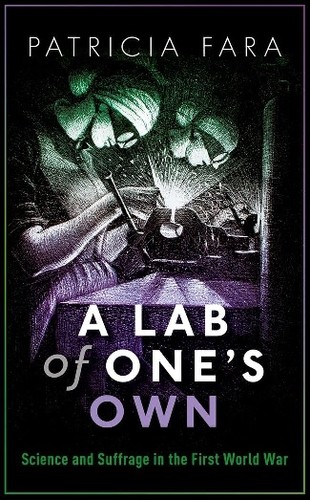
Patricia Fara · Buy on Amazon
"We’ve just seen the centenary of Armistice—the finale to a terrifying war—come and go. I think it’s key to remember, too, that 2018 is Britain’s ‘suffragist centenary’, marking the moment when more than eight million women over the age of 30 gained the vote. (The United States followed suit in 1920.) Science historian Patricia Fara’s powerful book looks at this socio-political ferment through a scientific lens. We walk the walk with scores of women in science from the nineteenth century, through the war years and into the early twentieth century, when sexism was pervasive and blatant. That prejudice has cast a long shadow. As Fara reminds, glass ceilings, leaky pipelines and unconscious bias are still very much out there for today’s women scientists. And those constraints can, in part, be traced back to failures in the battle for equality following the First World War. “Fara tells the stories of many women researchers who, after years of collaborating with their husbands, were publicly ignored or demoted” Fara describes intense discrimination. Between 1881 and 1916, just over 400 women studied science at Cambridge, although women could not graduate until half a century after University College London allowed it in 1880. Mockery and exclusion were a norm for female science students—and really, they were almost to be expected in an era when science itself strained to justify misogyny. Egregious treatment persisted through graduation and beyond. Physiologist Mabel Purefoy Fitzgerald was awarded an honorary Oxford MA at the age of 100 in 1972—a full three-quarters of a century late. Dorothea Pertz, who worked with the botanist Francis Darwin (Charles’s son), published papers and lectured at Newnham, but was never formally recognised. Fara tells the stories of many women researchers who, after years of collaborating with their husbands, were publicly ignored or demoted. Other stories were happier. Plant hybridization researcher Edith Saunders became president of the Genetics Society. Crystallographer Kathleen Lonsdale was one of the first women elected to the Royal Society. And Newnham became a centre of scientific inquiry for women—a ‘lab of their own’. Support Five Books Five Books interviews are expensive to produce. If you're enjoying this interview, please support us by donating a small amount . Fara gives us more names to conjure with: Scots geologist Maria Gordon, the chemists Ida Smedley and Mara Whiteley, wartime surgeon Louisa Garrett Anderson, suffragist and historian Ray Costelloe. Largely forgotten now, they are given fresh life on these pages. But Fara is a realist. While suffrage and war work changed many women’s lives, shut doors and stalled research careers blighted the following decades. And while prejudice in science may be partially concealed now, its roots are deep. Too many women in science still have distressing stories to tell."
The Best Science Books of 2019 (2019)
Scraped from fivebooks.com (2019-12-05).
Source: fivebooks.com

Oliver Morton · Buy on Amazon
"In 2018, when I recalled that the Apollo mission’s finest moment — first footfall on the lunar surface — was about to turn 50, I braced for a deluge. More than 20 commemorations of the event duly arrived. But in The Moon , Morton takes a different tack. He opts for a holistic portrait of our closest celestial body, while keeping the landing and future possibilities in view. This is a scrupulously researched, formally innovative delight. The writing ever edges into the poetic; it’s just a constant pleasure. At a time when many are eyeing up that dusty expanse again for what Morton calls the “Return”, this book steps back, deftly explaining the science on our satellite and its cultural niche in the charged space between the once and future Moons. Morton (a science writer now at the Economist , and former Nature editor) is tugged by the Moon’s beauty as it shifts through its phases, scimitar to pearl. But in the next breath he reminds us that lunar science has long been on the wane. Many astronomers dismiss the Moon as a luminous impediment to stargazing. And its “physical mysteries are few” compared to Earth’s, he notes. Yet he opens the door to re-enchantment. His entwined cultural and scientific history of how we came to understand the Moon is beguiling. For centuries, luminaries from artist Jan van Eyck to Enlightenment scientist Robert Hooke and Victorian industrialist James Nasmyth attempted to ‘read’ the lunar face. Leonardo identified the ‘ashen light’ reflected by Earth on the Moon. With NASA’s lunar-mapping missions and the Apollo landings, the furrowed surface came into proper focus, as did the satellite’s origins in an impact between proto-Earth and a body called Theia. The Moon formed from that “fiery orbital aftermath”. Get the weekly Five Books newsletter As for the landings themselves, Morton recreates the thrill of the moment by juxtaposing transcribed audio with analysis. And his survey of new plans for the Moon, from robotic payloads and extractive industries to colonies, is compelling. The list of humans who’ve been there and back (currently, 24) could swell. We examine the hardware, the investments, the involvement of commercial interests. We learn of the wee spacecraft called cubesats, such as NASA’s BOLAS (Bi-sat Observations of Lunar Atmosphere above Swirls), which suggest a way of studying processes on the lunar surface. We’re invited to ponder the possibility of a lunar ‘hab’ for humans in cathedral-sized lava tubes. Throughout, Morton braids the stories — parodic or science-fictional — that have spurred us towards that enigmatic surface. Stories that, clamped to science, also enable us to envision the future Moon. It’s highly realistic, in the sense that he marshals hard science and cogent conjecture to inform his discussions of potential lunar ventures decades or centuries hence. You feel on firm ground, wandering among moonbases for mining volatiles and baked-regolith-brick dwellings. But we know it’s not all just hardware and infrastructure. A human on the Moon is still a human, restless, flawed, carrying a ton of baggage. How do we imagine ourselves into that future? Here the speculative thinking of novelists comes into its own. Robert Heinlein’s 1966 The Moon Is a Harsh Mistress , for instance, envisions the satellite as a penal colony and hotbed for revolt. Morton is not, of course, seeking prophecies about actual developments, but insights into hypothetical life on the “Unworld”. We pack our Earth-born systems of economics and governance — and our demonstrable failings — into the luggage. As he puts it, “space is an extension of the Earth, not an exemption from its strictures. An antagonistic world will create a Moon to match.” In my view, we see the shadow of that in purely commercial conceptualisations of the Moon – lunar orbit as an adventure for the super-rich, industrial dreams of platinum mining. Inanimate rock it may be, but the Moon is ultimately more than a new colonial base for the same old inequities. Or so I would like to think."

Paul J. Steinhardt · Buy on Amazon
"It’s a window on the process of discovery, a blow-by-blow account of a long wrangle with theory and evidence. Paul Steinhardt — a cosmologist fascinated by novel forms of matter — relates his indefatigable decades-long quest for an ‘impossible’ material, the quasicrystal, with Holmesian intensity. And yet the journey is never less than engaging. Steinhardt immerses us in the human stories as well as the maths and physics. This is a book offering a real sense of the collaborative, generous-minded aspect of doing science. As for the thing discovered, Steinhardt delivers an excellent primer on his quarry. Quasicrystals are a form of matter upending the rules on crystalline structure. Crystals are periodic, or repeating, arrangements of atomic clusters forming regular shapes such as tetrahedrons. These shapes fit together neatly no matter how you rotate them — a phenomenon known as rotational symmetry. According to the laws, only one-, two-, three-, four- and six-fold symmetries are possible. That is, until the 1980s, when the work of Steinhardt, his collaborators and others began to reveal the possibility of other symmetries — and of quasicrystals. I loved how Steinhardt and then PhD student Dov Levine approached their theoretical experimentation on atomic arrangements — with paper, magnets, Styrofoam and pipe cleaners. Soon it resembled “an arts-and-crafts project gone berserk”. The two then discovered Penrose tiling – geometric patterns discovered by mathematical physicist Roger Penrose that had the necessary symmetry. It was the push they needed to give their work legs. “This is a book offering a real sense of the collaborative, generous-minded aspect of doing science” A thrilleresque edge emerges with a startling coincidence. In the early 1980s, materials scientist and Nobelist-to-be Daniel Shechtman had stumbled upon an ‘impossible’ 10-fold symmetry in grains of an aluminium-manganese alloy. When Steinhardt discovered Shechtman’s work in 1984, he was – briefly – the only person who’d seen both that experimental pattern, and the theoretical one he and Levine had worked on. It’s a riveting moment in the book. Two teams, working 150 miles apart, had made wholly complementary breakthroughs unbeknownst to each other. There are more scientific epiphanies, mixed in with hard knocks: Steinhardt is a master at conveying the emotional seesaw of lab life. But he takes it further: all the way to Siberia. Amid cooling interest in the scientific community, finding a quasicrystal in nature becomes an imperative. The narrative enters geological and ultimately expeditionary realms. Steinhardt and a by-now substantial team go quasicrystal-panning in Russia’s far east, dodging mosquitoes, freezing rain and gargantuan Kamchatka bears. It’s to Steinhardt’s credit that this mud-drenched phase of the adventure does not eclipse, in terms of thrills and spills, the long slog of labwork. By the time he and the many scientists he’s worked with triumph, you’re cheering with them. I emerged feeling as if I too have traversed a tumbled landscape of diffraction patterns and tundra into a new understanding of the world."

Alex Dehgan · Buy on Amazon
"I’m also fascinated by snow leopards – and Afghanistan. So I was intrigued when a new conservation-biology study focusing on both sailed into view. The Snow Leopard Project is frontline science of a rare kind. It reaffirms an old lesson: that conservation is most successful when it works for human stewards of the wild as well as for biodiversity. Field biology in Afghanistan — riven by conflict for 40 years and one of Earth’s most remote and spectacular countries — is bound to be extraordinary on all kinds of levels. And so this book proves. Alex Dehgan’s account of conservation along the country’s ‘biological Silk Road’ is alternately hair-raising, poignant and enlightening. He recounts the setbacks and stresses of assembling a crack team under impossible conditions, of field research in a bullet-strewn wilderness, of setting up the country’s first national park in Band-e Amir. It was, he shows, a grueling, complex operation with many moving parts. Dehgan is himself complex: an evolutionary biologist versed in both policy and entrepreneurship. He has been chief scientist of the US Agency for International Development (USAID), and more recently co-founded Conservation X Labs , which applies a start-up approach to conservation solutions. He cut his conservation teeth in tough locales: Russia, Madagascar, Iraq. You can see why the challenges of Afghanistan and elusive big cats drew him. George Schaller was, of course, the first biologist to study the snow leopard five decades ago, and he has trekked through its range from the Far East to Central Asia. Dehgan in some sense follows in those tracks, and their paths cross in his account. But Dehgan has very much blazed his own trail. Support Five Books Five Books interviews are expensive to produce. If you're enjoying this interview, please support us by donating a small amount . His narrative begins in 2006, when he was tasked by the Wildlife Conservation Society to set up an office in Kabul. WCS wanted to take the ecological pulse of the Wakhan Corridor, enclosed by vast mountain ranges from the Hindu Kush to the Kunlun. The aim was to study two apex species, snow leopards and their prey, Marco Polo sheep. Dehgan conveys the intricacies of such research in brutal terrain, complicated not only by conflict but an active wildlife trade. He trains that observational acuity on the human animal, too. We get up close to the letdowns, shocks and crazy risks his team endure. We learn of the odd constellations of disaffected individuals who are drawn to war zones. And we’re drawn into the tense negotiations Dehgan must endlessly initiate with everyone from politicians to border guards. All this gives the book a relatable immediacy. I’m deeply struck by one thing most: the optimism of the Afghan people, whom Dehgan notes remain “resolute in finding joy, seeking happiness, and moving forward”. He charts how the identity of Afghans — so many of whom still live close to the land — is powerfully linked to the preservation of its wildlife, even in the midst of the mines, the explosions, the opium addiction afflicting entire communities. That, in the end, was a huge factor in making Band-e Amir possible."

Gina Rippon · Buy on Amazon
"It’s a sizzling response to the ongoing intensity of need, in society and some scientific enclaves, to ‘sex’ the brain. That is an issue the psychologist Cordelia Fine, among others, has explored in studies such as Delusions of Gender . But we need to revisit it, Gina Rippon argues: myths and misconceptions persist. She accordingly debunks a great deal of bad science and received wisdom, while also constructing a realistic picture of the brain within its environmental context. Rippon, a cognitive neuroscientist, reminds us that everything from careers to clothing are still viewed by millions through gender-tinted glasses. Newborns are still swathed in pink or blue. And these insistent stereotypes extend to our thinking about the brain. That’s gone on, with alarming regularity, from the rise of proto-anthropology in the 18th century, when women were routinely viewed as unstable, neuronally defective weaklings. She examines each stage in the development of this sexist trope. Relative size, for instance: on average, men’s brains are bigger, as are their brain structures. Yet there is significant uncertainty over the relationship between brain structures per se and expressions of behaviours they may putatively be involved in. Hormones? She reminds us that while key in determining the development of genitalia (for instance), hormones are much harder to defend as shapers of brains and, ultimately, behaviours. She also looks at psychology, particularly how data is collected: what is being asked, how it’s asked, and why. Contextual bias lingers in scientific practice, as Criado Perez revealed so exhaustively in Invisible Women . Rippon also delves into controversial claims made on the basis of neuroimaging (her specialism). The methodology has led to a larderful of neurobaloney, she argues. She takes us back, for instance, to the overly heady days of early fMRI scanning in the early 1990s, when patches of brain ‘lighting up’ in response to, say, the thought of chocolate, were misconstrued, massaged and extended until the brain was seen as biological proof of almost any kind of behaviour. And all the time, the idea of gendered brains simmered on. This analysis of how so much has gone wrong occupies only part of the book, however. Rippon also lays out a more reality-tempered picture of what we know. She reminds us, for instance, of neurological plasticity — that “brains reflect the lives they have lived”, that brain and world have a two-way relationship. She explores in depth the science of the ‘social’ brain – our continual referencing of what others are thinking or feeling – that reflexively reminds us of self-identity. Add in the predilections and preconceptions of parents, teachers, coworkers and others, and we begin to see “how entangled our brain is with its environment”, as she puts it. “She examines each stage in the development of this sexist trope.” Rippon explores the infant brain at length. She shows, for instance, how extensive research by psychologists Paul Bloom, Karen Wynn and Kiley Hamlin on moral evaluation skills in five- and eight-month-olds reports no sex differences. Studies with older babies and children, however, do show them. Is that biological development, or internalised social expectations and gender signalling at work? One chapter looks at the differing ‘guidance rules’ doled out to boys and girls, which may activate an ‘inner critic’, with links to brain systems in the anterior cingulate cortex. In that context, Rippon quotes the lawyer and founder of tech organisation Girls Who Code, Reshma Saujani: “We’re raising our girls to be perfect, and our boys to be brave.” Throughout, Rippon is nuanced — for instance, critically examining binary thinking in relation to gender identity. I left this book amazed at how gender essentialism has so often been slapped onto the fatty mass within our skulls. As Angela Saini among others have made clear, the drive to find difference too often seeds a bid to ‘prove’ superiority. Rippon doesn’t ‘deny’ biology. She sees it as meshed with variables: our brains, she argues, are essentially mosaics “of past events and future possibilities”."

Sarah Dry · Buy on Amazon
"It’s inspired. Sarah Dry is a science historian specialising in climate. And it is history, she shows, that helps to ground our understanding of the nature and findings of baggy multidisciplinary fields like climate science. So at a time when millions of people worldwide are demonstrating over the climate crisis — basically fighting for a future — Dry looks to the past: to the very roots of the science of planetary change, told through the stories of six dedicated researchers. She follows the water. Over her 150-year chronicle, “water traces not the flow of energy but the flow of human activity and thought”, from Victorians such as the physicist John Tyndall and astronomer Charles Piazzi Smith to the 20th-century meteorologist Joanne Simpson. This band of originals become names to conjure with. Proto-climatologist Alexander von Humboldt may have speculated about industry’s impact on climate, but it was these subsequent generations of scientists who finally parsed the “wild confusions of the earth’s environment”. Ultimately, their scattered scientific endeavours were synthesised. Tyndall was deeply interested in glacial movement; Piazzi Smyth, in high-altitude sky-scanning and the behaviour of water vapour. The two became explorers by default: Tyndall in the Alps, Piazzi Smyth among the peaks of Tenerife. I was gripped by Dry’s descriptions of Tyndall, who alternated between manic mountaineering, dogged experimentation and public lectures. Tyndall’s labwork confirmed the heat-trapping properties of water vapour and carbon dioxide (and he is credited for it, although amateur American scientist Eunice Foote had beaten him to it by three years, Dry tells us). In a po-faced moment, James Clerk Maxwell objected to Tyndall’s ‘theatricality’ in communicating science, but Tyndall emerges as a scientific visionary in awe of the continuity of nature, the flow between energy and matter. “At a time when millions of people worldwide are demonstrating over the climate crisis…Dry looks to the past” The 20th century saw more doggedness and brilliance, from physical oceanographer Henry Stommel’s theories on complex ocean currents to palaeoclimatologist Willi Dansgaard’s early work on Greenland ice cores. Joanne Simpson was a revelation. The first women in the United States to earn a doctorate in meteorology, in 1949, she flew research aircraft into tropical cloud masses over Bermuda and seeded clouds (and hurricanes) experimentally. Her work helped to reveal how cloud dynamics drive large-scale circulation in the atmosphere and seas. I’m old enough to recall the debut of the Whole Earth Catalog , part-inspired by images of Earth from space. Seeing the planet entire felt transformative. But in Waters of the World , we’re shown that we were primed to see that, by research evolving long before Apollo. As Dry puts it, the “self-evidence of that wholeness is a very hardwon result”. She has wonderfully conveyed how scientific diversity worked to reveal scientific unities — how the insights of generations of astrophysicists, geologists, oceanographers, glaciologists and meteorologists converged and pieced Earth systems together. That collaboration through time and space has fostered resilience in practice and robustness in discovery. In denialism-drenched times, that is a vital insight."