Anna Smith Spark's Reading List
Anna Smith Spark is the author of the Empires of Dust trilogy, A Woman of the Sword, and A Sword of Bronze and Ashes. Described by the Sunday Times as ‘literary Game of Thrones’, her work has been shortlisted for the British Fantasy Award and the Gemmell award.
Open in WellRead Daily app →The Best Grimdark Fantasy (2024)
Scraped from fivebooks.com (2024-05-19).
Source: fivebooks.com

E. R. Eddison · Buy on Amazon
"Tolkien had conflicting views about it! He disliked the prose, and the fact that it’s more violent. It is a classic novel, a kind of vast romantic fantasy, originally published in 1926. It’s a really difficult read because it’s written in cod-Shakespearean prose; it is incredibly beautiful in places, but also every time I read it there are bits I’ve skipped, because it’s full of ye-s and thee-s and thou-s…. It’s incredibly high romantic fantasy, and it’s very strange. We’ve got people in pixie land and goblin land. We have people who are fundamentally extremely good, and then we have the enemy who are deeply unpleasant bad people, and we end with the good guys winning. But rather as Blake said of Milton , you get the feeling that Eddison is much more interested in what’s going on in the enemy court – the machinations! It’s historically accurate, as far as you can say that for a secondary world fantasy novel. There are political machinations: people will stab each other in the back, there’s an attractive young woman who is clearly sleeping around to get power and influence… And he’s really enjoying writing that – much more than he’s enjoying writing about the good king and his two brothers, who are these upstanding, noble, jolly good chaps you can imagine on the playing fields of Eton. But what’s really interesting about it is this theme… An ouroboros is a serpent swallowing its own tail. There’s a little section in the book, where three different armies are pursuing each other, around and around the desert. Each army is marching to attack the army ahead of it, and also marching to escape the army behind. So they go round and round in a circle through this desert. They’ve been doing this for a long time, and our heroes finally break the spell. But there’s that sense, in one paragraph, of the sheer futility of this entire world of questing knights and armies and kingdoms in conflict with each other for moral reasons. It’s spectacularly weird, and it’s never returned to. But it’s really important, and really strange. “It’s fantasy with the moral restraints taken off…grimdark is just fantasy getting in line with historical reality” And the end – spoilers, sorry! – we end with our three great brothers having defeated the enemy, and going back to their own kingdom to live in peace. So traditionally, that would be where we end: at this point, we’re going to live happily ever after. But they’re sitting around and they’re a bit bored – because they’re these great noble knights, and they realise that without the evil demonic king constantly plotting against them, they have no purpose. So they wish for everything to go back to the way it was at the beginning of the book – and it does! Everything goes back to the point where we began, with the people in the good kingdom arming and preparing. That’s the only way our heroes can be happy, knowing they have an enemy to fight. It’s an astonishing sense of the whole nature of why we read fantasy. A lot of people say they read fantasy and enjoy battle scenes because they enjoy good winning. But if in Lord of the Ring s, fairly early on, they sat down for a parley and decide that Sauron and his lot can carry on living over there , and they won’t bother anyone else, and that was the end… Boring! People want to see good win, but only at the last minute after great sacrifice. That’s the whole point. So this book is saying something really complicated about battle, about the fantasy of chivalry and of knights and of fighting for the good and the happy ending. I think it’s really, really interesting. Yes! One of the big criticisms made of it is that it has almost no characterisation. Partly because it’s written in cod-Shakespearean, fake 16th-century language – so rather like reading something like the Morte D’Arthur , there’s a huge barrier. But also Eddison’s not interested in the psychology of the characters, or why the world is worth preserving – it’s very much just, pixie landers are good, the other lot are bad, and that’s the mechanics. Tolkien gives you a sense of why it’s important; there’s an obvious sense of the Shire in particular, and you can see that Mordor is a terrible place. Whereas here it is just absolute. It’s not about the characters. It’s about the whole concept of chivalry, King Arthur and things, that’s what he’s engaging with."
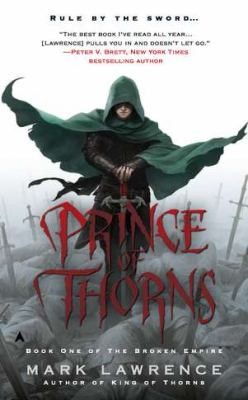
Mark Lawrence · Buy on Amazon
"So Prince of Thorns is completely different from The Worm Ouroboros . It’s doing something different from every other book that I want to talk about. It’s very flippant, very dark humour. It famously opens with a band of what Lawrence calls road brothers, basically a band of particularly unpleasant vicious bandits, who have destroyed an entirely peaceful village and are butchering everyone. And on the first page, it starts with something along the lines of ‘Queues were forming in front of the more attractive young women.’ It’s absolutely just, what would you do if you could… It’s a bit Ayn Rand , or A Clockwork Orange , the fantasy version. The main character Jorg is very much like Alex from A Clockwork Orange . Jorg is thirteen. He’s very physically precocious, so he’s not your normal thirteen year old – he’s six-foot-something and incredibly good with the sword. He’s bright, he’s witty, he’s always got a zippy one liner; and he has absolutely no morals. As we get into the books, we begin to see that he is actually very damaged. And he’s now doing the most revolting appalling things for the lols, because he can. He’s rampaging through what you begin to discover is in fact post-apocalypse Europe, which has gone back to the Middle Ages in the weird way that post-apocalypse fantasies often do – somehow, about 200 years after the apocalypse the few remaining people will be for some reason living like Monty Python and the Holy Grail . They’ve gone back to having witches and magic and wizards and swords and castles. But in the final book, Emperor of Thorns , you begin to realise that when he refers to Empire, he’s actually talking about the European Union . It’s this bizarre mash up of the Holy Roman Empire and the European Union, occupying the same geographical space. At one point we go to Strasbourg, and we begin to realise that what we’re actually going to is the remains of European Union parliament building. So there’s layers in it that you begin to unpick about what’s going on. This book is very important in grimdark, it’s always one of the texts that gets talked about. If people haven’t read much grimdark, Mark Lawrence and Joe Abercrombie are always the two people who are mentioned. And it’s a really enjoyable book. For me, it means a lot… I had very bad perinatal depression with my first child, and I was feeling that I should only read books about being a good parent and child rearing – my whole life should be dedicated towards making my baby’s life as good as possible. I’d never do anything that wasn’t totally focused on her. And then one day in the library, I saw the cover of Prince of Thorns – and if a book is called something like ‘Prince of Something’, and it has a picture of a young man with a sword… Yes, yes . I just couldn’t resist taking it out of the library and reading it. And you can imagine, I was sitting reading it with my baby next to me, having read nothing but books on how to nurture your baby, as if somehow even reading this would come through in breastmilk or something – and now this book begins with queues forming before the more attractive women in the village. And it was genuinely quite a liberating moment for me. There’s a famous scene in it, a really horrible scene, when we have flashbacks to when Jorg is a bit younger. He adopted a stray dog and then his father kills the dog in front of him. Bizarrely that’s always consistently talked of as the most upsetting chapter in the whole book… And I had this moment: I said, “Okay, it will probably be alright, as long as I never butcher a pet in front of her.” Yes! It was liberating: there I was, so anxious about the tiniest little things. It’s a moment of fantasising about what it’d be like to be a really, really awful person. And then you can get back in a much better state of mind. I think that’s a reason a lot of people read grimdark. I’m a member of a Facebook group called Grimdark Writers and Readers, and what’s really noticeable is that everyone is very, very supportive and caring. A lot of the people in the group have had mental health issues and struggles, but people are incredibly supportive and always pull together to help each other. I ran a charity book auction for Save the Children, particularly for the children of Israel and Gaza, and it was the Grimdark people who really came together, and were just throwing money at me. People reading and writing books that go into some really dark, unpleasant stuff — it seems to be nice people that do that. It’s the people who don’t ever cry laughing about it all that are the people you need to watch out for, I think. Yes, yes! A certain person has just launched her book Ten Years to Save the West … I mean, that’s the title , which in itself… the implications of that! Imagine being the kind of person who simply says, “Oh, I know how to save world, follow me.”"

R. Scott Bakker · Buy on Amazon
"Bakker is writing a masterwork. I would consider him the greatest living writer of grimdark fantasy, and his battle scenes are something else. Possibly slightly repetitive — he’s basically writing the same great big battle scene a lot — but they are stupendous. It’s a very misunderstood series of books. The first trilogy was published to great fanfare, then the second series of four by a smaller publisher, and I think he’s talking about self-publishing the last. Because they are very misunderstood, and they’re a difficult read, and serious — I think my criticism of them would be that they don’t have the touches of humour, the light and dark. It’s a bit like the difference between The Idiot and The Brothers Karamazov on the one hand, and Shakespeare writing Macbeth on the other, which has humour. Bakker is definitely more like Dostoevsky . They are about a very classically influenced world, which is threatened by something which is presented like Mordor and Sauron. We slowly begin to discover that it is a world very like our own Bronze Age, which had a spacecraft crash. It was inhabited by very unpleasant beings who had nuclear weapons and laser technology and things, so it works really well in the Mordor/Sauron trope: we have these beings which are inhuman, but almost human. You get the sense that they were maybe genetically altered, like the orcs. It’s alien contact with an intensely toxic masculine society. Into all of this strides the “hero,” who is the Nietzschean Superman: he is blond, he is handsome, he is incredibly physically powerful and intelligent, and he’s had some kind of special training. He’s part of a group of people who have become more than human. People flock to follow him because of that; people see him as the Messiah , and follow him. He is promising that he will save them and lead a crusade against the enemy, these strange inhuman beings who are led by something called the no-God, who are a threat to life, who are utterly evil and wallow in abomination. He will destroy them. He will make us great again… And then we begin to explore what that means. It’s a blatantly toxic, profoundly misogynistic world. In this whole series of books there are three female characters; in the first trilogy there are two, one of whom is a prostitute, the other of whom is a sex slave. They are the only two women who speak. But that’s the point of the books: it is a world of male armies, and women who have no status. A woman’s only value is either to simply be part of the great masses providing food, or to be sexually attractive. There’s a scene in one of the books in the series in which one of the great warrior princes in the hero’s entourage is in his palace relaxing by having sex with a slave girl. This woman is brought in. She’s been chosen as the most beautiful woman in all of this kingdom that they’ve sacked. She’s dressed in this beautiful, revealing outfit. She’s been trained in exotic sexual techniques. It’s the James Bond fantasy. And he begins to have sex – we’re reading this whole thing from his point of view – and he cannot climax. Eventually, he orders someone to bring him a mirror, so that he’s looking at his own face; and finally, he can climax. It’s showing that absolute sterility of what his society and his role actually bring – he’s this great feted war leader, he lives in this palace with all these beautiful women, and his life is utterly narcissistic and sterile and bleak. We contrast this with another character who has a relationship which is a bit like a marriage with a woman who is a prostitute, and they just have really boring sex and they love each other. And of course they are the only ultimately happy and fulfilled people in the book. The book also examines the idea that these people are very homophobic. The idea of two men having sex in an equal relationship terrifies them. So people are making homophobic comments – but that’s the point. The only way people relate to each other is through dumb dominance, either through violence or through sexual violence against people who are weaker than them. So yes, obviously, they’re institutionally homophobic and misogynistic, and it’s horrifying, it’s horrible. It’s meant to be horrible. It’s a world that’s almost totally defined by war. The whole book is spent either following an army around, or in palaces, talking about war. But yes, it’s about the fact that war and a militarised society will mean that everything is militarised: army and war is the most important thing, and that feeds through to everything. There’s a huge cast of workers, who are totally anonymous and live in extreme poverty. And that probably is the history and reality of most heavily militarised societies. The Bronze Age palace system in Mycenaean Greece seems to have operated in exactly that basis: you have palace economies, and they seem to control the whole area around them as almost factories, producing stuff for a totally centralised economy, supporting a warrior caste. One really interesting theory about the fall of the Mycenaean palace society is that it’s an example of a culture-wide riot, the peasants rising up and sacking the palaces, which is very cheering. A Woman of the Sword is my most personal book; the central character Lidae is based on me, her children are based on my children, and the things she says about motherhood are based on my more negative and ambiguous feelings about motherhood. Lidae is a mother and also a warrior, and the back of the book says “War is not kind to mothers or their sons”… I previously wrote a trilogy called Empires of Dust , which is an epic grimdark trilogy about powerful people – high priestesses and political leaders. It’s a world of total war. And as I was writing, I became more and more interested in the lives of the little people caught up in what’s going on. The decision for an army to cross the river at one crossing point rather than another means that one village is spared while another village is doomed; or the decision to send in a small force to be sacrificed, as part of a battle tactic… So I was getting more and more interested in writing about the lives of people who are pawns in the big fantasy landscape of war and violence. I’m a classicist , and there’s a whole stark dichotomy in the classical world – wars are the sphere of men, the household is the sphere of women. But women are the ones who are giving birth to the men who become warriors. You’re a woman somehow bringing up a son in this profoundly misogynistic culture. And women are the ones who are at home, powerless, while their men go off to fight – and if your city is under siege, and if you were on the losing side, there is nothing you can do if war comes to you. So war is absolutely women’s business – just not in the direct way of holding the sword. Of course, women did fight in many cultures: in the Viking period, and in Mongol armies… In most societies which have a fairly small population, women are fighting because economically, they can’t not; you can’t afford to exclude half of your population from fighting. Lidae is a female soldier in a fairly toxically masculine army, in the way that I suspect most armies are, and she is dealing with issues around what armies do. I read a lot of stuff about the classical world, and there’s a lovely little bit in a Mary Renault book about Alexander, where the Macedonian villagers are watching the Macedonian army come back from further south in Greece with a line of slaves; and Mary Renault writes, this is the pity of war, and the message is: win. The message isn’t make peace and stop other women being taken slaves! The message is win, make sure it doesn’t happen to you. So my character is living in a world where violence is economically beneficial to her, but also a world where at any moment that might turn on her. It’s also influenced by Mother Courage; I was lucky enough to see Fiona Shaw in Mother Courage and Her Children , which was amazing. It has that sense of a woman whose life is defined by, and in some ways made better by, war. Mother Courage is economically quite well off, because she is a sutler woman in the Thirty Years War . The war completely consumes her and destroys all of her children; but even then, she cannot imagine a world where she is not caught up in the war, because her entire economic life is dependent on the war. Lidae is a woman for whom war has given huge opportunities, and I suspect war did give people opportunities: the soldiers’ fantasy of pillaging a city and making money to be able to send back to their family, so the family is able to move up in the world. So war is an economic change opportunity. But there’s also the weirdness of thinking about a woman watching her husband, her dad, or brother, or son, going off to war, and knowing what he will do – and welcoming him back, knowing what he’s done. It’s something that really interests me. At one point Lidae is confronted with the reality of what one of her sons has done, and on the one hand, it’s perfectly normal… Yes! I read about a casket that was dug up from a domestic household, and it has a woman’s name carved into it – I can’t remember if it was in Norway or Denmark – but it is clearly an Irish relic. And the best explanation is that someone – possibly the woman herself, more likely a male member of her family, I always think of it as her son – went and massacred a bunch of monks. This was his share of the spoils he brought it home. And you can you can see it, right? – “Here Mom, look, this beautiful little box, use it to keep your precious things in.” I have things like that, things that my children made me in primary school for Mother’s Day gifts. In some ways it’s kind of wholesome; and yet the most convincing explanation of how it ended up where it did is that some monks, who are entirely harmless, have been massacred. You could write this as something really darkly comic – “Oh, whoops, you haven’t cleaned up the blood off.” So there’s a sense of trying to articulate how society operates. And of course all of us do, in fact, live like that, just at a much greater remove. It’s clear if you look at the food production chains, or cheap clothing, or batteries – the conditions in which these things were produced are unspeakable. We are all complicit, we live in a society which is absolutely grounded in other people’s suffering and destitution. It’s important to talk about that. Back to exploring women and war – it bothers me when people talk about wanting kickass women in fantasy sometimes. Yes, traditionally women did nothing. Galadriel stands about being beautiful; Arwen sews a banner, that’s her big role. And then you get the occasional female warrior figure, a kickass warrior, and people talk about wanting this – and of course, seeing a woman being strong and being powerful and fighting the bad guys is in some ways really cheering. But at the same time, is that the greatest thing we can think of for a woman — to be strutting around killing people as well? It’s rather like when we talk about how terrible it is that of the top FTSE 100 companies, most of the board members are men. Great, let’s have more evil capitalists who are women, what a triumph! I don’t want parity on corporate boards, I want more men working in nurseries, not more women abandoning working in nurseries to work in the corporate world, destroying people’s livelihoods. And one more thing about gender – with the writers on this list, I’m aware I’ve got one woman of colour and everyone else is a white man. But there’s another important point to make there – in epic fantasy and grimdark, it is much harder still, depressingly, for women to get somewhere. You still see an awful lot of lists of these books where it’s a great long list of men. Robin Hobb at the bottom is the only woman – and of course, notoriously, lots of people think Robin Hobb is a man. That’s her pen name, and it’s an ambiguously gendered name."

R. F. Kuang · Buy on Amazon
"The Poppy War is the first in a trilogy by R F Kuang, who I think is probably most known now for Babel . It’s a book about the colonial experience: she is ethnically Chinese — I believe she lived in China when she was a child and her family left to go to America. So she’s very interested, obviously, in the experience of recent Chinese history , which was not Britain’s finest hour. The Poppy War is about 19th and 20th century Chinese history, in a fantasy world. We’re imagining what it would be like if Chairman Mao was a teenage girl in a medieval fantasy setting. It begins very un-grimdark-ly, in this Harry Potterish magical school. Our hero Rin is taken off to this school, where she is ridiculed by most of the other people because she’s from the peasant class. She’s also got dark skin, so she is the victim of colourism and of classism. To no one’s surprise but her own, she discovers that she is in fact very, very gifted. So we begin with a non-western spin on Harry Potter and Hogwarts – now she’s working to save the country. It’s something like what Bakker’s doing in The Darkness That Comes Before , or what I’m doing in Empires of Dust : writing about power and military structures and the danger of militarism, and the complexity of the idea of saviours. She’s writing about the experience of someone who is trying, genuinely trying, to save her country and liberate it from colonialism. By the time you get to the end of the trilogy, there are armies which are being sponsored by foreign powers, who are coming into her country. She writes about the experience of China during the Second World War ; she writes horribly about the Nanjing Massacre, and about the violence that was inflicted on China in the 19th century by Europe, and then in the 20th century by Japan. But she’s also writing about the resistance to it, generating the need for extreme action. Her character Rin is not an Aragorn or Harry Potter-like ‘decent person’. She’s driven, she’s violent, she’s not a pleasant character. There’s an astonishing scene at the end of the third book, where she takes something which burns out her womb; and I’ve read several reviews of this where people say it is gratuitously disgusting, and just Kuang being horrible: why does she do that? But of course, on the Long March, Mao and his first wife abandoned several of their children, and they were never found. On the Long March children were left and abandoned, and died. Because as far as Mao and his wife and many of the other people on the March were concerned, what they were doing was so important that even one’s children had to be sacrificed. We see similar things in other resistance movements and extreme circumstances… It’s not done happily, and the scars will be there, but it’s necessary. So what Kuang is writing about is a leader who is not pleasant, and who is forced to do terrible things, but because terrible things are being done to their country. She writes about what happens to the people of China during the Rape of Nanjing; the response to that can only be extreme. You get these reviews along the lines of, “I started off reading this and I thought it was a bit of a clichéd magic school trope, and then Whoa ” – because actually, if you were Harry Potter and Voldemort was real, it would be “Whoa.” Yes. It’s interesting, a friend was talking about Babel , and he was saying, “Gosh, Kuang is amazing. She totally rewrites the history of Victorian Britain.” And I thought, she’s re-writing the history of Victorian Britain for you …"

Michael R. Fletcher · Buy on Amazon
"Fletcher’s written lots of books. Swarm and Steel is my particular favourite, but what I’m saying about him stands for all his books. Mike is a friend of mine; we co-wrote a book together. He takes grimdark insanity to extremes. His books are not serious, they are funny, and just gleeful – it’s just, how far can ‘too far’ go. But his world is actually in some ways a nice world – it’s not a world where people are racist or homophobic or sexist, it’s a world of completely equal opportunities to be a complete asshole. Anyone can torture, maim, sack cities, and set themselves up as a deranged cannibalistic god. The one thing people do not talk about is disliking someone because of their sexual preferences or gender preferences or skin colour. It’s just a world where everyone does horrible things, but also will show great goodness and great kindness for the people around them they love. A world without moral limits, with extreme violence, but with real people who are muddling through. Often someone starts out trying to do the right thing, and violence becomes more and more extreme because things escalate. It’s a very human picture of how badly we all mess up. It’s just done very graphically! It’s set in his world of manifest delusions, which is a world in which a lot of people have extreme mental illnesses and delusions, but those are real. So if you believe that your body is overrun with insects, your body is overrun with insects; and you can then use those insects in combat, send them off to attack other people. There’s this wonderful character we never meet, but we read his poems, and he believes that he’s dead – so he is dead. He’s the heartbroken drug addled sort of poet; the kind that says, “I love you, I tried to be faithful to you, but unfortunately then I took an absolute shitload of drugs and slept with sixteen prostitutes, but I love you.” And it’s a ghoul writing this stuff, because he believes he’s dead, in the way of that romantic poet trope. I love that. Our main characters are a fantastically kickass young woman called Zerfall, and a young man who’s been thrown out of his tribal warrior society because he accidentally killed someone. Zerfall has accidentally founded her own religion, which has taken over the world and is now one of the big dominant religions – and it’s a really horrible religion where everyone goes to hell. But she didn’t mean it to happen like that; it just escalated. They are wandering around this world of complete insanity, where reality constantly shifts… like, if you meet someone with a split personality, then they are two people. It’s a world where everyone’s mad, and everyone’s madness is inflicting pain on themselves and other people. Our heroes are always the only sane people. Acting to defend those around you that you love is the last vestige of sanity. It’s a bit like a really violent Asterix , in the way that Asterix and Getafix are the only two sane people in the Asterix world. Yes! It’s that Asterix world where everyone is completely loopy and hitting each other and fighting all the time. But because of that, it’s recognisable as absolutely human. It’s also like classic Father Ted or Blackadder ; it reminds me of Blackadder Goes Fourth , with the complete insanity of life, and the humour – and a lot of people say it’s the most convincing depiction of the First World War . There’s that horrible final episode when they’re going over the top, and the closing line of Blackadder’s about everyone being mad. It’s real because it’s completely deranged – because the world is completely deranged! It’s a very human world about human people constantly messing up, and most of the people are deeply damaged people. But they’re never evil."