Angela Duckworth's Reading List
Angela Duckworth is the Founder and CEO of Character Lab , a nonprofit whose mission is to advance the science and practice of character development. She is also the Christopher H. Browne Distinguished Professor of Psychology at the University of Pennsylvania, faculty co-director of the Penn-Wharton Behavior Change For Good Initiative , and faculty co-director of Wharton People Analytics . A 2013 MacArthur Fellow, Angela has advised the White House, the World Bank, NBA and NFL teams, and Fortune 500 CEOs. Her latest book is the best-seller Grit: The Power of Passion and Perseverance . She can
Open in WellRead Daily app →Character Development (2019)
Scraped from fivebooks.com (2019-04-01).
Source: fivebooks.com

Walter Mischel · Buy on Amazon
"Sigmund Freud said that the chief developmental challenge of childhood is to be able to delay the gratification of certain impulses and to negate certain impulses altogether. That’s what allows you to achieve maturity as an adult. Nobody had figured out how to test that until Walter Mischel. The marshmallow test is one of psychology’s greatest experiments, conducted by one of the twentieth century’s greatest psychologists, Walter Mischel. He created a test where children were given the choice: Do you want to eat one treat, or several? All the kids in the experiment—and I really mean all of them—chose the bigger pile. Walter would then say: You can have the bigger pile, but you have to just wait until I do something in the other room and come back. Then, he would ask, ‘Do you want to wait?’ And again, all the children say, ‘Oh, I can wait!’ Walter would leave the room and observe what would happen next. Many children gobbled a marshmallow as soon as he stepped out. Some children were able to wait two minutes, seven minutes, even fifteen minutes. Then Walter followed these kids through life. Support Five Books Five Books interviews are expensive to produce. If you're enjoying this interview, please support us by donating a small amount . The ability to wait predicted a wide range of life outcomes, just like Freud and Walter hypothesized. How long you sat—the ability to delay gratification—predicted the quality of your friendships, your physical health, and whether you would go on to commit a crime, along with a whole host of other positive outcomes in later life. It’s not just about the marshmallow test—it’s autobiographical, too. He talks about his struggles with self-control and how he developed his experiments. It’s fascinating. But the best reason to read this book, and I think the reason why his books remain perennially popular, is because Walter packed his whole life’s work between two covers. It integrates all his studies, all his wisdom. It’s a wonderful thing that we still have the book, because we lost Walter."
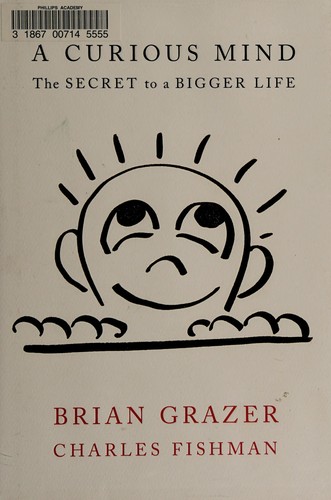
Brian Grazer · Buy on Amazon
"I read A Curious Mind in one sitting. I sank into a chair and fell into the story of this person, who did not start with material advantages but ended up doing great creative work as a Hollywood producer, creating award-winning, wildly-popular work like Apollo 13 and Arrested Development. The list of things Brian Grazer did is long and it’s all because of his curious mind. “Curiosity makes you smarter: when you are curious about something, you learn and remember it better than if it bores you” He calls curiosity ‘a superpower.’ When we read this book, filled with his personal story, we get how curiosity made his life extraordinary. The book has lots of stories about curiosity conversations with people that are famous for different reasons and in different fields. I read it cover to cover in part because it’s so fun and it’s so fueled by curiosity and creativity. Curiosity is increasingly grabbing the attention of top neuroscientists and psychologists. One of the things that’s been discovered by a scientist named Matthias Gruber is that curiosity makes you smarter: when you are curious about something, you learn and remember it better than if it bores you. I’m really excited about the coming research on curiosity."

Carol Dweck · Buy on Amazon
"A recent study showed that the majority of teachers in the US know this phrase: growth mindset. Why? I think partly because it’s so intuitive. Growth mindset is the belief that people can grow with effort and opportunity. But Dweck said recently that there is a lot of ‘false growth mindset.’ I’ve seen that happen in schools, where whenever kids struggle they are told ‘you need a growth mindset.’ Of course, many other factors matter and must be address. But you also really need to understand that ‘growth mindset’ is not just a slogan. “I’ve never met a CEO who didn’t have Mindset on their bookshelf” Understanding the research that Carol Dweck has done and unpacking is invaluable. Why do some have fixed mindsets? Where do they come from? What goes on in kids’ heads when they fail? How do mindsets determine what we do? Plus, Carol Dweck is not only a great psychologist, she is an outstanding writer. It’s a beautifully written book. Without exaggeration, I’ve never met a CEO who didn’t have Mindset on their bookshelf. It resonates with people who have become successful—CEOs, coaches and other leaders—because the belief that your abilities can grow is foundational to their achievements. We are the first generation to use the science of experimental psychology to help people become happier and healthier. When Carol Dweck does research on mindset, or I do research on self-control, or Matthias Gruber does research on curiosity, we don’t want people to take away the wrong lesson. Take the importance of practice: studies show that not all practice is effective, but concentrated practice focused on precise skills, with deliberate goals and immediate feedback, can lead to large improvements in performance. Get the weekly Five Books newsletter We did a very short experiment where we taught kids that information and found that, compared to placebo controls, they actually improved their grades. You could say the lesson of all this research and the lesson of your character lab is that it only takes 25 minutes to change a child. But I don’t think that’s the lesson. For example, in the experiment that I just told you about, performance improvements disappeared or got diluted over longer periods of time, so that by the second marking period following the intervention, they were no longer detectable. “Studies show that not all practice is effective, but concentrated practice focused on precise skills can lead to large improvements in performance” The real lesson is if you—as a parent, coach, teacher or boss—help someone to understand the nature of practice, it will help them deal with the effort and the frustration that is necessary to achieve better. That needs to be reinforced in continually and in every possible way. So, we are working on providing the scientific insights that you can use to make your managing, parenting, and teaching better. But applying those insights is not as simple as relaying them."

Mitch Prinstein · Buy on Amazon
"Mitch Prinstein is a fabulous psychologist who studies social intelligence. I only chose books that I think are great science, but also really well-written. Prinstein wrote a wonderful book, very warm and relatable. There are a lot of great stories, and it’s a terrific summary of more or less everything that’s known on the topic of popularity. Popularity is an inescapable part of life—especially for adolescents and teenagers and the people who love them, but for everybody in many facets of life. His work (and this book) shows that there are ways to go about the popularity game that are bad for you and for others. The thing about the chicken-and-egg question is that for almost everything that I study—grit, popularity, productivity—the relationship between the attribute and achievement is truly reciprocal. In other words, there is no real good answer to your question, because they follow each other. For example, kids who are more socially adept and have more friends do better in school, which probably helps them have more friends. Both my intuition and the science show that most things feed into each other. Get the weekly Five Books newsletter That’s why we can get into virtuous cycles. Kids who are happy are healthy and tend to do well in school, which makes them happy and healthy. It also means that there are vicious cycles—people who start to get depressed and become socially isolated and stop sleeping well. Performance slips, causing a continued downward spiral. What we want are upward spirals."

William Damon · Buy on Amazon
"Bill Damon pioneered the science on purpose. He would say that purpose is doing something that is beyond the self, but also rewarding to self. That’s what’s so magical about it. Personally, my top level goal is to help people thrive. But I also find the process very gratifying and pleasurable. There is nothing I want to do more passionately than reading a new psychology article. In the book, Bill Damon talks about his own research as well as that of others. His research shows that only a minority of young people feel a sense of purpose. He studies both those who have a sense of purpose and those who don’t. His research focuses on where purpose comes from and how to share it. It’s a beautifully written book, and pretty short. When you read it, you feel like you are sitting across from someone who is not only a great scientist, but a wise soul. Path to Purpose radiates his warmth, his empathy and his wisdom on how to lead a good life. For that reason, it has had a big impact. All of the books that I recommended concern genetically-influenced attributes. At the same time, all these things are environmentally shaped. The practical take-home answer is yes, we’re born with different genes, but our role models—how we are raised, the quality of our educational experiences and whether we have access to sports and music— also influence how we turn out. So it’s not nature or nurture: it’s nature and nurture. Science teaches us that we disproportionately focus on things that are going wrong and we tend to slight what’s right. And studies also show that, in general, reinforcing the positive, and highlighting strengths, is more effective in remediating negative behavior then dwelling on what’s wrong. So, in general, positive reinforcement is the best way to deter negative behavior."