Andy Puddicombe's Reading List
Andy Puddicombe is the co-founder of Headspace , a popular app that teaches simple, 10-minute meditation techniques. Puddicombe began learning to meditate at the age of 11, and traveled to Asia in his early twenties to become a fully ordained Buddhist monk at a Tibetan monastery in the Indian Himalayas.
Open in WellRead Daily app →Meditation Books (2019)
Scraped from fivebooks.com (2019-05-09).
Source: fivebooks.com
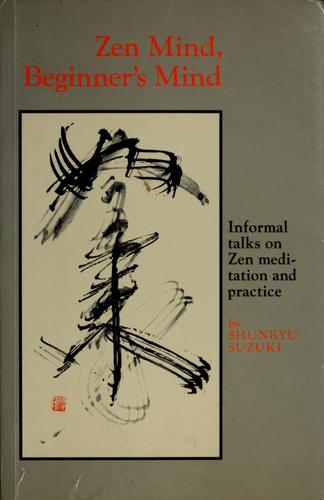
Shunryu Suzuki · Buy on Amazon
"It’s genius. I really think it’s one of the best books on the planet. I mean, I’m not the most widely read person, so take that with a pinch of salt, but I really do. When you go into retreat—long-term retreat, a year or more—you’re not normally allowed to take books in with you. Occasionally, though, some teachers will let you to take a few books. I was told by my teacher—even though it was a Tibetan Buddhist monastery, and this is teachings from a Zen master—he said: “If you take just one book in with you for the year, take this book.” So that’s quite an endorsement, you know. It says a lot for the book. It’s about meditation, but it’s bigger than that: it’s about life. And he talks a lot about ‘big mind’ and ‘small mind,’ small mind being our intellectual/thinking mind, which is very important. It’s the mind of relativity; the relative mind, the dualistic mind. But he also talks about this ability to fall back and rest in ‘big mind’, or awareness, and to see life with a different perspective and approach it. “Every time I read it, it still has the effect of pulling me out of everyday life, and making me see the world in a very different way” So, meditation is a technique, and there are lots of different techniques. But actually, the technique is not really the important thing, although most people think it is. It’s actually how you approach the technique. This is what Suzuki Roshi focuses on. And this is true for so many things in our life: it’s often not about the things that happen; it’s about how we’re relating to them. It’s amazing. You don’t have to read the whole book—you can just read one of the chapters, which are only four or five pages long. Every time I read it, even now when I reckon I’ve read it more than 40 or 50 times, it still has the effect of pulling me out of everyday thinking, out of everyday life, and making me see the world in a very different way. I have no idea how he does it: he’s transcended religion, transcended tradition, transcended mind itself. And therefore he’s able to deliver it in a way that anybody can relate to. It’s a book for anybody. Regardless of whether they have an interest in meditation, as it’s about more than that. It’s about life. But that whole idea of a ‘beginner’s mind’ is an important part of the meditation journey for sure: it’s very easy to assume that if we’re sitting down and doing the same thing—sitting in the same position with our eyes closed each day, to fall into a routine or habit, because we’re trying to replicate an experience. But if we look more closely, we see the mind is always changing. Different people, different places in our mind; different thoughts, different sensations. So, maintaining that sort of interesting, curious, open mind—or as he prefers it, ‘beginner’s mind,’ is a really important part of the practice."

Chogyam Trungpa · Buy on Amazon
"Yeah, Chögyam Trungpa was obviously quite a controversial figure. But he taught in a way that was quite revolutionary at the time. I think within any religion or philosophy, generally people had always spoken in a serious way, a dry way. Trungpa cut through all of that. He would say it as it is, he would call people out and say, ‘that’s a load of nonsense.’ I like that. I think it was very bold, it was very brave, it reflected a new time and the spirit of the sixties, the seventies: something different was happening. I also felt he was calling out probably the biggest trap in the journey of self-discovery, that of spiritual materialism. Although it’s easy to say in the West that everything is great in the East . . . It’s not like that. But I do feel like in the West, as many of these traditions have come in, as they’ve landed and people have adopted them, it’s had less to do with going on a journey, giving up identity, and transforming the mind, and more to do with, ‘Oh, this looks nice, this is a bit different.’ You hear people say things like: ‘Oh, he’s a spiritual person,’ or ‘she’s spiritual’—but I don’t even know what that means. If we meditate in order to let go of labels, to let go of identity, the last thing we want to do is take on another label: of being ‘spiritual.’ We’re looking to let go of that kind of judgment. It’s not about becoming— it’s actually about stripping back, letting go of, and simply being . We can call it spiritual, but ultimately it’s about being present. It’s about being open, curious, kind, compassionate. If we do that, it doesn’t really matter what we call it, as long as we’re living that life. I feel like he gets to that point in a way that I haven’t seen, still to this day, in any other book. I actually don’t see them as separate. All of the teachings that I was fortunate enough to study in the past or study now, there’s no longer an idea of separation. I’m not sure why, but over time, it has become less thought-through, and more spontaneous. But I do feel that Trungpa was unusual in that way, that he had come from a deep tradition, in that he’d been a Buddhist monk for a long time, yet he was presenting it in quite a secular way. He wasn’t talking in the way Tibetan Buddhist masters have talked in the past. He was a little bit like, ‘I’m a regular guy, just living in the world.’ That was a real shift."

Śāntideva · Buy on Amazon
"Śāntideva’s is a really interesting book. It’s so lofty, so aspirational, although there is some commentary in there; in some ways the traditional text is quite dry. But it’s so rich in terms of its intention; I feel really attracted to it, and like it sets a goal and a direction in life. In no way am I suggesting that I am living his ideals, moment to moment, day to day. I wish that I were that transformed. But I think there’s something really healthy about having a sense of direction in life. You know, just knowing where we’re going. Whether we think about it in terms of purpose or fulfilment, there’s the day-to-day kind of living, but also the where-we’re-going kind of living. I don’t see where we are going as a physical place, or a place in our career, or in our family, or anything like that. For me, it’s in our sense of purpose or intention, and I feel like that text, well, if we were to have a north star, that’s a really beautiful north star to have. Whatever you do, don’t sit down and try and read the book cover to cover. It’s not designed in that way. The instructions themselves are normally split up into four or five lines of text. The first time I read it, I read the commentary at the start. Then I tried to read a page or two a day. It might be I would only read four lines of text. Not even full page lines either, they’re what—10, 20 words? But for me, that is the purpose of the book. It probably took about a year to read it the first time, and once I found something that stood out, I would put a little mark by the side of that passage. I’m not a big believer in writing in books normally, I just don’t do that, but this is one book where I would so I could go back to it later. The purpose is not to read cover to cover; the purpose is to find out what is the essence you need in that moment that’s going help you live a happier, healthier life, and in turn to help others lead a healthier and happier life. And that’s enough. I still use the book in that way."

Ryōkan · Buy on Amazon
"I’m not really into poetry. I haven’t had loads of exposure to that in the past. But when I was a monk, my mum really struggled to know what to buy me on birthdays and at Christmastime, because monks are not really—well, you can receive a gift, but you’re not really supposed to keep it unless it’s related to one’s training. That was always really hard for my mum. So, I went home to visit one Christmas, and she thought this was the one thing she could buy me that I wouldn’t give away, and I would be allowed to keep in my room. I read it, and it had such an impact on me. Support Five Books Five Books interviews are expensive to produce. If you're enjoying this interview, please support us by donating a small amount . To this day, I’m still not too sure why. But I have a sense. I felt like what he was expressing was my experience of living in the monastery. Most of his poetry is about living in a home that’s up in the hills, away from everybody else, an incredibly simple life. Really, it’s just a commentary on the passing experience of life; on impermanence and everything changing. I think in everyday life it’s very difficult to see that, because we are so busy. But when you’re away like that, you see the leaves changing colour on the trees, those things that perhaps feel very ordinary if we have lots going on in our life, but in that context, they’re everything. This is life, happening all around us. So I felt that in those simple haiku in that book, he just captures a moment, that, for me, reflected a very similar experience at that time. I’m a little biased. But I’m a huge believer in taking retreats. I think retreats can take many forms. You definitely don’t need to become a monk or a nun, you definitely don’t need to go to live alone in the mountains, but I do think that retreating into nature can be a really helpful shift for both body and mind. When most people go into nature, we let go of some of the tension. Our body and mind tend to quiet down. There’s less distraction, so we tend feel a bit calmer, more at ease. For people considering a more meditative-type retreat, I always say—because it was recommended to me in this way—dip your toes in the water before jumping into the deep end of the pool. Rather than saying, ‘Right, I’m going to do a 10-day, or a month-long, retreat,’ try a weekend. And see how the weekend goes. Make sure there’s a teacher there who’s very supportive, who understands that you’re new, and that you haven’t done this before. You can then build it up from there. That can really begin a journey of a lifetime. A journey of not only better understanding our own minds, but of better understanding the human condition. If we better understand the human condition, out of that arises empathy, and out of that arises compassion. As a consequence, we tend to live in the world in a more harmonious and peaceful way."