Andrew M. Butler's Reading List
Andrew M. Butler is a British academic who teaches film, media and communications at Canterbury Christ Church University. He is a former editor of Vector , the critical journal of the British Science Fiction Association and was membership secretary of the Science Fiction Foundation. He is the non-voting chair of the judges for the Arthur C. Clarke Award for Science Fiction.
Open in WellRead Daily app →The Best Science Fiction of 2022: The Arthur C. Clarke Award Shortlist (2022)
Scraped from fivebooks.com (2022-09-03).
Source: fivebooks.com

Harry Josephine Giles · Buy on Amazon
"Novels-in-two-verses, you might argue. One in Orcadian, one in English. Orcadian is a dialect of Scots—as opposed to Gaelic—and there’s a history of Scots feeding into science fiction and horror, especially Gothic horror. In 1919, someone came up with the idea of the Caledonian antisyzygy —the Scots think in one language, but feel in another, say. There’s a sort of divided consciousness at the centre of Scottish books , poetry and art—and we can trace this division in authors such as Robert Louis Stevenson, Iain M. Banks and many others. The action of Deep Wheel Orcadia is mostly set on or close to an isolated space station, at a crisis point in the solar system, and focuses on the working and private lives of the characters on board. You could decide to read the Orcadian version and then the English, or vice versa, or just one—but you’d miss so much if you only read half. I think you can pick up the Orcadian, as you might the Riddleyspeak in Russell Hoban’s Riddley Walker . Mind you, the English isn’t straightforward. Look at this on the first page: She watched the Deep Wheel approach, grey-green, its Central Station still turntwistwhirlspinning againstaboutbefore the yellow gas giant. That first coinage is a translation, well, four translations, of ‘tirlan,’ which I assume could be translated as any of them. Translators usually just pick one equivalent, which can shift the meaning of the original. As the text is their own translation, Giles could adjudicate between them, but allows all four. And sometimes what you might see as ‘Received Pronunciation’ dialogue breaks into the Orcadian. There’s a long tradition of science fiction looking to the past or to other cultures as inspiration. I was at a maritime museum in Bergen, Norway, a couple of years ago and a map there located Orkney as almost being central to the Viking interests—the North Sea as a sort of internal sea as the Mediterranean was for the Romans. You can read the Norse sagas and some of the Old English poetry of the pre-eleventh century and there’s a science fictional, certainly a fantastical, feel. There’s an account of discovering America , say, which might be real history or might be an imagined history. Choosing it is pushing the boundaries of the award, as we did with Simon Stålenhag’s illustrated The Electric State a couple of years ago. We don’t see verse novels often in science fiction. Giles’s poetry makes us see the world in a new way—doubly so in an outer space setting. I’ll definitely be pushing the judges over whether it is indeed a novel. But I think it’s the sort of book the prize exists to draw attention to for die-hard scifi readers, and to make non-scifi readers question their assumptions about the genre. Thinking about it, there’s a couple of science fiction novels in Welsh, and I’d love for translations of those to be submitted."

Kazuo Ishiguro · Buy on Amazon
"I can’t be too specific about their opinions, but we spent a long time arguing over its inclusion— Never Let Me Go was shortlisted a few years ago and The Buried Giant was submitted, but that probably too fantasy . Some of the judges had very emotional reactions to the novel, especially about the central narrating character, Klara, who is an ‘Artificial Friend’ and somewhat… pliant. But in fact, most of the female characters in the novel are passive or altruistic, accepting of their fate. The novel was on the Booker long-list, and he’s won a Nobel Prize —pretty rare for scifi writers—but that won’t necessarily count in his favour or indeed against him. I don’t see why not—arguably it’s a traditional science fiction novel, told from a first-person point of view. Ishiguro was on the original Gran ta list of the best young British novelists back in 1983, with Martin Amis, Salman Rushdie, Ian McEwan and Clarke-winner Christopher Priest. Several of them have written science fiction or something close to it. Ishiguro’s literary trick is that the world Klara knows is limited by what she can see or what she is told about. As readers, we might have a better idea of some of the things she doesn’t realise—what she has got herself into, say—but the narrative might not go where we expect or perhaps hope. We’re assembling Klara’s world alongside Ishiguro. And the idea of the Sun as potentially a God is fascinating; in science fiction it could, of course, be a superior being."

Arkady Martine · 2022 · Buy on Amazon
"I guess this is space opera, about interplanetary conflict and first contact, not necessarily in that order. The Teixcalaanli Empire encounters a superior alien threat and Three Seagrass, the protagonist from the previous book, is brought in to try and communicate with them. She insists on getting the help of her friend, Ambassador Mahit Dzmare, hoping to stop a war. But there are factions within the empire who would like war or would find it quite useful for their careers, so there are a lot of conflicting and murky motives on display. I don’t think you need to read Empire to enjoy Peace ; in fact, not all of the judges had, since it was different group of readers. I’d read it, but that’s a few years ago now and I’ll try and read them back-to-back before the final meeting. You need to know that Mahit’s predecessor as ambassador died in mysterious circumstances and that she has an incomplete back up of him in her mind. The Teixcalaanli emperor, Six Direction, was also under attack and now Nineteen Adze has taken over the position. But there’s an eleven-year-old partial clone of Six who is taking an interest in imperial events and make possibly end up making it worse. It’s a rich brew of characters and conspiracy, but there is a useful glossary at the back, which I confess I did use as I’m rubbish with names. It’ll be up to the judges whether they feel it stands alone or is the second half of a single novel. We’ll see!"

Courttia Newland · Buy on Amazon
"It’s so timely—there’s the In the Black Fantastic exhibition at the Hayward Gallery at the moment, which has both responses to the legacy of colonialism and attempts at reconstructing the lost heritage of what we call African. Colson Whitehead’s The Underground Railroad recast an era of American slavery through science fiction and Namwali Serpell’s The Old Drift put a science fictional spin on a long history of Zambia; both won the Clarke Award in previous years. Recently there was Marlon James’s fantasy trilogy, which draws on African mythology and narratives. Newland uses beliefs from various African cultures, and you have to accept them as true within the context of the novel. It’s way of looking at the world, treating it as science. Get the weekly Five Books newsletter In this novel, Africa has not been subjected to the horrors and traumas of European colonisation and it seems as if technology has developed faster than in our world. I think you could argue about this—the Industrial Revolution seems pretty solidly developed through imperial exploitation—but it’s clearly a divergence from our history, way back. There’s a timeline at the start of the book where Columbus reaches American in 1392 or thereabouts, so technologically, things have happened more quickly. There’s been some disaster in what we call London, a couple of centuries before the novel, around the time of the Regency . An Ark has been built—essentially a fortress—to protect the chosen citizens from poverty and the fall out of the disaster. The central character, Markriss Denny, aspires to join this elite and has discovered he can astral project himself. But he pretty quickly discovers that the Ark isn’t a utopia, and that he is part of a struggle which could destroy everything. I think the term goes back to William James in the nineteenth century, but a key name is the quantum theorist Erwin Schrödinger—he of the dead-and-alive-cat thought experiment—who suggested that different events could be described or predicted by the same equations at the same time. He wasn’t happy about this. The writer Michael Moorcock then used the term—or maybe he came up with it independently, I’m not sure—to describe his individual and overlapping novels featuring versions of the Eternal Champion. He rewrites the different books with the same character, or vice versa. In a sense, the idea relates to the science fictional alternate world—such as in Philip K. Dick’s The Man in the High Castle where the Nazis won the Second World War . In that novel, characters slide between versions of reality, and the same is true of A River Called Time . It’s not necessarily the same imagined world in each of the sections. In fact, in one case, clearly not. That could be a spoiler, so I won’t say any more. Newland plays it straight, but we as readers are trying to work out what is real and what isn’t. Funnily enough, I’ve wondered if Whitehead is doing something equivalent in The Underground Railroad; it’s as if each station opens in a different version of America. It’s an impressive science fiction debut, but Newland has been publishing for years. I need to get hold of his newish collection, Cosmogramma , which seems to include science fiction, and it might be that some of the stories predate the novel. I only knew his name from a couple of credits on Steve McQueen’s Small Axe anthology series about Black experience in Britain. He’s clearly done masses of research and I hope he writes another scifi novel."

Mercurio D Rivera · Buy on Amazon
"This is formed from short stories. There’s a term for this which science fiction criticism invented and has argued over ever since, the ‘fix-up.’ Ray Bradbury’s The Martian Chronicles is a good example—that’s a series of short stories set on Mars, mostly, which reads as if it’s a novel. But in fact, some editions of it have different stories. They tend to be episodic and can cover a long period of time. The Wergen are an alien race who are sexually attracted to human beings, whether they like it or not, and want to help them. Humans are more than happy to exploit this, and some of the Wergen resist or fight back. They don’t want to be subject to desires they can’t control. It’s an extraordinary achievement—Wergen biology is fascinating, and it really plays with our notions of gendered desire. Of course, same sex and opposite sex is rather different when applied to cross-species relationships. It’s deeply moving at times. There are lots of tragic moments. That term is also argued about! It tends to refer to science fiction that is very dependent on scientific extrapolation— physics , chemistry, astronomy, the hard sciences—in fact, the sort of fiction that Clarke tended to write. In later novels, he had the habit of stopping the narrative to spend a chapter discussing a random moon of Jupiter or wherever, presumably jumping off from the latest academic scientific article. It tends to be used as the opposite of ‘soft’ science fiction, which extrapolates from sociology, psychology and other soft sciences. There’s a chapter in Alien Love War where a group of characters are descending in freefall from a great height and hoping to survive. In hard science fiction, the author will have worked out the mass of the planet below and the gravitational pull, when maximum velocity would be reached, and so forth. In soft science fiction you’d get an allusion to Icarus or Lucifer, as you try not to worry that that character won’t walk again. I’m not sure I would have thought of this novel as hard science fiction myself, as there’s so much psychology. Maybe Rivera did crunch the numbers."

Aliya Whiteley · Buy on Amazon
"Again, I think the judges were responding to the platonic romance at the inn between a human, Jem, and a Qitan, Isley. It seems we invaded the Qitans’ planet when we discovered it, looking to exploit them, except they more or less willingly surrendered. The inn is in ‘the Protectorate,’ an anti-technological enclave in Devon, where Isley is the only permitted alien. It feels a little like the fundamentalist settlement in Wyndham’s The Chrysalids : a puritanical, pastoral utopia-dystopia, which wants to stop the clock. This enclave is threatened by the arrival of another Qitan and a plague. There’s no escape from pandemics! Can I? There’s certainly the thread of conquest as based on capitalism—which was typical of European imperialism, as I said earlier. A few of the reviews I’ve looked at cite H.G. Wells’s The War of the Worlds , with its throwaway footnote about the genocide in Tasmania . Partly Wells imagines us in the role of the colonised—then all the Martians die from flu, or something like it. In Skyward Inn, I think it gets more complicated, since there’s a cultural interaction between the species, like there was in Alien Love War. And A Desolation Called Peace, come to that. How changed were we by the people we colonised, kidnapped or enslaved? We’ve appropriated their music and their food, and yet acknowledging historical injustices is often dismissed as just another woke salvo in the culture wars. Meanwhile, the National Trust and English Heritage get attacked for acknowledging the source of the swag that financed so many of the stately piles they look after… The impact of the encounter with the alien is profound in several of these novels – it’s up to the reader to decide if these changes are to be welcomed or feared. I think so. To return to H.G. Wells , he gave us a toy box of half a dozen or so novels: time travel , alien invasion, trips to the Moon, and so on. There’s a constant fear that these devices will go stale or become useless clichés—although there’s always room for another murder or another romance in other genres. The history of genre science fiction is dominated by straight white men and, whilst there’s nothing wrong in that in itself, it’s refreshing to get an unfamiliar take on the world from other identities. We obviously owe a debt to Mary Shelley, but far too many other women have been downplayed or written out of scifi history. With a few exceptions. Get the weekly Five Books newsletter There’s only a handful of Black, British science fiction writers. If you look at the catalogue for the exhibition I mentioned before, In the Black Fantastic, African Diasporic science fiction has been healthy for decades in music, cover art, the visual arts and so on. It’s just not necessarily been published in New Worlds or InterZone or by Gollancz or HarperCollinsVoyager, and we’ve not been paying enough attention. I’m sure Stewart Hotston will have crunched the numbers for us, about how many writers of colour were submitted and how many women, and how that compares to previous years. But the diversity of our shortlist is testimony to the strength of the books, rather than the judges filling quotas. And I genuinely don’t know which book will be chosen as the winner. I think we will have a tough and even more passionate meeting to decide. Part of our best books of 2022 series."
The Best Science Fiction Books of 2025 (2025)
Scraped from fivebooks.com (2025-06-19).
Source: fivebooks.com

Julia Armfield · 2024 · Buy on Amazon
"It’s focused on sisters in a near-future Britain ravaged by the climate catastrophe and concerned with the illness and then death of their father. It’s a variant on King Lear , which of course doesn’t end well, and it nods to horror, even folk horror. The family is falling apart, and its secrets are beginning to surface. It’s a far from comforting book. It was, along with the apocalyptic in general. That’s nothing new. Richard Jefferies flooded London in 1885 and Ballard did it in 1962. We seem to take a perverse pleasure in the end of the world – even when it seems all too plausible in our near future."

Kaliane Bradley · Buy on Amazon
"It’s a page-turning account of the scooping of a number of people out of the past and then what happens to them when they end up in a near future. One of them is Commander Graham Gore, who in our world died in Sir John Franklin’s attempt to cross the Northwest Passage in the Arctic, and has a present-day minder to help him cope with the inevitable culture clash. Both main characters are utterly believable and you wait for what seems to be the inevitable romance to develop. It’s become hugely popular in the BookTok community and I look forward to more novels from her. Time travel can get bogged down with paradoxes and other complications. It can feel like a logic puzzle – there’s one classic story, which I won’t name because of spoilers, where the main character becomes both his parents and indeed all the characters in the story. Or there’s the “Let’s kill Hitler” cliché. Bradley uses paradox more subtly, but it’s characterisation and character development which sold it to me – who is Gore and how will the narrator relate to him?"

Ian Green · Buy on Amazon
"The author has previously written fantasy and I think this is the first novel-length science fiction he’s published. It’s a caper, set in a climate-damaged near-future London, where a high-risk heist might save the world. Some of it is bound to go wrong and there’s a very densely imagined culture. There is an undercurrent of anger at what we are doing to our world and how corporations treat people – rather like Ned Beaumann’s Venomous Lumpsucker , which won a couple of years ago. In fact, there’s anger in a couple of the books. Again, it’s very promising work. With the success of cyberpunk forty years ago, there was a vogue for naming any new subgenre somethingpunk – steampunk , hopepunk, solarpunk and of course biopunk. It’s like every scandal having the word -gate stuck on the end. Some of the original cyberpunk stories had genetic and biological modification alongside implanted computer chips and virtual reality, but some people find it useful as a term. Your typical biopunk protagonist has modified DNA, which changes where they can live or how long they live. It might be they can photosynthesise rather than needing to eat. There’s usually a dodgy black market and corrupt multinational corporations, with quite a lot of overlap between the two. Again, that’s rather cyberpunk."

Sierra Greer · Buy on Amazon
"Annie is a companion, a manufactured housewife who is programmed to keep her husband happy. The husband’s best friend is a jerk and mistreats Annie, whilst the husband gets more and more unpleasant. If she were a real woman, you’d be thinking this is coercive control, but if it’s just a machine… well, it gets messy. The judges spent a lot of time talking about the ethics of the novel and what they made of the husband. I think that’s the mark of a great book – it leaves you with questions. I think if it was about real AI then Annie would be a lot more deluded than she is! She’d be hallucinating rather than misjudging things. It’s very traditional in some ways – there are hints of The Stepford Wives , the film anyway, but Annie is more isolated. She’s like a 1950s housewife in some ways – which most women weren’t like even at the time."
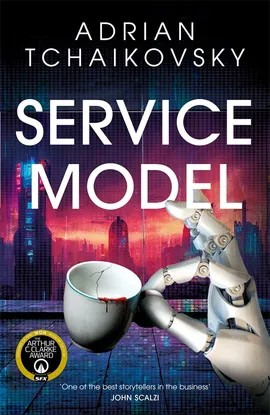
Adrian Tchaikovsky · Buy on Amazon
"I’m not sure I see Charles as rebellious – it’s just obeying its programming. (Have you read The Good Soldier Švejk, where the main character keeps getting into trouble for obeying orders?) Charles is a robot valet, whose master has died; in fact Charles may have murdered him. Hmm, I guess that’s rebellious! Charles first has to negotiate the medical and police services and then the fact that it is unemployed. It spends the rest of the novel trying to find a new master. There’s a curious collision between Charles’s seemingly reasonable logic and the rather colder logics of the organisations it encounters. There’s also a sense of anger peppering the novel. I got in trouble about fifteen years ago when I said that I thought it was hard for a comic novel to win the award – The Guardian twisted this into my dismissing Terry Pratchett , whose novels I love. Humorous books can make profound points, but if you say that then you risk ending up in Pseud’s Corner for spoiling the joke. Glancing through nearly forty years of shortlists, it’s hard to spot that many comedies. Venomous Lumpsucker is very funny at times, and there’s been a thread of satire and black humour over the decades. Nana Kwame Adjei-Brenyah’s Chain-Gang All-Stars leaps from comic moments to making you cry or provoking anger. Several of the shortlist made me chuckle, but that could just be me. I suspect that Tchaikovsky is looking to Douglas Adams as well as to Franz Kafka and it wouldn’t surprise me if there wasn’t some Tom Stoppard in the mix. And there’s John Sladek’s Roderick/Roderick at Random from the early 1980s, which is another novel about a robot stuck in a maze of logic taken to absurdity."

Maud Woolf · Buy on Amazon
"There’s a very strong narrative which gripped them – a clone has to destroy all her previous copies and survive the attempt. If the plan was followed through, then it might get a bit tedious, but, rather like Killing Eve , there are spanners in the works. There’s also a moral dilemma of whether the clones deserve to die. Does it say something about the world we live in that this and Service Model are the most fun books on the short list? Like I say, science fiction humour is often dark. She’s very engaging and she makes us care about her characters, and there’s a subtle exploration of gender expectations – what roles do we expect women to take up and which might be inappropriate? What sacrifices are we prepared to make to succeed? Woolf builds a complex and rich world without spelling things out in exact detail, and she avoids going for the obvious. It reminded me that two people can have completely opposite views about the same book. And you can see that both of them are right, although that can make constructing a shortlist tough. As you’ve suggested, climate catastrophe is a common thread, as it has been for years, and the postapocalyptic. I don’t think that we had any novels featuring viruses this year and we didn’t shortlist any space opera , which I confess surprises me. There’s a lot of variety in what is getting published. Looking through the shortlist, we have a lot of diversity in LGBTQIA+ characters, and this is integrated into the storytelling – the assumptions we make about gender identity are tested in several of the novels. There was no danger of an all-male shortlist this year, as has happened in the past – arguably science fiction began with a woman in her teens, and it’s important to read a diversity of voices. It would be great to see more writers of colour on the shortlist, but either we are seeing the few books that are being written, or not much of it is being submitted. But we have five very different authors who are new to writing adult science fiction and one previous winner who is doing something different, which I think bodes well for the future. We received over a hundred books last year and we don’t get to see everything. I wouldn’t dare to guess which book would win – it genuinely could be any of the six."
The Best Science Fiction: The 2024 Arthur C. Clarke Award Shortlist (2024)
Scraped from fivebooks.com (2024-06-04).
Source: fivebooks.com

Nana Kwame Adjei-Brenyah · Buy on Amazon
"Speaking for myself, it’s the footnotes which makes the novel – and I know the judges discussed these. The set-up is that criminals are made to fight each other, with the possibility that the eventual winner will be freed. In the notes, Adjei-Benyah gives more details about some of the minor characters, but more importantly discusses and provides statistics about the racism of the American ‘justice’ system and miscarriages of justice. It works as a gripping thriller, but it educates us or reminds us of the inequalities in society; it’s at times harrowing. It’s a reminder that Black Lives Matter."

Lavanya Lakshminarayan · Buy on Amazon
"This is a mosaic novel , which I suspect is a specialism of science fiction and fantasy – think of Ray Bradbury’s Martian Chronicles . Lakshminarayan’s narrative is set in a dystopia centred on Big Data and algorithms and is effectively laid out in short stories, with characters rarely recurring between chapters. There’s no Winston Smith or D-503 for us to identify with or root for; we have to adjust or question our allegiances every few pages. The novel trusts us to do part of the world-building and yet it can wrong-foot us."
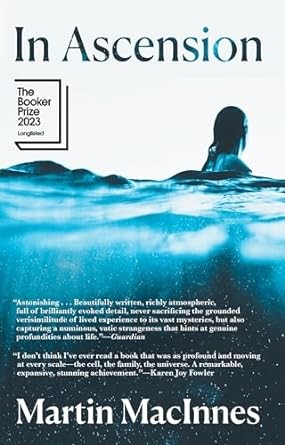
Martin MacInnes · 2023 · Buy on Amazon
"It was also named the Blackwell’s Book of the Year . One of their judges called it “a science fiction novel fit for the 21st century.” I think it’s the most Clarkeian book on the shortlist, with adventures deep under the sea and ventures into outer space. It’s also got a bit of a Gravity vibe at times, although one of the judges would like to see Denis Villeneuve adapt it for the big screen after Dune . If memory serves, MacInnes has come close to being shortlisted before, but like all this year’s shortlistees is new to the Clarke. This is a page turner, but it doesn’t sacrifice characterisation or big ideas."

Ray Nayler · Buy on Amazon
"It’s got octopus, so what more does anyone need to know? In fact, speaking of Denis Villeneuve, there’s a hint of the film Arrival in the depiction of the attempts to make first contact with a very alien species – octopus anatomy and psychology is so alien to ours and there’s been some speculation that they come from a very different origin to us . They are incredibly talented at escaping from captivity and seeking revenge on their human keepers. The book encourages us to see humanity through their eyes and this isn’t always pretty. Meanwhile, we’ve got side-plots with robotic monks and assassination attempts, and it all comes together in a satisfying way."
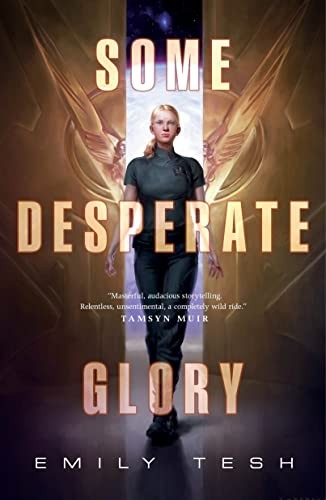
Emily Tesh · 2024 · Buy on Amazon
"There’s a slightly daunting trigger warning at the start, which I took as a bit of a hint not to take the main protagonist at face value. Much of humanity has been wiped out by an alien species, with a surviving rump of humanity divided into the military and ‘breeders.’ Seventeen-year-old Kyr learns that she has been assigned to reproduction, whilst her brother has been given a suicide mission – but may have defected. She sets off to track him down, and in the process discovers that the situation isn’t quite as she’s been led to believe. Tesh’s novel takes a sharp left turn a couple of times, which is brave, but I think she pulls it off."

Isabel Waidner · Buy on Amazon
"This is perhaps this year’s wild card and I think it may have been one the judges called in. Waidner won the Goldsmiths prize for Sterling Karat Gold , their third novel, but theirs was a new name to me and I want to work my way through their back catalogue. The eponymous protagonist has won a prize in a city that seems to be a surreal version of Prague, but there’s a complication when they try to collect it. They enlist the help of a chat show host to track it down, but they seem as busy dealing with an eight-legged version of Bambi… There are nods to a real murdered playwright, to Franz Kafka , to Disney and to the American artist Nicole Eisenman , alongside time travel and paradoxes. In the meantime, the novel raises questions about gender, sexuality, class, intersectionality and creativity, in a short but densely constructed narrative. Of course, if they win, we need to send them to Hyde Park so they can fail to pick up the trophy! We have a shortlist with six authors new to the award, although only a couple are debuts. Which is not to say that there weren’t great books by previous winners or shortlistees – but none of them cut through. One of the jobs of the award is to promote writers that not everyone has heard of, and each of these novels stand alone, rather than being parts of long series. I like series fiction, but it’s sometimes hard to find the entry point. There are a lot of publishers that are still committed to print fiction, including some ambitious small presses and some people who have chosen the self-publication route. I’m optimistic because publishers are taking chances. I haven’t crunched the numbers on demographics on the submissions list, but I don’t think we were in danger of an all-male shortlist. On the other hand, I think writers of colour are still underrepresented by British publishers. I hasten to say, there’s nothing inherently wrong with novels by cis, straight, white men – and the judges definitely don’t pick books to meet any kind of quotas – but it’s great to get perspectives that are different from the majority of the last century of science fiction writers."