Andrei Zorin's Reading List
Andrei Zorin is Professor of Russian at the University of Oxford and a fellow of New College. He works on the history of Russian literature and culture in the 18th and 19th centuries.
Open in WellRead Daily app →Catherine the Great (2021)
Scraped from fivebooks.com (2021-07-29).
Source: fivebooks.com

Isabel de Madariaga · Buy on Amazon
"The choice of five books is always contentious. Whoever you might ask would give you a different list. However, if you reduced the number of necessary books on Catherine the Great and her reign to just one, I don’t think anyone could possibly disagree. Any expert would say that the most important book written on this topic in any language, not excluding Russian, was the one written by Isabel de Madariaga. She is the founding mother of contemporary Catherine the Great scholarship. It is the only book on my list that is 40 years old. The others, Catherine’s letters aside, were written in the 21st century. Yes, absolutely. The book is called Russia in the Age of Catherine the Great and it is a comprehensive history. It’s a huge book and de Madariaga worked on it for decades. She published it in her 60s and it was her first book. It was the result of an enormous amount of work and a paradigm-shifting book, completely changing the understanding of Catherine the Great and her reign. Before that, Catherine was mostly viewed through her sexual exploits and considered mostly interesting because of her lovers. She was criticised for hypocrisy—she corresponded with the philosophes , but at the same time maintained despotic rule and preserved serfdom. She was much denigrated. There are two usual explanations why Catherine never tried to address the peasant question. One was that she was hypocritical and never wanted to. The other was that she was afraid of the nobles and didn’t want to undermine their interests, because they constituted her main support. De Madariaga challenged both assumptions and produced her own, much more convincing explanation which, from my point of view, actually solves the paradox. “It’s absolutely clear that she was a usurper” She pointed to the weakness of the Russian state and bureaucratic apparatus. The book makes clear that state machinery was totally lacking when Catherine the Great came to the throne and she had to try and build it. She was not able to contemplate the creation of millions of new subjects that needed to be taxed, recruited to the army and brought to law and had to outsource it to land and serf owners. From her reign until the abolition of serfdom in the 1860s, all Russian emperors, excluding Paul I who reigned just for a few years, hated serfdom and believed that it constituted an abominable evil of the Russian social system. They were absolute rulers, but none of them actually dared to do anything about it because they knew there was nothing they could rely on. The state was virtually non-existent and too weak and to deal with this enormous mass of subjects. That was de Madariaga’s basic answer, which solved one of the very important mysteries of Russian history . She was a daughter of the Spanish ambassador of Republican Spain to England and she worked in the BBC foreign service. Her PhD was on Russian diplomacy at the time of Catherine the Great, and I think her analysis of Catherine’s foreign policy is an absolute masterpiece, too. For the reader who is reluctant to read this nearly 1,000 page book there is a shortened version, Catherine the Great: A Short History . But I don’t think that, in the foreseeable future, this book’s pre-eminence is going to change because, if you study the period, there is no way around this very fundamental achievement."
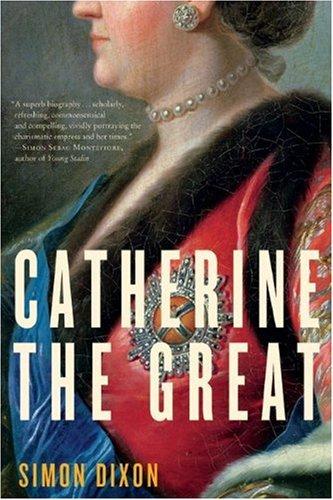
Simon Dixon · Buy on Amazon
"It’s not so much a biography. Simon Dixon is a professor at University College London and one of the generation of Russian 18th century scholars who have developed their vision based on de Madariaga’s work. Unlike Madariaga’s book, it is a short history, written mostly for undergraduate students. It’s less than 200 pages long. But it constitutes an astute analysis of different aspects of her reign. What Dixon’s book achieves is to bring together Catherine the Great’s policy and her personality. It’s a highly challenging question—when you analyse an absolute ruler where does the person end and the state begin? What is personal and what is political? You can’t fully explain everything by the personal features of the ruler as that would be too simplistic but, at the same time, you can’t avoid them. Many scholars now think there are only factors, not actors. That approach doesn’t promise an exciting narrative, but what’s worse, may not help us to understand history. Simon Dixon manages both factors and actors very well, in a short, readable, clearly written book. He looks at Catherine’s attitude to absolutism, her conviction that Russia, being as big as it is, could only be ruled by an absolute ruler and, at the same time, explains the influence of Montesquieu’s The Spirit of the Laws on her political instincts. Some aristocratic thinkers, being fans of Montesquieu, believed that the nobility should, as a corporate body, participate in the running of the government and the country, but Catherine with all her admiration for the French thinker did not buy it. She did want the nobles to enjoy their corporate rights, but was not ready to share her power and responsibility with them. Dixon succeeds wonderfully in a very short space, in bringing together her vision, her personal impact, her policy, the actual problems she faced during her reign and how she addressed them. It’s a very skilful book, weaving all this together."

Simon Sebag Montefiore · Buy on Amazon
"Yes, he was. Potemkin is arguably the most famous of Russia’s pre-revolutionary statesmen, apart from the rulers. He also enjoys the honour, or notoriety, of having become part of the language because a lot of people have heard about so-called ‘Potemkin villages.’ These were imagined settlements along Catherine’s road to Crimea, serving as predecessors to today’s fakes. In fact, these villages never existed. They were invented by French diplomats who aspired to draw Turkey into a war with Russian Empire. They wanted to convince everyone that there was nothing built in the south of Russia except Potemkin villages—to give an incentive for the Turks to start hostilities. The Ottoman Empire paid a huge price for believing that. Of course, Potemkin produced many performances during Catherine’s famous trip to the south, to show what he had already achieved and planned to achieve there. Such practices were widespread in court life. If we study the court of Louis XIV, who was a model ruler for Catherine, we can see how important all these staged performances were. In a way Potemkin represented his vision. If there were dressed-up peasants, he didn’t plan to deceive the audience, which knew very well that these were theatrical decorations. It was very, very expensive for the Treasury. He spent a lot of money on these performances. But Catherine was shrewd and knew him very well. She easily forgave him excessive expenses, but would never allow him to deceive her. This book tells us the true story about that. It is a wonderful biography of both lovers. It dwells on the question of their secret marriage, which might have taken place—we’ll never know. Montefiore seems to be all but certain that they were secretly married. Simon Dixon is nearly certain. I’m slightly less certain but it is highly probable, at the very least, that it was the case. And it was an incredible love. Catherine had a lot of lovers throughout her life and Montefiore is specific about her relations with each of them. But very seldom did she allow them to play a serious political or administrative role in the running of the country. “She changed her lovers, but she was not promiscuous” Montefiore discusses the gender bias around the stories of all her lovers. Nobody ever sees it as something to wonder at when male rulers exchange their lovers for new, younger ones. But when it happens to a female ruler it is seen as an act of terrible immorality and deviation. Catherine had about a dozen lovers—maybe there were a couple more—but they followed one after another. She changed her lovers, but she was not promiscuous—at least by modern standards. All of her affairs were conceptualised as love. She was very much under the spell of sentimental literature. Potemkin was the greatest and the strongest of those loves. And Montefiore has worked in the archives, unearthing their exciting correspondence. He gives a vivid portrait of a strange, eccentric man who lived like a sultan but was, at the same time, fervently religious, who contemplated becoming a monk and was an administrative genius. Potemkin’s managerial and administrative skills, arguably, have been unmatched in Russian history. Montefiore quotes a couple of ambassadors to Russia who had personally met Napoleon and George Washington . Both of them said that Potemkin was the most impressive personality that they’d ever seen. The book confirms that perception. It tells the story of this incredible personality and his incredible love, which continued after Catherine and Potemkin ceased to be lovers and lasted until Potemkin’s death in 1791—five years before Catherine, although he was 10 years her junior. They both had other partners, but their intimacy realised itself in their political cooperation. Potemkin had a great plan of resurrecting Greece and reconquering Constantinople—the notorious ‘Greek Project’. A lot of scholars believed before that it was just a sham. But Montefiore shows that it was a real plan to reorient Russia from the Baltics to the southern borders. For all this, I think it is an exciting book about one of the most important people of 18th century Russia."

Catherine the Great · Buy on Amazon
"This book is not a scholarly monograph, but a scholarly edition of Catherine the Great’s letters. I think it is worth having a book on the list that gives voice to the Empress herself. Letters, of course, played an enormous role in 18th century culture and life. Not only did they serve as a main vehicle of communication, but they created information networks, were tools for running policy, and so on. Catherine was a prolific letter writer. She wrote tens of thousands of letters to 400 correspondents and to nearly half of them she wrote in her own hand. She was a workaholic. As well as the huge number of letters that she wrote, she wrote plays, she wrote articles, she wrote fairy tales for kids, for the education of her sons. You wonder when she had time to rule the country. She was the first Russian monarch ever to have a regular day schedule. This book is not very big, but it gives a glimpse of her networking, of her correspondence with Voltaire and the Baron von Grimm, whom she was keen on making agents of her influence in Europe. She wanted to charm European thinkers. If you read her correspondence with Voltaire , you can immediately see that Voltaire wrongly believes he is playing the leading role and educating this young woman. He saw Russia as a tabula rasa where he could put into practice his ideal of becoming an adviser to the enlightened ruler. Catherine mainly didn’t follow his advice, not because she was hypocritical, but because she knew she understood her job better than he did. She was very keen on maintaining good relations with the most popular thinker of the age, listened to his opinions and wanted to produce a good impression on him, but she never allowed herself to be guided too much by anyone. Yes, mostly. We know slightly less about her relations with Diderot because he personally came to St Petersburg, they communicated face-to-face and there are not many letters left. When Diderot arrived, Russia was on the verge of destruction. There was a huge peasant rebellion and a war at the time of his visit, but Catherine found time for daily conversations with him. She was very attentive to, and interested in, what Diderot had to say, but never allowed him to influence her decisions. Diderot was irritated because he believed he had come to St Petersburg to become the counsellor to the ruler. Support Five Books Five Books interviews are expensive to produce. If you're enjoying this interview, please support us by donating a small amount . I think the worst legacy of the French philosophes was that they strongly developed the idea that the role of intellectuals is to give advice to, and to guide, rulers. This delusion never worked well either for the intellectuals or for the rulers. Clearly Catherine understood this but, at the same time, she did believe that she as a monarch, and Russia as a whole, could benefit from their thoughts. She supported them, she bought their libraries. Needless to say, Voltaire and Diderot were not fools who could just be messed around. They perceived real interest on her part, but aspired for real political influence that she never granted to them."

Douglas Smith · Buy on Amazon
"This stands a little bit apart from my other choices. The book is the history of Russian Freemasonry in the 18th century, primarily in Catherine the Great’s reign. Freemasonry started to develop in Russia in Petrine times, but it blossomed under Catherine. It was the start of Russia’s public sphere, of a Russian society independent from the throne, at least in some ways. Douglas Smith offers a perceptive analysis of the ways in which the public sphere can function in an unfree and undemocratic country, which doesn’t have open modes of political debate. For Russia, the Masonic lodges provided a sort of alternative network across social boundaries. Smith shows this role of Masonry. He also—I think accurately—discusses the paradox of Masonic secrecy. Masonic meetings were secret and you were supposed to keep silent about what took place. But, at the same time, Freemasons didn’t want their members to conceal the fact that they were Freemasons. They only had to conceal what actually happened at meetings, which worked well to provoke both excitement and animosity. “Her system of provincial government exists to the present day” At first, Catherine was rather condescending. Being a rationalist and a sceptic, she was indifferent to Freemasonic pursuits. She believed she could use them as she needed educated people. But the more mystical they became, and the closer it got to the French Revolution, the more nervous she grew. For a while in the 1780s, she even believed that Freemasons wanted to assassinate her. In the last period of her reign, she started to write comedies and pamphlets against them. Her European correspondents lauded her for using comedies and not repression against her opponents. But in the 1790s she actually started limited repressions against one of the groups of Freemasons. One of the leaders was arrested, several were sent to their villages. But it was some sort of start of an opposition in the country, albeit based on moral grounds and not on political ideology. Smith shows this emergence of public opinion, independent of the throne. I started by saying that for most of Catherine’s reign politics was consensual. But I think this book shows how the cracks between the policy of the throne and the educated part of society started to appear."