Andrei Codrescu's Reading List
Andrei Codrescu is a Romanian-born American poet, novelist, essayist and screenwriter. He has taught literature and poetry at Johns Hopkins University, the University of Baltimore and Louisiana State University, and is a regular commentator on NPR's All Things Considered . Codrescu founded and edits the online literary journal Exquisite Corpse . His first poetry book, License to Carry a Gun , won the Big Table Poetry award. His most recent book, Whatever G ets Y ou T hrough the N ight , is a fictional revisiting of the Arabian Nights tales
Open in WellRead Daily app →Fantastical Tales (2012)
Scraped from fivebooks.com (2012-08-08).
Source: fivebooks.com

Thomas Bulfinch · Buy on Amazon
"As a boy, I spent some summers in the Carpathian mountains, where I heard stories from shepherds. When I read a children’s version of Bulfinch’s , I recognised some of the stories, and realised that there existed an underground world where supernatural beings and humans did strange things with adventurous consequences. The human body I dragged to school every day in a drab uniform was only the flesh tip of a universe parallel to ours, where gods, animals and superhumans played inexhaustible games. I suspected that this secret underground – which I could go to whenever I felt like it – actually held together the drab world of school and our boring society, as a kind of mask in order to hide itself from the police. Bulfinch’s was dangerous because it told everybody about this world. Luckily, everyone condescended to it as being “unreal”, just “fantasy”. I knew better. “TS Eliot was a banker, and wrote like one.” When I read the original in English, at 25, I was amazed by the beauty of the language, and the storyteller’s unrelenting fascination with the stories he has collected. I can still open it anywhere, start reading, and not stop for hours. He was just like me in Romania. But thanks to his other life, I didn’t have to go work in a bank when I grew up. Oh, no, the black-listed poets did. When I was 16, the best poets of pre-war Romania – Lucian Blaga and Tristan Tzara, to name two – were forbidden reading. Writing poetry was a dangerous profession, like being a burglar. I felt doomed, alien and angry, and poetry seemed like the perfect way to go out in flames. While my two girlfriends – Aurelia, who didn’t, and Marinella, who did – watched in speechless admiration. Then I found out that I was good at poetry , because the cultural police questioned me. I felt like Arthur Rimbaud, Queen of the Damned. Then even Aurelia started doing it. Support Five Books Five Books interviews are expensive to produce. If you're enjoying this interview, please support us by donating a small amount . Things like Bulfinch were extra-curricular reading. When I was a teenage poet, the only prose I deigned to look at was fairy tales – especially bloody ones, with cannibalism involved if possible. Happily, there are a lot of fairy tales with cannibalism, necrophilia and alienated heroes. I do think that some writers who lead double lives are inspiring, though. Nathaniel Hawthorne, for one, wrote normal stories for family magazines and weird ones for his friends. Wallace Stevens worked for an insurance company in the day, and wrote poetry at night. And then there are writers whose double lives are both boring. TS Eliot was a banker, and wrote like one. Philosophically, I mean. If he’d written memos like his poems he’d have been let go. I never wanted to be anything but a writer, so I was willing to stay poor – which I did, forever."

Virginia Woolf · Buy on Amazon
"This is Woolf’s mysterious and magical insight into the cyclical, sexual nature of time. Her hero/heroine appears and reappears in new bodies in new ages. It’s her most beautiful writing too, in my opinion. Yes, which is why it’s such a great book. It was Virginia’s only completely light-hearted, love-inspired, spontaneous story. She wrote it in one weekend, or so it’s said, while a guest at Vita’s west country place. Books inspired by love and written at once are rare for novelists. Orlando may even be unique. Poets, of course, write a lot of occasional poems, but they are short. Orlando is mysterious, tender and profound all at once, because the love she celebrated was doomed by both her and Vita’s circumstances. But in the process of trying to preserve that feeling, she invented (or discovered) a form of time travel. Orlando is an angel. In my novel Messiah , there is an angel modelled on Orlando . There are also some others. I’m big on angels."
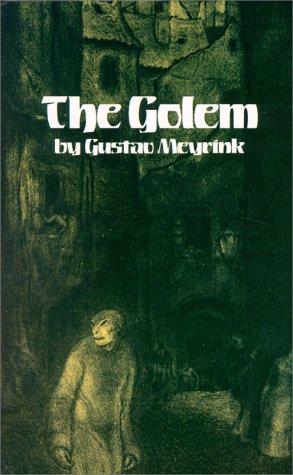
Gustav Meyrink · Buy on Amazon
"The rabbi of Prague made the Golem alchemically, by writing the unspeakable word of “G*d” on his forehead. The Golem was a giant who defended the Jews from anti-semites. He fell in love with the rabbi’s daughter, Esther, and went on a destructive rampage when he was denied. The rabbi erased the word from his forehead and the Golem broke into pieces, some of which are still kept under lock and key in the attic of the synagogue in the Prague ghetto – which the Nazis intended to make into the museum of a vanished race when they killed all the Jews. Meyrink foresaw the coming catastrophe and the renewed usefulness of the Golem. He wrote other prophetic books, one of which is about an apocalypse brought about by burning fires in the oil and gas pipelines under the Gulf of Mexico. For one, he’s big and brutal – just like the dumb angry mobs that used to attack the Jews. He doesn’t shy away from knocking heads together and tramping on them. The Jews needed something supernatural, but popular, to give them hope in those dark witch-burning ages of the 16th century. The Golem is also mostly robot, created by a cabbalist rabbi who got his secret knowledge by occult means – which meant that wisdom and book-reading were the ghetto-dwellers’ best chance out of the shithole that was Europe. The common people, who toiled for a living, wanted something practical from their scholars. Of course, the Golem is a sweet robot that didn’t help much. He also had human feelings, a flaw his maker didn’t foresee. Jews continued to be persecuted for a few more centuries after the Golem was destroyed, and they are not out of the woods yet. The Golem also inspired Mary Shelley’s Frankenstein , and all robots with feelings since, like the ones in Battlestar Galactica . I didn’t check, but there are probably Jews in Battlestar Galactica . The producers probably are, because Hollywood, since the beginning, was the work of Jews who fled Europe and were very familiar with the Golem story. Meyrink’s novel is just one version of it, there are dozens. But I like it best because Meyrink was a mystic. He really gives you the feeling that he gets his info through super-secret channels. The chill of suspense, and the suspicion that the world of the tale is more real than the one you’re in when you’re reading it. The best stories have this effect of making the world seem strange when you’re done reading or watching."

Bram Stoker · Buy on Amazon
"Vampirism is a growth industry. Dracula is bigger than Jesus now. Halloween has overtaken Christmas . All this came from the imagination of an Irishman, Bram Stoker, who never went to Transylvania, but pored over maps and stories in the British Museum library at desk 07 – right next to 06, where Karl Marx wrote Das Kapital , and 05, where Lenin wrote What is to Be Done? Stoker’s Dracula is an immortal who suffers from the mortal disease of love. He fed on the blood of a long history to emerge fully alive into our techno-vampirical world. He’s become so chic that his minions have a hard time keeping out the mobs, who are begging to have their blood sucked so that they might live all night forever."