Andrea Wulf's Reading List
Andrea Wulf is the author of The Brother Gardeners: Botany, Empire, and the Birth of an Obsession , which won the American Horticultural Society 2010 Book Award. She is co-author of This Other Eden: Seven Great Gardens and 300 Years of English History .
Open in WellRead Daily app →Horticulture (2010)
Scraped from fivebooks.com (2010-12-14).
Source: fivebooks.com

Simon Schama · Buy on Amazon
"Books like Landscape & Memory came after I got interested but it was a book which expressed in black and white the hunch I had: it was there, laid out so beautifully, because Simon Schama has this talent for taking little stories and placing them in a broad context. I read it ages ago but the one chapter that has stayed with me most vividly is the one about mountains. He describes the journey humankind has taken in relation to their perception of mountains, which started as something really horrid and scary, so that in the early 18th century tourists who crossed the Alps drew their blinds to avoid seeing the horror of the mountains. They would literally blindfold themselves. Then in the later 18th century there’s the whole idea of the sublime, that you find God in the mountains as an awesome, glorious expression of God’s might. Then there’s the chapter on the Teutenwald, the idea of barbarian wilderness as viewed from the Roman world of classical order. When we look at the shift in the relationship between man and nature, that’s what really interests me. If you look at the medieval garden – the hortus conclusus – it shuts out the wilderness. The wilderness is something scary so you put up walls and create this very manicured little paradise and then with industrialisation and more people moving into the city, more people losing their direct relationship with nature, suddenly nature in its wildness becomes celebrated. So you have the ha-ha for example, where, instead of putting up a wall to protect your garden, you dig a ditch. You have the same security because the cattle can’t come in but you can look over the whole landscape: you invite the wilderness into the garden. And it’s a continuing process. In a very simplistic way you could see how people respond to threats to the environment by planting wild meadows in their gardens. I’ve found Landscape & Memory one of the most extraordinary books of cultural history I’ve ever read and it certainly seems to be one that has set all sorts of hares running."

Tim Richardson · Buy on Amazon
"Well, I see it slightly differently. For me The Arcadian Friends is a brilliant book because Richardson does two things. For one thing he really knocks Capability Brown off his green throne. It really is inexplicable how Brown has become the hero of British landscape garden when, in fact, he destroyed quite a lot of landscapes. He must have been a very good promoter of the services he provided in order to achieve that status. So I adore the book for its relentless demolition of Capability Brown, because he really annoys me so much. So that’s a large part of its appeal. But what he does very brilliantly, unlike any other garden historian I know, is that he doesn’t only consider the pretty landscape and plants. He really understands that in the 18th century the landscape garden was a canvas to express your political beliefs. There are two elements to it. He explains the difference between a Whig and a Tory garden and he also brilliantly shows how landscape was the only way disgraced politicians could express their power. He begins with the Glorious Revolution, saying that before then all gardens were imitating French gardens. He then looks at how after the Whigs in Britain invite William III to take the throne, instigating a constitutional monarchy, French gardens can no longer be countenanced because they express French absolutism. These French gardens have avenues that cut through the landscape. Everything is formal. There’s this corset of patterns you impose on nature. Here I am, the King: I can subjugate. After the Glorious Revolution they stop clipping their trees and it becomes a symbol of liberty, at a time when England was seen as the seat of liberty. The Empire becomes really important in terms of the plants in the garden. You have someone like Joseph Banks who sees the Royal Botanic Garden at Kew as the engine of colonial growth, the storehouse of the Empire. His idea was to bring potentially lucrative plants from all the colonies back to England, to test them, propagate them, experiment with them at Kew, and then send them out to other colonies. For example, it was Banks’s idea to bring tea plants from China to India, though it’s not until 40 years later that it finally works. But let me give you an example too of how Banks used his horticulture to project values in visual form. In the gardens at Stowe House that he designed there are temples in the gardens that are literally a manifesto of his political beliefs. You have a ‘Temple of Modern Virtue’ and a ‘Temple of Ancient Virtue’, which is built as this flawless classical temple with statues of all the Greek thinkers in it, because Banks and his friends all believe that the Roman and Greek Republics represented virtuous civilisation. At that time Robert Walpole was the Prime Minister and was criticised by the country Whigs for being debauched, for having too much power, for being too close to court. So Banks builds a ‘Temple of Modern Virtue’ deliberately as a ruin to show how bad modern virtue has gone and, to ram it home, he puts in a headless statue of Walpole in modern dress. We’ve forgotten how to understand this language: we see the building as a pretty ruin, but to the aristocratic visitor of the day all these things would be understood as political satire. That effect starts at the gate to the garden, where you have to choose between the Path of Vice and the Path of Virtue, which is the choice of Hercules, so they’re taking Greek myths, placing them in the garden and applying them to modern politics. Everyone understands it. When John Adams and Thomas Jefferson go to Stowe they talk about the garden in that way, and they love it because they view in it an expression of liberty: actually, they go a step further in interpretation, seeing in it symbols of debauched England and the virtuous America."

Joseph J Ellis · 2000 · Buy on Amazon
"Ellis wrote this quite small book, Founding Brothers, for which he won the Pulitzer, I think. And he’s very bold and brave because what he does in looking at the period just after the American Revolution is, instead of writing a massive 700-page book, he just gives you seven events which will tell you everything you need to know. So, in terms of narrative structure, it’s a great book. One example he takes, that he titles ‘The Dinner’, is a dinner party hosted by Thomas Jefferson for James Madison and Alexander Hamilton in June 1790. At the time Madison and Hamilton were at complete loggerheads about two things: one is the financial plan that Hamilton is proposing as the Secretary of Treasury, which is all about very close financial and trading ties with Britain, and which Madison, as a Virginia planter, hates. Then, on the other side, there’s the big question of where the new capital of America is going to be. The northern states want it somewhere like Philadelphia or New York, which have commercial ties, and the southern states don’t want that because at that time the 13 states are only just growing up from being a war alliance and are concerned that the United States will become a mercantile country rather than an agrarian republic. So there’s this ongoing struggle between the two men and Jefferson brings them together at this dinner party over lots of French wine and good food cooked by the French cook and they reach an agreement whereby Madison agrees to accept Hamilton’s financial plan, if he will accept that the capital will be in the middle of nowhere, a place which will become Washington DC. So what Ellis does is take this one moment and cast it as a narrative device. Other events include the duel between Aaron Burr and Hamilton, the friendship between Adams and Jefferson, Washington’s farewell address, which he really spins out. I think that’s a brilliant way of getting into big history: through small moments. I do think that there are paradigms in these kinds of moments that we can only see in hindsight and it makes a very effective way of telling a story."
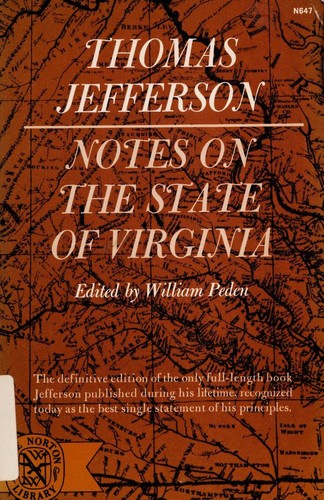
Thomas Jefferson · Buy on Amazon
"Jefferson does this really interesting thing. Monticello is a garden that celebrates the American landscape, which becomes incredibly important after the War of Independence when the Americans, who don’t have the poetry and castles of the Old World, are desperately trying to be able to demonstrate that things are better in the New World. And landscape becomes a way of doing that, because the towering trees and vastness of the continent are genuinely more spectacular. So what Jefferson does is put his garden on a mountain top which overlooks 60 miles of Virginia but he doesn’t just create a sublime garden but also incorporates, right at the garden’s centre, a vegetable garden that’s 1,000 feet long and has the best view in the whole garden. So he combines the beauty and the utilitarian, which I think really marks the difference between the English and American garden. The English is more manicured with pretty shrubbery and with the kitchen garden hidden away behind walls. And, because the garden’s on a mountain, the approach to it is important too. Imagine you’re coming to Monticello from Washington in the 18th century. For three or four days you’re riding through the Virginia forest, the roads are awful, you have to ford rivers, it’s really tough. Finally you arrive at Jefferson’s gate, expecting a straight driveway leading up to a mansion, but what does he do? He leads you up on winding roads, taking far longer than it should take, and when people complain he tells them that it’s the rule of the wilderness. He’s one of the very first Americans to do that, not to see the forest merely as a hindrance to settling: unlike the colonialists, who just get rid of the forest because they want to have their fields there. So for me Monticello is a celebration of the new America; this young, strong, bountiful nation that’s at ease with its own environment. In his writings, Jefferson himself is very explicit about the importance of the American landscape in terms of patriotism. So, for example, he says to the American painter John Trumble: come and paint this landscape before a bungling European does it. And, you know, when Jefferson goes on a garden tour of England, the first thing he realises is that they’re full of imported American trees."

Jenny Uglow · Buy on Amazon
"I think that Jenny Uglow is an absolutely wonderful writer. Her book The Lunar Men was an important book that marked the beginning of the very interesting form of group biography, where you don’t have to begin with birth and end with death but you can just pick the best bits. I once heard her explain that a group biography is like an opera: some people are singing solo and others duets, while others appear only in the choir. I think that’s a good metaphor and I was tempted to choose that book. But in the end I went for this because of the topic of gardening. Uglow’s writing is very light yet without losing any of the weight of research. Like Schama and Ellis, she’s very good at picking stories that reveal broader things and it’s a nice, galloping ride through why the English are so obsessed with gardens, which is very much a foundation of the nation. I think it’s just a delightful story of English history told through plants, and the absolutely mad individuals who, for example, spend their time engaging hermits to be set up in their gardens. And she does it which such self-assurance, starting with the Romans and coming all the way up to the present day. She leaves out whole chunks but she leaves out the bits that are quite boring. And she writes really engagingly."