Anders Roslund and Börge Hellström's Reading List
Anders Roslund and Börge Hellström made up the Swedish crime-writing duo known as Roslund & Hellström.
Open in WellRead Daily app →Swedish Crime Writing (2012)
Scraped from fivebooks.com (2012-05-22).
Source: fivebooks.com
Maj Sjöwall and Per Wahlöö · Buy on Amazon
"This book was made into a Hollywood film and it got the Best Novel Edgar Award from the Mystery Writers of America. The hero of the story is Martin Beck, a Swedish police detective. But you also get the story from the point of view of many different policemen who are all contributing to solving the story. And that is one of the things we have inherited from Maj Sjöwall and Per Wahlöö that we use in our books – we try to write from different people’s perspectives. They had a very different way of working from me and Börge. According to them they wrote a chapter each and they imitated each other’s styles. I know for a fact that that is very very hard – at least for us. In the end it must be one pen delivering the final version. The reader can tell if someone is trying to imitate someone else’s style and feels uncomfortable with that. So if they really did manage to write like that they are even more fantastic than I thought! To me it feels like one person was writing the story and it doesn’t matter who is writing it. I re-read The Laughing Policeman a few years ago because I was writing the foreword for it and what struck me is that despite some of their descriptions obviously coming from the 1970s the plot is timeless. So even though in the book they talk about the price of electricity very much in terms of back then and people are lying about in bed smoking all the time, the story isn’t old. The plot still works. Forty years later the story is still gripping. The way they switch between the different policemen contributing to the investigation is really good. Börge and I are very happy to talk about anything apart from the actual process of how we write our books together. We gave a promise never to talk about the actual process of writing the books. I like to keep some mystery around that. But I can tell you about the lead up to writing our books. We have worked together for 15 years and when we are thinking of writing a book we divide it into three periods. Our latest book took us three years. We had a year of research to get the unique people we needed for the story. Then there was one year of sitting face to face plotting about 120 pages. So we know exactly what is going to happen in chapter 18 and chapter four before the writing process even starts. And then the actual writing takes eight months to a year. We had to invent this style because there are two of us and we had to agree on everything before the writing process, when we turn those 120 pages into 500 pages. But we have seen that it works. Our books have been turned into movies both in Hollywood and here in Sweden and when the script writers get in touch with us they often comment on how they haven’t been able to find anything which is illogical and doesn’t work within the story. Yes."

Henning Mankell · Buy on Amazon
"Kurt Wallander is the nineties version of Martin Beck, the hero from the last book I was talking about. He is a police detective who thinks a lot and likes to be on his own. But unlike the Martin Beck books, Henning Mankell uses Wallander as the main voice throughout the book. In 1991 I was working at the biggest news station in Sweden, which is a bit like the BBC because it is a public service one as well. My editor came to me and said, “Anders, there is some sort of new prize about crime – it is the Nordic Prize. I am not sure what it is about. There is this new guy called Henning Mankell. Can you do a story on him?” So that was the first time Henning Mankell was on television. And then when we got the Nordic Prize in 2004 I was so happy. But Mankell was the one who took the Swedish tradition from Martin Beck and turned it into Wallander. Support Five Books Five Books interviews are expensive to produce. If you're enjoying this interview, please support us by donating a small amount . One thing he did was place him in a small town called Ystad in the south of Sweden. That is different from the Martin Beck books and our books, which are based in Stockholm. We think that if you base a story in Stockholm it is more realistic in that a lot of crime is going on there already. He chose to set his books in a peaceful town. But that is his thing and it works. Even though I don’t know how realistic it is to set the stories there, I still really enjoy them. They are well written. He is so productive. He writes a whole range of other books as well and also writes plays."

Dennis Lehane · Buy on Amazon
"This is the best non-Swedish crime book I have ever read. It has the same ingredients as his other more serial-like books – the surprising end and the language. He was in Stockholm not long ago and I missed that and I am still angry I wasn’t there. He is someone I really admire because he writes the almost complete crime. It has characters I believe in, there is good writing and it has an ending which I didn’t see coming. So for me that was perfect. He takes me by the hand and he leads me through the story as a storyteller should. I just appreciate him. Whenever you write yourself you have to be yourself and believe that you are good enough as yourself. You can’t try to take on someone else’s style. But of course other good writers can always inspire you to do better and Lehane is one of them. I was picking books which have inspired me, and Stieg was inspired by us! I am not trying to sound difficult. But you have to understand that in Sweden we had such a big audience before he even started to publish. If anyone was inspiring anyone it was Stieg at that stage being inspired by me and Börge because we had already published our books. In the UK and US he was successful before us, so I realise that for people in countries like the UK and the US it seems as if he was the first one. I knew him as a journalist and he helped me when I was investigating a story on a right-wing extreme party. I had to have a bodyguard for my own protection and he helped me to deal with that because he was living under the same circumstances. So I really appreciate him because of that. In my opinion he invented a character in Lisbeth Salander that was the perfect character for his story. The books are somewhat longer in Sweden. I guess we get more of the Swedish politics than when they are published for a wider audience. The English publisher has, of course, changed parts."

Maj Sjöwall and Per Wahlöö · Buy on Amazon
"Yes, they did a very good job. I grew up in that area and everything is very well described. They are writing about a part of Stockholm and there is a helicopter crash in a local square in the story. A policeman gets killed and just beside that square is a place I used to go as a child when I went to the dentist, so I remember it well. Also, at the end of the story the murderer is up on the roof of the building that he was operating from. And that house actually belongs to a friend of mine from school. It starts with a murder in the local hospital. A senior policeman is killed. Martin Beck is investigating the murder and he realises that the policeman who got killed wasn’t a good policeman. Everyone hated him. The story shows how the murderer is in some way connected to the bad policeman. The policeman made one bad choice which links him to the murderer and that is why the killer started killing policemen. The authors are great at doing the dialogue. It is so realistic. They were a little bit radical in their politics and there are lots of discussions to do with that. They describe Swedish society in the late sixties and early seventies."
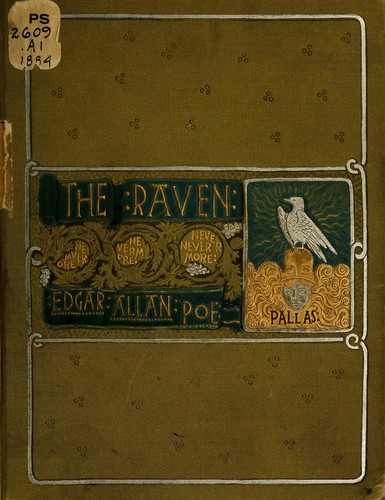
Edgar Allan Poe · Buy on Amazon
"This is very special. I first came across it when I was nine years old. I still remember this cartoon which had the raven in it. It really affected me because the raven was so sinister and nasty. It really scared me. It was so close to things to do with death and the supernatural. What I was looking at was a cartoon version of Poe’s The Raven . I was so taken by the story I asked my mother to track down the original for me. Yes, definitely. Every big city has gangs in the suburbs. This is a book about those gangs, made up of young people. We are exploring how they think and act. They are extremely violent, these gangs. They are involved in a lot of crime. I have seen this problem growing over the last 20 years and exploding in the last six months. So now it is on the map. Everybody knows about it. Not that long ago a female prison guard was murdered in prison by one of these gangs. We describe something similar in our book. We wrote about it before this had actually happened. We go to the prison as part of a support group for the people who are trying to make the prison more of a cultural place. So the prisoners get to work with different cultural groups. We started talking about our books to the prisoners and the guards. But then when we finish everyone comes to us and we talk about lots of different things. It was very interesting because some of these prisoners were gang members so we can find out from them what is going on. I have been in prison twice in my life. I was very young. I was using drugs. Today I am a recovering alcoholic. I have been sober for 19 years now. As a young kid I used to fight a lot and got mixed up in crime. But now I have completely changed. I no longer have a criminal record and I have realised that by preventing crime you can also help both criminals and victims. I help the criminals not to create more victims. Every time a person does a crime, they create a victim. As long as you are not a psychopath, the chances are you will have feelings towards your victim. I know I did and other people do. So to prevent crime you have to try to stop people from suffering, be that the criminal or the victim."