A C Grayling's Reading List
A C Grayling is an English philosopher. Until June 2011, he was Professor of Philosophy at Birkbeck, University of London. He is also a supernumerary fellow of St Anne's College at Oxford University. Grayling is the author of around 30 books, including What is Good? and most recently The Good Book: A Secular Bible . In 2011 he founded the New College of the Humanities, an independent undergraduate college in London.
Open in WellRead Daily app →Ideas that Matter (2009)
Scraped from fivebooks.com (2009-10-19).
Source: fivebooks.com

Aristotle · Buy on Amazon
"The Nicomachean Ethics sets out in a systematic way to answer the question, “What is the good life? ” Aristotle wrote it not for scholars, not for other professional philosophers, but for everybody. He took the view that if a person applied practical wisdom to the right course of action in a given circumstance, he would achieve the good. And I like the fact that, as Socrates had done before him, he was thinking about a theory of the good life in terms of what is practical and reasonable. In writing some of my own books for a general readership, I’ve tried to do something along these lines. Aristotle’s answer to the question is based on the idea that we call “good” what relates to the distinguishing function of a thing. So a knife is a good knife if it cuts well. Analogously, when we say that a person is good, what we mean is that he lives according to the most distinctive thing about human beings, which is the faculty of reason. If you live a considered life you will have what Aristotle called “ eudaimonia ”. The usual translation of eudaimonia is happiness, but that concept is rather too thin. It really means “flourishing” and “achievement”. The idea that philosophy belongs to every educated person has been diminished as a result of the professionalization of the academy over the last century or so. The result has in many ways been negative; philosophy has developed into an esoteric pursuit marked by technical jargon and over-fine distinctions, rather like scholastic philosophy. If you go back to Hume , Locke or Descartes, you find that they weren’t writing for professionals in university, they were writing for their educated peers. Every educated mind should be reflective and engaged with the great questions."

Immanuel Kant · Buy on Amazon
"True, the Critique of Pure Reason is not a book for the general public (unless they work very hard at it). But the contribution it makes to philosophy is fascinating, although I don’t think that it’s right in many of its details. It was a powerful effort to make sense of the relationship between thought and the world. In my own more technical work in philosophy I’m fascinated by the same question Kant is asking. It is one of the most fundamental questions in philosophy: how do thought, experience, language and theory-formation relate to the world out there? Critique of Pure Reason is an effort to show that when we try to apply the concepts of our ordinary perceptual experience to what lies beyond sense perception, they run wild, like cogs not engaged with each other. All the concepts we use in thinking about the world, for example unity and causality, are only the properties of our ordinary experience. When we start thinking about things that lie beyond the bounds of our senses, and try to apply these concepts to them, we get into trouble."

Jane Austen · 1813 · Buy on Amazon
"You could say that – I used to go to bed with Austen every Easter holiday when I was a student! Austen sets the example of how to do what all great literature should do – reveal something about the human condition. Pride and Prejudice is a great example of this. Everyone knows roughly what it is about. Elizabeth Bennett and Darcy misunderstand each other at the outset – he thinks she is rather vulgar, and she thinks that he is horribly stuck up. As the novel goes on they both re-learn how to judge one another, they re-evaluate the other’s moral worth. Among many other things, Pride and Prejudice is an exploration of moral epistemology."

William Hazlit · Buy on Amazon
"Table-Talk is a collection of essays. Hazlitt is one of the greatest essayists of the English language. He applies himself in his essays to everything from philosophy to the arts and theatre. He works to the model set by Montaigne, the French essayist. Another of his books particularly testifies to his perceptive mind, The Spirit of the Age , in which he names all the people he thought would still be known 100 years ahead. Reading it now, one sees that he was amazingly prescient. What’s interesting about the collection is that the essays are some of his most wonderful work, and yet he wrote them at a time of heartbreak. He had fallen in love with a girl of 19 and divorced his wife to be with her. But by the time he had done this, it was too late; she was already sitting on someone else’s knee. Mary Shelley, Mary Godwin’s daughter, said after seeing Hazlitt at this time that she didn’t recognize him until he smiled at her; he was looking so harrowed by the experience of unrequited love. And yet he was able still to produce this fantastic work. Hazlitt’s era was the great heyday of the essay. All educated people, who admittedly only made up a small portion of the population, would read essays. The participants of this intellectual society were participants in the “great conversation”, what you might call the great debate of mankind, the conversation that society has with itself about ideas, politics, and beliefs. All these areas were written about in journals and magazines, which were miscellaneous in content. Essay collections were the television, the radio, the debating society of the day. If you open a Sunday newspaper you tend to get a variety of subject matters, and in a way you might say that the Sunday papers have inherited the role of collections of essays. Essays were an education, a university in themselves. There is nothing exactly matching them today."
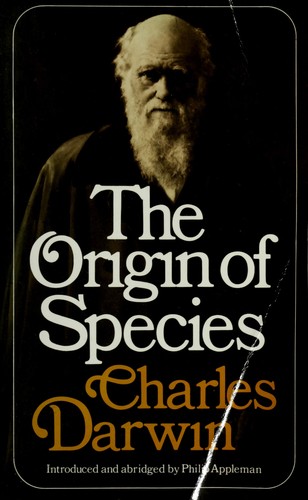
Charles Darwin · 1859 · Buy on Amazon
"I chose The Origin of Species because it’s the 150th anniversary of the book’s publication and the 200th anniversary of Darwin’s birth. All this year we’ve been having celebrations and conferences. I wonder how many people have actually read The Origin of Species , which I think they should. The book is a classic for two reasons. The first is that it’s the foundation of modern biology. Since it was written 150 years ago none of the work done in biology has undermined its original thesis, but supplemented and developed it. It remains the bedrock of modern biology. The second reason it’s a classic is that it utterly changed the point of view of humankind. Beforehand it was impossible to think otherwise than that humanity and the earth were at the centre of the universe. The puzzle was how could all the variety of life, and indeed life itself, be the work of anything other than a omnipotent agency? Darwin’s evolutionary theory answered that. It was a revolutionary moment. Although all my chosen books so far have been important books, this was one of the most important books ever written."
Being Good (2012)
Scraped from fivebooks.com (2012-04-06).
Source: fivebooks.com
Aristotle · Buy on Amazon
"It was of course Socrates who challenged his time, and has challenged us all, with the great question: What sort of people should we be? How should we live? And by implication, what kind of society is the right kind to ensure that individual flourishing can occur? That question which Socrates asked was not hijacked but was at least developed by Plato into a set of views that we might not agree with because they’re a bit too idealistic. Also, the society that he envisaged as a setting for the good life is a bit too much like fascism for most of our tastes now. But Aristotle, who is a more down-to-earth character, has a much more realistic grasp of what is possible for human beings to do. He said the great question is how we should live well, so that we live a good life, and he came up with a very positive response – which is to say that what distinguishes us from the rest of the world is our possession of reason. It’s in the application of reason to circumstance that we do our best. So if we navigate our way through situations where we’re obliged to make certain sorts of choices or respond in certain ways, using our reason, then we will in general be expressing the virtues. For example, you find yourself in a situation where courage is called for. What is courage, in that situation? Well, it is the middle path between rashness on the one hand and cowardice on the other. Or suppose you’re asked to be generous? What’s that? In the circumstances, it is not being mean and not being profligate, but something in between. People have said this sounds like a middle class, middle aged, middle brow approach to the virtuous life, but in a way it isn’t because [Aristotle] was very conscious of the fact that circumstances differ, our capacity to respond to them differs from individual to individual, and therefore the real expression of a moral life is this serious, sincere endeavour to do the best in your circumstances. Indeed, friendship is a very important thing for Aristotle, and perhaps one of the most beautiful things in the Nichomachean Ethics is his discussion of friendship. That discussion may push the concept of friendship just that little bit too far, because he says we must treat a friend as another self, so we identify our friend’s interests with our own. That seems to fly in the face of the thought that we should give our friends some space, recognise their individuality and not make too many demands on them to be like us. So you could have a conversation with Aristotle – and I think all great ethical works are ones that we can have a conversation with. But he’s dead right that if we become friends with our children as they grow up, become friends with our parents as we grow up, become friends with our lovers or spouses, our comrades, our colleagues, then even if they remain those things – if your lover remains your lover, but you become a friend with him or her – that is a human achievement of the very highest order. He’s right about that, and it sets us a worthy goal. He also talked, as you point out, about magnanimity. There is a wonderful expression in the ancient Greek – the “megalopsychos”, which sounds like something certifiable but it just means magna anima [great soul], from which we get our word “magnanimity”. The magnanimous person, the great souled person, is a person of generosity and sympathy. I think this is very beautiful, and underlies almost all humanist ethics – the idea that we premise our engagement with other people on the most generous and sympathetic understanding we can have of human nature and the human condition. That we make allowances for being human. The Greeks have this marvellous idea, so different from the theological moralities where sin is a stain on your soul which you have to work hard to scrub off, and perhaps never quite get rid of. The Greek conception is what they called hamartia , which is the mistaken shot. You shoot your arrow at the target – if you miss, what do you do? You take better aim next time. Indeed. That’s a very good way of putting it. The well lived life is the well lived life. The well living of life is what it is to live life well. The quest of the good is itself good. This idea is I think a tremendously important one, that one can easily demonstrate by saying: The reason why you admire your friends is not because of what they’ve achieved, but because of what you know they would sincerely like to achieve. We know that if we were to measure the value of a human life only by its successes, then there would be very little value in the world. But we ought to value, and I think do value, people in terms of what they authentically are trying to do and to be. And it’s that endeavour which is the serious thing."

Baruch Spinoza & Samuel Shirley (translator) · Buy on Amazon
"This is a work which is perhaps of all Spinoza’s works the most accessible, because he’s quite a difficult and technical writer, and yet he is a tremendously significant figure for our modern age. Some people have identified him, I think rightly, as being the chief wellspring of the Enlightenment, although people didn’t quote him overtly or reference him too much because he was regarded with a certain horror as an atheist. Somebody once described him as the most God-besotted of all philosophers. But in this work, he commits himself to the view that people have used in order to interpret him as an atheist. One of the key things that comes out of it – the perspective that people took from it, and which made him an important figure in the Enlightenment – is this idea of the responsibility of the individual. He put it slightly differently in the Ethics – which is his major work and a much more substantial work even than the Tractatus – where the final two books are called “Of Human Bondage” (which is where Somerset Maugham got his book title from) and “Of Human Freedom”. In the latter he talks of human freedom [as] resulting from the realisation that we are not at all free, that we’re determined, that everything we do is the outcome of necessity, that we’re all part of this great single thing – this one great reality which operates in an entirely necessary way out of its own laws. When we recognise this, we cease to strive in a futile way against the impossibilities – we recognise that our desire is the source of our suffering. It’s a rather Buddhist view in a way, and similar to a view that Schopenhauer much later took. And the realisation that this is so, and the acceptance that we have to act in conformity to necessity, is what makes us free. I take it that the root of humanistic ethics is the idea that we are each of us ultimately responsible for our moral choices, for our ethics – that is, the answer we give to the question “what sort of person are you going to be?”. Whereas the root of the theological moralities is that there is a demand imposed on us from outside, a transcendent sort of demand, and that our morality is the act of response or indeed of obedience to that demand. These are two very opposed ways of thinking about the moral life. As a humanist myself, I’m committed to the idea that we should encourage people to accept the challenge of the first way of thinking about things. One way you could dramatise this a bit is to appeal to something that I find more attractive than many of my contemporary philosophers, which is some of the insights of existentialism in the last three quarters of a century. Namely, the idea that our existence precedes our essence, in the sense that we find ourselves existing and we have to answer the challenge of what kind of person we’re going to make ourselves, what sorts of constructions we are going to erect in our best endeavours. Famously, the existentialists said that dignity and creativity and indeed love – affection for our fellow human beings – are things worth pursuing in their own right, and by pursuing them we make ourselves, according to our individual capacities. This I think is where the deep autonomy of the human position has its greatest value. This is re-asserted – rediscovered, perhaps – in the 18th century Enlightenment. I see Western history as being one with a very long intermission between the great conversation of classical antiquity [to the 18th century] – from Plato and Aristotle, right on to late stoicism, which came to an end with the triumph of Christianity over the European mind, and through the process of reformation and scientific revolution in the 17th century, we arrive at this great insight of the 18th century, which is that it’s wrong to think there’s a one-size-fits-all story. We must recognise diversity, and in particular we must allow the autonomy and individuality of the person, with his or her rights, entitlements and responsibilities, to be the determiner of how they are to live."
John Stuart Mill · Buy on Amazon
"On Liberty is a very important document, and one which, because of the clarity with which one can read it and its brevity, is slightly passed over. First-year students are asked to read it, but then it’s thought not to have very great philosophical substance. And sometimes it’s criticised on the grounds that Mill commits himself to saying that reading Aeschylus is of much higher value than going to the pub for a pint of beer. Whereas going to the pub for a pint of beer is sometimes a very pleasant thing, and much more pleasant than reading Aeschylus. Indeed. So people miss a really significant point that he makes, that allowing people the opportunity and space to experiment in quest of the good – and to do so in a way that frees them from the worst kind of tyranny, which is the tyranny of public opinion and oppressive attitudes – is of the very essence in human progress, and that you only get human progress if you will allow a thousand flowers to bloom in that respect. So he’s asking for something very big, because it’s right across all sorts of boundaries. It’s not just a question of education, it’s also a question of sexual morality, and it’s a question of allowing people to arrange relationships with others. [Mill] would have found it, I think, very acceptable indeed that we in our own time have come to be accepting of people who are gay. He would have regarded that as paradigmatic of how we should be open to allowing different sorts of experiment in human relationships to flourish – and he would have spread that across the board. So I applaud that. I think that’s a very significant moment, and a very prescient and a brave one, given that it was a high Victorian period in which it was written. He says that we should be free under the government of the Harm Principle, which is that you shouldn’t do harm to others. That’s right. This again is the point about self-realisation, self-development, the fulfilling of the promise that you find in yourself. Self-knowledge is of course key to that. Indeed, the whole process is premised on having a good understanding of what your capacities are, and to some extent what your limitations are. And perhaps people should be encouraged not to take their limitations too seriously – they should push hard at themselves. This harks way back to the Delphic oracle: “Know thyself”. When you do have some sense of yourself, and some sense of the things that you might be good at and are interested in, then you should go for them. Support Five Books Five Books interviews are expensive to produce. If you're enjoying this interview, please support us by donating a small amount . I’m very fond of quoting what Solon said to King Croesus, about a human life being only a thousand months long. And 300 of those months you sleep, 300 you do banal things. So you have relatively short time to make those self-discoveries and take a grasp of the opportunities that they present to you to do this thing that all these people – Aristotle and Spinoza and Mill – in their different ways are saying makes for the good life, makes for the life that’s worth living."

Denis Diderot · Buy on Amazon
"Rameau’s Nephew is perhaps the most immediately accessible and readable of his works, given that so many of them are entries for the encyclopedia of which he and [Jean le Rond] d’Alembert was the editor. Indeed it is. And it picks up on these themes which are central to the Enlightenment. This conversation, between what is perhaps the voice of Diderot and another individual, is the conversation of enlightenment in Kant’s sense. You remember Kant’s great essay, “What is Enlightenment?” He said we don’t live in an enlightened age, but we live in an age in which enlightenment is occurring – there is light dawning over the whole, and it comes when we accept the challenge to think for ourselves. Instead of obeying the priest, obeying the taxman, obeying the policeman, we begin to try to dare to be wise on our own account. If you wanted to be a spectator on a transaction, a thought process, an age where the dawn is coming up in the East, so to speak, here it would be. Yes, money is certainly one of the themes, and that’s because of the materialism of society that Diderot was satirising. It’s very interesting. You’re seeing, in a divagatory and fragmentary way in the conversation, a reflection of how hard it is to get a coherent perspective on things. I think that was Diderot’s point. That in order to try to understand how destructive people are, how shallow the conversation of society is, and how easy it is to become focused on things like the getting and having of wealth, you lose sight of things that are very central to what he regarded as the great Enlightenment promise – which is that you can in the end yourself, as an autonomous individual, make good choices towards a good life."

Bertrand Russell · Buy on Amazon
"Russell was an atheist, although he described himself as an agnostic, as [do] a lot of people do who are sensitive to the scientific requirement to be open-minded about even outré possibilities of things. It’s interesting that he should be a public sceptic of religion – that he should be prepared to talk and indeed to write about this matter – at a time when to do that was to put yourself a little bit beyond the pale. It was still the case even in the interwar period that people were regarded as particularly provocative to come out and speak with such clarity. In this talk, published as Why I Am Not a Christian , he sets out the reasons that somebody who takes a very rational, philosophical, sceptical look at the claims, arguments and supposed evidences for a [Christian] outlook might apply. Given that Christianity was then, and had been for a long time, such a major influence in European culture, it was a brave and in my view very appropriate attempt to shake up people, to get them to think, get them to see that there could be serious, careful and considered reasons why you might not accept that outlook. So it’s a bold, brave statement for its time – and indeed it sets out quite a few of the reasons why somebody might not be [religious]. I agree with it, yes. He was not alone, by the way, at that time in making that sort of point. George Bernard Shaw said, the day that I gave up my religious faith – which happened when he was a young teenager – I felt the dawning of moral passion. Russell and Shaw and many other people of their persuasion felt that the putatively religious European culture had been a disaster. It had fallen into the catastrophe of the First World War, which is why he and [Karl] Popper and Wittgenstein and a number of other people thought that the only possible remedy was education. This would be an education in how to think, in how to get away from just accepting these great slabs of traditional attitudes, which led to English bishops blessing English tanks and German priests blessing German tanks, and nobody ever seriously thinking about the underlying moral principles. That, I think, was a brave and correct thing to do. Because I’m not any kind of religious person. I’m an atheist, so none of the religions – Hinduism or Zoroastrianism or the belief in the Olympian deities or Christianity – appeal to me. You have to start quite a long way back, in belief in the existence of supernatural agency, before you get to any of the particular historical religions, and when I start that long way back I find every reason not to think that there are such agencies in the universe. Not only is there no good evidence for the existence of supernatural agency – gods and goddesses and demons and so on – but there is a very great deal of evidence suggesting that this universe is not the kind of place that has those sorts of things in it. Very often people say you can’t prove that there aren’t gods and goddesses. And I say you can, if you understand the nature of proof in the contingent case. Of course, in the formal case of mathematics and logic, proof is something completely coercive – the conclusion is entailed by the premises. But in the contingent case what we mean by proof is test. We prove a bar of steel by bending it until it snaps. That’s the test of it. This is where we get expressions like “the proof of the pudding”. Proof in the contingent, empirical sense about the world around us is a matter of testing it. [This argument] is beautifully done by Carl Sagan with the dragon in the garage. Somebody says, I’ve got a dragon in my garage. You say, I’d love to see it. Ah, says the other person, it’s invisible. You say, let’s sprinkle some powder on the floor and see if we can see its footprints. Oh, it never lands on the floor. Well then we can hear its wings fluttering. It’s got silent wings. And so on and so on. Nothing whatever will count as a test, one way or another, for the claim that there’s a dragon in the garage. And that simple, straightforward but very deep observation applies to all claims to the effect that there are supernatural agencies or entities in this universe of ours. For that reason it’s not rational – ratio means proportion, so we’re proportioning evidence to judgements – to think that there are fairies at the bottom of the garden, gods on Olympus or Poseidon under the sea. I think that’s a very good way of putting it. It’s exactly the same pattern we’ve been talking about earlier, which is the attempt to attain a certain degree of self-understanding about what one’s capacities are – what one can offer, what contribution one can make – and then trying to develop them, and trying to fulfil the potential, if any, that lies within them. Trying to be a responsible, cooperative partner in the great conversation of mankind – to take a share in that endeavour, and to try to do it with the degree of sincerity or authenticity which would make it really intrinsically worthwhile. [This way] one would feel on one’s deathbed that one hadn’t tried to pretend to be something that you’re not. Get the weekly Five Books newsletter I’ve been extremely fortunate. I’ve been able to dedicate my life to reading and to study and to writing. I don’t pretend for one minute to be able to tell anybody else how they should live or what they should think. I think that would be quite wrong to do. It’s everybody’s own individual responsibility to do that. But you might be able to share with them things that you’ve learned or discovered, or to encourage them to read something or see something a certain way. To offer them a perspective which they might accept or reject, or that they might engage in that dialogue with the great minds of the past, with people who are eager now to debate and think about them, and write about them – in the hope, and indeed in the faith, that when people do think, when people do read, when people become a bit more knowledgeable about the past and about ideas, that their overall tendency is towards the good."