You Are Not So Smart
by David McRaney
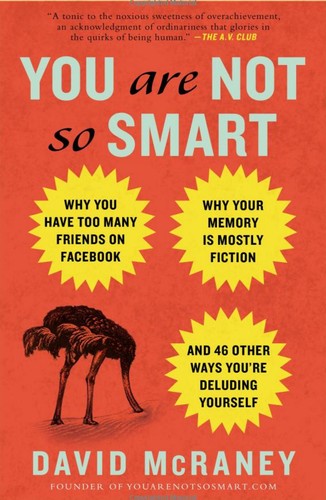
Buy on AmazonAn entertaining illumination of the stupid beliefs that make us feel wise, based on the popular blog of the same name. Whether you’re deciding which smartphone to purchase or which politician to believe, you think you are a rational being whose every decision is based on cool, detached logic. But here’s the truth: You are not so smart. You’re just as deluded as the rest of us—but that’s okay, because being deluded is part of being human. Growing out of David McRaney’s popular blog, You Are Not So Smart reveals that every decision we make, every thought we contemplate, and every emotion we feel comes with a story we tell ourselves to explain them. But often these stories aren’t true.…
Recommended by
"From confirmation bias — our tendency to seek out information, whether or not it’s true, that confirms our existing beliefs, something all the more perilous in the age of the filter bubble — to Dunbar’s Number , our evolution-imposed upper limit of 150 friends, which pulls into question those common multi-hundred Facebook “friendships,” McRaney blends the rigor of his career as a journalist with his remarkable penchant for synthesis, humanizing some of the most important psychology research o…"
Best Psychology & Philosophy Books of 2011 · themarginalian.org
"LB : I would primarily label this a social psychology book. It’s in a little bit of a different category and is structured a lot differently to anything we’ve talked about thus far. McRaney also wrote a follow-up called You are Now Less Dumb . LB : So he’s good at punchy titles. But I really think—and I wrote this in the write-up on our site— that this book could substitute our teaching of the whole social psychology unit. In almost every introductory psychology textbook, social psychology comes last, but I like to teach it first, because every day in a social psychology unit, students will come to me and say: ‘Miss Brandt, I saw the bystander effect .’ And if there’s one thing that every student in our class should be doing, it is taking psychology outside of the classroom and seeing how it applies in their day-to-day life. Even for the student who never takes another psychology class, I’m very conscious of how this class can help them to lead a better life. Because psychology as a discipline is a helping science. So: how can we help them manage stress better? How can we help them interact with their peers and their parents and their future children in a more effective way? “Psychology isn’t something that theoretically exists in the classroom. It exists every single day” What this book does is it gives the students a concept. It’s confirmation bias , the bystander effect. It gives them a brief paragraph of description of the term that you might get from a textbook, but then it gives them two or three real life examples. ‘This is the self-fulfilling prophecy experiment, and this is how it applies to your life.’ Honestly, almost every major topic that we cover in an introductory social psychology chapter is covered in the book. It makes psychology real: this isn’t something that theoretically exists in the classroom. It exists every single day. That’s why I love this book. LB : Psychology is going to apply regardless of whatever field they might end up in. Having exposure to it helps them focus kind their interest and see an application. Sign up here for our newsletter featuring the best children’s and young adult books, as recommended by authors, teachers, librarians and, of course, kids. How can you take what we know from psychology with, say, Moonwalking with Einstein , to help you become a better student? How can aspects of You Are Not So Smart help you to be a more compassionate person, or to be aware of the fundamental attribution error and prevent yourself from making it? How can you take something from Brain on Fire and reduce stigma around mental illness? How can they be advocates? I think it’s a course that all students can be successful at. All students can use it in their everyday life and in their career and it’s also a fantastic way to get students really interested in science and build on their understanding of research—by presenting it in such an engaging way."
The Best Psychology Books for Teens · fivebooks.com