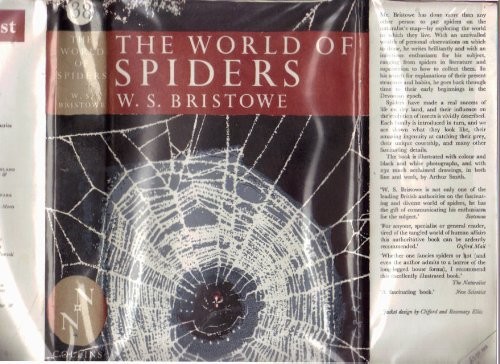
The World Of Spiders
by W S Bristowe
Buy on AmazonBristowe’s Spiders is very short but quite a nice little gem. It encourages you to go deeper. The World of Spiders is a development from that. He covers all the British families. Let me quote you from the book. We spoke about the daddy long legs spider, which you find indoors, Pholcus. For a long, long time, people assumed that you only found it in the southern part of the country, but Bristowe hunts around for it: The daddy longlegs spider, Pholcus phalangioides, must be well known to people who live in the south of England and Wales. She sits unobtrusively in corners of rooms, between ceilings and walls, hanging motionless from a scaffolding of fine, invisible threads. Her presence is not resented, because she seldom moves and is regarded as an innocuous creature, which may be useful at catching mosquitoes or clothes moths. Pholcus did not live in my childhood home at Stoke D’Abernon in Surrey, although she thrived elsewhere only about 10 miles further south. So the quest of an explanation inspired me to trace her distribution. This had to await the acquisition of a motor bicycle, and then, with the impudence of youth, I zigzagged across England, ostensibly seeking rooms in hotels or lodgings, whose ceilings I viewed with nonchalant interest. “You can capture the spiders—and I do it in my garden when I want to get false widow spiders—by just touching the silk. They dash out, they grab hold of it, and they don’t let go” My apologies are no doubt due to a host of hoteliers for gaining entry under false pretences. In the result, their unwitting cooperation enabled me to draw a map which showed that Pholcus inhabited houses coinciding with a narrow southern strip where the average temperature throughout the year exceeds 50 degrees Fahrenheit. North of this strip, she is normally confined to cellars, where temperature varies little with the seasons, and is usually about 50 to 52 degrees. Probably it is the absence of certain extremes of cold over a period which determines whether Pholcus can survive. This idea of going across the country and getting into rooms is typical of him, and you get these instances all the way through the book. The thing about Pholcus is, it’s now spread much further north than Bristowe talked about, probably with climate change—certainly up into Lincolnshire and beyond. I would say that looking at a distribution map, it’s probably covering most of the country now. It’s a species you find in houses, and people are moving around more. So it’s able to hitch a lift when people move. What’s even more interesting is that it has been found to be a species that has one of the strongest venoms of any spider in the UK. It doesn’t harm us, because it can’t break human skin, but it can certainly deal with house spiders very easily. Bristowe also talks about hunting for a spider on the south coast—a large tube web spider called Segestria florentina. I was actually inspired by him to go and look for it myself. He writes: She’s only established in southern towns with near access to the sea—I failed to find her in Bath, from which she was wrongly recorded—Dorchester, Weymouth, Folkestone, and Dover. So it would seem likely that the colonies are derived from chance importations which can establish themselves only in the warmest southern ports. Once the tube entrance has been seen, it cannot be confused with that of another spider, “On account of the long, straight fishing lines. To catch one of these spiders, it should be necessary only to brush one of these lines very gently with a fine tip of grass and then to block the spider’s retreat with a blunt instrument. But the theory has to be put into practice.” Then he goes on. “When tried on a full-grown Segestria florentina on a warm summer’s day when she’s active, it is unusual for the beginner’s nerves to stand the strain of this huge spider with her flashing green jaws darting out with the speed of lightning, biting fiercely and then backing into the tube once more, all in the space of about two seconds….She’s very fierce and will bite violently to a pencil blocking her retreat.” He then goes on somewhere else to talk about going down into Exeter and catching these things in holes in the old walls of the port, where the mortar has started to break up. The spider spins a tubular web back into the wall, and at the entrance to the web, there are these fishing lines, radiating lines of silk. Now, having read that, I was keen on going to see it for myself. My wife’s sister lived in Exeter. We were down there one weekend, and I was determined find this thing. He recommends using a tuning fork to vibrate the fishing lines. There was me on a Saturday morning in the old port area of Exeter, finding these webs, seeing them, and attempting to catch a Segestria with a sweep net and touching the radiating lines of silk with a vibrating tuning fork. Sure enough, the Segestria florentina came out and, as he describes, they do have green flashing jaws, and they are quite large. I was quite pleased with myself but what the people doing their Saturday morning shopping on the other side of the road thought I was up to, heaven only knows. What’s interesting now is that florentina is found in Oxford. It’s another one that is spreading. Rather than using a tuning fork, these days people use an electric toothbrush—because it seems to provide a better, more effective vibration. You touch the silk with an electric toothbrush and the vibrating head attracts them out. You can capture the spiders—and I do it in my garden when I want to get false widow spiders—by just touching the silk. They dash out, they grab hold of it, and they don’t let go. We like to take large specimens to some of the shows we do, so we just pop them in a glass tube. Then people can actually see them and not be harmed by the spider—as they assume will happen. But I’ve had no experience of that. They’re only aggressive when they’re protecting their environment. That is when people might be bitten occasionally. Some people would say that they are, yes. It’s rather like being stung by a bee or a wasp. In the vast majority of cases, it’s no problem, but some people are sensitive and react. As with insect bites, there might be a secondary infection and that can be really quite serious. But I still remember October 2013. The papers were full of reports about false widow spiders. The Daily Star said 50 million of them were invading Britain. All this rubbish! That spider has been living here for over 100 years. It was originally imported—probably with bananas from Madeira—into Torquay. It then gradually spread across the southern part of the country and is living quite happily in people’s gardens. It’s related to the black widow—but it’s a huge family, so it’s not closely related. “There’s a phenomenon called ‘gossamer,’ where you get lots of spiders spinning silk at the same time in the same location, and you get a whole of a field covered in silk.” But it was given the name of false widow spider. That immediately gave the press something to grab hold of. It does have a very potent venom, certainly, and it can break human skin. If people are bitten, if they are sensitive, they may well react, but not in the way that the papers would have you believe. No worse than a wasp or a bee sting. If you’re particularly sensitive, you may have to go for medical assistance, as you do with bee or wasp stings. Some doctors or hospitals may not know much about what to do. I was rung up by a radio station in Suffolk. The man on the phone said he’d just been contacted by a woman, and she said that she’d been chased by 50 of these spiders. My response was, ‘Why would they do that? There’s no earthly reason why spiders would expend energy chasing somebody!’ These were the sort of stories we were getting all the time. It was getting crazy. The only reason a false widow spider might bite is when it’s feeling threatened, so the advice is don’t bother it. Keep clear of them. I’ve got them in the garden and I go out and catch them. I’ve had no problems at all. Once—by a large orb web spider. I just happened to grab it out of a web to show somebody, and it was somewhat annoyed and sunk its jaws into me. There were a couple of red spots and then, within five minutes, those were completely gone. No reaction, no after-effects at all. So they can break human skin, but only half a dozen species in the UK will do that. There have been no recorded or reported fatalities of people being bitten by a spider. Not to worry, no, not at all. He gives you lots of encouragement to go out and do that, simply by the way he writes the book. If people are at all interested, I always recommend they try and get hold of a copy, because it is so readable and there’s some lovely stories in there. But he wasn’t a professional arachnologist. You don’t need to be a professional to be able to learn about spiders, and he’s a prime example of how you go about doing it. He’s very much in the tradition of what we were talking about earlier, the amateur enthusiast. It is if you want to be seriously studying spiders, yes. When we wrote Britain’s Spiders , the idea was to enable people to get an idea of what they were seeing out in the field with digital photographs and illustrations. If you’re seeing webs, for example, giving you a clue which spider they might belong to. But it doesn’t cover everything, because there are lots of tiny ones—the linyphiids—where photographs wouldn’t be of any use. The books we’re going to talk about now rely on the fact that you can use a microscope.