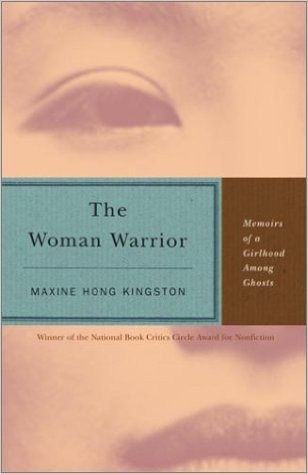
The Woman Warrior
by Maxine Hong Kingston
Buy on AmazonThe Woman Warrior: Memoirs of a Girlhood Among Ghosts is Kingston's disturbing and fiercely beautiful account of growing up Chinese-American in California. The young Kingston lives in two worlds: the America to which her parents have immigrated and the China of her mother's "talk stories." Her mother tells her traditional tales of strong, wily women warriors - tales that clash puzzlingly with the real oppression of women. Kingston learns to fill in the mystifying spaces in her mother's stories with stories of her own, engaging her family's past and her own present with anger, imagination, and dazzling passion.
Recommended by
"This is a very interesting memoir by a woman, Maxine Hong Kingston, who was born in America but of a Chinese immigrant family, so it is an immigrant memoir. It recounts her childhood and youth in a desperately poor family, originally from rural China, who are uneducated and think of Americans as “ghosts” – the literal Chinese name for the natives. Her father has a contemptuous attitude to women, and she is treated shabbily in many ways. The memoir is about her conflict between this family and the American world that she enters into. She feels a double alienation. She feels increasingly alienated from her family and the Chinese immigrant community that she grows up in. But she also, initially, feels very lost in the American world which she goes to school in. It’s also an incredibly imaginative and inventive memoir. On one level, it has this realist narrative. On another level, it imagines her mother’s life in China. Her mother recounts at length the stories of her own childhood and youth in pre-Maoist China. So Maxine listens to the story of her mother’s very interesting life, and that story – which may be semi-fictionalised – is interspersed with the story of her own life. The mother is in one sense a heroic figure, who went to medical school, “battled ghosts” and bought a slave at one point. She has a much less kind and gentle view of the world than Maxine, who struggles with her less heroic present in America. Alongside her mother’s story, Maxine intercuts her anguished sense that she is not living up to it. In the latter part of the memoir, she uses Chinese mythology – specifically a fantastically imaginative recreation of the myth of the woman warrior – to redeem her own sense of self, and imagine the possibility of being completely loved and accepted by her parents as a girl. She creates her sense of self through her mother’s stories, but also through her rebellion, through being a good student in an American school, and through her initiation into the English language. At first, she can hardly speak English. Then, as she learns, there is quite a stunning encounter with another Chinese girl, who refuses to speak English. Maxine attacks her and begins to slap her. She cannot bear the silence of this girl, which she also was arrested in until she overcame it, and she wants the other girl to overcome it too."
Memoirs · fivebooks.com
"Then I read "Woman Warrior," and that book was proof that yes, Asian Americans could be writers and they could be successful at it. So maybe I could be, too."
By the Book: Tess Gerritsen · nytimes.com
"I find the book endlessly rewarding to teach, because it's so rich and layered and still relevant to the lives of students."
By the Book: Viet Thanh Nguyen · nytimes.com
Favorite books · radicalreads.com