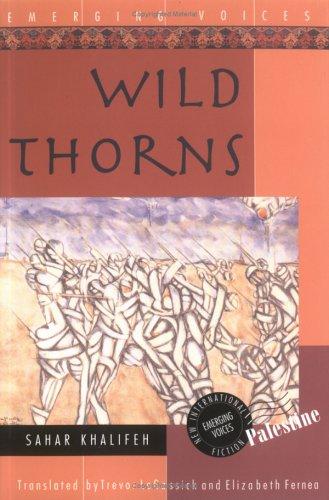
Wild Thorns
by Sahar Khalifeh & Trevor Le Gassick and Elizabeth Fernea (translators)
Buy on AmazonThis is the second Palestinian novel in this list and it’s another book about hopelessness, about the constant tension between collaboration and resistance. Unlike Habibi’s book, it’s set in the West Bank, in Nablus, which has been recently occupied. This makes the tenor somewhat different. It’s much heavier, I suppose. The book is about a man, Usama, who has come back to Palestine from working in the Gulf. He finds that following the conquest of the West Bank, no one is resisting. Lots of his family have got jobs in Israel, and they’re in this period of stasis. He’s very upset about it, and tells them that they need to resist. In his fervour, Usama joins a militant movement, who plan to blow up busses of Palestinians going to work in Israel—collaborators. Usama’s cousin is one of the people riding those buses—clearly a symbolic choice from Khalifeh. But, to take things from the other side, Usama’s friends and relatives who stayed in the West Bank are a little suspicious of him. ‘You haven’t been here! You’re just coming back from abroad, you don’t know what it’s like,’ they say. What Sahar Khalifeh does really well is let all of those tensions and juxtapositions sit alongside each other in the characters. I think if this book does have a message, it’s that violent resistance is self-destructive and perhaps pointless. But the novel also allows for the complexity of what it is like to be in this situation, caught between resistance and collaboration. What do you do and how do you live your life? The follow-up to this book is called Abbad El Shams , which has not yet been translated into English. Wild Thorns is largely about male resistance fighters or men who go and work in Israel. Abbad El Shams is much more focused on women in the West Bank. People are always slightly confused why it hasn’t been translated into English because she’s one of the most famous Palestinian authors. When you ask Palestinians, ‘Who should I read?’ Sahar Khalifeh is one of the writers they often recommend. I think it’s sad that someone with this complex but also well-grounded and sensitive portrayal of West Bank Palestinian life does not have an English audience, whereas many more simplistic books on Israel-Palestine do. I haven’t chosen the one Arabic language Nobel prize winner, Naguib Mahfouz , which I suppose stands out as a gap. To be honest, I have never really got along with his epic, state-of-the-nation Cairo Trilogy —it all feels so momentous and serious—but I do like his shorter novels, such as Adrift on the Nile or The Thief and the Dogs . I also haven’t included any Lebanese novels in Arabic, which some people might disagree with. There’s no Hoda Barakat, no Elias Khoury, no Hanan al-Shaykh , for instance. Though I did notice, when I was going through them, that the majority of my choices are from the 1960s and 1970s. I didn’t pick them for that reason, but that does fit the idea that this period was the golden age of Arabic literature. It was a post-colonial moment when there was a lot of funding behind Arab culture. It came particularly from left wing regimes, partly as a propaganda move, but one which contributed to a flourishing of literary production. A lot of other classic novels came out in this period: That Smell by Sonallah Ibrahim , for instance, and Men in the Sun by Ghassan Kanafani. As well as plays, poems, films, and so on. The story behind that is that it was serialized in a magazine called Hiwar, which was based in Beirut. It was a bit like Encounter magazine in the UK. The CIA was funding magazines everywhere! Lots of well-respected writers published in Encounter : Robert Graves, Frank Kermode, Anthony Burgess, John le Carré. Both Encounter and Hiwar met with opposition when the source of their funding emerged. It might be a little dramatic to say the CIA funded Season of Migration to the North except in a very convoluted way, but there are perhaps reasons to think that Cold War politics also lie in the background of this novel (the academic Elizabeth Holt has certainly argued this). Though there is also an argument that Salih was primarily supporting his friend Tawfiq Sayegh, the editor of Hiwar who had been boycotted by many writers in response to the revelations of CIA funding. Another layer to its complexity! It’s a history of the 1920s, 30s and 40s, told through the lives of two occult performers. One of them, Tahra Bey, was an Armenian born in Istanbul, who lived through the violent collapse of the Ottoman Empire, ended up as a refugee in Europe, and created the persona of a mystical Egyptian fakir. As Tahra Bey ‘the fakir,’ he took Paris by storm in the 1920s, performing all kinds of inexplicable feats of wonder and preaching a gospel of Eastern spiritual sciences. Through this character, I tell the story of interwar Europe, lost in a post-World War I malaise and grasping at anything to rebuild their ailing civilization. I wanted to answer the question of why so many people were drawn to the occult in that period, and he offers a good perspective on that. The second half of the book is more focused on a man called Dr Dahesh. He started as a copycat Tahra Bey performer in Jerusalem, then became a hypnotist, then a spiritualist and then a spiritual leader. In 1940s Beirut, he started his own religion called Daheshism. I use him to look at what’s going on in the Middle East. My contention is that the Middle East is too often left out of these big global stories of the 1920s and 30s. My first book, Midnight in Cairo, was about female cabaret stars in Cairo. It was a way of saying, ‘We hear a lot about Berlin and Paris in the roaring 20s, but what does the story look like from the Middle East?’ In the case of the occult, there’s this weird mirror image happening, where in the West, everyone’s obsessed with these bizarre Eastern sages and the secrets of the East, whereas in the Middle East, people become obsessed with hypnotism and spiritualism as manifestations of modern science. So the book is about big global trends and the insecure world of the early twentieth century from the Middle East to America. But it also tells the life stories of these two very complicated men. It is about identity and fakery, science and wonder, suffering and turmoil—life, if you want.